CFTC Partners With SEC On ‘Project Crypto’ For Unified Regulatory Approach

bitcoinist2026-01-31 tarihinde yayınlandı2026-01-31 tarihinde güncellendi

Özet

The U.S. SEC and CFTC are relaunched "Project Crypto" as a joint initiative to create a unified regulatory framework for crypto assets. The effort aims to harmonize oversight, clarify jurisdictional boundaries, eliminate redundant compliance requirements, and enhance interagency coordination. Both agencies emphasized the need for precise, innovation-friendly regulation that supports economic growth while protecting investors. Additionally, the SEC delayed its anticipated innovation exemption for crypto firms, originally expected by early 2026, citing the need for careful implementation and potential disruptions from government shutdowns. The exemption would allow crypto products to launch under principles-based conditions rather than prescriptive rules. Both chairs reaffirmed their commitment to ensuring that the U.S. remains a leader in the evolving digital asset landscape.

The Securities and Exchange Commission (SEC) and Commodity Futures Trading Commission (CFTC) have announced they are relaunching the Project Crypto initiative as a joint policy effort to prepare US markets for the digital era.

SEC-CFTC Joint Efforts For Project Crypto

On Thursday, CFTC Chairman Michael Selig revealed that the regulatory agency is partnering with the SEC on its Project Crypto initiative to bring “coordination, coherence, and a unified approach to the federal oversight of crypto asset markets.”

At a joint event on regulatory harmonization, Selig and SEC Chairman Paul Atkins outlined their plan to advance a clear crypto asset taxonomy, clarify jurisdictional lines, remove duplicative compliance requirements, and reduce regulatory fragmentation through their partnership.

The SEC-CFTC harmonization agenda will focus on the fundamentals, as the chairmen detailed, including aligned definitions, coordinated oversight, and seamless, secure data sharing between agencies. “Harmonization strengthens standards through coherence, predictability, and economic rationality.”

The agencies aim to ensure that “innovation takes root on American soil, under American law, and in service of American investors, customers, and businesses,” Selig affirmed during his opening remarks.

He added that he had directed the CFTC staff to work with the SEC to study “joint codification” of the common-sense crypto asset taxonomy recently laid by Atkins, “as an interim measure while Congress finalizes legislation.”

In a joint statement shared by the CFTC, the pro-industry chairmen explained that Project Crypto was designed to ensure that the US is ready to reinforce its global financial leadership when Congress acts:

At its core, Project Crypto and our broader harmonization efforts reflect a shared philosophy: financial regulation must be precise, not punitive. Rules must be narrowly tailored to address material risks, nimble enough to adapt to technological change and remain anchored in our agencies’ statutory authorities.

Innovation Exemption Timeline Pushed Back

During the panel, Chair Atkins discussed the timeline for the Commission’s long-awaited innovation exemption for the crypto industry, which was initially expected to come before the end of January.

As reported by Bitcoinist, the SEC chair said in December that the regulatory agency could issue innovation exemption rules for crypto firms in early 2026. Notably, the Commission has been studying a rule exemption since July 2025.

The measure would allow crypto firms to quickly launch products by complying with “certain principles-based conditions designed to achieve the core policy aims of the federal securities laws” instead of “burdensome prescriptive regulatory requirements that hinder productive economic activity.”

Atkins affirmed that the agency is still working on the innovation exemption, arguing that they “need to measure twice and cut once.” As he outlined, the agency wants to deliver a rule change that is “fit for purpose that will allow enough people to be able to develop their products, you know, within a predictable ambit of maneuver and then with an end date, an off-ramp, that sort of thing.”

In addition, he noted that last year’s government shutdown delayed progress on crypto regulation, adding that the potential new shutdown could further delay the highly anticipated measure.

Atkins denied that the SEC is waiting on the market structure bill to put out the innovation exemption, arguing that it is within the agency’s authority. However, he emphasized that they are taking the upcoming regulation into account because “there are a lot of moving parts to the situation.”

“I just want to make sure that we keep the train going forward at full speed and for all parties’ sake,” he asserted, but did not offer a new potential timeline for the innovation exemption rollout.

Meanwhile, Chair Selig also shared his plan to explore “ways in which the agency can encourage innovation in software development and support builders as they work toward product market fit.” This includes assessing whether an innovation exemption “may be appropriate in certain circumstances.”
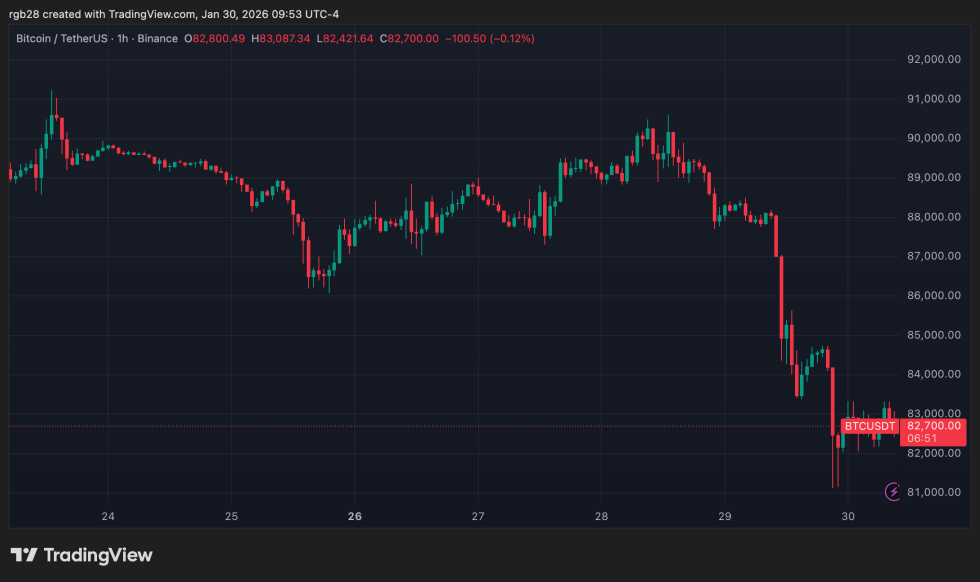
Bitcoin (BTC) trades at $82,700 in the one-week chart. Source: BTCUSDT on TradingView


İlgili Sorular

QWhat is the main purpose of the relaunched 'Project Crypto' initiative announced by the SEC and CFTC?

AThe main purpose is to bring coordination, coherence, and a unified approach to the federal oversight of crypto asset markets, preparing US markets for the digital era.

QWhat are the key focus areas of the SEC-CFTC harmonization agenda as detailed by the chairmen?

AThe key focus areas include advancing a clear crypto asset taxonomy, clarifying jurisdictional lines, removing duplicative compliance requirements, reducing regulatory fragmentation, and ensuring aligned definitions, coordinated oversight, and secure data sharing.

QWhat did CFTC Chairman Michael Selig direct his staff to study in collaboration with the SEC?

AHe directed CFTC staff to work with the SEC to study 'joint codification' of the common-sense crypto asset taxonomy recently laid out by SEC Chairman Atkins, as an interim measure while Congress finalizes legislation.

QWhat is the initial expected timeline for the SEC's innovation exemption for crypto firms, and what was the reason for the delay mentioned?

AThe innovation exemption was initially expected by the end of January but is now anticipated in early 2026. The delay was attributed to the need for careful development ('measure twice and cut once') and was further impacted by last year's government shutdown.

QAccording to the chairmen's joint statement, what is the core philosophy behind Project Crypto and their broader harmonization efforts?

AThe core philosophy is that financial regulation must be precise, not punitive, with rules narrowly tailored to address material risks, nimble enough to adapt to technological change, and anchored in the agencies' statutory authorities.

İlgili Okumalar

a16z: From Companies to DAOs, DUNA May Become the Next Generation Organizational Form

This article, "From Companies to DAOs: How DUNA Could Become the Next Organizational Form," traces the 500-year evolution of business collaboration. It begins with medieval structures like the *commenda* and Florentine *compagnia*, which exposed partners to personal risk. The modern corporation, exemplified by the Dutch East India Company (VOC), was a revolutionary leap, enabling large-scale, capital-intensive ventures by offering limited liability and reducing coordination costs. However, corporations introduced new challenges like principal-agent problems and bureaucratic overhead. The piece argues that software and internet-native protocols are now reducing these traditional overheads. Decentralized Autonomous Organizations (DAOs) emerged as a new model for coordination without centralized management. Yet, DAOs face a significant legal vacuum: they lack legal recognition, leaving members exposed to unlimited personal liability, and their tokens are vulnerable to being classified as securities under unclear regulations (e.g., the Howey Test). This has forced projects into suboptimal workarounds like offshore foundations. The article identifies the Decentralized Unincorporated Nonprofit Association (DUNA) as a potential solution. Recently legalized in states like Wyoming, the DUNA provides a legal wrapper for decentralized networks. It grants key protections—legal personality, limited liability, and perpetual existence—to a group without imposing a traditional hierarchical management structure. This allows token-holder communities to govern, hold assets, and contract as a single legal entity, aligning with their decentralized nature. While DUNA doesn't solve all governance challenges or magically resolve securities law questions, it represents a crucial step. It fills the legal recognition gap, offering a native legal form for internet-scale, decentralized collaboration and extending the separation of personal risk from organizational venture into a new domain.

marsbit3 dk önce

a16z: From Companies to DAOs, DUNA May Become the Next Generation Organizational Form

marsbit3 dk önce

2026 Mid-Year Report On-Chain RWA: Tokenized Stock Market Cap Doubles in a Year, But 90% of Rights Are Hollow Shells

The 2026 Mid-Year Report on On-Chain RWA highlights a significant growth in tokenized stock market capitalization, which nearly doubled from $951 million in March to $1.89 billion by July. However, the report reveals a fundamental contradiction in this "layer 2.5" ecosystem: products with the strongest legal foundation (like regulated U.S. infrastructure) lack liquidity and distribution, while freely tradable offshored wrapper products often lack substantive ownership rights. The increase is driven largely by a few products (SECZ, FGRS, STRCx) and platforms (Ondo, xStocks, Securitize collectively hold over 85% share). While distributed value across networks like Ethereum, Solana, and BNB Chain has grown, the market remains fragmented. Products referencing the same underlying asset (e.g., Apple stock) are distinct legal liabilities with different intermediaries and jurisdictional rules, offering varying degrees of legal claim. The report cautions that headline numbers are misleading, as they reflect changes in distributed token value—driven by issuance, conversions, and price movements—not pure investor inflows. True "canonical shares" with legal ownership, wide wallet distribution, institutional liquidity, and independent on-chain price discovery do not yet exist at scale. Tokenized treasuries show stronger product-market fit, and ETFs may be easier to scale than single stocks. The core takeaway is a trade-off: legal certainty versus liquidity and composability.

marsbit52 dk önce

2026 Mid-Year Report On-Chain RWA: Tokenized Stock Market Cap Doubles in a Year, But 90% of Rights Are Hollow Shells

marsbit52 dk önce

Coldcard Hardware Wallet Hacked: 594 Bitcoin Withdrawn in 25 Minutes

The Coldcard hardware wallet has been compromised, with hackers stealing approximately 594.5 Bitcoin (~$40 million) from 500 addresses in just 25 minutes. The root cause was a critical software bug, undetected for five years, which disabled the device's secure chip for generating true random numbers. This led to the creation of private keys based on predictable data like the processor's serial number, drastically reducing cryptographic security. The attackers exploited this offline by brute-forcing possible seed phrases, finding active addresses on the public ledger, and signing transactions. Initially, Coinkite (Coldcard's maker) claimed only older models were at risk but later admitted all devices running the compromised firmware were vulnerable. CEO Rodolphe Novak (NVK) apologized but ruled out financial compensation for affected users. To secure funds, owners must urgently update their firmware to specific safe versions, generate a completely new seed phrase on the updated device, and transfer all assets to new addresses created with that new seed. While a BIP-39 passphrase can help, it does not replace this migration process. Other Coinkite products like TAPSIGNER were not affected. This incident underscores that even specialized hardware requires rigorous, independent code audits, especially for cryptographic functions. It parallels past failures, like a 2006 OpenSSL bug in Debian, and raises questions about whether automated code analysis can ever fully replace human scrutiny in critical security areas.

cryptonews.ru3 saat önce

Coldcard Hardware Wallet Hacked: 594 Bitcoin Withdrawn in 25 Minutes

cryptonews.ru3 saat önce

İşlemler

Spot
活动图片




