CFTC changes guard as Selig takes reins, Pham departs

cointelegraph2025-12-23 tarihinde yayınlandı2025-12-23 tarihinde güncellendi

Özet

The US Commodity Futures Trading Commission (CFTC) has undergone a leadership transition, with Mike Selig sworn in as the new chairman, replacing acting chair Caroline Pham, who has departed. Selig, confirmed by the Senate after being nominated by President Trump, is now the agency's sole commissioner. He is widely viewed as pro-crypto and has pledged to support innovation in technologies like blockchain by avoiding a "regulation by enforcement" approach. Meanwhile, Pham, who had led the CFTC since January, is moving to crypto fintech company MoonPay. Both expressed support for balanced regulatory frameworks that foster innovation while ensuring market integrity.

The US Commodity Futures Trading Commission has officially undergone a change of leadership, with acting chair Caroline Pham saying she will leave the agency on Monday, while Mike Selig was sworn in as chair.

Pham, who had been serving as the CFTC’s acting chair since January and its sole commissioner since August, said on Monday that it would be her last day at the agency.

Meanwhile, the CFTC confirmed that Selig was sworn in as the agency’s 16th chairman on Monday after being nominated for the role by President Donald Trump on Oct. 27 and confirmed by the Senate on Thursday.

Pham’s departure leaves Selig as the CFTC’s sole commissioner. He is widely seen as pro-crypto and previously served as the chief counsel of the Securities and Exchange Commission’s Crypto Task Force.
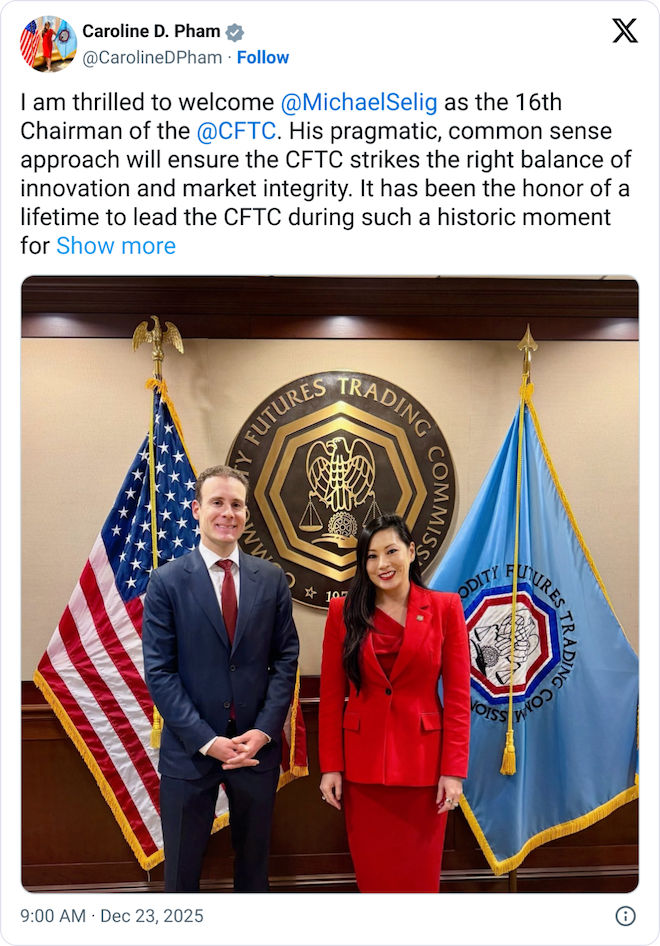
Source: Caroline Pham

Selig to continue positive momentum in crypto oversight

Selig will now serve a term that will expire in April 2029, and has previously vowed to support growth in innovative technologies such as crypto and blockchain by avoiding a so-called “regulation by enforcement” approach.

“I’m grateful for the confidence President Trump has placed in me and for the opportunity to lead the CFTC at this pivotal time,” Selig said.

“We are at a unique moment as a wide range of novel technologies, products, and platforms are emerging, retail participation in the commodity markets is at an all-time high, and Congress is poised to send digital asset market structure legislation to the President’s desk, cementing the US as the Crypto Capital of the World.”

On Monday, White House crypto czar David Sacks said Selig and SEC chair Paul Atkins were a “dream team to define clear regulatory guidelines.”

Pham shifts to crypto after steering CFTC

Pham has long said she would leave the CFTC once Congress confirmed someone to lead the agency, and on Wednesday, MoonPay confirmed earlier reports that Pham was headed to the crypto fintech company.

Pham’s time as acting chair saw her take a proactive approach to supporting crypto regulation.

Related: Wall Street’s bid on crypto dominated 2025 but what’s the demand outlook for 2026?

Pham said in her departing statement that the CFTC had “refocused on our mandate to promote responsible innovation and fair competition as the CFTC prepares to take on expanded oversight of new markets and new products like digital assets, crypto, and prediction markets.”

“I am thrilled to welcome Michael Selig as the 16th Chairman of the CFTC. His pragmatic, common-sense approach will ensure the CFTC strikes the right balance of innovation and market integrity,” she added.

Magazine: Meet the onchain crypto detectives fighting crime better than the cops

İlgili Sorular

QWho is the new chairman of the CFTC and when was he sworn in?

AMike Selig is the new chairman of the CFTC. He was sworn in on Monday after being nominated by President Donald Trump on Oct. 27 and confirmed by the Senate.

QWhat is Mike Selig's stance on cryptocurrency regulation and what is the length of his term?

AMike Selig is widely seen as pro-crypto and has vowed to support growth in innovative technologies by avoiding a 'regulation by enforcement' approach. His term will expire in April 2029.

QWhy did Caroline Pham leave the CFTC and what is her new role?

ACaroline Pham left the CFTC once a new chair was confirmed by Congress. She is headed to the crypto fintech company MoonPay.

QWhat did White House crypto czar David Sacks say about the new regulatory leadership?

ADavid Sacks said that Selig and SEC chair Paul Atkins were a 'dream team to define clear regulatory guidelines'.

QWhat was Caroline Pham's approach to crypto regulation during her time as acting chair?

AAs acting chair, Caroline Pham took a proactive approach to supporting crypto regulation, refocusing the CFTC on its mandate to promote responsible innovation and fair competition for new markets like digital assets.

İlgili Okumalar

Global Market Share Survey: Japanese Firms Lead in Semiconductor Materials

Global Market Share Survey: Japanese Firms Lead in Semiconductor Materials According to the 2025 "Major Goods and Services Market Share Survey" by Nikkei, Japanese companies maintain strong positions in semiconductor-related materials. In silicon wafers, Shin-Etsu Chemical ranks first with a 26.3% share, followed by SUMCO at 17.8%. Together, they hold 44.1% of the market, widening their lead over competitors from Taiwan, Germany, and South Korea. In photoresists, Tokyo Ohka Kogyo, JSR, and Shin-Etsu Chemical occupy the top three spots, with a combined share of 60.5%. Despite their strength in materials, Japanese firms have a weaker presence in core semiconductor segments like DRAM and NAND flash memory, where South Korean and U.S. companies dominate. For instance, SK Hynix and Samsung lead in DRAM, while China’s CXMT doubled its share to 6% in 2025. The semiconductor market is projected to grow rapidly, with WSTS forecasting a 90% increase to $1.5112 trillion by 2026. Major players like Samsung, SK Hynix, and Micron are making massive investments to expand capacity. To maintain their edge in materials, Japanese companies must similarly commit to large-scale, risk-taking investments. In contrast, Japan’s automotive sector shows stagnation. Toyota remains the global leader but with only a slight share increase to 12.3%, while Japanese brands are absent from the top five in the EV market. In shipbuilding, Imabari Shipbuilding rose to third place globally with a 7.2% share, benefiting from large container ship deliveries. However, Chinese and South Korean firms dominate the sector, holding the top two positions. Japan aims to revitalize its shipbuilding industry through government and corporate efforts, targeting a near doubling of output by 2035. Addressing labor shortages and adopting advanced technologies like physical AI will be critical for competitiveness.

marsbit16 dk önce

Global Market Share Survey: Japanese Firms Lead in Semiconductor Materials

marsbit16 dk önce

STRC Major De-pegging's First Financial Report, How Will Strategy Repair Its Capital Flywheel?

Bitcoin treasury company Strategy released its Q2 2026 earnings report on July 31. Despite a 6.9% year-over-year revenue increase to $122 million, the company recorded a net loss of $8.22 billion, largely due to $8.32 billion in unrealized losses from Bitcoin price fluctuations. As of quarter-end, Strategy holds 843,775 BTC with an average cost of $75,000 per coin, and Bitcoin per share increased. The report highlights a critical shift in Strategy's capital model following the de-pegging of its key financing tool, STRC (Strategic Coin), which fell below its $100 target. Management's top priority is restoring STRC to its target value, aiming for a recovery by September 8. They rule out discounted STRC issuances and plan to maintain its dividend yield at 12%, instead focusing on bolstering its $3.75 billion cash reserve. Strategy has moved from a one-way "buy-and-hold" Bitcoin strategy to active capital management. This new approach, part of its "Digital Credit Capital Framework," involves flexibly managing its balance sheet across four elements: BTC, USD cash, common stock (MSTR), and digital credit securities like STRC. This allows for BTC monetization (having sold $218.4 million in BTC so far), strategic repurchases of discounted securities, and debt optimization, as seen with a $1.5 billion convertible bond buyback. The company's future hinges on two key tests: successfully re-pegging STRC to restore market confidence in its digital credit system, and a long-term recovery in Bitcoin's price to ultimately support its growth thesis.

marsbit1 saat önce

STRC Major De-pegging's First Financial Report, How Will Strategy Repair Its Capital Flywheel?

marsbit1 saat önce

STRC's First Financial Report Post-Depegging, How is Strategy Restoring the Capital Flywheel?

On July 31, 2026, Bitcoin treasury company Strategy released its Q2 financial report. Despite a 6.9% year-over-year increase in revenue to $122 million, the company recorded a substantial net loss of $8.22 billion, primarily due to $8.32 billion in unrealized losses from Bitcoin holdings. While Strategy's core Bitcoin strategy remains intact—its holdings grew 11% to 843,775 BTC—the company is undergoing a fundamental shift in its capital model. Following the de-pegging of its key financing tool, the STRCoin (STRC), from its $100 target in May, Strategy has pivoted from a one-directional "raise funds, buy Bitcoin" cycle to a more dynamic, multi-asset capital management approach. A key part of this new framework is the "Monetization Program," through which Strategy has sold approximately $218.4 million worth of BTC to bolster liquidity. The company's top priority is repairing STRC's peg, committing not to issue discounted shares until it returns to its target range. It has initiated a $1 billion buyback program for discounted digital credit securities, having repurchased $28.9 million face value of STRC so far. Management aims to restore the peg around September 8, 2026. Strategy now actively manages a matrix of assets: Bitcoin (for accumulation or strategic sales), USD cash reserves (now at $3.75 billion), common stock (MSTR), and digital credit securities like STRC. This allows for tactical moves like repurchasing discounted debt or equity to capture value. The future success of Strategy's "capital flywheel" hinges on two factors: the short-term ability to successfully re-peg STRC to restore market confidence in its digital credit system, and the long-term price trajectory of Bitcoin, upon which its entire investment thesis ultimately depends.

Odaily星球日报1 saat önce

STRC's First Financial Report Post-Depegging, How is Strategy Restoring the Capital Flywheel?

Odaily星球日报1 saat önce

İşlemler

Spot
活动图片