Can panic wallets stop a wrench? Why crypto’s next security debate is physical

cointelegraph2025-12-08 tarihinde yayınlandı2025-12-08 tarihinde güncellendi

Özet

In Val-d’Oise, France, a crypto entrepreneur’s father was kidnapped, adding to a growing list of over 225 verified physical attacks on digital asset holders. Jameson Lopp, Casa’s chief security officer, reports a 169% surge in such attacks in 2025, correlating with Bitcoin bull markets and OTC trading spikes. While not unique to crypto, these "wrench attacks" are driving innovation in "panic wallets" with duress triggers—features like balance wiping, decoy wallets, or biometric alerts. However, their effectiveness is unproven, and attackers often assume hidden funds even after compliance. The US leads in absolute cases, but per-capita risk is higher in the UAE and Iceland. About 25% of incidents involve home invasions aided by leaked KYC data, while 23% are kidnappings. Two-thirds of attacks succeed, though 60% of perpetrators are caught. Builders like Haven are creating biometric, multi-party custody systems to resist coercion, but Lopp warns that over-reliance on custodians risks centralizing Bitcoin and undermining its decentralized ethos. Ultimately, the best defense remains social discretion: avoiding public association with crypto holdings. The real vulnerability isn’t weak wallets—it’s being targeted in the first place.

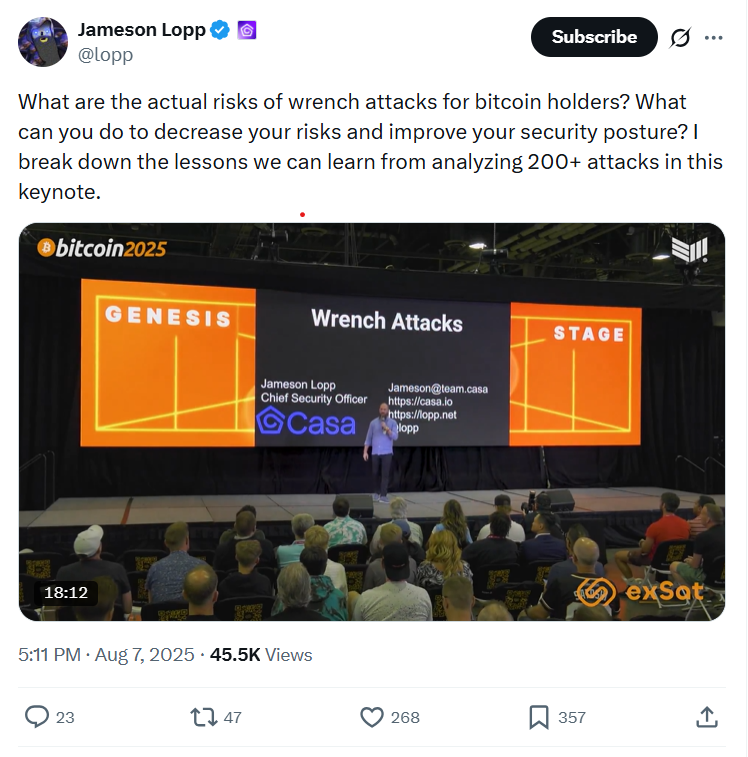
On Dec. 1 in Val‐d’Oise, France, the father of a Dubai‐based crypto entrepreneur was kidnapped off the street; another entry in Jameson Lopp’s directory of 225‐plus verified physical attacks on digital asset holders.

The database Lopp, the chief security officer at Bitcoin wallet Casa, has maintained for six years, shows the pace of coercion rising fast, with a 169% jump in reported physical attacks in 2025.

The risk itself isn’t unique to crypto: gold brokers, luxury resellers, even cash couriers have faced the same basic weapon for centuries (violence). What’s new is that digital assets are now being stolen face‐to‐face.

The shift is fueling a new arms race in wallet design. “Panic wallets” with duress triggers that can instantly wipe balances, send false decoys, or call for help with a subtle biometric gesture.

The idea sounds elegant until you add a wrench. As Lopp told Cointelegraph, “Ultimately, use of duress wallets relies upon speculation about the attacker, and you can’t possibly know their motivations and knowledge.”

The data behind the fear

Lopp’s findings suggest wrench attacks follow market cycles. They rise during bull runs and periods of intense over‐the‐counter (OTC) trading, when large deals move off exchanges. The US leads in absolute cases, although the per-capita risk is higher in the United Arab Emirates and Iceland.
Source: Jameson Lopp

About a quarter of incidents are home invasions, often aided by leaked Know Your Customer (KYC) data (as Lopp laments, “Kill Your Customer”), or public‐records doxing. Another 23% are kidnappings. Two‐thirds of attacks succeed, and roughly 60% of known perpetrators are caught.

The trend line correlates roughly with Bitcoin’s (BTC) price chart. Each retail mania pulls new money and new targets into public view, and criminals chase return on investment like everyone else.

Related: Crypto user attacked in France over Ledger hardware wallet — Report

Testing the panic gesture

If digital self‐defense is evolving, it’s doing so without evidence. “There’s not much we can definitively state about the effectiveness of duress wallets/triggers, because we have so little data,” Lopp points out.

Related: Bitcoin ’wrench attacks’ on track to double its worst year

He’s aware of one victim who tried a decoy wallet and failed to convince the assailant, and another who complied immediately but was still tortured for hours because the thief assumed hidden reserves.

The builders fighting back

Matthew Jones, co-founder of Haven, learned the hard way. While attempting a 25 BTC trade in Amsterdam, his counterpart fled with a waiting van. His photos helped Europol trace the gang across Europe; none were ever caught.

He’s since turned that experience into a product: a biometric, multi‐party custody system built on “continuous authentication without identity exposure.”

Haven’s biometric wallet locks transfers behind a live facial scan stored only on the user’s device. Large transactions, above $1,000, require real‐time confirmation from a secondary verifier, such as a spouse or partner.

Changing that contact imposes a 24‐hour wait, making on‐the‐spot coercion nearly useless. Jones says, “It’s about having the cash in your wallet stolen, rather than your bank accounts emptied. So it’s about deciding what your risk tolerance is and deciding on an amount.”

Related: Are seed-phrase-free crypto wallets the key to mass self-custody? Expert weighs in

The custody dilemma

As physical coercion rises and privacy rules such as the Organization for Economic Cooperation and Development’s Crypto-Asset Reporting Framework tighten, even veteran Bitcoiners are reevaluating self‐custody. Some now prefer custodianship to personal risk.

Lopp calls that outcome catastrophic: “If enough people decide that Bitcoin self-custody is too dangerous to undertake, this will create massive centralization and systemic risk to the entire system. It’s a battle I’ve been fighting against for a decade.”

It exposes the paradox at the heart of crypto security in 2025: every safeguard, from stricter KYC databases to offchain biometrics, narrows anonymity while widening the attack surface. The frontier problem isn’t smart‐contract exploits anymore; it’s data exposure and fear.

Related: The case for a ‘non-mandatory KYC’ model — Interview with Toobit

What actually works

For all the innovation, the simplest protection remains social discretion. Lopp advises, “The most effective thing that a Bitcoiner can do to reduce their wrench attack risk is very difficult: don’t talk about Bitcoin, at least not while using your real name or face.”

As hardware wallets learn panic modes and regulators demand more visible ownership, the only defenses that scale may be cultural. Most wrench attacks succeed because the victim can be found, not because their wallet can be broken.

Magazine: 2026 is the year of pragmatic privacy in crypto — Canton, Zcash and more

Trend Kriptolar

İlgili Okumalar

The Entire Internet Hails Noam's Joining, But OpenAI's Loss Bill Just Got Thicker

While the AI community celebrates Noam Shazeer, co-author of the "Attention Is All You Need" paper, joining OpenAI as Head of Architectural Research, the company's audited financials reveal a starkly different reality. In 2025, OpenAI reported $13.07 billion in revenue but a massive $20.92 billion operating loss. Even excluding a one-time accounting charge, the cash burn is severe, with $3.7 billion consumed in Q1 2026 alone. This high-profile hiring occurs against a backdrop of significant internal research talent drain, with key founders and researchers departing as the company's focus shifts from exploratory research to product iteration. Meanwhile, OpenAI's fundamental business model faces a deep crisis. It paid Microsoft $10.59 billion for compute in 2025, while its vast user base of 9 billion weekly actives includes only 50 million paying customers, making growth a direct driver of escalating costs. The article argues Shazeer's recruitment is less about technical necessity and more about crafting a compelling narrative for OpenAI's upcoming IPO, aiming to justify a rumored $1 trillion valuation to future public market investors. It contrasts OpenAI's strategy with Anthropic's reported path to profitability, which relies on a strong enterprise customer base and cost control, rather than star-powered narratives. Ultimately, the piece concludes that while Shazeer's architectural work may take 1-2 years to materialize, OpenAI's financial clock is ticking much faster, with its massive losses undercutting the celebratory headlines.

marsbit48 dk önce

The Entire Internet Hails Noam's Joining, But OpenAI's Loss Bill Just Got Thicker

marsbit48 dk önce

Market Trend (June 19): US-Iran Deal Drives Out Geopolitical Premium; Chip Stocks Soar to New Highs; Energy Sector Leads Declines

U.S. Market Trends (June 19): U.S.-Iran Deal Eases Tensions, Chip Stocks Soar, Energy Sector Leads Declines. U.S. stocks rallied on Thursday as the signing of a temporary U.S.-Iran deal in Geneva de-escalated Middle East tensions, with Saudi oil tankers transiting the Strait of Hormuz. This geopolitical relief helped markets recover from recent Fed-driven volatility. The S&P 500 rose over 1%, the Nasdaq gained nearly 2%, and the Dow Jones Industrial Average closed at another record high. The Philadelphia Semiconductor Index surged over 6% to a historic peak. Chip stocks were the standout performers. Reports of an Apple-Intel design and foundry deal for certain products, alongside mentions of potential Nvidia and SpaceX collaborations with Intel, propelled the sector. Intel surged ~10.5%, while memory chip makers like Micron also saw significant gains, highlighting sustained confidence in long-term AI capital expenditure. In contrast, the energy sector was the day's sole loser, with the S&P 500 energy sub-index declining as WTI crude fell ~2% to around $74.29/barrel. The reopening of key shipping routes erased prior geopolitical risk premiums. SpaceX extended losses for a second day on news of a potential large bond offering. Market volatility (VIX) dropped sharply, indicating a swift reversal of post-Fed jitters. Treasury yields dipped slightly but remained elevated. The focus now shifts to upcoming economic data, including next week's PCE inflation report and Micron's earnings, which will serve as a key test for the AI trade's durability.

marsbit1 saat önce

Market Trend (June 19): US-Iran Deal Drives Out Geopolitical Premium; Chip Stocks Soar to New Highs; Energy Sector Leads Declines

marsbit1 saat önce

Will MicroStrategy Fall Into a Death Spiral? How Will the Macro Outlook Evolve in the Second Half of the Year?

**Summary:** The discussion centers on recent Bitcoin price declines and the evolving financial strategy of MicroStrategy (MSTR). The core argument is that the primary pressure is not from one-off Bitcoin sales by MSTR, but from the market's new expectation that MSTR may need to engage in *sustained, small-scale* Bitcoin sales to cover cash flow obligations for its growing portfolio of preferred shares and debt instruments (like STRC). This shift is driven by its stated goal of maintaining "bitcoins per share neutrality." The market is now testing whether it can absorb this potential ongoing selling pressure without entering a severe "death spiral" with Bitcoin's price. A resolution may involve MSTR softening its approach to avoid damaging both its stock and Bitcoin. The conversation then explores the parallel rise of AI-related stocks. The guest posits that AI is fundamentally restructuring labor, with "tokens" (representing access to AI models/compute) becoming a new form of capital and a substitute for human execution. This drives corporate efficiency and profits, benefiting upstream hardware providers (semiconductors, data centers), which explains the sustained rally. This represents the early stages of a "machine economy." Regarding crypto exchanges offering US stock trading, this is seen as a natural evolution. With few crypto-native assets generating lasting value, exchanges are pivoting to distribute valuable real-world assets (RWAs). This doesn't necessarily harm crypto's long-term prospects, as blockchain infrastructure may become crucial for future machine-to-machine economies. The analysis concludes that the era of rampant altcoin speculation is likely over, heavily damaged by the liquidity shock of the "1011" event (likely referring to a major market crash). Meme-driven capital has largely migrated to US equities. Looking ahead, macroeconomic uncertainty is rising due to potential large IPOs (e.g., SpaceX) and the US elections. While short-term market corrections are possible, the long-term trends of AI-driven productivity gains and the maturation of blockchain towards real-world utility and institutional adoption remain intact.

marsbit1 saat önce

Will MicroStrategy Fall Into a Death Spiral? How Will the Macro Outlook Evolve in the Second Half of the Year?

marsbit1 saat önce

İşlemler

Spot
Futures

Popüler Makaleler

COPPER Nasıl Satın Alınır

HTX.com’a hoş geldiniz! Copper (COPPER) satın alma işlemlerini basit ve kullanışlı bir hâle getirdik. Adım adım açıkladığımız rehberimizi takip ederek kripto yolculuğunuza başlayın. 1. Adım: HTX Hesabınızı OluşturunHTX'te ücretsiz bir hesap açmak için e-posta adresinizi veya telefon numaranızı kullanın. Sorunsuzca kaydolun ve tüm özelliklerin kilidini açın. Hesabımı Aç2. Adım: Kripto Satın Al Bölümüne Gidin ve Ödeme Yönteminizi SeçinKredi/Banka Kartı: Visa veya Mastercard'ınızı kullanarak anında Copper (COPPER) satın alın.Bakiye: Sorunsuz bir şekilde işlem yapmak için HTX hesap bakiyenizdeki fonları kullanın.Üçüncü Taraflar: Kullanımı kolaylaştırmak için Google Pay ve Apple Pay gibi popüler ödeme yöntemlerini ekledik.P2P: HTX'teki diğer kullanıcılarla doğrudan işlem yapın.Borsa Dışı (OTC): Yatırımcılar için kişiye özel hizmetler ve rekabetçi döviz kurları sunuyoruz.3. Adım: Copper (COPPER) Varlıklarınızı SaklayınCopper (COPPER) satın aldıktan sonra HTX hesabınızda saklayın. Alternatif olarak, blok zinciri transferi yoluyla başka bir yere gönderebilir veya diğer kripto para birimlerini takas etmek için kullanabilirsiniz.4. Adım: Copper (COPPER) Varlıklarınızla İşlem YapınHTX'in spot piyasasında Copper (COPPER) ile kolayca işlemler yapın.Hesabınıza erişin, işlem çiftinizi seçin, işlemlerinizi gerçekleştirin ve gerçek zamanlı olarak izleyin. Hem yeni başlayanlar hem de deneyimli yatırımcılar için kullanıcı dostu bir deneyim sunuyoruz.

6 Toplam GörüntülenmeYayınlanma 2026.06.18Güncellenme 2026.06.18

COPPER Nasıl Satın Alınır

XAG Nedir

XAGUSDT Sürekli Sözleşmesi, ABD doları cinsinden fiyatlandırılan gümüş için ticaret sembolüdür ve 1 troy ons gümüşü temsil eder.

3 Toplam GörüntülenmeYayınlanma 2026.06.18Güncellenme 2026.06.18

XAG Nedir

XAG Nasıl Satın Alınır

HTX.com’a hoş geldiniz! Silver (XAG) satın alma işlemlerini basit ve kullanışlı bir hâle getirdik. Adım adım açıkladığımız rehberimizi takip ederek kripto yolculuğunuza başlayın. 1. Adım: HTX Hesabınızı OluşturunHTX'te ücretsiz bir hesap açmak için e-posta adresinizi veya telefon numaranızı kullanın. Sorunsuzca kaydolun ve tüm özelliklerin kilidini açın. Hesabımı Aç2. Adım: Kripto Satın Al Bölümüne Gidin ve Ödeme Yönteminizi SeçinKredi/Banka Kartı: Visa veya Mastercard'ınızı kullanarak anında Silver (XAG) satın alın.Bakiye: Sorunsuz bir şekilde işlem yapmak için HTX hesap bakiyenizdeki fonları kullanın.Üçüncü Taraflar: Kullanımı kolaylaştırmak için Google Pay ve Apple Pay gibi popüler ödeme yöntemlerini ekledik.P2P: HTX'teki diğer kullanıcılarla doğrudan işlem yapın.Borsa Dışı (OTC): Yatırımcılar için kişiye özel hizmetler ve rekabetçi döviz kurları sunuyoruz.3. Adım: Silver (XAG) Varlıklarınızı SaklayınSilver (XAG) satın aldıktan sonra HTX hesabınızda saklayın. Alternatif olarak, blok zinciri transferi yoluyla başka bir yere gönderebilir veya diğer kripto para birimlerini takas etmek için kullanabilirsiniz.4. Adım: Silver (XAG) Varlıklarınızla İşlem YapınHTX'in spot piyasasında Silver (XAG) ile kolayca işlemler yapın.Hesabınıza erişin, işlem çiftinizi seçin, işlemlerinizi gerçekleştirin ve gerçek zamanlı olarak izleyin. Hem yeni başlayanlar hem de deneyimli yatırımcılar için kullanıcı dostu bir deneyim sunuyoruz.

5 Toplam GörüntülenmeYayınlanma 2026.06.18Güncellenme 2026.06.18

XAG Nasıl Satın Alınır

Tartışmalar

HTX Topluluğuna hoş geldiniz. Burada, en son platform gelişmeleri hakkında bilgi sahibi olabilir ve profesyonel piyasa görüşlerine erişebilirsiniz. Kullanıcıların A (A) fiyatı hakkındaki görüşleri aşağıda sunulmaktadır.

活动图片