Can Entropy Become the Second Trade? The Pre-IPO Competition War Has Begun

marsbit2026-08-27 tarihinde yayınlandı2026-08-27 tarihinde güncellendi

Özet

The article examines whether Entropy can become a second major player like Trade in the emerging pre-IPO prediction market space. Entropy’s recent launch of its Anthropic market gained significant attention and trading volume, but also drew comparisons to the earlier, less successful platform Ventuals. The author argues that dismissing Entropy as "just another Ventuals" overlooks the importance of nuanced design differences, similar to how Hyperliquid succeeded by innovating with its HLP and Hypercore infrastructure where previous DEXs failed. Ventuals struggled due to extremely long time horizons for pre-IPO events (e.g., launching an Anthropic market over a year before the IPO), which led to wild price dislocations and unsustainable funding rates, causing a loss of market share to Trade. In contrast, Entropy launched its Anthropic market much closer to the expected IPO date. The piece draws a parallel to Hyperliquid’s successful "pre-market wars," where gaining early liquidity was key to capturing future trading volume. Trade achieved dominance in HIP-3 markets for traditional assets by partnering with market makers and ensuring its markets reflected true economic value. Entropy’s core thesis is that providing more direct, sustainable liquidity (akin to an HLP model) and forging strong distribution partnerships will lead to more stable and accurate markets. Its success hinges on building trust in its model, possibly by pioneering a new, large-scale liquidity mechanism fo...

Author: diogenes(X)

Compiled by: Deep Tide TechFlow

Deep Tide Insights: Entropy's HIP-3 prediction market immediately went viral upon launch. As an investor, the author was initially very excited, considering it one of the rare, well-executed launches among recent new founders; its Anthropic market open interest surged from a few hundred thousand dollars to nearly $3 million. However, skepticism soon followed—"They just want to make another Ventuals." On the surface, this logic seems flawless: it's been tried before and didn't work, so what makes you special? But the author argues: Before Hyperliquid, no DEX had truly challenged centralized exchanges. It was the design differences between HLP and Hypercore that changed the outcome. Minor innovations in the details often determine success or failure.
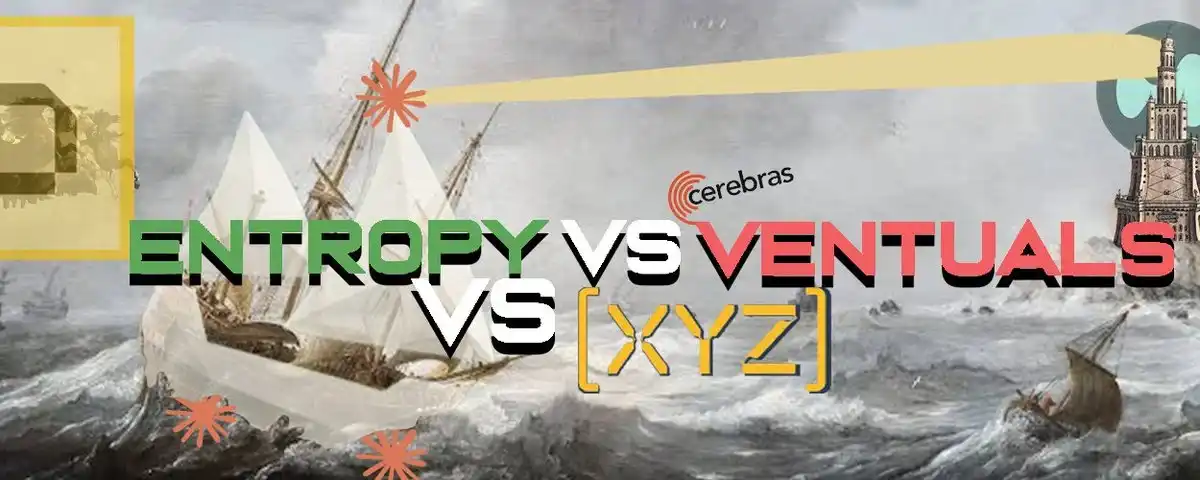
Entropy's recent launch has been the talk of the town. As an investor, I felt extremely excited. I believe this is one of the most successful launches I've seen recently, especially for new ventures in the crypto space. The open interest for Entropy's Anthropic market has skyrocketed from an initial few hundred thousand dollars to nearly $3 million at the time of writing, far surpassing other markets I've seen. However, not everyone viewed this launch positively.

Apart from Jake Paul's controversial tweet (which predictably drew some criticism), an interesting point I heard on Twitter was: "Oh, these guys just want to do..." @ventuals "all over again." People naturally think, "Oh, this has been tried before, it didn't work. What makes them think they're special?"

This logic seems plausible at first glance. Einstein said, "Insanity is doing the same thing over and over again and expecting different results." However, ignoring nuance demonstrates great ignorance. There are countless examples where this thinking is completely wrong. Before Hyperliquid, no DEX had truly challenged centralized exchanges.

While DEXs improved over time, they still had limitations. Many people thought the same would happen with Hyperliquid. Hyperliquid revolutionized the game because its design allowed for launching liquidity in a sustainable way using HLP, and the Hypercore infrastructure was scalable enough to handle the trading volumes required by large exchanges. There are many other differences between Hyperliquid and its predecessors, but these two are its core innovations.

The point is: details matter. Seemingly small changes can have a significant impact on the outcome.
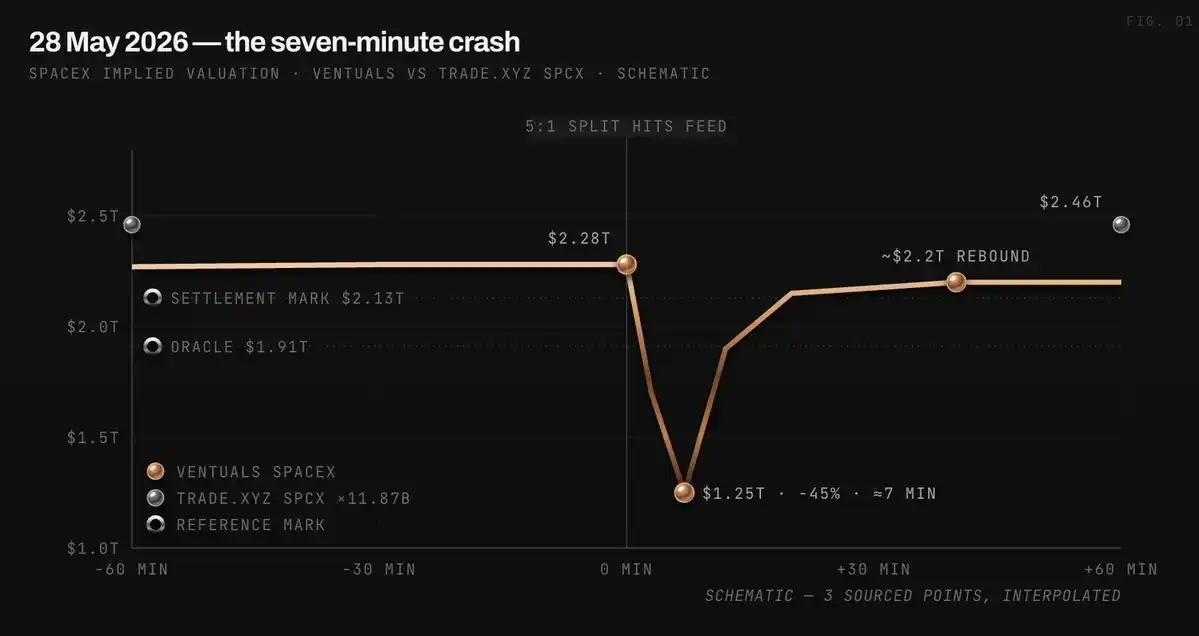
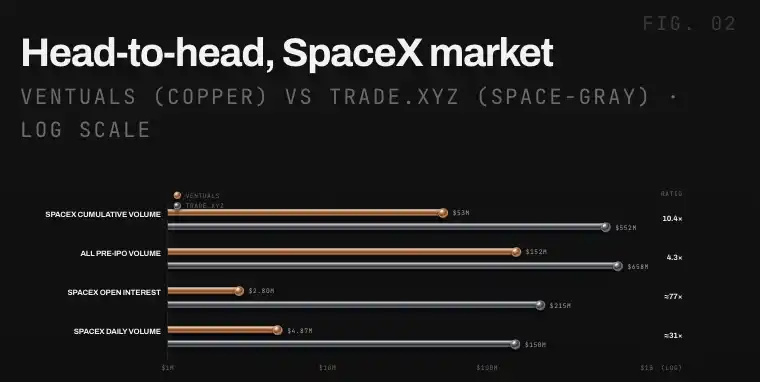
Now, let's examine Ventuals' issues, because they are numerous. Ventuals focused on pre-IPOs but had timeframes far exceeding what an IPO requires. Ventuals' Anthropic market launched in November 2025, at a time when Anthropic hadn't even filed for an IPO yet.

This led to a huge disparity between the price on Ventuals' market and the actual price of Anthropic in the secondary market. Given the limited supply of Anthropic's underlying asset (i.e., it was difficult for people to acquire), and Ventuals' underlying asset being partly from the secondary market and partly from other sources, this meant the funding rates on Ventuals' market were extremely volatile. Notably, the funding rate once reached as high as 8700%!

These funding rates were not arbitraged away because holders of the underlying market did not trust Ventuals' design, believing its market could not reflect the true value of these assets. Thus, a vicious cycle formed: an asset similar to Anthropic existed on the market, yet not quite Anthropic, with extreme volatility and extremely high holding costs. This situation, combined with an inability to attract liquidity providers, led to most of Ventuals' markets being acquired by Trade.
Now, let's look at Entropy. Entropy launched its Anthropic market the month after Anthropic filed its S-1; according to Fortune, the IPO is currently expected in October. Depending on the specific date in October, that's between one-and-a-half to two months from now. This window falls within a somewhat forgotten piece of Hyperliquid history. I'm accustomed to calling it the "pre-market wars."
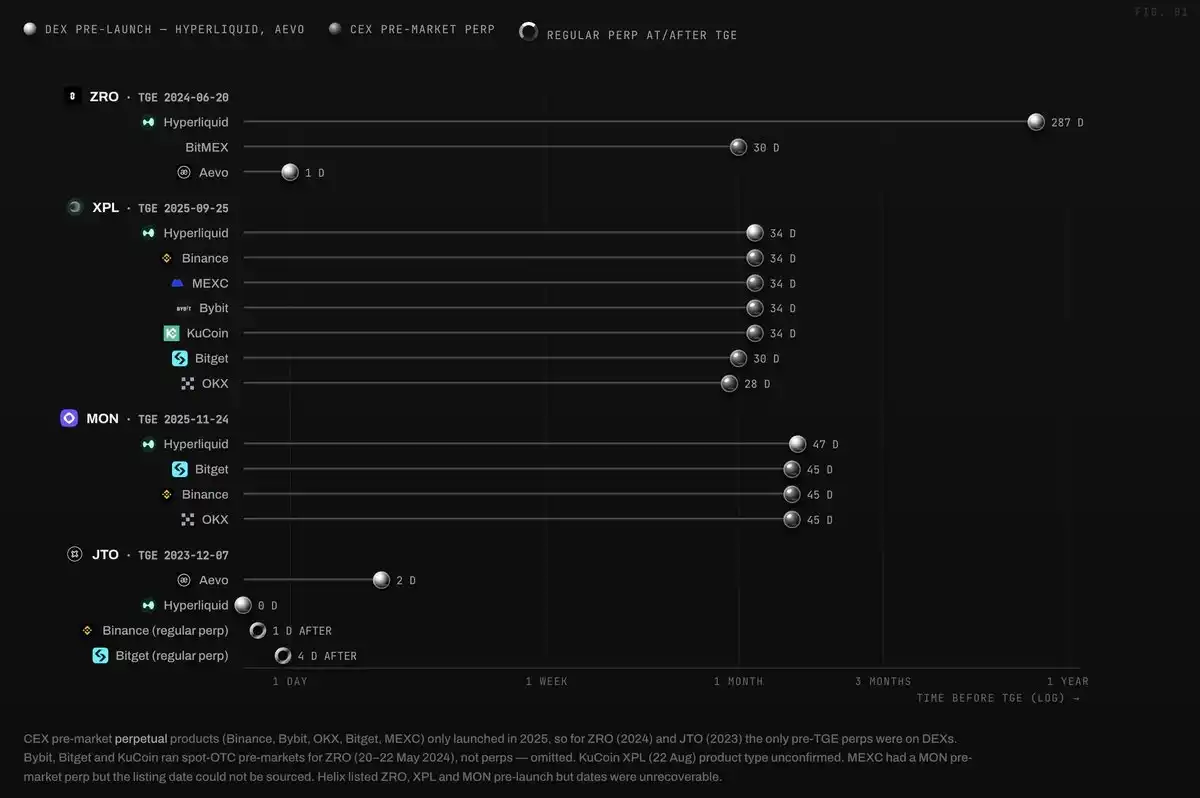
During the "pre-market wars" period before token listings, exchanges like Hyperliquid engaged in fierce competition to get a head start by enabling trading on new tokens before they were widely available. By launching a market first and having the best liquidity, an exchange could become the primary venue for that token after its official launch. This meant most trading volume would flow through these exchanges, generating huge profits. Therefore, exchanges were even willing to operate at a loss to secure market dominance, much like how Costco sells hot dogs at a loss to attract more customers into the store to buy other profitable goods. Here, the "hot dog" refers to pre-listing liquidity, and the "other goods" refer to post-launch trading fees.
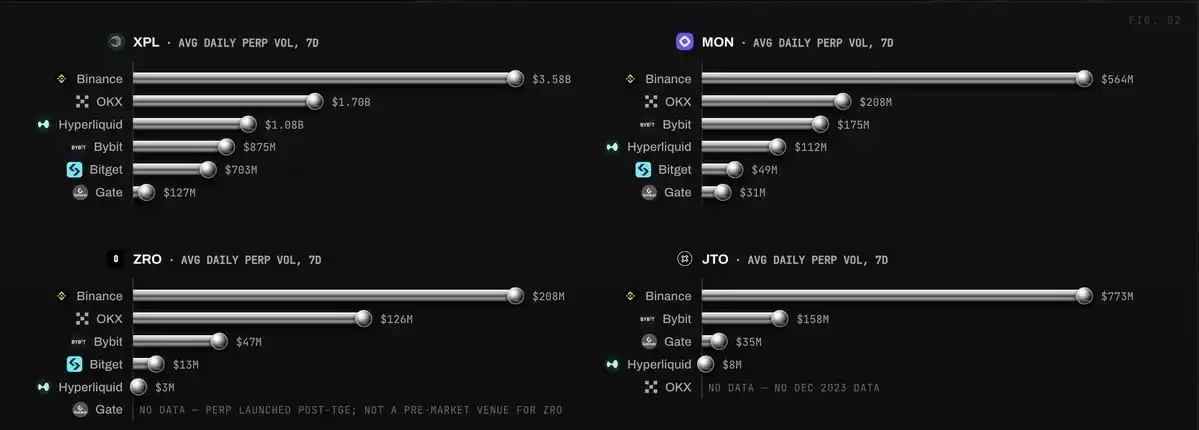
With few exceptions, Hyperliquid achieved a decisive victory in the pre-market wars. While it obviously didn't become the world's largest exchange, that wasn't the point. It went from an unknown small exchange to a top-four exchange, largely thanks to the pre-market wars. By launching markets with better liquidity earlier than its competitors, it captured a significant market share. This relied heavily on HLP itself. Entities wanting to harm Hyperliquid or profit from it (often both) would employ various means to manipulate prices or directly impact HLP itself (list of events). However, despite these challenges, Hyperliquid persevered and has become one of the most valuable projects of the past five years, potentially even the greatest project since Bitcoin's inception.

Hyperliquid's next logical step would naturally be to allow traditional asset markets. As the world's preeminent economic hegemon and issuer of the preferred foreign exchange currency, the United States holds the vast majority of these assets. Moreover, its regulators have historically been active and ready to send warning letters to any project that might be perceived as even slightly touching US companies or prices. Therefore, after solidifying its control over crypto assets, Hyperliquid would logically want decentralized third-party teams to manage these markets, while leveraging Hyperliquid's built-up infrastructure and user base. However, Hyperliquid does not provide support via HLP; any new team would have to create liquidity on its own.
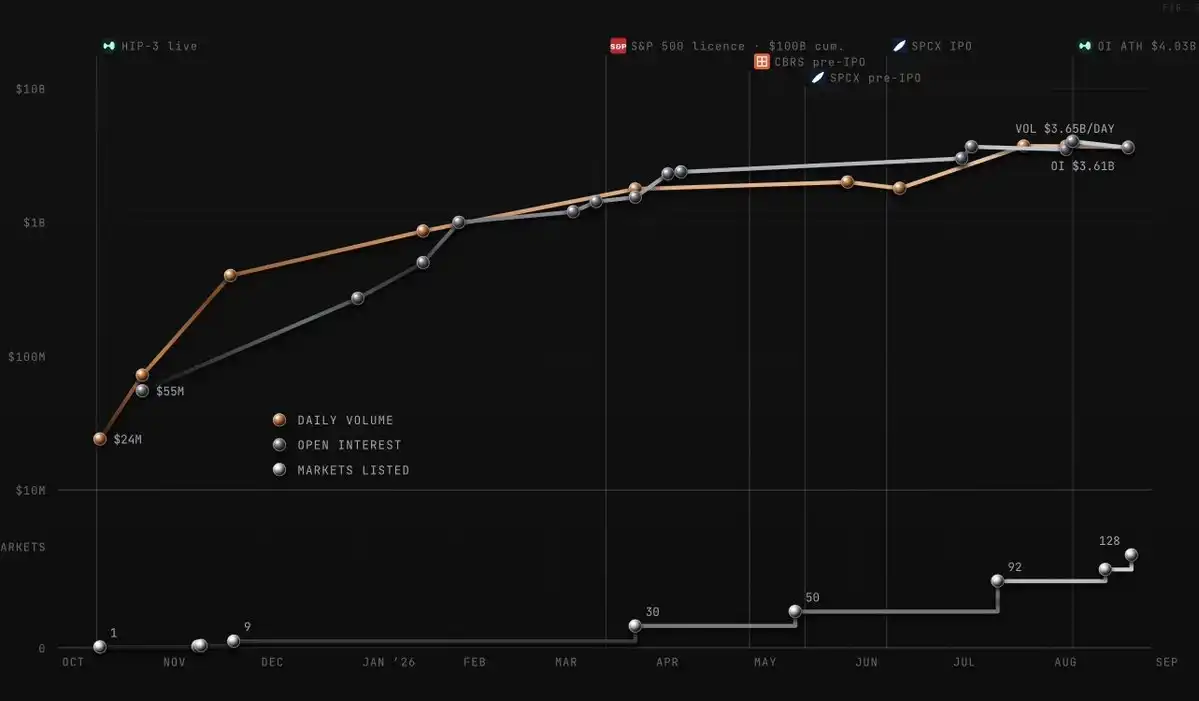
Trade was the first company to deploy HIP3 at scale and the first to truly leverage liquidity. @sershokunin Trade successfully launched multiple stock markets and rapidly expanded liquidity through partners and trader distribution channels. Trade launched in mid-October 2025. By November 6th, Trade's XYZ100 (a Nasdaq 100 index-type product) had surpassed $1 billion in trading volume. Today, its open interest and daily trading volume are in the tens of billions.
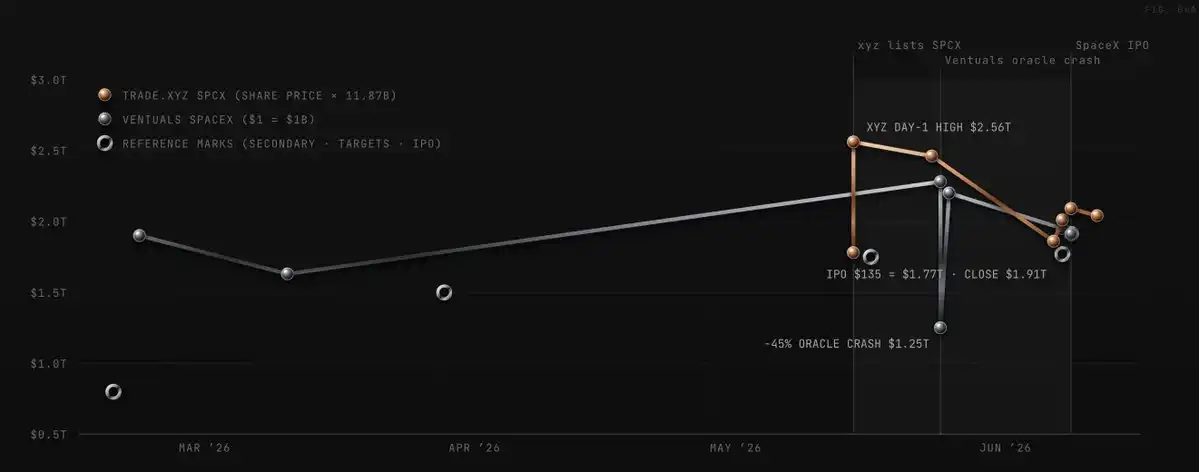
While Trade flourished, Ventuals' product underperformed. Ventuals often entered markets ahead of Trade but failed to capture sufficient market share. Subsequently, when Trade launched competing products, it eroded Ventuals' market share.
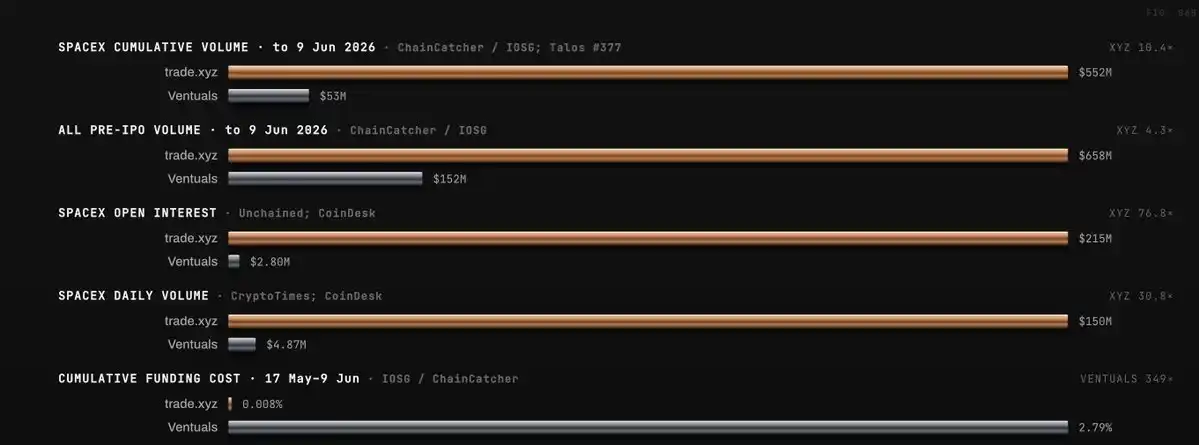
Trade's core innovation and competitive advantage lay in extensive collaboration with market makers and traders to ensure trading volume, while also altering some mechanisms of its market operations to be closer to "economic gravity," or to make its markets reflect the true price of the assets.
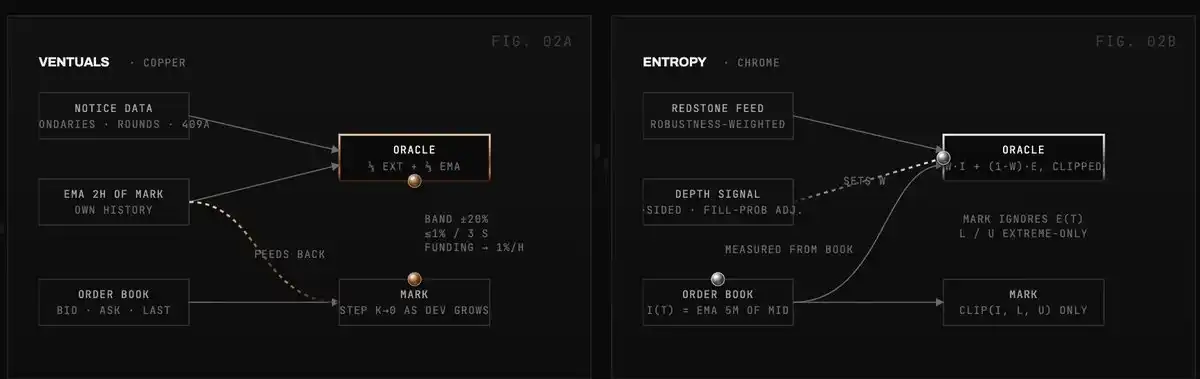
Entropy adheres to two core ideas: First, that providing more direct liquidity (e.g., an HLP-like model) is beneficial for the long-term health and stability of its markets. Second, that establishing partnerships with distribution entities will become increasingly important. Liquidity and stability are crucial. This is also reflected in its vastly different design compared to Ventuals, especially regarding funding rates: Entropy's funding rates gravitate towards 10%, whereas Ventuals' rates grew exponentially.
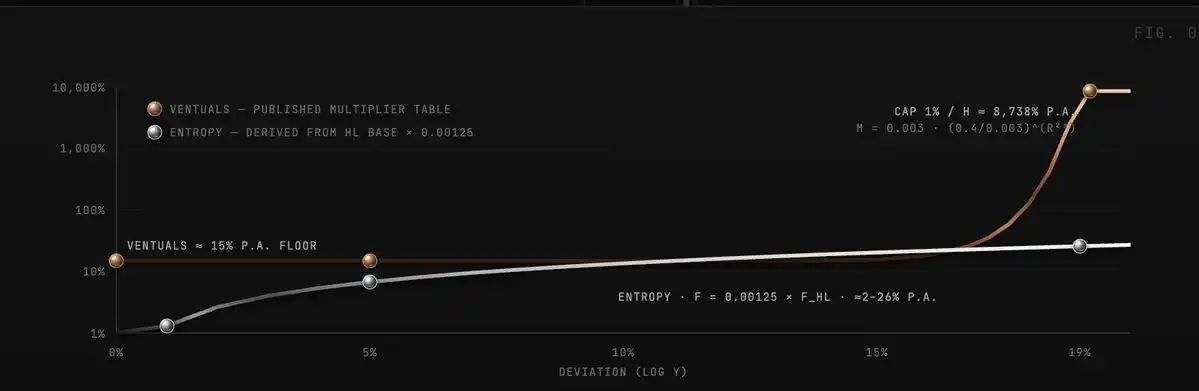
In theory, these methodological and design differences should allow Entropy to help markets price stocks more accurately and effectively. It also allows both long and short traders to feel secure that their positions won't get liquidated due to funding in these less liquid pre-market environments (where traders suffer losses and may become prey for others if forced to close positions due to slippage).

Whether Entropy can win the pre-IPO competition first depends on its ability to build public confidence in its model and markets. This will likely require consistent execution and close collaboration with traders, ensuring they feel comfortable using its markets. Second, it depends on whether it can, on its own or through partners, engage in market pricing/market making, attempting to introduce a model akin to HLP (High-Liquidity Pricing) for pre-IPO trading, a model not yet applied at scale within HIP3.

At that point, perhaps a second truly successful HIP3 market could emerge. We might see it engage in genuine competition with Trade in emerging markets and in driving HIP3 forward.


Trend Kriptolar

İlgili Sorular

QWhat are the main differences between Ventuals and Entropy's approach to pre-IPO markets according to the author?

AThe author highlights several key differences. Ventuals launched its Anthropic market long before the IPO filing, leading to a massive price disconnect from the real secondary market and extremely high, volatile funding rates (up to 8700%). This eroded trust. Entropy, in contrast, launched its Anthropic market shortly after the S-1 filing, much closer to the expected IPO date. Its design focuses on direct, stable liquidity (similar to an HLP model) and maintains funding rates around 10%, aiming for more accurate price discovery and trader confidence.

QHow does the article connect the success of Hyperliquid to the potential of Entropy?

AThe article draws a parallel by emphasizing the importance of micro-innovations in design. Before Hyperliquid, no DEX truly challenged CEXs. Hyperliquid succeeded due to core innovations like the HLP for sustainable liquidity bootstrapping and the scalable Hypercore infrastructure. The author argues that similarly, Entropy's design differences from its predecessor (Ventuals)—particularly in liquidity provision and funding rate mechanisms—could be the critical micro-innovations that determine its success in the pre-IPO market space, just as HLP was for Hyperliquid.

QWhat is the 'pre-market wars' concept mentioned in the article, and why is it relevant for Entropy?

AThe 'pre-market wars' refer to the period before a token's official listing where exchanges like Hyperliquid fiercely compete to launch trading markets first and capture the best liquidity. Winning this war allows an exchange to become the primary venue post-listing, capturing significant volume and fees. The article states Entropy's Anthropic market launch falls within a similar 'pre-IPO war' window. By establishing a strong, liquid market before the IPO, Entropy could position itself as the dominant trading venue for that asset after it goes public, mirroring Hyperliquid's strategy.

QWhat does the article identify as Trade's core competitive advantage in the HIP3 market space?

AAccording to the article, Trade's core competitive advantage is its extensive partnership network with market makers and traders. This collaboration ensures high trading volume and liquidity for its markets. Additionally, Trade adjusted its market mechanisms to better reflect the 'economic gravity' or true price of the underlying assets, making its markets more reliable and attractive compared to competitors like Ventuals.

QWhat two key factors will determine if Entropy can succeed in the pre-IPO competition according to the author's conclusion?

AThe author concludes that Entropy's success hinges on two factors: 1) Building public confidence in its model and markets through consistent execution and close collaboration with traders to ensure they feel secure using its platform. 2) Successfully implementing or partnering to introduce a sustainable, HLP-like liquidity model for pre-IPO pricing within the HIP3 framework, which hasn't been done at scale yet. Achieving this could make it a true competitor to Trade.

İlgili Okumalar

DeFi Wasn't Built for You. It Was Built for AI.

Summary of "DeFi Wasn't Built for You. It Was Built for AI." Most people's experience with DeFi—abandoned wallets, complex apps, and high fees—feels like a failed promise to replace banks. But what if DeFi was never meant for humans? The real user is the coming agent economy: billions of AI agents performing real economic work and transacting at machine speed. The existing financial system cannot handle this scale. DeFi's requirements—24/7 monitoring, instant rebalancing, emotionless execution—are impossible for humans but trivial for software. As Stripe noted, agents will soon handle most internet transactions, needing infrastructure for millions of transactions per second. DeFi, with its permissionless, non-custodial, and always-on smart contracts, is the necessary infrastructure. Its "decentralization" becomes an engineering requirement, not an ideology. Every financial function will be rebuilt on-chain with agents embedded. An agent managing corporate payments will lend idle capital, borrow for opportunities, exchange tokens, and hedge risks—all on-chain. Agents will route transactions to the fastest, cheapest chain, driving fees toward zero. The winning blockchain will settle unprecedented value almost for free. This leads to an economic "singularity," where most transactions are invisible to humans, occurring at speeds that break traditional models. The investment implication is clear: value accrues to the foundational settlement layer. The way to participate is not by outperforming robots but by owning a piece of the infrastructure they require. DeFi's success should be judged not by its utility for people, but by its fit for the machines already operating it.

marsbit12 dk önce

DeFi Wasn't Built for You. It Was Built for AI.

marsbit12 dk önce

Tokenized deposits could raise US credit costs: Dallas Fed economists

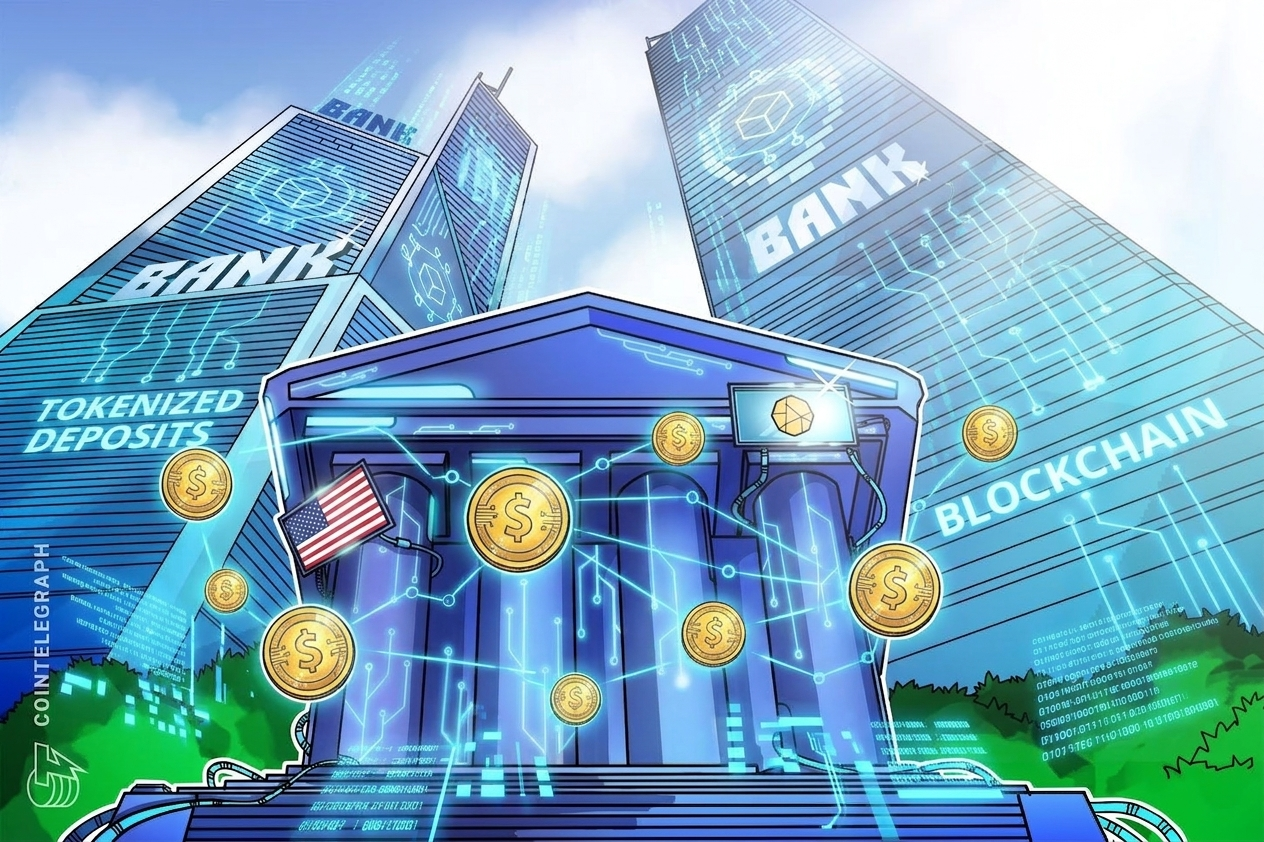
The Dallas Fed economists have released a paper analyzing that tokenized deposits, if widely adopted, may increase credit costs for U.S. households and businesses by making bank funding more volatile and less stable. The core concern is that instant settlement, combined with programmable tokens and AI, could enable depositors to move funds between banks rapidly in search of higher yields, significantly increasing deposits' sensitivity to interest rates. The economists modeled that a 10% increase in this sensitivity could reduce banks' capacity to hold long-term assets by an estimated $700 billion over a 10-year equivalent, while deposits staying 10% less time at banks could reduce it by about $580 billion. These figures represent capacity constraints, not direct lending cuts. The analysis comes as U.S. banks actively develop shared blockchain networks for tokenized deposits, such as the new BankChain Alliance and a network by major banks including JPMorgan. While aimed at keeping funds within the regulated system, the economists warn banks might respond to more volatile funding by holding more liquid assets (like Treasuries) or relying more on wholesale term debt—both of which could raise the cost of credit. They referenced Brazil's Pix system as a comparative case where increased instant payment usage led banks to hold more liquidity and reduce credit intermediation.

cointelegraph17 dk önce

Tokenized deposits could raise US credit costs: Dallas Fed economists

cointelegraph17 dk önce

İşlemler

Spot

Popüler Makaleler

WAR Nasıl Satın Alınır

HTX.com’a hoş geldiniz! WAR (WAR) satın alma işlemlerini basit ve kullanışlı bir hâle getirdik. Adım adım açıkladığımız rehberimizi takip ederek kripto yolculuğunuza başlayın. 1. Adım: HTX Hesabınızı OluşturunHTX'te ücretsiz bir hesap açmak için e-posta adresinizi veya telefon numaranızı kullanın. Sorunsuzca kaydolun ve tüm özelliklerin kilidini açın. Hesabımı Aç2. Adım: Kripto Satın Al Bölümüne Gidin ve Ödeme Yönteminizi SeçinKredi/Banka Kartı: Visa veya Mastercard'ınızı kullanarak anında WAR (WAR) satın alın.Bakiye: Sorunsuz bir şekilde işlem yapmak için HTX hesap bakiyenizdeki fonları kullanın.Üçüncü Taraflar: Kullanımı kolaylaştırmak için Google Pay ve Apple Pay gibi popüler ödeme yöntemlerini ekledik.P2P: HTX'teki diğer kullanıcılarla doğrudan işlem yapın.Borsa Dışı (OTC): Yatırımcılar için kişiye özel hizmetler ve rekabetçi döviz kurları sunuyoruz.3. Adım: WAR (WAR) Varlıklarınızı SaklayınWAR (WAR) satın aldıktan sonra HTX hesabınızda saklayın. Alternatif olarak, blok zinciri transferi yoluyla başka bir yere gönderebilir veya diğer kripto para birimlerini takas etmek için kullanabilirsiniz.4. Adım: WAR (WAR) Varlıklarınızla İşlem YapınHTX'in spot piyasasında WAR (WAR) ile kolayca işlemler yapın.Hesabınıza erişin, işlem çiftinizi seçin, işlemlerinizi gerçekleştirin ve gerçek zamanlı olarak izleyin. Hem yeni başlayanlar hem de deneyimli yatırımcılar için kullanıcı dostu bir deneyim sunuyoruz.

382 Toplam GörüntülenmeYayınlanma 2024.12.11Güncellenme 2026.06.02

WAR Nasıl Satın Alınır

Tartışmalar

HTX Topluluğuna hoş geldiniz. Burada, en son platform gelişmeleri hakkında bilgi sahibi olabilir ve profesyonel piyasa görüşlerine erişebilirsiniz. Kullanıcıların WAR (WAR) fiyatı hakkındaki görüşleri aşağıda sunulmaktadır.

活动图片