Can $12 Really Turn into 8300 Times? The Demise of a Polymarket Trading Myth

比推2026-01-21 tarihinde yayınlandı2026-01-21 tarihinde güncellendi

Özet

A user known as @ascetic0x on Polymarket claimed to have turned $12 into over $100,000—an 8,300x return—through a series of highly leveraged, all-in bets on Bitcoin price movements. The story went viral, attracting millions of views and widespread admiration. However, the narrative was soon challenged. Twitter user Moses alleged that @ascetic0x operated multiple accounts (Sybil farming), funding each with small amounts. Only the single successful account—which reached around $2,900—was publicized, while many others failed. Moses also accused the user of wash trading to artificially inflate results. In response, @ascetic0x denied the allegations, stating that the claims were false and part of a targeted harassment campaign. He admitted his strategy was extremely high-risk and advised others from copying it. The incident highlights the risks of blindly following influencers in speculative markets and serves as a reminder that extraordinary gains often come with untold or unverified backstories.

Written by: Ma He, Foresight News

Original title: What's It Like to Turn $12 into 8300 Times on Polymarket?


The arena for acquiring wealth through trading is no longer confined to exchanges and DEXs. Imagine opening the Polymarket page, sitting in front of your computer, watching the Bitcoin price chart. On the screen, the Polymarket platform interface flashes with an orange Bitcoin icon. You bet your entire fortune—just $12—wagering that Bitcoin will rise within a certain period. The market odds are highly uncertain, but relying on your analysis of on-chain data, news trends, and candlestick patterns, a few hours later, the market settles, and you win. Your account balance doubles to $24.31. But this is just the beginning. You take a deep breath and go all-in on the next bet. You win again, and the balance becomes $40.35. Just like that, going all-in each time, you accumulate victories like a snowball.
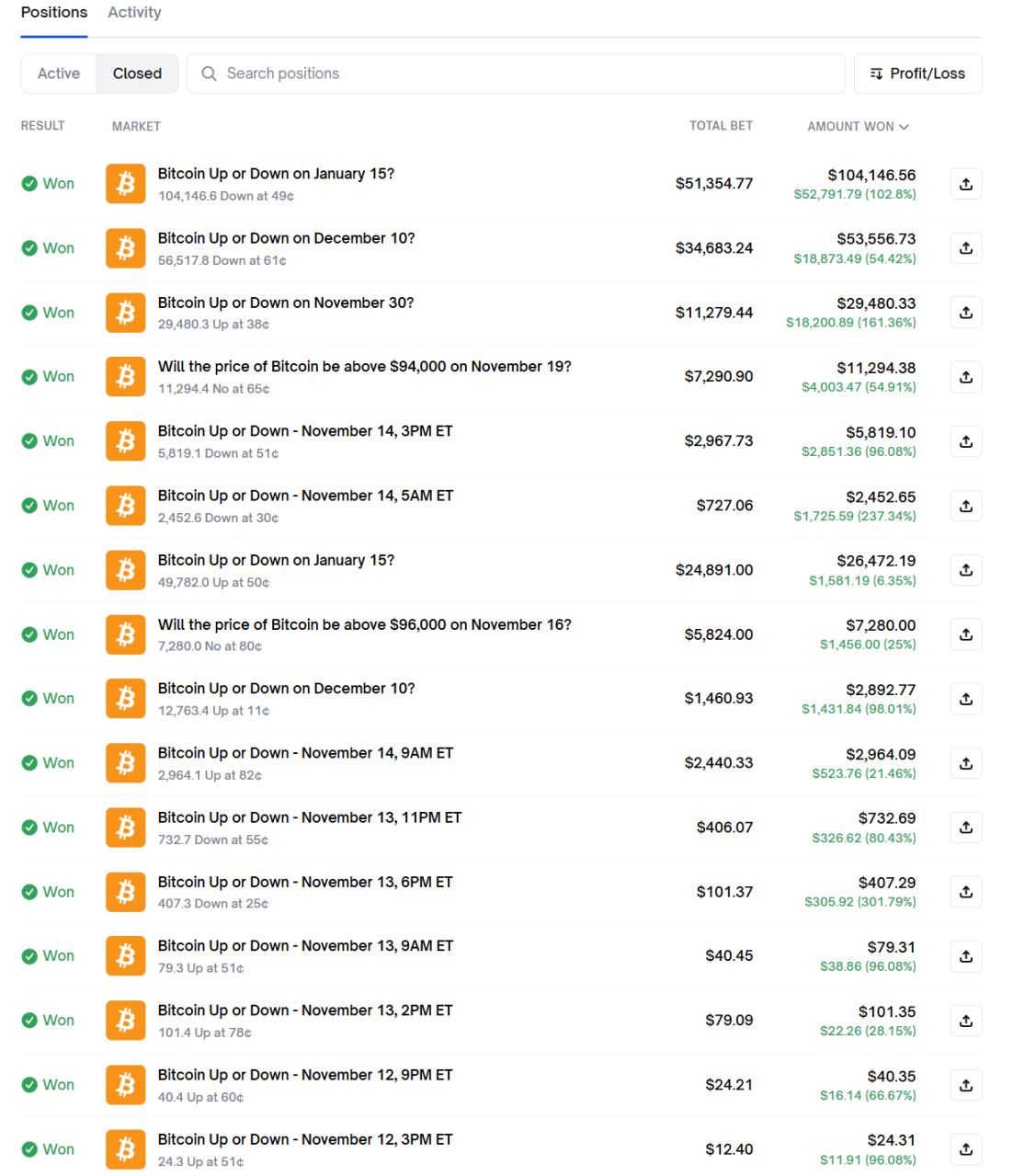
Starting with tens of dollars, then going all-in, winning big again and again, and finally earning over $100,000—this isn't a dream but the masterstroke of the account @ascetic0x.

Ascetic's wealth story quickly went viral, with 4.21 million views, 13,000 likes, and 8,000 bookmarks. In the comments, some exclaimed "legend," while others sighed, "Only Polymarket can let small retail investors turn the tables."

Perhaps, in the heart of every Polymarket player, there has been a dream of making a fortune quickly with a small stake. Ascetic's wealth story was like a shot of adrenaline, giving endless hope to every player hoping to "change their destiny."

But the truth of the story is far from just the surface glamour.

Just one day after his highlight tweet, Twitter user Moses posted to reveal the truth: creating multiple Polymarket accounts and then publicizing the most successful one.
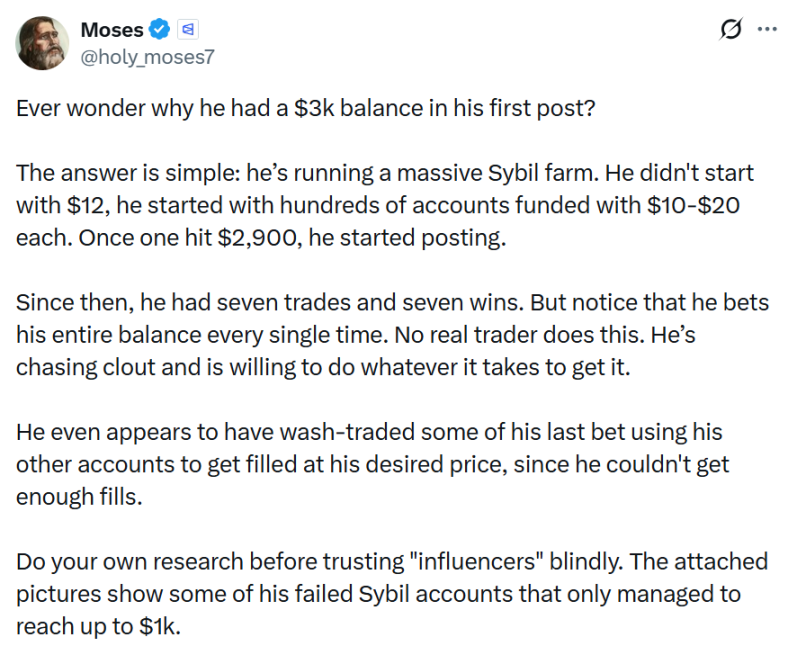
Moses questioned: "Why did his first post already have a $3k balance? The answer is simple: he was operating a large-scale Sybil account. He didn't start with $12; he raised hundreds of accounts simultaneously, each pre-loaded with $10–20. When one account grew to $2,900, he immediately started posting. After that, he made a total of 7 trades, all of which he won. But note: every time, he went all-in with the entire balance. No real trader would play like this.

Moses criticized him for chasing clout and刷存在感 (seeking attention), willing to do anything to become famous. Ascetic even疑似 (suspectedly) used other small accounts to wash trade his last transaction, forcibly taking the order at his desired price because normal orders couldn't get enough volume. Moses advised not to blindly believe these so-called 'influencer big Vs'; do your own homework before deciding what to believe.
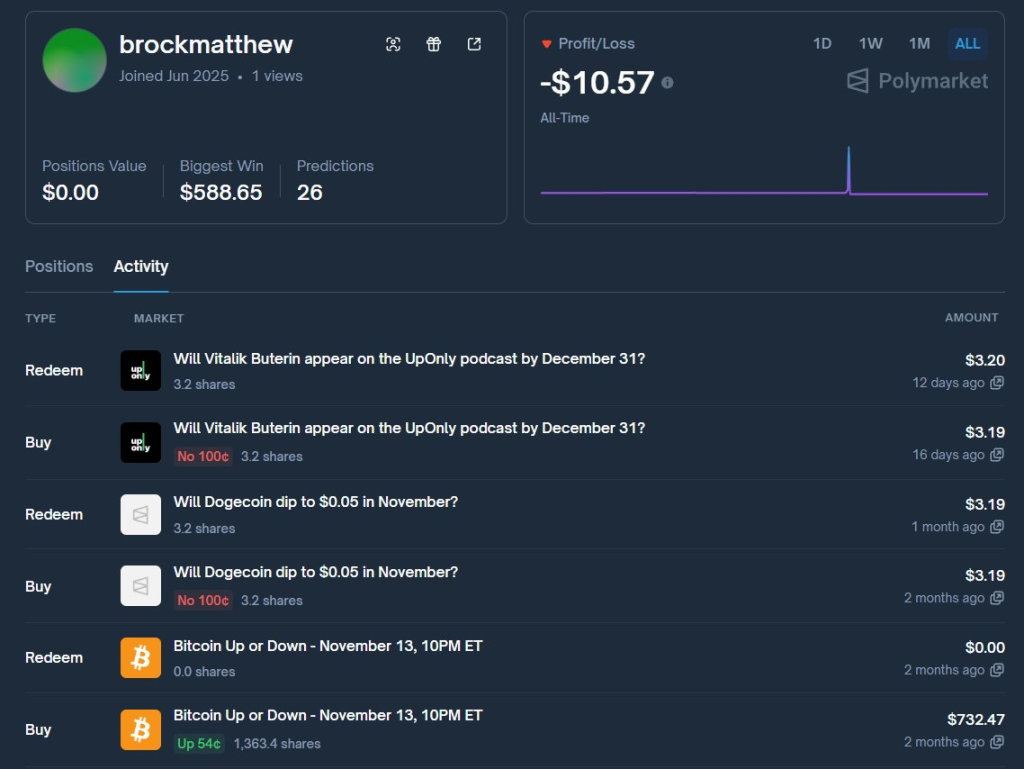
He also posted some of ascetic's failed Sybil small accounts, which at most only reached around $1,000 before collapsing.

These accounts were created 7 months ago, first绑定 (binding) to random markets for 5 months, then simultaneously started going all-in on Bitcoin short-term markets 2 months ago.
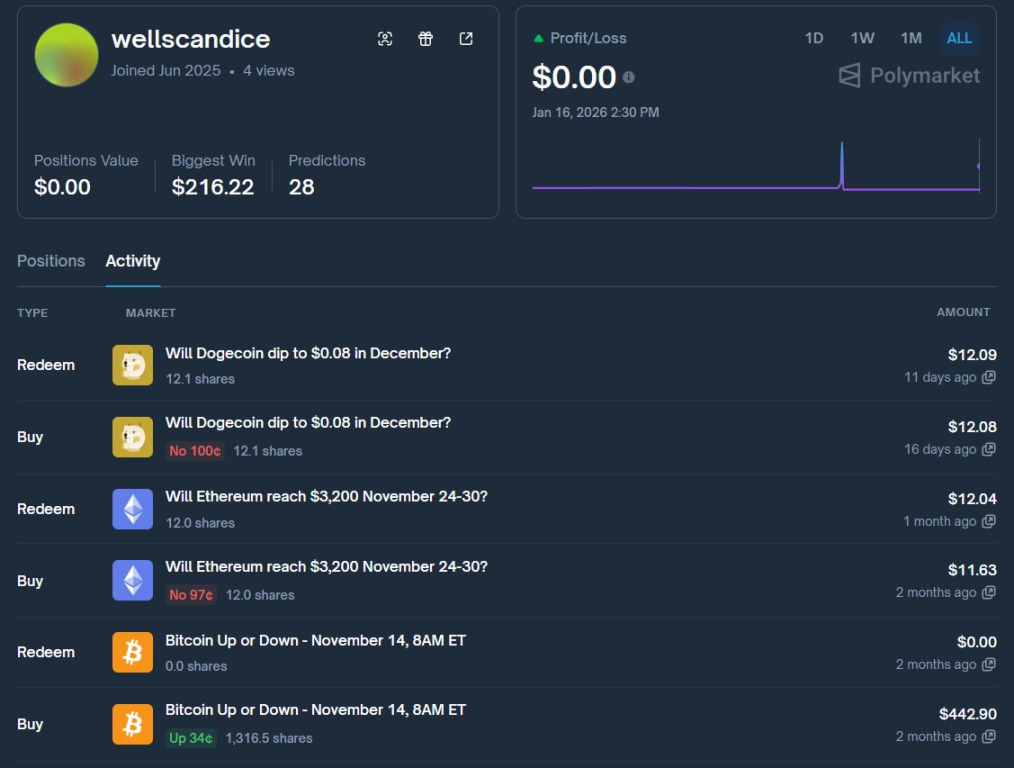
Some accounts quickly lost everything, some reached hundreds or nearly $1k, but only one 'survived' to $2,900 and was made public.
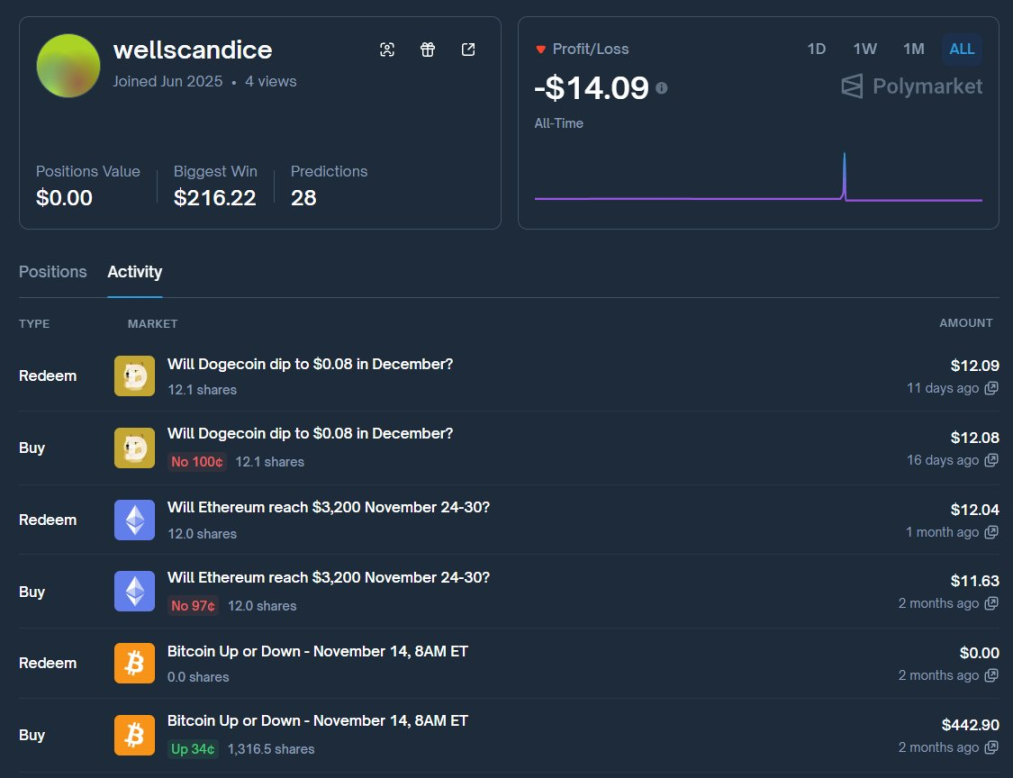
This tactic is very similar to some crypto market analysts who open both long and short positions, trade with multiple accounts, and no matter how the market moves, they can always dig out screenshots of profitable orders, harvesting traffic and attention amidst exclamations of "又麻了" (winning big again).
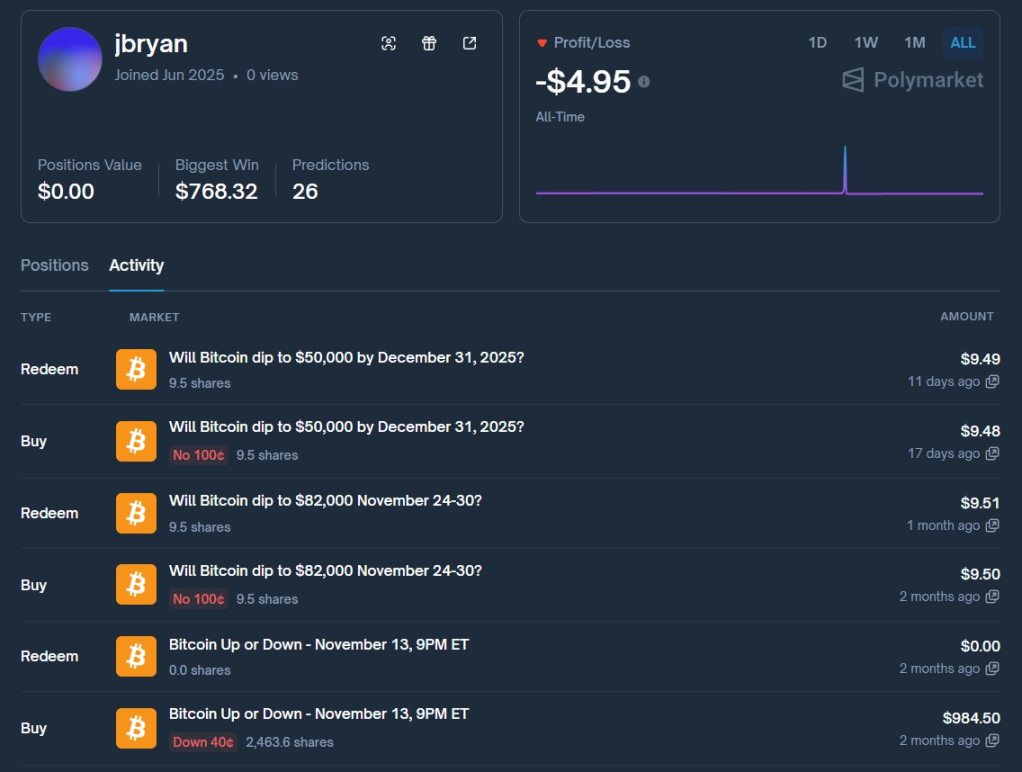
The controversy quickly escalated.

On January 18, facing overwhelming质疑 (skepticism), ascetic tweeted again in response, saying, "In the past 24 hours, I've received more hate and threats than ever before in my life. Some KOLs, to蹭热度 (ride the trend) and刷流量 (boost traffic), deliberately spread false information about me, organizing hate raids under my posts. Some people didn't even bother to check my homepage before喷 (trashing), completely missing that I've been publicly logging my trades on X for the past two months. They accuse me of operating a bunch of small accounts, but they can't produce any accounts or provide any evidence that these accounts ever existed. I have no connection to Sybil farms; this is pure nonsense."

Ascetic also warned users not to copy trades because the strategy is extremely high-risk, and trading like this long-term will almost certainly lead to liquidation. The individual used such an aggressive approach only because they believed they were a good trader, wanting to prove their skills and establish themselves in the Polymarket Trade community.

What is the truth? It might be an unsolvable mystery, but this incident still offers profound lessons for ordinary players.

Don't blindly follow KOLs. Others' success is often hard to replicate, and there are no real big shots in the market acting like Guanyin (the Goddess of Mercy) to make people rich. In the trading market, the wealth you think is within reach is, most of the time, far beyond your grasp.


Twitter:https://twitter.com/BitpushNewsCN

Bitpush TG Discussion Group:https://t.me/BitPushCommunity

Bitpush TG Subscription: https://t.me/bitpush

Original link:https://www.bitpush.news/articles/7604842

İlgili Sorular

QWhat was the initial claim made by the Twitter user @ascetic0x regarding their Polymarket trading?

AThe user @ascetic0x claimed to have turned $12 into over $100,000 by making a series of successful all-in bets on Bitcoin price movements on Polymarket, achieving an 8300x return.

QHow did Moses on Twitter challenge @ascetic0x's trading success story?

AMoses alleged that @ascetic0x was operating a large number of Sybil accounts (hundreds of wallets), each funded with $10-20, and only publicized the one account that succeeded, while the vast majority of the accounts failed.

QWhat specific trading behavior did Moses point to as evidence that the story was not genuine?

AMoses pointed out that a real trader would not consistently go all-in on every single bet, as @ascetic0x claimed to have done. He also suggested wash trading, where the user allegedly used other accounts to fill their own orders to create the illusion of success.

QHow did @ascetic0x respond to the accusations made against them?

A@ascetic0x denied the allegations, stating they had no connection to any Sybil farm and that the claims were false information spread by KOLs for clout. They also warned others not to copy their high-risk strategy.

QWhat is the key lesson for ordinary users from this Polymarket event, as suggested by the article?

AThe key lesson is not to blindly follow Key Opinion Leaders (KOLs) or their trading strategies, as their success is often not replicable, and the market does not have 'gurus' who can reliably make others rich.

İlgili Okumalar

human.tech Launches Clean SDK for Privacy-First Web3 Apps

human.tech has launched the Clean SDK, a toolkit enabling developers to build privacy-first Web3 applications with transparent accountability. Released alongside Aztec's version 5, the SDK provides components for integrating zero-knowledge identity verification, sanctions screening, and private transactions, without developers handling sensitive user data or building compliance infrastructure from scratch. It uses zero-knowledge proofs and programmable verification to allow apps to confirm user legitimacy and sanctions compliance while keeping identities confidential. The first application built on the SDK, Shield, a privacy bridge to Aztec, also launched. It allows users to transfer assets privately while proving a unique human is behind each transfer and that funds have passed sanctions checks, as verified by a May 2026 audit. The SDK offers three core verification techniques: Proof of Innocence (sanctions screening against 23 sources), Proof of Personhood (simpler verification via Human Passport), and Proof of Clean Hands (higher-assurance zero-knowledge government ID checks). This allows apps to authenticate users and transactions without exposing personal data. Designed for Aztec builders, the SDK lets developers add programmable privacy to decentralized apps, eliminating the need to create their own verification and ZK infrastructure. Shield demonstrates its practical use for private bridges, but the SDK aims to enable a wider ecosystem of private, accountable financial apps and services. The launch addresses growing demand for infrastructure that balances privacy and accountability. The SDK avoids traditional identity databases, storing encrypted data off-chain, screening at both entry and exit points, and including a gated disclosure mechanism for legal requests. human.tech's products, including the Clean SDK, focus on using zero-knowledge technology to enable verifiable personhood and privacy in digital systems.

TheNewsCrypto4 dk önce

human.tech Launches Clean SDK for Privacy-First Web3 Apps

TheNewsCrypto4 dk önce

Unlocking $100 Million in Liquidity? Pump.fun's New Policy Tests the 5-Minute Pump Technique

Pump.fun, a popular meme coin launchpad, has introduced a new standard mechanism called BOOST. It aims to address a significant capital efficiency issue: when a newly launched token graduates from its initial bonding curve to a liquidity pool (LP), roughly 20% of its liquidity becomes permanently locked as "dead liquidity," estimated to waste over $100 million annually. Instead of locking these funds permanently, BOOST repurposes them. Upon a token's migration, approximately 20% of the settlement funds (e.g., 17.6 SOL or ~$2516 USDC) are used to buy back the token on the open market over a 5-minute period via a Time-Weighted Average Price (TWAP) mechanism. All purchased tokens are immediately burned. This creates a brief, systematic buy pressure immediately after migration, potentially generating a short-term price surge ("pump") while permanently reducing the token's circulating supply. The goal is to enhance the immediate post-launch trading experience, potentially increasing trader retention and sustainable protocol revenue, which funds ongoing token buybacks. However, concerns exist that this artificial 5-minute boost could lower the barrier for launching low-quality tokens and lead to steeper price crashes once the buy pressure stops, if followed by large sell-offs. The feature automatically applies to tokens migrating after July 21, 2024, but not to previously migrated tokens or those launched via the Mayhem AI Agent lab.

marsbit12 dk önce

Unlocking $100 Million in Liquidity? Pump.fun's New Policy Tests the 5-Minute Pump Technique

marsbit12 dk önce

Podcast Notes | Conversation with GSR Asset Management Head: To Determine if This Crypto Rally is Real, Just Watch the Lending Rates on Aave

Podcast Summary: Dialogue with GSR's Head of Asset Management: To Determine if This Crypto Rally is Real, Just Check Lending Rates on Aave Andy Baehr, Managing Director of Asset Management at GSR, discusses the current crypto market, characterizing it as stuck in a state of "ambivalence" with short-lived, unsustainable rallies. He outlines a simple framework: the market moves between "ambivalence" and "conviction" (sustained upward momentum). Currently, every rally resembles a single-stage rocket booster that quickly fizzles out. Baehr identifies three key signals to watch: 1) DeFi lending rates, 2) the potential passage of the CLARITY Act, and 3) the market forming a consensus on the "Fed hawkish peak." He emphasizes that the most immediate indicator for the sustainability of the recent CPI-triggered rally is the USDC borrowing rate on Aave, currently around 3.75%—close to U.S. Treasury yields. The absence of a credit spread indicates low leverage demand and a lack of market energy. He explains that a healthy, sustained rally requires layered buying pressure. Last year's rally progressed from an ETH short squeeze to crypto-native trader influx and finally to ETF inflows. Currently, this structure is missing. Other potential structural buyers like Digital Asset Treasury (DAT) companies are absent, and ETF flows have proven transient. Baehr notes that while small-cap crypto tokens outperformed large caps in Q2—a potential sign of capitation in major assets—capital is also flowing to more exciting opportunities like AI stocks and tech IPOs, leaving crypto sidelined. Regarding DeFi, he highlights that platforms like Aave provide a clear, real-time signal of leverage demand through their supply/demand-driven interest rates. A significant, sustained rate increase would signal genuine market conviction. He also observes the quiet emergence of fixed-income-like products and vaults in DeFi. On regulation, the probability of the CLARITY Act passing before the August 7th deadline has dropped linearly from 75% to below 40% on Polymarket. Baehr suggests its passage would be treated as a bullish surprise, a potent driver for price movement. However, political hurdles, including ethical clause debates and disclosures about the First Family's crypto profits, remain significant obstacles. Ultimately, the market awaits clarity on the Fed's terminal rate under Chair Warsh. Until the "Fed Solstice"—the point where the market collectively understands the peak of hawkish policy—sustained conviction will be difficult to achieve.

marsbit43 dk önce

Podcast Notes | Conversation with GSR Asset Management Head: To Determine if This Crypto Rally is Real, Just Watch the Lending Rates on Aave

marsbit43 dk önce

İşlemler

Spot
活动图片





