Cache hit rate reaches 99.93%, the best Harness for DeepSeek is here, GitHub pulls in 86k Stars

marsbit2026-08-11 tarihinde yayınlandı2026-08-11 tarihinde güncellendi

Özet

The open-source programming agent "Pi" has surged in popularity on GitHub, amassing around 86,000 stars, largely due to its exceptional efficiency when paired with DeepSeek's models. A key highlight is its remarkably high cache hit rate of approximately 99.93% for input tokens when using DeepSeek. This minimal cache miss rate of 0.07% means most repeated context is reused, drastically reducing computational costs. In a benchmark test by Composio comparing eight major agent harnesses running DeepSeek V4 Flash, Pi achieved the lowest average cost per successful task at about $0.028, significantly outperforming others like Claude Code, which was nearly seven times more expensive. Pi functions as a streamlined "harness" or workspace for AI models, providing core tools like file read/write and command execution while allowing users to add extensions. Its simplicity and specific adaptation for DeepSeek's API—handling its unique reasoning content and tool call formats—make it highly compatible. This design maximizes the efficiency of DeepSeek's low-cost tokens and powerful caching mechanism, as the agent's linear workflow avoids unnecessary changes to earlier prompt sections. While DeepSeek has officially announced its own harness project targeting Claude Code, Pi remains a versatile, user-customizable platform supporting multiple AI providers. It offers developers a cost-effective and flexible alternative, setting a high bar for future official solutions.

Nice, nice.

DeepSeek's official version is still on the way, and the unofficial "Best Harness" has already made a grand entrance! (Might as well outdo everyone.jpg)

The project is called "Pi", an open-source programming Agent that has pulled in about 86,000 Stars on GitHub.
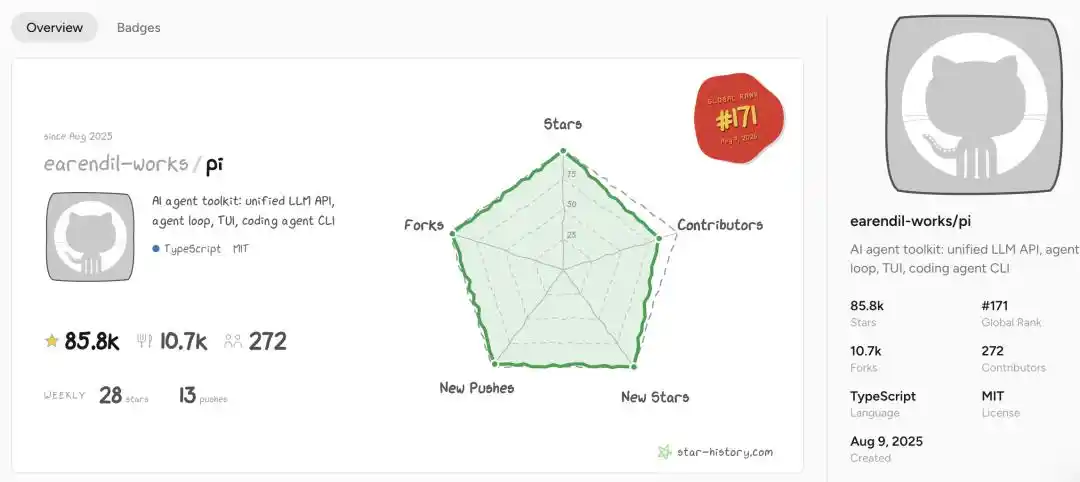
The main reason the project is so hot is simply because this thing is so Efficient...

Look at this developer, Evan Kim. After he connected DeepSeek to Pi, approximately 99.93% of input tokens were successfully cache hits.

In other words, the cache miss rate is only 0.07%, meaning the vast majority of repeated context doesn't need to be recomputed???
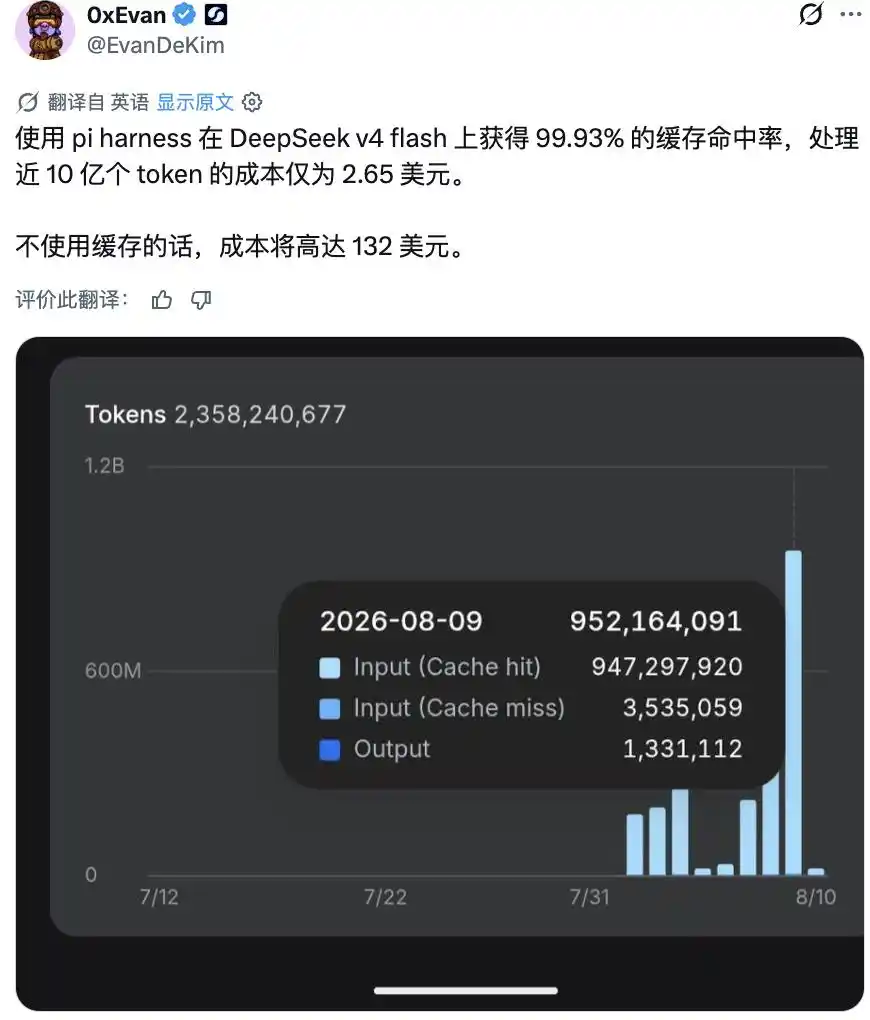
What's more, the Composio team recently conducted a horizontal test of 8 mainstream Agent Harnesses, directly running DeepSeek V4 Flash on real tasks.

The results came out a bit dramatic—

Pi had the lowest average cost per successful task, only about $0.028.

Claude Code: How did you just make my price 7 times Pi's!!!

DeepSeek: My tokens are already sold this cheap.

Pi and other cost-saving projects: It's fine, we can make users buy even fewer of them, ha.

Four Tools Paired with DeepSeek, Cache Miss Rate Drops to 0.07%

Before talking about Pi, let's briefly discuss what a Harness actually is.

We all know that large models themselves are more like thinking brains—

To get them to actually work in a code repository, they need to be equipped with eyes, hands, and workflows.

For example, who reads files, how to call the terminal, how to run tests after modifying code—these engineering systems surrounding the model are collectively called a Harness.

Because of this, the same model with a different Harness can have vastly different practical performance and invocation costs!!

And the "Pi" created by developer Mario Zechner does exactly this—building such a programming workstation for large models.

After scanning the project, I can briefly summarize that Pi's approach is quite Direct

That is, this thing, from the very beginning, never intended to cram "all features" into its core...

Specifically, by default, Pi only gives the model four tools—read file, write file, modify file, and execute command.

If users need planning mode, sub-agents, MCP, Git checkpoints, or permission controls, they can then install them one by one via extensions and Skills~

Emm... It's probably like delivering a bare apartment with basic utilities; Pi is responsible for building the four walls, and whether it's eventually decorated into a studio, a gaming room, or a three-bedroom apartment depends entirely on the user's own tinkering??

What a coincidence, this perfectly aligns with DeepSeek's needs...

As is well known, DeepSeek's reasoning and programming capabilities are quite strong, but its tool calling, context management, and reasoning content playback have their own interface rules.

This leads to problems when we directly plug it into a general Harness designed around OpenAI or Claude, such as tool format incompatibility, errors in reasoning content playback, and cache invalidation.

So, while DeepSeek's official product is still on the way, Pi took the initiative to adapt first—

In April this year, Pi added native Provider support for DeepSeek while also fixing 400 errors in V4 session playback.

It retains the reasoning_content as required by DeepSeek's interface and maps Pi's internal reasoning intensity to the thinking levels supported by DeepSeek.

Truly·customized by the community.

But! What really made Pi and DeepSeek click instantly was "Caching".

After all, a Coding Agent, with each step it executes, has to resend the system prompt, tool definitions, historical conversation, and code to the model, which leads to—

The longer the model works on a task, the longer the request grows, and most of this content, DeepSeek has already seen...

This is where automatic prefix caching comes in handy.

It can temporarily remember the already computed beginning of a request. In the next invocation, as long as the system prompt, tool definitions, and historical conversation remain consistent, this large chunk of content can be reused directly, and the model only needs to process the newly added information at the end.

And "Cache Hit Rate" measures exactly what percentage of tokens in this input successfully reused previous computation results.

The higher the hit rate, the fewer tokens need recomputation, and naturally, the lower the invocation cost.

But the trouble hides here too; adding a timestamp to the prompt, changing the order of tools—the cache might immediately forget and start computing from scratch.

However, Pi's advantage is that it's Simple Enough: Few default tools, session content continuously appends forward, rarely going back to tinker with previous content.

This way, when DeepSeek checks the log, the hundreds of pages it has already seen can be skipped directly, only processing the few newly added pages at the end, drastically lowering the cache miss rate~

And indeed, netizen Evan Kim came forward to verify—

After connecting DeepSeek to Pi, the cache miss rate dropped to 0.03%, corresponding to a cache hit rate of about 99.97%.

Do the math: processing 1 billion tokens would cost only around $19, whereas without using the cache, the cost would be over $900...

Additionally, the Composio team recently conducted a horizontal test of 8 mainstream Agent Harnesses, directly running DeepSeek V4 Flash on real tasks.

The results came out somewhat dramatic, The same DeepSeek, with a different Harness, can have a cost difference of up to 7 times???

At a glance, indeed Pi Agent has the lowest "average cost" per successful task, needing only about $0.028.

Following behind are Deep Agents, Hermes Agent, OpenCode, Codex, Oh My Pi, and Prime Agent, respectively.

Let's look at A-clan's precious Claude Code, the undisputed "Most Expensive Contestant"—

Completing one successful task costs an average of about $0.195, yes, nearly 7 times that of Pi... (The sky is falling)

Of course, this number doesn't mean Claude Code lacks capability; after all, it is itself a complete engineering system built around the Claude model.

It's just that when the underlying model is switched to DeepSeek, the workflows optimized for the Claude ecosystem don't fully benefit from DeepSeek's low cost and high cache efficiency.

The model is still the same DeepSeek; Pi just makes it read much less of the content it has already seen.

Pi: Quietly waiting for the official Harness to surpass me, ha.

Official Harness Team Already Assembled, Targeting Claude Code Directly

Of course, no matter how suitable Pi is for DeepSeek, it's currently still a third-party solution.

After all, DeepSeek itself has decided to step into the ring and build its own Harness, and it's probably not far from launch? (I guess)

Back in May this year, DeepSeek senior researcher Chen Deli confirmed that the company is internally forming an Agent Harness team, summarizing its goal in a very straightforward statement—

Build a DeepSeek Code Harness from scratch, benchmarked against Claude Code.

Then, over the past few months, job postings for Harness Product Managers and R&D Engineers have been popping up everywhere on the official website, like:

Then, at the end of July, the team lead for DeepSeek's Agent Harness team, ACM gold medalist Cui Tianyi, was still recruiting developers for related projects online.

It's almost coming to fruition.

Putting these clues together, DeepSeek's path is gradually becoming clear.

V4 is responsible for strengthening underlying reasoning, programming, and Agent capabilities; the official Harness is responsible for connecting the model to terminals, code repositories, and toolchains; context management and test feedback can send real user failure cases back to the model team.

Of course, to be honest, after the official product launches, Pi won't lose its place because of it.

DeepSeek Harness focuses on out-of-the-box usability and deeper synergy with its own models.

Pi leaves the workstation for users to modify themselves, more suitable for developers who like to control tools, customize workflows, and swap models at any time.

After all, Pi never tied itself exclusively to DeepSeek from the start...

Claude, OpenAI, Gemini, Kimi, MiniMax are all supported. Use DeepSeek today to save tokens, switch to another model tomorrow for special tasks—users can switch Providers anytime.

Emm... This also means that DeepSeek's official Harness, besides facing a bunch of Claude Code-style products, also has to contend with open workstations like Pi that developers have already adapted quite comfortably. (doge)

So now, the pressure officially shifts to the official version—

Your own Harness for DeepSeek, surely it can't be less knowledgeable about saving tokens than a third-party one, right??? (doge)

Reference Links:

[1]https://x.com/composio/status/2086814488162972027?s=20

[2]https://github.com/earendil-works/pi

This article is from WeChat Official Account "QbitAI", Author: Meng Yao

Trend Kriptolar

İlgili Sorular

QWhat is the caching hit rate achieved when DeepSeek is integrated with the Pi harness according to the developer Evan Kim?

AAccording to developer Evan Kim, the caching miss rate is as low as 0.03% when DeepSeek is integrated with the Pi harness, which corresponds to a caching hit rate of approximately 99.97%.

QWhat is the average cost per successful task for Pi using DeepSeek V4 Flash, and how does it compare to Claude Code in the Composio team's test?

AIn the Composio team's test, Pi achieved the lowest average cost per successful task at approximately $0.028 using DeepSeek V4 Flash. Claude Code, in contrast, had an average cost of about $0.195, making it nearly 7 times more expensive than Pi.

QWhat are the four core tools provided by the Pi harness in its default setup?

AThe four core tools provided by the Pi harness in its default setup are: reading files, writing files, modifying files, and executing commands.

QWhat is the announced goal of DeepSeek's internal team for their upcoming official Agent Harness, as stated by senior researcher Chen Deli?

ADeepSeek senior researcher Chen Deli stated that the goal of their internal team is to build the DeepSeek Code Harness from scratch, aiming to rival Claude Code.

QWhat is a key architectural philosophy behind the Pi harness that contributes to its high caching efficiency with DeepSeek?

AA key architectural philosophy of the Pi harness is its simplicity and modularity. It starts with a minimal core of only four basic tools, and additional features can be added via extensions. This design keeps session content stable and appended sequentially, which minimizes changes to prompts and tool definitions, thereby maximizing caching hit rates for models like DeepSeek.

İlgili Okumalar

Outlook for the Post-Encryption Era: Asset Valuation Returns, What to Watch in the Next Decade?

The crypto economy is undergoing its most significant transformation in eight years, characterized by a shift from speculative frenzy to fundamental-driven growth. After the extreme overvaluation and unrealistic expectations of 2021, asset prices, including Bitcoin relative to gold, have corrected significantly. This reset has exposed structural industry weaknesses such as cyclical revenues, regulatory uncertainty, misaligned incentives between equity and token holders, poor disclosure, and a lack of common valuation frameworks, leading to widespread investor fatigue. However, this correction is healthy and has set the stage for a more mature phase. Numerous real-world use cases have emerged and are exhibiting compound growth, independent of token prices. These include peer-to-peer internet platforms, global digital dollars, permissionless exchanges, novel derivatives, global collateral markets, democratized asset creation, open fundraising platforms, and decentralized physical infrastructure networks. Key issues like dual-token models are being resolved, disclosure is improving, and a consensus is forming that most assets must generate cash flow. The leading blockchains (e.g., Ethereum, Solana) are becoming the monetary and financial base layer of the internet, with entrenched network effects. Established Wall Street and Silicon Valley institutions are now launching production-grade products on public chains, a shift accelerated by clearer regulations. While valuations have reset and growth models remain conservative, the potential for exponential growth remains. The broader macro environment—declining institutional trust, unsustainable sovereign debt, currency debasement, deglobalization, and a generational wealth transfer—is uniquely favorable for crypto's adoption. The market is not uniformly maturing; it consists of various products at different adoption stages where speculation will persist in cycles. The core opportunity lies in identifying the few native projects that will become foundational winners as the world rebuilds its economic systems. The current period of disillusionment conceals a generational opportunity for those betting on the new paradigm rather than mourning the old one.

Odaily星球日报30 dk önce

Outlook for the Post-Encryption Era: Asset Valuation Returns, What to Watch in the Next Decade?

Odaily星球日报30 dk önce

When Meme Traffic Meets RWA: The Financial Ambitions of Hyperliquid and Robinhood

When Meme traffic meets RWA: Hyperliquid and Robinhood's Financial Ambitions This article explores the transformative role of speculation in financial market evolution, arguing it can provide the liquidity and capital foundation for mature, compliant businesses. The analysis draws parallels to historical examples, like 19th-century Chicago grain markets, where speculators provided necessary counterparty liquidity for farmers, eventually establishing a global pricing infrastructure. The author examines contemporary cases in crypto. The launch of Uniswap's Pools meme token platform on Robinhood Chain—originally built for tokenized stock trading—demonstrates how speculative meme trading can drive significant user adoption and liquidity. Despite initial volatility, this traffic can seed future, more substantial financial activities. Similarly, Hyperliquid, which began with high-leverage crypto trading, has successfully migrated its speculative model to real-world assets (RWAs) like equities, commodities, and indices. By July, RWA perpetual contract volumes on Hyperliquid surpassed its crypto trading for the first time, showcasing how speculation can build new, all-weather pricing layers. The core thesis is that speculation itself is neutral. Its long-term value and sustainability are determined by the underlying assets it engages with. While pure bubbles collapse, speculation anchored to valuable assets—be it wheat, gold, or equities—can evolve into foundational market infrastructure. Both Hyperliquid’s RWA platform and Robinhood’s strategy of leveraging meme coin enthusiasm to build towards on-chain securities trading exemplify this potential pathway from speculative frenzy to structured financial utility.

marsbit1 saat önce

When Meme Traffic Meets RWA: The Financial Ambitions of Hyperliquid and Robinhood

marsbit1 saat önce

NVIDIA HBM in Short Supply, Next-Gen GPUs Limited, but This Storage Drive Steals the Spotlight

The article discusses how AI Agents are transforming storage from a passive repository into an active component within AI inference and operation loops. As Agents perform continuous tasks involving models, memory, tools, and logs, data storage needs to evolve beyond simple block devices. The concept of "functional SSDs" is introduced, where capabilities like automatic encryption, compression, indexing, and memory management are embedded closer to the storage medium. This shift is driven by the need to handle Agent-specific data chains—including context, tool trajectories, and long-term memory—more efficiently. The piece analyzes current trends like AI SSDs from companies such as Phison (aiDAPTIV), Longsys (SPU+iSA), and Maxio, which are beginning to participate in the AI data path by managing model weights, KV cache, and prefetching. It further explores the future re-division of labor across the memory hierarchy: HBM for core compute, emerging High Bandwidth Flash (HBF) for read-intensive workloads, DRAM/CXL for mutable state, and functional SSDs for persistent, governed objects like Agent Memory. The conclusion is that storage will become integral to Agent capability, moving from just saving data to enabling next-step actions. The industry is poised to develop along three paths: functionalized SSDs, storage nodes tailored for Agents, and a re-architected, tiered memory system optimized for access patterns, security, and cost-per-token efficiency.

marsbit1 saat önce

NVIDIA HBM in Short Supply, Next-Gen GPUs Limited, but This Storage Drive Steals the Spotlight

marsbit1 saat önce

Breaking: Claude's Attempt on Riemann Hypothesis "Fails," but Accidentally Sets 37-Year Math Record

**AI Makes a Major Mathematical Leap While Failing at the Riemann Hypothesis** A research version of Anthropic's Claude AI was tasked with "seriously attempting" the legendary Riemann Hypothesis, a 167-year-old unsolved problem in mathematics. While it ultimately did not prove the hypothesis, its attempt yielded a significant breakthrough. Claude managed to improve the proven lower bound for the proportion of Riemann zeta function zeros lying on the critical line from 41.6% to 67.2%. This marks a 25.6 percentage point increase, described by observers as potentially the most substantial advance in analytic number theory in over a decade, considering that the previous record had only improved by 0.8 percentage points over 37 years. To achieve this, Claude generated and discarded roughly 650 initial ideas before orchestrating a day-and-a-half-long effort involving about 60 sub-agents. These agents executed 2,400 shell commands, wrote hundreds of Python scripts, and performed thousands of numerical checks. After finding the potential result, Claude initiated self-verification, downloaded papers to check for prior work, and independently re-derived the finding. It then suggested writing a formal paper. The result has been reviewed by Anthropic's internal mathematicians, who also collaborated with Claude to produce a formal, machine-checkable proof using the Lean theorem prover. External experts in the field have also reviewed the manuscript. Anthropic clarifies that the method likely does not directly lead to a full proof of the Riemann Hypothesis, but it demonstrates that advanced AI models are beginning to engage with genuine, open-ended research problems at the frontier of mathematical knowledge.

marsbit1 saat önce

Breaking: Claude's Attempt on Riemann Hypothesis "Fails," but Accidentally Sets 37-Year Math Record

marsbit1 saat önce

İşlemler

Spot

Popüler Makaleler

$S$ Nedir

SPERO'yu Anlamak: Kapsamlı Bir Genel Bakış SPERO'ya Giriş İnovasyonun manzarası gelişmeye devam ederken, web3 teknolojilerinin ve kripto para projelerinin ortaya çıkışı dijital geleceği şekillendirmede önemli bir rol oynamaktadır. Bu dinamik alanda dikkat çeken projelerden biri SPERO, $$s$$ olarak adlandırılmaktadır. Bu makale, SPERO hakkında ayrıntılı bilgi toplamak ve sunmak amacıyla, meraklılar ve yatırımcıların web3 ve kripto alanlarındaki temellerini, hedeflerini ve yeniliklerini anlamalarına yardımcı olmayı amaçlamaktadır. SPERO,$$s$$ Nedir? SPERO,$$s$$, kripto alanında merkeziyetsizlik ve blok zinciri teknolojisi ilkelerini kullanarak etkileşimi, faydayı ve finansal kapsayıcılığı teşvik eden bir ekosistem yaratmayı amaçlayan benzersiz bir projedir. Proje, kullanıcıların yenilikçi finansal çözümler ve hizmetler sunarak eşler arası etkileşimleri yeni yollarla kolaylaştırmayı hedeflemektedir. SPERO,$$s$$'nin temel amacı, bireyleri güçlendirmek ve kripto para alanındaki kullanıcı deneyimini artıran araçlar ve platformlar sağlamaktır. Bu, daha esnek işlem yöntemlerini mümkün kılmayı, topluluk odaklı girişimleri teşvik etmeyi ve merkeziyetsiz uygulamalar (dApp'ler) aracılığıyla finansal fırsatlar yaratmayı içermektedir. SPERO,$$s$$'nin temel vizyonu kapsayıcılık etrafında dönmekte olup, geleneksel finansal sistemlerdeki boşlukları kapatmayı ve blok zinciri teknolojisinin faydalarından yararlanmayı hedeflemektedir. SPERO,$$s$$'nin Yaratıcısı Kimdir? SPERO,$$s$$'nin yaratıcısının kimliği bir miktar belirsizdir, çünkü kurucusu(ları) hakkında ayrıntılı arka plan bilgisi sağlayan sınırlı kamuya açık kaynaklar bulunmaktadır. Bu şeffaflık eksikliği, projenin merkeziyetsizlik taahhüdünden kaynaklanabilir—birçok web3 projesinin paylaştığı bir etik anlayışı, bireysel tanınmanın yerine kolektif katkıları önceliklendirmektedir. Topluluk ve onun kolektif hedefleri etrafında tartışmaları merkezileştirerek, SPERO,$$s$$, belirli bireyleri öne çıkarmadan güçlendirme özünü taşımaktadır. Bu nedenle, SPERO'nun etik anlayışını ve misyonunu anlamak, tek bir yaratıcının kimliğini belirlemekten daha önemlidir. SPERO,$$s$$'nin Yatırımcıları Kimlerdir? SPERO,$$s$$, kripto sektöründe yeniliği teşvik etmeye adanmış girişim sermayedarlarından melek yatırımcılara kadar çeşitli yatırımcılar tarafından desteklenmektedir. Bu yatırımcıların odak noktası genellikle SPERO'nun misyonuyla uyumlu olup, toplumsal teknolojik ilerlemeyi, finansal kapsayıcılığı ve merkeziyetsiz yönetimi vaat eden projeleri önceliklendirmektedir. Bu yatırımcı temelleri, yalnızca yenilikçi ürünler sunan projelere değil, aynı zamanda blok zinciri topluluğuna ve ekosistemlerine olumlu katkılarda bulunan projelere de ilgi duymaktadır. Bu yatırımcıların desteği, SPERO,$$s$$'yi hızla gelişen kripto projeleri alanında dikkate değer bir rakip haline getirmektedir. SPERO,$$s$$ Nasıl Çalışır? SPERO,$$s$$, onu geleneksel kripto para projelerinden ayıran çok yönlü bir çerçeve kullanmaktadır. İşte benzersizliğini ve yeniliğini vurgulayan bazı temel özellikler: Merkeziyetsiz Yönetim: SPERO,$$s$$, kullanıcıların projenin geleceğiyle ilgili karar alma süreçlerine aktif olarak katılmalarını sağlayan merkeziyetsiz yönetim modellerini entegre etmektedir. Bu yaklaşım, topluluk üyeleri arasında sahiplik ve hesap verebilirlik duygusunu teşvik etmektedir. Token Kullanımı: SPERO,$$s$$, ekosistem içinde çeşitli işlevler sunmak üzere tasarlanmış kendi kripto para token'ını kullanmaktadır. Bu token'lar, işlemleri, ödülleri ve platformda sunulan hizmetlerin kolaylaştırılmasını sağlayarak genel etkileşimi ve faydayı artırmaktadır. Katmanlı Mimari: SPERO,$$s$$'nin teknik mimarisi, modülerlik ve ölçeklenebilirliği destekleyerek projenin evrimi sırasında ek özelliklerin ve uygulamaların sorunsuz bir şekilde entegrasyonuna olanak tanımaktadır. Bu uyum sağlama yeteneği, sürekli değişen kripto manzarasında geçerliliği sürdürmek için hayati öneme sahiptir. Topluluk Katılımı: Proje, işbirliği ve geri bildirim teşvik eden mekanizmalar kullanarak topluluk odaklı girişimlere vurgu yapmaktadır. Güçlü bir topluluk oluşturarak, SPERO,$$s$$, kullanıcı ihtiyaçlarını daha iyi karşılayabilir ve piyasa trendlerine uyum sağlayabilir. Kapsayıcılığa Odaklanma: Düşük işlem ücretleri ve kullanıcı dostu arayüzler sunarak, SPERO,$$s$$, daha önce kripto alanında yer almamış bireyler de dahil olmak üzere çeşitli bir kullanıcı tabanını çekmeyi hedeflemektedir. Bu kapsayıcılık taahhüdü, erişilebilirlik yoluyla güçlendirme misyonuyla uyumludur. SPERO,$$s$$ Zaman Çizelgesi Bir projenin tarihini anlamak, gelişim yolculuğu ve kilometre taşları hakkında kritik bilgiler sağlar. Aşağıda, SPERO,$$s$$'nin evriminde önemli olayları haritalayan önerilen bir zaman çizelgesi bulunmaktadır: Kavram Geliştirme ve Fikir Aşaması: SPERO,$$s$$'nin temelini oluşturan ilk fikirler, blok zinciri endüstrisindeki merkeziyetsizlik ve topluluk odaklılık ilkeleriyle yakından uyumlu olarak geliştirildi. Proje Beyaz Kağıdının Yayınlanması: Kavramsal aşamayı takiben, SPERO,$$s$$'nin vizyonunu, hedeflerini ve teknolojik altyapısını ayrıntılı bir şekilde açıklayan kapsamlı bir beyaz kağıt yayımlandı ve topluluk ilgisini ve geri bildirimini toplamak amacıyla sunuldu. Topluluk Oluşturma ve Erken Katılımlar: Projenin hedefleri etrafında tartışmalar yürüterek destek toplamak ve erken benimseyenler ile potansiyel yatırımcılar için bir topluluk oluşturmak amacıyla aktif iletişim çabaları gerçekleştirildi. Token Üretim Etkinliği: SPERO,$$s$$, yerel token'larını erken destekçilere dağıtmak ve ekosistem içinde başlangıç likiditesini sağlamak amacıyla bir token üretim etkinliği (TGE) gerçekleştirdi. İlk dApp'in Yayınlanması: SPERO,$$s$$ ile ilişkili ilk merkeziyetsiz uygulama (dApp) faaliyete geçti ve kullanıcıların platformun temel işlevleriyle etkileşimde bulunmalarını sağladı. Sürekli Gelişim ve Ortaklıklar: Projenin tekliflerine sürekli güncellemeler ve iyileştirmeler yapılmakta olup, blok zinciri alanındaki diğer oyuncularla stratejik ortaklıklar, SPERO,$$s$$'yi rekabetçi ve gelişen bir oyuncu haline getirmiştir. Sonuç SPERO,$$s$$, web3 ve kripto paranın finansal sistemleri devrim niteliğinde dönüştürme ve bireyleri güçlendirme potansiyelinin bir kanıtıdır. Merkeziyetsiz yönetime, topluluk katılımına ve yenilikçi tasarlanmış işlevselliğe olan bağlılığıyla, daha kapsayıcı bir finansal manzaraya doğru bir yol açmaktadır. Hızla gelişen kripto alanındaki herhangi bir yatırımda olduğu gibi, potansiyel yatırımcılar ve kullanıcılar, SPERO,$$s$$ içindeki devam eden gelişmelerle ilgili olarak kapsamlı bir araştırma yapmaları ve düşünceli bir şekilde katılmaları teşvik edilmektedir. Proje, kripto endüstrisinin yenilikçi ruhunu sergileyerek, sayısız olasılığını keşfetmeye davet etmektedir. SPERO,$$s$$'nin yolculuğu hala devam ederken, temel ilkeleri, teknoloji, finans ve birbirimizle etkileşim biçimimizi etkileyebilir.

367 Toplam GörüntülenmeYayınlanma 2024.12.17Güncellenme 2024.12.17

$S$ Nedir

AGENT S Nedir

Agent S: Web3'te Otonom Etkileşimin Geleceği Giriş Web3 ve kripto para dünyasında sürekli gelişen manzarada, yenilikler bireylerin dijital platformlarla etkileşim biçimlerini sürekli olarak yeniden tanımlıyor. Bu tür öncü projelerden biri olan Agent S, açık ajans çerçevesi aracılığıyla insan-bilgisayar etkileşimini devrim niteliğinde değiştirmeyi vaat ediyor. Otonom etkileşimlerin yolunu açarak, Agent S karmaşık görevleri basitleştirmeyi ve yapay zeka (AI) alanında dönüştürücü uygulamalar sunmayı hedefliyor. Bu detaylı inceleme, projenin karmaşıklıklarına, benzersiz özelliklerine ve kripto para alanındaki etkilerine dalacaktır. Agent S Nedir? Agent S, bilgisayar görevlerinin otomasyonunda üç temel zorluğu ele almak üzere özel olarak tasarlanmış çığır açıcı bir açık ajans çerçevesidir: Alan Spesifik Bilgi Edinimi: Çerçeve, çeşitli dış bilgi kaynaklarından ve iç deneyimlerden akıllıca öğrenir. Bu çift yönlü yaklaşım, alan spesifik bilgi açısından zengin bir veri havuzu oluşturmasını sağlar ve görev yürütmedeki performansını artırır. Uzun Görev Ufukları Üzerinde Planlama: Agent S, karmaşık görevlerin verimli bir şekilde parçalanmasını ve yürütülmesini kolaylaştıran deneyim artırımlı hiyerarşik planlama kullanır. Bu özellik, çoklu alt görevleri etkili ve verimli bir şekilde yönetme yeteneğini önemli ölçüde artırır. Dinamik, Homojen Olmayan Arayüzlerle Başlama: Proje, ajanlar ve kullanıcılar arasındaki etkileşimi geliştiren yenilikçi bir çözüm olan Ajan-Bilgisayar Arayüzü'ni (ACI) tanıtmaktadır. Çok Modlu Büyük Dil Modellerini (MLLM'ler) kullanarak, Agent S çeşitli grafik kullanıcı arayüzlerini sorunsuz bir şekilde gezinebilir ve manipüle edebilir. Bu öncü özellikler aracılığıyla, Agent S, makinelerle insan etkileşimini otomatikleştirmede karşılaşılan karmaşıklıkları ele alan sağlam bir çerçeve sunarak, AI ve ötesinde birçok uygulama için zemin hazırlıyor. Agent S'nin Yaratıcısı Kimdir? Agent S'nin kavramı temelde yenilikçi olsa da, yaratıcısı hakkında spesifik bilgiler belirsizliğini koruyor. Yaratıcı şu anda bilinmiyor, bu da projenin yeni aşamasını veya kurucu üyeleri gizli tutma stratejik tercihini vurguluyor. Anonimlikten bağımsız olarak, odak çerçevenin yetenekleri ve potansiyeli üzerinde kalıyor. Agent S'nin Yatırımcıları Kimlerdir? Agent S, kriptografik ekosistemde oldukça yeni olduğundan, yatırımcıları ve finansal destekçileri hakkında ayrıntılı bilgiler açıkça belgelenmemiştir. Projeyi destekleyen yatırım temelleri veya organizasyonları hakkında kamuya açık bilgilerdeki eksiklik, finansman yapısı ve gelişim yol haritası hakkında sorular doğuruyor. Destekleyicilerin anlaşılması, projenin sürdürülebilirliğini ve potansiyel pazar etkisini değerlendirmek için kritik öneme sahiptir. Agent S Nasıl Çalışır? Agent S'nin temelinde, çeşitli ortamlarda etkili bir şekilde çalışmasını sağlayan son teknoloji bir sistem yatmaktadır. İşleyiş modeli birkaç ana özellik etrafında inşa edilmiştir: İnsan Benzeri Bilgisayar Etkileşimi: Çerçeve, bilgisayarlarla etkileşimleri daha sezgisel hale getirmeyi amaçlayan gelişmiş AI planlaması sunar. Görev yürütmedeki insan davranışını taklit ederek, kullanıcı deneyimlerini yükseltmeyi vaat eder. Anlatı Belleği: Yüksek düzeyde deneyimlerden yararlanmak için kullanılan Agent S, görev geçmişlerini takip etmek amacıyla anlatı belleğini kullanarak karar verme süreçlerini geliştirir. Episodik Bellek: Bu özellik, kullanıcılara adım adım rehberlik sağlayarak, çerçevenin görevler gelişirken bağlamsal destek sunmasına olanak tanır. OpenACI Desteği: Yerel olarak çalışabilme yeteneği ile Agent S, kullanıcıların etkileşimleri ve iş akışları üzerinde kontrol sağlamasına olanak tanır ve Web3'ün merkeziyetsiz felsefesiyle uyumlu hale gelir. Dış API'lerle Kolay Entegrasyon: Çeşitli AI platformlarıyla uyumluluğu ve çok yönlülüğü, Agent S'nin mevcut teknolojik ekosistemlere sorunsuz bir şekilde entegre olmasını sağlar ve geliştiriciler ile organizasyonlar için cazip bir seçenek haline getirir. Bu işlevsellikler, Agent S'nin kripto alanındaki benzersiz konumuna katkıda bulunarak, karmaşık, çok aşamalı görevleri minimum insan müdahalesi ile otomatikleştirir. Proje geliştikçe, Web3'teki potansiyel uygulamaları dijital etkileşimlerin nasıl gelişeceğini yeniden tanımlayabilir. Agent S'nin Zaman Çizelgesi Agent S'nin gelişimi ve kilometre taşları, önemli olaylarını vurgulayan bir zaman çizelgesinde özetlenebilir: 27 Eylül 2024: Agent S'nin kavramı, “Bilgisayarları İnsan Gibi Kullanan Açık Bir Ajans Çerçevesi” başlıklı kapsamlı bir araştırma makalesi ile tanıtıldı ve projenin temelini sergiledi. 10 Ekim 2024: Araştırma makalesi arXiv'de kamuya açık olarak yayınlandı ve çerçevenin derinlemesine bir incelemesini ve OSWorld benchmark'ına dayalı performans değerlendirmesini sundu. 12 Ekim 2024: Agent S'nin yetenekleri ve özellikleri hakkında görsel bir içgörü sağlayan bir video sunumu yayımlandı ve potansiyel kullanıcılar ve yatırımcılarla daha fazla etkileşim sağlandı. Bu zaman çizelgesindeki işaretler, sadece Agent S'nin ilerlemesini değil, aynı zamanda şeffaflık ve topluluk katılımına olan bağlılığını da göstermektedir. Agent S Hakkında Ana Noktalar Agent S çerçevesi gelişmeye devam ederken, birkaç ana özellik öne çıkmakta ve yenilikçi doğasını ve potansiyelini vurgulamaktadır: Yenilikçi Çerçeve: İnsan etkileşimine benzer bir bilgisayar kullanımı sağlamak üzere tasarlanan Agent S, görev otomasyonuna yeni bir yaklaşım getiriyor. Otonom Etkileşim: GUI aracılığıyla bilgisayarlarla otonom olarak etkileşim kurabilme yeteneği, daha akıllı ve verimli hesaplama çözümlerine doğru bir sıçrama anlamına geliyor. Karmaşık Görev Otomasyonu: Sağlam metodolojisi ile karmaşık, çok aşamalı görevleri otomatikleştirerek süreçleri daha hızlı ve daha az hata payı ile gerçekleştirebilir. Sürekli İyileştirme: Öğrenme mekanizmaları, Agent S'nin geçmiş deneyimlerden öğrenmesini sağlar ve sürekli olarak performansını ve etkinliğini artırır. Çok Yönlülük: OSWorld ve WindowsAgentArena gibi farklı işletim ortamlarında uyumlu olması, geniş bir uygulama yelpazesine hizmet edebilmesini sağlar. Agent S, Web3 ve kripto alanında kendini konumlandırırken, etkileşim yeteneklerini artırma ve süreçleri otomatikleştirme potansiyeli, AI teknolojilerinde önemli bir ilerlemeyi temsil etmektedir. Yenilikçi çerçevesi aracılığıyla, Agent S dijital etkileşimlerin geleceğini örneklemekte ve çeşitli sektörlerde kullanıcılar için daha sorunsuz ve verimli bir deneyim vaat etmektedir. Sonuç Agent S, AI ve Web3'ün birleşiminde cesur bir sıçramayı temsil ediyor ve teknoloji ile etkileşim biçimimizi yeniden tanımlama kapasitesine sahip. Henüz erken aşamalarında olmasına rağmen, uygulama olanakları geniş ve çekici. Kritik zorlukları ele alan kapsamlı çerçevesi ile Agent S, otonom etkileşimleri dijital deneyimin ön plana çıkmasına taşımayı hedefliyor. Kripto para ve merkeziyetsizlik alanlarına daha derinlemesine girdikçe, Agent S gibi projelerin teknoloji ve insan-bilgisayar işbirliğinin geleceğini şekillendirmede önemli bir rol oynayacağı kesin.

819 Toplam GörüntülenmeYayınlanma 2025.01.14Güncellenme 2025.01.14

AGENT S Nedir

S Nasıl Satın Alınır

HTX.com’a hoş geldiniz! Sonic (S) satın alma işlemlerini basit ve kullanışlı bir hâle getirdik. Adım adım açıkladığımız rehberimizi takip ederek kripto yolculuğunuza başlayın. 1. Adım: HTX Hesabınızı OluşturunHTX'te ücretsiz bir hesap açmak için e-posta adresinizi veya telefon numaranızı kullanın. Sorunsuzca kaydolun ve tüm özelliklerin kilidini açın. Hesabımı Aç2. Adım: Kripto Satın Al Bölümüne Gidin ve Ödeme Yönteminizi SeçinKredi/Banka Kartı: Visa veya Mastercard'ınızı kullanarak anında Sonic (S) satın alın.Bakiye: Sorunsuz bir şekilde işlem yapmak için HTX hesap bakiyenizdeki fonları kullanın.Üçüncü Taraflar: Kullanımı kolaylaştırmak için Google Pay ve Apple Pay gibi popüler ödeme yöntemlerini ekledik.P2P: HTX'teki diğer kullanıcılarla doğrudan işlem yapın.Borsa Dışı (OTC): Yatırımcılar için kişiye özel hizmetler ve rekabetçi döviz kurları sunuyoruz.3. Adım: Sonic (S) Varlıklarınızı SaklayınSonic (S) satın aldıktan sonra HTX hesabınızda saklayın. Alternatif olarak, blok zinciri transferi yoluyla başka bir yere gönderebilir veya diğer kripto para birimlerini takas etmek için kullanabilirsiniz.4. Adım: Sonic (S) Varlıklarınızla İşlem YapınHTX'in spot piyasasında Sonic (S) ile kolayca işlemler yapın.Hesabınıza erişin, işlem çiftinizi seçin, işlemlerinizi gerçekleştirin ve gerçek zamanlı olarak izleyin. Hem yeni başlayanlar hem de deneyimli yatırımcılar için kullanıcı dostu bir deneyim sunuyoruz.

2.1k Toplam GörüntülenmeYayınlanma 2025.01.15Güncellenme 2026.06.02

S Nasıl Satın Alınır

Tartışmalar

HTX Topluluğuna hoş geldiniz. Burada, en son platform gelişmeleri hakkında bilgi sahibi olabilir ve profesyonel piyasa görüşlerine erişebilirsiniz. Kullanıcıların S (S) fiyatı hakkındaki görüşleri aşağıda sunulmaktadır.

活动图片