Bybit to discontinue services for Japanese residents, citing regulations

cointelegraph2025-12-23 tarihinde yayınlandı2025-12-23 tarihinde güncellendi

Özet

Bybit will discontinue services for residents of Japan and begin implementing gradual account restrictions starting in 2026 to comply with local regulatory requirements. The exchange, which ranks among the world's largest by trading volume, had already paused new user registrations in Japan in October. This decision follows earlier pressure from Japan’s Financial Services Agency (FSA), which had requested Apple and Google to block downloads of unregistered exchanges, including Bybit. Japan maintains strict crypto regulations, which some industry figures say may be driving innovation abroad. Meanwhile, Bybit is expanding in other regions, including reentering the UK market and securing a license in the UAE.

Bybit will discontinue services for residents of Japan and begin rolling out gradual account restrictions to comply with local regulatory requirements.

The cryptocurrency exchange will impose phased restrictions beginning in 2026 on customers classified as Japanese residents. Users who were incorrectly classified have been asked to complete identity verifications.

“If you're a resident of Japan, please note that starting from 2026 your account will be subject to gradual restrictions. You'll receive additional updates on the remediation process in subsequent communications,” the exchange said in an announcement on Monday.

Bybit often ranks as the world’s second-largest crypto exchange by daily trading volume. At the time of writing, it processed about $4.3 billion in trades in 24 hours, according to CoinGecko data.
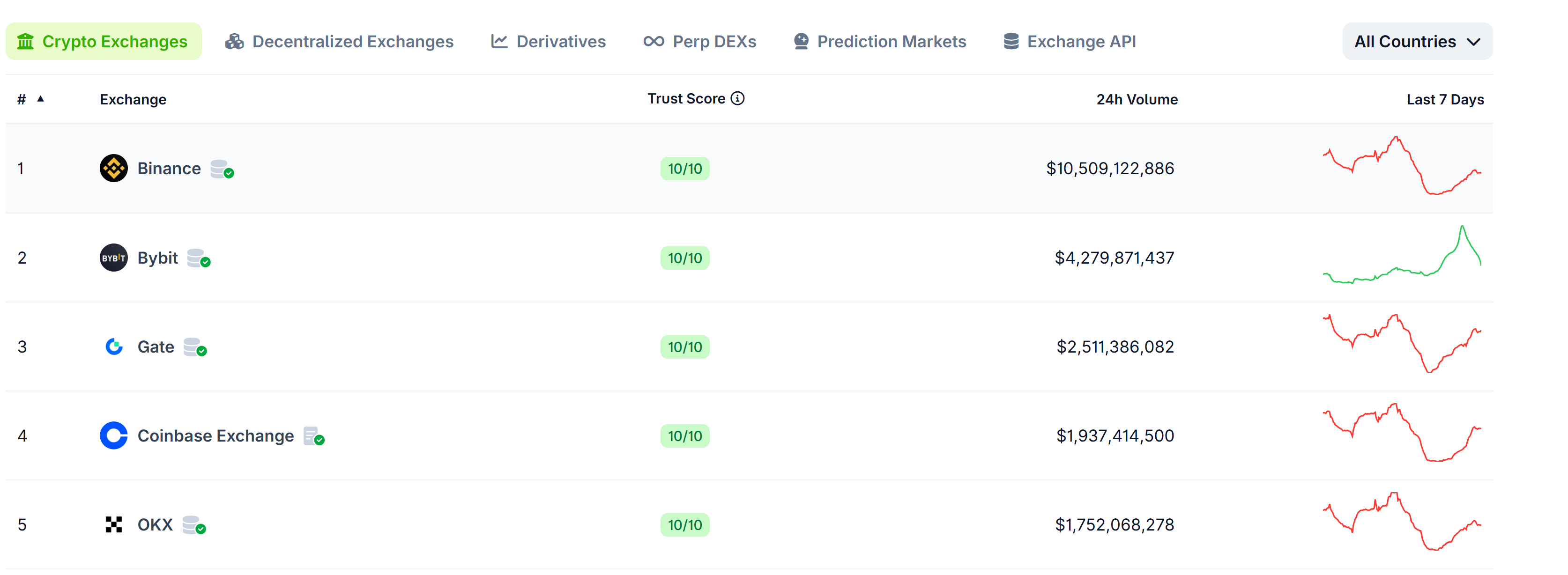
Top five crypto exchanges by volume. Source: CoinGecko

Related: Japan plans tough new rules for crypto exchanges: What liability reserves actually mean

Bybit halts new user registrations

The announcement follows earlier steps taken by Bybit to limit its exposure to Japan. In October, the exchange said it would pause new user registrations in Japan, citing ongoing discussions with the country’s Financial Services Agency (FSA).

In February, the FSA asked Apple and Google to suspend downloads of five unregistered cryptocurrency exchanges, including Bybit, MEXC Global, LBank Exchange, KuCoin and Bitget.

Japan maintains one of the world’s strictest crypto oversight regimes. In July, Maksym Sakharov, co-founder and CEO of decentralized onchain bank WeFi, told Cointelegraph that Japan’s regulatory bottleneck is pushing innovation out of the country.

Bybit did not respond to Cointelegraph’s request for comment by press time.

Related: Japan’s new crypto tax could wake ‘sleeping giant’ of retail investors

Bybit reenters the UK

Meanwhile, Bybit is reentering the UK market after a two-year pause with a new platform offering spot trading and a peer-to-peer service, operating under a promotions arrangement approved by Archax rather than its own UK registration.

Last month, Bybit also secured a Virtual Asset Platform Operator License from the Securities and Commodities Authority of the United Arab Emirates, eight months after receiving an in-principle approval from the local regulator.

Magazine: 2026 is the year of pragmatic privacy in crypto — Canton, Zcash and more

İlgili Sorular

QWhy is Bybit discontinuing services for Japanese residents?

ABybit is discontinuing services for residents of Japan to comply with local regulatory requirements set by the country's Financial Services Agency (FSA).

QWhen will the gradual account restrictions for Japanese residents begin?

AThe phased restrictions on accounts classified as Japanese residents will begin in 2026.

QWhat action did Japan's FSA take against Bybit and other exchanges earlier in the year?

AIn February, Japan's FSA asked Apple and Google to suspend downloads of five unregistered cryptocurrency exchanges, including Bybit, MEXC Global, LBank Exchange, KuCoin, and Bitget.

QHow does Bybit's trading volume rank among global crypto exchanges?

ABybit often ranks as the world's second-largest crypto exchange by daily trading volume, processing about $4.3 billion in trades in 24 hours at the time of the article.

QIn which other major market has Bybit recently reentered or secured a license?

ABybit has reentered the UK market with a new platform and also secured a Virtual Asset Platform Operator License from the Securities and Commodities Authority of the United Arab Emirates.

İlgili Okumalar

Bitcoin Withdrawals Continue: 8 Years of Storage in a Coldcard Cold Wallet Ended in Zero

Coldcard Hardware Wallet Hacked: Losses Mount Due to Vulnerable Seed Generation A critical vulnerability in Coldcard hardware wallets has led to a continued wave of fund thefts. According to Galaxy Research, the total stolen has reached 1,367.05 BTC (approx. $88.6 million) from 4,585 addresses, a significant increase from the initial 594.5 BTC reported on July 30, 2026. Most of the stolen funds remain on the attackers' addresses. The issue is not with the current firmware, which Coinkite has updated, but with seed phrases generated on vulnerable devices between March 2021 and the release of fixed firmware versions. Due to a programmer error, devices switched from using a hardware random number generator to the software-based Yasmarang generator, which was initialized with publicly accessible data like the chip's serial number. This made the seed phrases predictable through offline brute-force attacks, meaning wallets remain at risk until funds are moved to a new wallet generated with the patched firmware. Affected devices include Mk2/Mk3 with firmware 4.0.1–4.1.9 (and up to 5.0.3), Mk4/Mk5 up to version 5.6.0, and Q models up to 1.5.0Q. The only exceptions are seeds created with a high-entropy method like at least 50 independent dice rolls or a strong unique BIP-39 passphrase. All other owners must generate a new seed on the fixed firmware and transfer their assets. A case highlighting the human impact involves a 39-year-old long-term investor who lost 2 BTC (approx. $130,000) in minutes. He had accumulated the Bitcoin over eight years through physical labor, viewing it as a financial lifeline and a retirement plan in a country suffering from hyperinflation. His story underscores that even conservative "buy and hold in cold storage" strategies can be compromised by such underlying technical flaws. From a technical perspective, this incident echoes historical failures where weak random number generators undermined cryptographic security, challenging the assumption that offline storage is automatically foolproof.

cryptonews.ru3 saat önce

Bitcoin Withdrawals Continue: 8 Years of Storage in a Coldcard Cold Wallet Ended in Zero

cryptonews.ru3 saat önce

İşlemler

Spot
活动图片





