Bybit Pay Integrates With Yape and Plin to Enable Crypto Payments Across Peru

TheNewsCrypto2026-01-15 tarihinde yayınlandı2026-01-15 tarihinde güncellendi

Özet

Bybit Pay, the payment service of the world’s second-largest crypto exchange, has integrated with Yape and Plin—two of Peru’s most widely used digital payment platforms. This integration enables millions of users in Peru to make everyday transactions using cryptocurrencies such as USDT, USDC, BTC, and ETH, which are instantly converted to Peruvian Sol (PEN). Customers can pay via Yape QR codes or Plin phone-number transfers both online and at local merchants, benefiting from fast settlement and enhanced security. The move supports Peru’s growing digital economy, where over 50% of adults use mobile wallets. To celebrate the launch, Bybit is offering incentives including a 50% discount voucher for new users and cashback rewards for existing customers.

Yape and Plin, two of the most widely used digital payment systems in Peru, have seamlessly integrated with Bybit Pay, which has been launched by Bybit, the second-largest cryptocurrency exchange in the world based on trading volume. Millions of users of digital wallets in Peru now have access to real-world cryptocurrency payment capabilities thanks to this expansion, which is another significant step in connecting conventional banking with the Latin American digital economy.

Boosting the Digital-First Economy in Peru

The usage of digital wallets has increased dramatically in Peru in recent years; in 2024, Yape and Plin will each have around 14 million users. Bybit Pay’s most recent integration combines the innovation of digital assets with the familiarity of Peru’s most trusted payment methods, allowing Peruvian customers to make cryptocurrency-backed payments both online and at local merchants using their existing Plin phone-number transfers and Yape QR codes.

Yape handled 54% of in-person transactions and PLIN handled 34% in 2024, placing Bybit Pay at the center of Peru’s quickly developing cashless economy. According to research, more than 50% of Peruvian adults use digital wallets that are based on their phones.

Using the extensive local networks of Plin and Yape, Bybit Pay customers in Peru can now:

  • Use QR codes to make payments: To instantly pay with cryptocurrencies at participating retailers around the country, use your current Yape QR code.
  • Money Transfer using Phone Number: Use crypto holdings to support safe Plin phone number transfers.
  • Use Digital Assets to Shop: Access payments at actual retail stores as well as online.
  • Enjoy Fast Settlement: Take advantage of improved security and almost instantaneous transaction confirmation.

Several cryptocurrencies, such as USDT, USDC, BTC, ETH, and other significant digital assets, are supported in Peru by the platform, which instantly converts them for smooth Peruvian Sol (PEN) transactions.
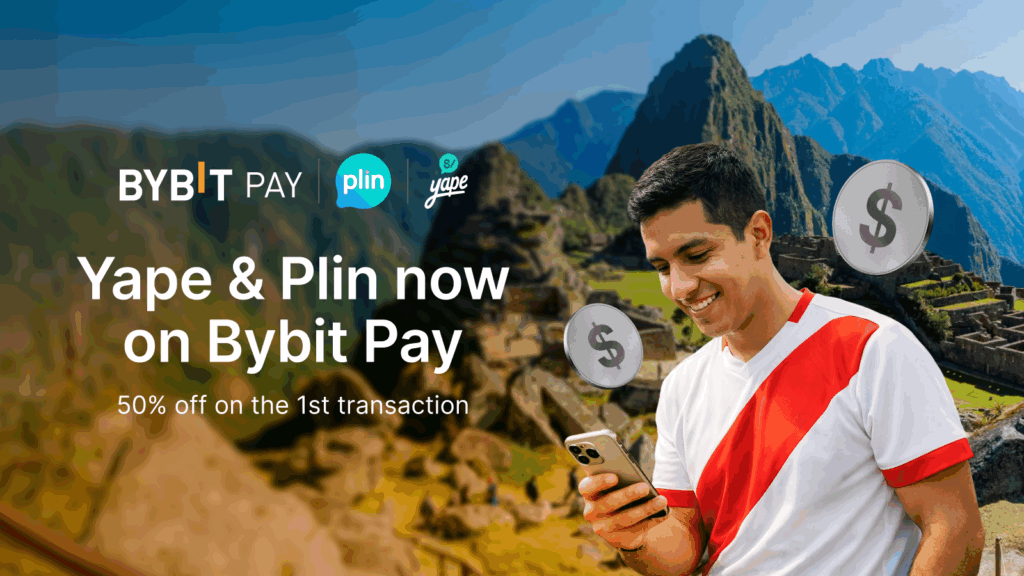
Bybit Pay is providing consumers in Peru with previously unheard-of incentives to commemorate the launch:

  • Exclusive to New Users: New customers who successfully register for Bybit Pay may get a 50% discount voucher on their first phone-number transfer or QR code payment in addition to additional welcome perks.
  • Benefits to Current Users: Current Bybit Pay customers may get 2–10% reward on each payment made via phone number transfer or QR code.

“By integrating with mainstream payment methods Peruvians already know and trust, Bybit Pay is removing barriers to digital asset adoption and making crypto genuinely useful for everyday transactions,” said Patricio Mesri, CEO of Bybit LATAM. “Peru represents one of Latin America’s most dynamic digital payment markets, and we are proud to be building the infrastructure for financial innovation and inclusion together with our partners.”

Through collaborations with top regional organizations and payment infrastructure suppliers from Brazil to Argentina, Bybit Pay has been making progress throughout Central and Latin America. Users may visit How to Make Payment with QR Pay utilizing Bybit Pay to find out more about how to utilize Bybit Pay.

Currently, Bybit Pay provides services to users worldwide who have successfully finished Bybit’s Identity Verification process. At this time, local Bybit entities and users from Service Restricted Countries are not supported. Users may visit the official Bybit Pay site for the most recent information as well as comprehensive terms and conditions.


TagsBybitexchange

İlgili Sorular

QWhat is the significance of Bybit Pay's integration with Yape and Plin in Peru?

AThe integration enables millions of digital wallet users in Peru to make real-world cryptocurrency payments, connecting traditional banking with the Latin American digital economy and placing Bybit Pay at the center of Peru's cashless economy.

QWhich cryptocurrencies are supported by Bybit Pay for transactions in Peru?

AThe platform supports several cryptocurrencies including USDT, USDC, BTC, ETH, and other significant digital assets, which are instantly converted for smooth Peruvian Sol (PEN) transactions.

QWhat specific payment methods can Peruvian users now employ through Bybit Pay's integration?

APeruvian users can make payments using Yape QR codes at participating retailers and conduct safe money transfers using Plin phone number transfers, all backed by their cryptocurrency holdings.

QWhat incentives is Bybit offering to users in Peru to celebrate the launch?

ANew users may receive a 50% discount voucher on their first phone-number transfer or QR code payment, while existing users can get a 2–10% reward on each payment made through these methods.

QHow does Bybit Pay's CEO view the impact of this integration on digital asset adoption in Peru?

ACEO Patricio Mesri stated that by integrating with mainstream payment methods Peruvians already trust, Bybit Pay is removing barriers to digital asset adoption and making crypto genuinely useful for everyday transactions in one of Latin America's most dynamic digital payment markets.

İlgili Okumalar

Polymarket's "2028 Presidential Election" Volume King Is... LeBron James???

An article from Odaily Planet Daily, authored by Azuma, discusses a peculiar phenomenon observed on the prediction market platform Polymarket regarding the "2028 US Presidential Election" event. Despite having a real-time probability of less than 1%, unlikely candidates such as NBA star LeBron James (with $48.41 million in trading volume), celebrity Kim Kardashian ($33.84 million), and even ineligible figures like Elon Musk ($23.14 million) and New York City Mayor Zohran Mamdani ($18.39 million) account for approximately 70% of the total trading volume. In contrast, high-probability candidates like Vice President JD Vance ($10.58 million), California Governor Gavin Newsom ($15.71 million), and Secretary of State Marco Rubio ($9.32 million) have significantly lower trading activity. The article explains that this counterintuitive trend is not driven by irrational speculation but by rational strategies. Polymarket offers a 4% annualized holding reward for certain markets, including the 2028 election, to maintain long-term pricing accuracy. This yield exceeds the current 5-year US Treasury rate (3.98%), attracting large investors ("whales") to hold "NO" shares on low-probability candidates for risk-free returns. Additionally, some users utilize a platform feature that allows converting a set of "NO" shares into corresponding "YES" shares for better liquidity or pricing efficiency, rather than directly buying "YES" shares for their preferred candidates. Thus, the seemingly absurd trading activity is strategically motivated.

marsbit53 dk önce

Polymarket's "2028 Presidential Election" Volume King Is... LeBron James???

marsbit53 dk önce

Dialogue with ViaBTC CEO Yang Haipo: Is the Essence of Blockchain a Libertarian Experiment?

"ViaBTC CEO Yang Haipo: Blockchain as a Hardcore Libertarian Experiment" In a deep-dive interview, ViaBTC CEO Yang Haipo reframes the essence of blockchain, arguing it is not merely a new technology or infrastructure but a hardcore libertarian experiment. This experiment, born from the 2008 financial crisis and decades of cypherpunk ideology, tests a fundamental question: to what extent can freedom and self-organization exist without centralized trust? The discussion highlights the experiment's verified outcomes. On one hand, it has proven its core value of censorship resistance, providing critical financial lifelines for entities like WikiLeaks and individuals in hyperinflationary or sanctioned countries via tools like stablecoins. However, Yang points out a key paradox: the most successful product, USDT, is itself a centralized compromise, showing users prioritize a less-controlled pipeline over pure decentralization. On the other hand, the experiment has exposed the severe costs of this freedom—a "dark forest" without safeguards. Events like the collapses of LUNA, Celsius, and FTX, resulting in massive wealth destruction and prison sentences for founders, underscore the system's fragility and the inherent risks of an unregulated environment. Yang observes that despite decentralized protocols, human nature inevitably recreates centralized power structures, speculative frenzies, and narrative-driven cycles (from ICOs to Meme coins), where emotion and belonging often trump technological substance. Looking forward, he believes blockchain's future is significant but niche. Its real value lies in serving specific, real-world needs for financial sovereignty and bypassing traditional controls, not as a universal infrastructure replacing all centralized systems. For the average participant, Yang's crucial advice is to cultivate independent judgment. True freedom is not holding a crypto wallet, but possessing a mind resilient to groupthink and narrative hype in a high-risk, often irrational market.

marsbit1 saat önce

Dialogue with ViaBTC CEO Yang Haipo: Is the Essence of Blockchain a Libertarian Experiment?

marsbit1 saat önce

İşlemler

Spot
Futures
活动图片