Bybit Partners with Stockholm Open as LiquidChain Redefines Cross-Chain Infrastructure

bitcoinist2026-02-10 tarihinde yayınlandı2026-02-10 tarihinde güncellendi

Özet

Bybit has partnered with the Stockholm Open, rebranding it the 'BNP Paribas Nordic Open,' as part of a strategic move to target high-net-worth and institutional investors in Europe. This shift reflects a broader trend of crypto exchanges building credibility with sophisticated capital. However, this institutional interest highlights a critical weakness in the market: fragmented on-chain infrastructure and liquidity across major blockchains like Bitcoin, Ethereum, and Solana. This gap is driving demand for unified cross-chain solutions. LiquidChain ($LIQUID) is addressing this by building a Layer 3 infrastructure designed to fuse liquidity from these ecosystems into a single execution layer. Its 'Cross-Chain Virtual Machine' aims to enable 'Single-Step Execution,' allowing users to perform complex actions across chains in one transaction without manual bridging. The protocol is currently in its presale phase, having raised over $533K with tokens priced at $0.0136. This early capital inflow indicates investor interest in utility-driven infrastructure projects that solve liquidity fragmentation, positioning them to capture the next wave of DeFi volume as the need for interconnected blockchain rails intensifies.

Trusted Editorial content, reviewed by leading industry experts and seasoned editors. Ad Disclosure

Quick Facts:

  • ➡️ Bybit’s partnership with the Stockholm Open signals a strategic pivot toward high-net-worth and institutional demographics in Europe.
  • ➡️ The gap between institutional interest and on-chain user experience is driving demand for unified infrastructure solutions.
  • ➡️ LiquidChain is addressing liquidity fragmentation by fusing BTC, ETH, and SOL ecosystems into a single execution layer.
  • ➡️ Infrastructure projects are seeing steady capital inflows, with early backers focusing on utility-driven tokenomics over pure governance rights.

The intersection of digital assets and elite sports hit another milestone this week.

Bybit announced its title partnership with the Stockholm Open, rebranding the tournament to the ‘BNP Paribas Nordic Open’ with the exchange as a top-tier partner. This isn’t just about slapping a logo on a court; it’s a calculated push into high-net-worth territory.

By aligning with the oldest ATP indoor tournament, Bybit is positioning itself directly in front of a European institutional audience, a demographic that has historically been skittish about entering the volatile crypto fray.

Why the shift? Sports sponsorships have evolved from simple awareness plays to strategic credibility moves. Just as Crypto.com’s arena naming rights tried to normalize digital assets for retail, Bybit’s entry into the ‘gentleman’s sport’ of tennis targets a sophisticated, capital-rich investor class.

The data suggests exchanges are pivoting marketing spend toward trust-building, anticipating a market shift from retail speculators to long-term holders.

But there’s a catch. Bringing institutional capital on-chain exposes a glaring weakness in the current market structure: infrastructure fragmentation. While exchanges smooth the on-ramp, the actual on-chain experience is still plagued by complex bridging, wrapped asset risks, and liquidity that’s fractured across chains like Ethereum and Solana.

As traditional finance (TradFi) eyes the exit, the rails they’re expected to run on are still being built. This gap between marketing promise and technical reality has shifted smart money focus toward Layer 3 (L3) solutions capable of unifying these ecosystems.

Among the protocols addressing this friction is LiquidChain ($LIQUID), a cross-chain liquidity layer that has quietly started accumulating capital in its early presale stages.

Read more about $LIQUID here.

Unifying Fragmented Liquidity Across Bitcoin, Ethereum, and Solana

The current DeFi landscape effectively forces users and developers into silos. A developer building on Solana can’t easily access Ethereum liquidity without relying on cumbersome bridges or wrapped tokens, mechanisms that have historically been vectors for major hacks.

LiquidChain ($LIQUID) aims to solve this via its Layer 3 infrastructure, designed to fuse Bitcoin, Ethereum, and Solana liquidity into a single execution environment.

This distinction is critical. Most ‘interoperability’ protocols merely message between chains. LiquidChain operates as a Cross-Chain Virtual Machine (VM), enabling what the protocol calls ‘Single-Step Execution.’ In practice, a user could stake an asset on Ethereum and take a loan against it on Solana in a single transaction, without manually bridging funds.

For developers, the appeal lies in the ‘Deploy-Once’ architecture, writing code once that can simultaneously tap into the user bases of the three largest blockchains.

Of course, the risk here is execution complexity. Building an L3 that handles verifiable settlement across non-EVM (Bitcoin) and high-speed (Solana) chains is a heavy technical lift. Yet, the demand for a Unified Liquidity Layer is undeniable.

As liquidity fragmentation continues to dilute capital efficiency, protocols that can abstract away the underlying chain are positioned to capture the next wave of DeFi volume.

$LIQUID is available here.

Early Capital Flows Into LiquidChain’s $0.0135 Presale Round

While the broader market reacts to macro signals and exchange partnerships, on-chain metrics show a rotation into infrastructure plays.

LiquidChain has currently raised $533K in its ongoing presale, with tokens priced at $0.0136. This raise amount is notable not for its size relative to the massive ICOs of 2017, but for the steady accumulation during a period where capital is generally risk-averse.
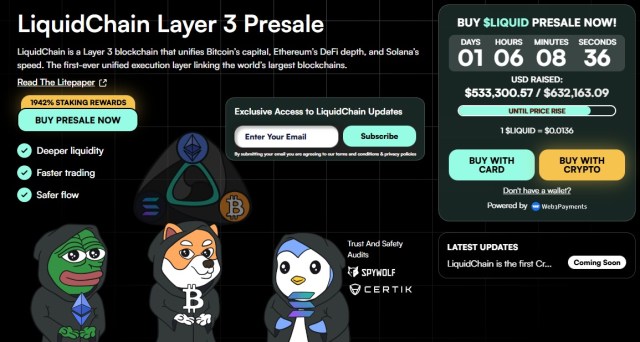
The pricing structure suggests early positioning before the protocol moves toward mainnet deployment. Investors seem to be betting on the ‘transaction fuel’ narrative, where the native $LIQUID token is required to power cross-chain operations and liquidity staking.

Unlike governance-only tokens, infrastructure tokens often derive value from network usage volume. If LiquidChain succeeds in capturing even a fraction of the cross-chain arbitrage and settlement market, the utility demand for the token could theoretically decouple from pure speculation.

What most coverage misses is the timing. With Bitcoin’s ecosystem expanding via L2s and Solana’s dominance in retail memes, the need for a connecting layer hasn’t been higher. The presale data points to a subset of the market hedging against the “winner takes all” chain thesis, opting instead to invest in the rails that connect them all.

$LIQUID is available here.

This article is not financial advice. Cryptocurrency investments, including presales and Layer 3 protocols, carry high risks, including total loss of capital. Always conduct independent due diligence before investing.

Editorial Process for bitcoinist is centered on delivering thoroughly researched, accurate, and unbiased content. We uphold strict sourcing standards, and each page undergoes diligent review by our team of top technology experts and seasoned editors. This process ensures the integrity, relevance, and value of our content for our readers.

patrubogdan

Follow

Full Profile

Related Posts

Meme Coins Outpace Blue Chips as Retail Liquidity Rotates, Igniting Maxi Doge’s $4.5M Rise

AI Can’t Save the Market Alone, But It Can Transform It: How SUBBD Token Redefines Content Economics

Russian Lawmaker Predicts Bitcoin Collapse While Smart Money Rotates into Layer 2 Utility

Solana’s Low Fees Create Strong Competition for Base, BNB, and Polygon and Fuel SUBBD Token

Chainlink Founder Sergey Nazarov Identifies 3 Trends That Will Define the Cryptosphere as Hyper Token Soars

Bitcoin Demand Plunges Per CryptoQuant, Yet Maxi Doge Endures

İlgili Sorular

QWhat is the strategic significance of Bybit's partnership with the Stockholm Open?

ABybit's partnership with the Stockholm Open, rebranding it to the 'BNP Paribas Nordic Open', is a strategic move to target a high-net-worth and institutional European audience. It's a calculated effort to build credibility and position itself in front of a sophisticated, capital-rich investor class that has been cautious about entering the volatile crypto market.

QWhat key problem in the crypto market is LiquidChain aiming to solve?

ALiquidChain is addressing the problem of liquidity fragmentation across different blockchains. It aims to unify the fractured liquidity silos of Bitcoin, Ethereum, and Solana into a single execution layer, eliminating the need for complex bridges and wrapped assets which are vectors for hacks.

QHow does LiquidChain's 'Single-Step Execution' work?

ALiquidChain's 'Single-Step Execution' is enabled by its Cross-Chain Virtual Machine (VM). It allows a user to perform a complex action, such as staking an asset on Ethereum and taking a loan against it on Solana, in a single transaction without manually bridging funds between the chains.

QWhat is the current status and price of LiquidChain's ($LIQUID) presale?

AAs detailed in the article, LiquidChain's presale has raised $533K. The tokens are currently priced at $0.0136 in this ongoing early funding round.

QAccording to the article, how are infrastructure project tokens like $LIQUID different from governance-only tokens?

AInfrastructure tokens like $LIQUID derive their value from network usage and utility, as they are required to power cross-chain operations and liquidity staking. This is in principle from governance-only tokens, whose value is more closely tied to speculation and voting rights rather than direct utility demand from transaction volume.

İlgili Okumalar

Uncovering the Truth About Agent Commerce, Payments, and Infrastructure

Decoding Agent Commerce, Payments, and Infrastructure: The Reality Over the past year, I've been building infrastructure for the Agent economy, engaging with major players like Stripe, Visa, Coinbase, Google, and dozens of startups. A clear conclusion emerges: true, large-scale demand does not yet exist. Startups face structural challenges. Data points illustrate this gap. Stripe's Agent commerce platform has over 1,000 merchants but only single-digit transacting agents. Visa's Agent payment token requires 9-month KYC and a $250M revenue threshold, accessible only to giants like Amazon. On-chain analysis reveals actual daily Agent transaction volume is around $17k, half of which are test transactions. The article analyzes four potential markets: **1. Agent-to-Merchant (A2M):** Current AI shopping UX is often inferior to traditional e-commerce for visual, comparison-heavy purchases (clothing, electronics). Chat interfaces are a step back. Real merchant interest is defensive "Agent Engine Optimization," fearing future obsolescence, not current demand. Potential exists in high-frequency, low-decision purchases (e.g., food delivery) or simplifying terrible UX (complex checkouts, non-native shoppers), but these require massive consumer distribution channels dominated by giants like DoorDash and Amazon. **2. Agent-to-API (A2A):** Developers already have subscriptions and billing for core APIs (compute, data). The argument for micro-payments via crypto for sub-dollar API calls is addressed by pre-paid balances today. The deeper issue is supplier resistance; major SaaS firms rely on enterprise contracts, not fractional cent pricing. Opportunity lies in the long tail of niche services, but this is a smaller market catering to developers, a historically low-paying group. **3. Agent-to-Agent (A2A):** This remains a theoretical long-term vision with near-zero current transaction volume. It involves unique challenges: discovery, trust, negotiation, dispute resolution. When it materializes, it will require a fundamentally new settlement infrastructure for high-speed, variable-value, multi-party transactions. It's a real long-term bet, but not the current market. **4. Agent-to-Finance (A2F):** This is the only category with existing, paying demand. Integrating AI into financial workflows (trading, portfolio management) is a natural evolution and enables new capabilities like autonomous rebalancing. However, competition favors incumbents with regulatory licenses, compliance infrastructure, and existing client relationships. **The Real Issue:** Why is infrastructure still being built? Incumbents can afford long-term bets, and payment companies see every problem as a nail for their payment hammer. However, payment is just one piece. The core challenge is *coordination*—orchestrating work between Agents and humans, verifying outcomes, and settling results. Payment is part of settlement, which is part of coordination. Companies that solve the coordination problem will subsume payments, not the other way around. Startups lack the infinite runway of giants and must find today's real market, which, after a year of exploration, lies outside these four categories—in an area with real, growing, and underserved activity.

marsbit1 saat önce

Uncovering the Truth About Agent Commerce, Payments, and Infrastructure

marsbit1 saat önce

Kalshi, MTS, and a16z's Ambition

The article "Kalshi, MTS, and a16z's Ambition" explores prediction markets as a focal point of excitement in 2025 for investors, crypto enthusiasts, and media. It traces their intellectual lineage from Friedrich Hayek's ideas on dispersed knowledge and market coordination to Robin Hanson's Logarithmic Market Scoring Rule (LMSR), which incentivizes truthful information sharing. The piece argues that a16z's significant investment in prediction market platform Kalshi (valued at $220B) transcends mere financial speculation. a16z frames prediction markets as a new form of "media" that provides "presence"—a way for individuals to actively engage with and influence world events through financial stakes, countering postmodern detachment. By wagering on outcomes, users become "super observers," and the market's aggregated probabilities gain authoritative power to define event truth and importance. The article uses media company MTS ("Monitoring The Situation") as a case study of a16z's "new media" strategy: rapidly producing high-intensity, multi-format content to "take over the timeline." However, prediction markets like Kalshi are presented as the ultimate piece in this media empire. Their real-money, crowd-sourced probabilities possess a unique "reality distortion field" and perceived objectivity, potentially swaying public opinion and granting a private company unprecedented interpretive power over reality. Ultimately, Kalshi's immense valuation is attributed not just to its exchange model, but to its role as a foundational component in a16z's envisioned new media landscape, where prediction markets define narrative and truth.

链捕手1 saat önce

Kalshi, MTS, and a16z's Ambition

链捕手1 saat önce

İşlemler

Spot
Futures
活动图片





