Author: Prathik Desai
Compiled by: Saoirse, Foresight News
When you hold stock in a company, you have a residual claim: after the company settles with all other creditors, all remaining assets belong to the shareholders. The order of payment is employee compensation, bondholders and lenders, general creditors, taxes, preferred stock, and finally, common stockholders.
This residual claim also comes with exclusive rights: you have the right to vote for company managers, share in dividends distributed by the company, and, if the company is sold or liquidated, you are entitled to a share of the remaining assets.
For a long time, major crypto protocols have painted a similar picture for token holders — at least in their promotional rhetoric. By holding tokens, you can participate in network governance decisions and share in the future profits and growth of the project. But this narrative has been a one-sided agreement from the start. The crypto industry has long deliberately avoided this fact because there were no sharp conflicts of interest in the past. Now, however, the situation is changing.
Previously, regulatory gaps allowed crypto protocols to maintain this narrative to placate token holders, but the advancing CLARITY Act will close this gray area. The fact that some crypto protocols issue equity while also selling tokens to the public further highlights the vast difference in rights between shareholders and token holders.
What Ownership Truly Means
Equity's enduring appeal as a financial instrument isn't solely due to investment returns. Often, bonds offer higher yields and lower volatility. The unique allure of equity stems from its rights structure: it represents a legally enforceable ownership stake in a company. When a company makes a profit, the board of directors can declare dividends, and shareholders are legally entitled to them; if the board refuses to pay dividends, shareholders can vote to replace the board; if a majority of shareholders wish to sell the company, there is a mechanism to execute that desire. All these rights do not rely solely on the goodwill of management.
Over the past century, corporations have continuously adjusted the degree of control shareholders have over daily operations, but shareholders' legally enforceable claim on corporate profits has remained largely unchanged.
During Google's 2004 IPO, a dual-class share structure was established, giving founders Larry Page, Sergey Brin, and then-CEO Eric Schmidt ten times the voting rights of ordinary public shareholders, but the economic rights of ordinary shareholders were completely equal to those of the founders and insiders. Snap Inc. issued non-voting shares in 2017; Berkshire Hathaway has had a dual-class structure since 1996.
Although these cases reshaped the traditional shareholding model, they all retained the core foundation of equity: a legally enforceable claim on the residual value of the enterprise, enforceable through the courts.
Crypto protocol token holders possess no such right. They have no right to dividends, and if the enterprise is acquired, they have no entitlement to a share of the sale proceeds. This is the fundamental difference between truly owning an asset and being told you own an asset. All legal systems related to ownership assume that the owner has enforceable rights, but token holders have none.
A common method for projects to support token prices is to use a portion of revenue to buy back and burn tokens on the secondary market. The worst part is: such arrangements are not enforced by any contract. A protocol can modify, suspend, or even completely terminate its buyback-and-burn policy without board approval. Token holders who suffer losses have no legal basis for recourse.
Since this rights gap has always existed, why is it being discussed now? In the early days of crypto, this contradiction wasn't prominent, as there were no equity holders as a reference point — only tokens existed in the market. Community users, founding teams, and project entities all held tokens, and their interests were naturally aligned.
But now, that balance is being disrupted.
Mature crypto protocols are gradually shifting towards commercial operations, with revenue, products, and user scale becoming core metrics. Sooner or later, they will need large-scale financing for expansion, and the most established way to obtain substantial capital is still fundraising from traditional capital markets, just as Google and Snap went public, and Tesla and SpaceX conducted private placements before their IPOs.
On July 1st, Venice AI completed a $65 million Series A funding round led by Dragonfly and Coinbase Ventures, valuing the company at $1 billion. Investors received 8.98% equity plus token rewards. This funding structure fundamentally altered the ownership landscape, exposing a structural flaw the crypto industry has deliberately ignored for a decade.
Before the funding round, Venice had only one type of rights holder; after the round, it split into two groups: the first consists of equity investors, who have formal legal contracts, board seats, information rights, anti-dilution protection, and legally enjoy the profits corresponding to 8.98% of the company's assets; the second consists of native token VVV holders, who rely solely on the company's voluntary burn plan, which the project can terminate at any time.
This funding round established a market valuation for Venice's equity. Future value created by the company's growth is directly shared by equity investors through legal contracts; token holders do not automatically share in the growth — their benefit depends entirely on whether Venice's management continues to execute buybacks and burns. In other words, the initiative for distributing each future revenue stream lies with management — they can treat both groups of holders fairly, or simply abandon token buybacks.
Venice is not an isolated case. Aave directs 100% of protocol revenue to buy back AAVE tokens; Hyperliquid boasts one of the largest buyback mechanisms in the crypto market, having cumulatively allocated over $1.2 billion in protocol revenue to HYPE buybacks, distributing 97% of fees annually, which corresponds to an annualized buyback rate of about 5%–6% of market cap. Although these projects haven't conducted equity financing like Venice, they all face the same underlying issue: the buyback policy is entirely at the discretion of the team, and no rules can prevent the Hyperliquid team from redirecting the funds.
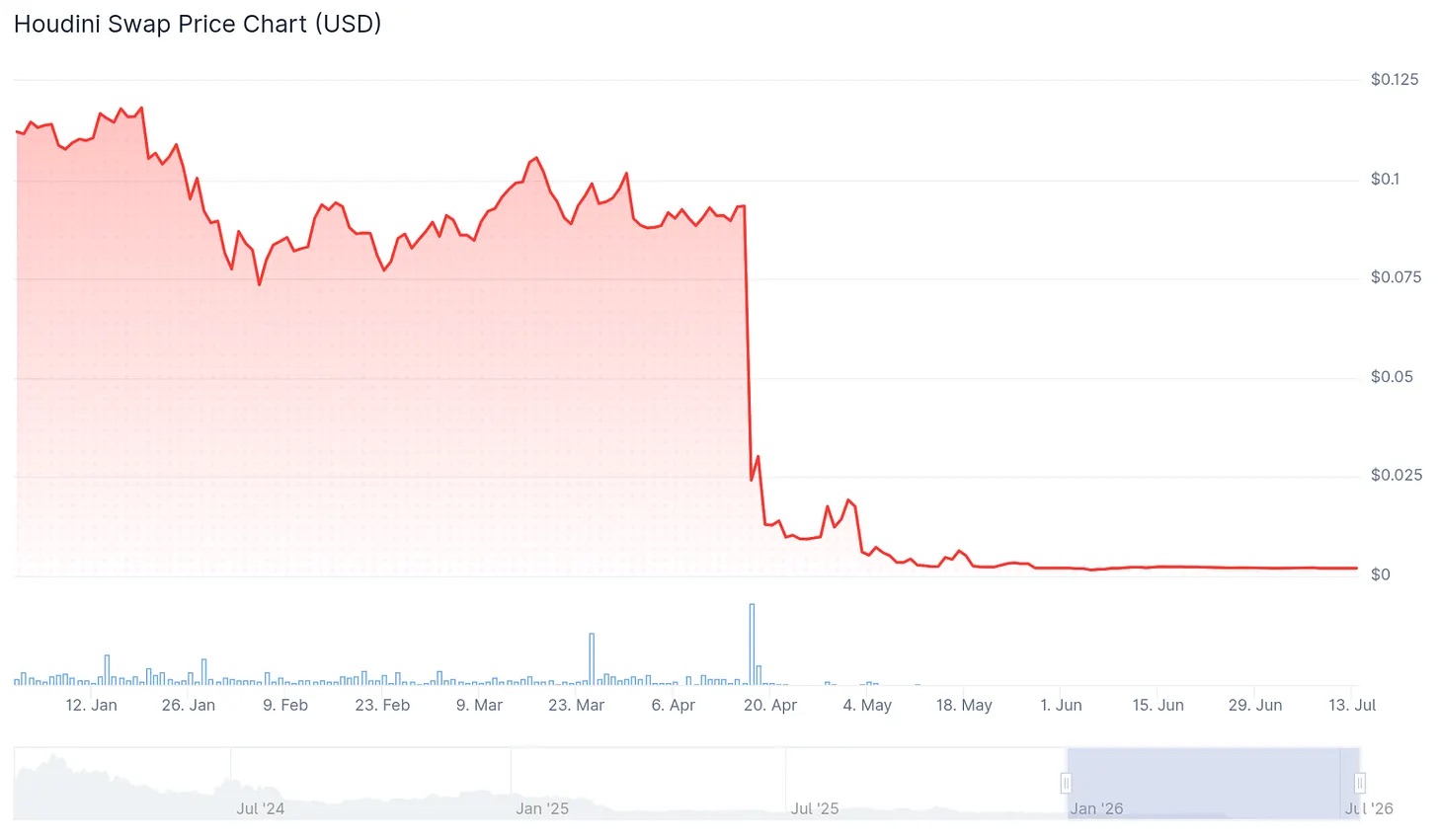
A real-world example illustrates the possible outcome: In May 2026, Sol Strategies acquired Houdini Swap for $18 million. The acquisition funds were paid entirely to the founders and equity holders, while holders of Houdini Swap's native token, LOCK, received nothing, and the token price plummeted to zero.
Source: @coingecko
This case confirms: the mechanisms originally intended to protect token holders' interests are ultimately controlled by the protocol. All the returns investors expect from holding tokens depend entirely on whether project management changes its mind. The root cause is: the acquirer has no legal obligation to compensate token holders.
The Legal Dilemma
The CLARITY Act passed the US House of Representatives in July 2025 and, as of July 2026, remains stalled in the Senate. If enacted, it will further intensify the aforementioned conflict. The bill plans to categorize all crypto tokens into two major regulatory classes:
- Digital Commodities: Regulated by the CFTC (the agency overseeing commodities like crude oil, wheat, and gold).
- Investment Contract Assets (Securities): Regulated by the SEC (the agency overseeing stocks and bonds).
Almost all protocols want their tokens classified as digital commodities to enable free trading on public exchanges; once classified as securities, token liquidity would significantly shrink, and compliance costs would overwhelm most projects.
The constraints attached to these two regulatory tracks are the key point of conflict.
The bill clearly states: digital commodity tokens can have governance rights, staking rewards, and their value can increase with protocol usage. However, issuers are strictly prohibited from granting token holders any legally enforceable claim on the enterprise's revenue, profits, assets, or debts. In simple terms: tokens can capture value generated from network usage but cannot share in the enterprise value of the company operating that network.
Protocols can still design tokens whose value is tied to trading activity, but they cannot base token appreciation on corporate operating income. Buyback-and-burn falls precisely in this regulatory gray area. To date, the SEC has not provided clear guidance, but regulators have no obligation to interpret it in favor of token holders.
During the regulatory gap, projects navigated the legal fog, promoting tokens as quasi-equity, using regulatory ambiguity to attract investors. Currently, although the CLARITY Act is not yet in effect, no law prohibits such promotion; but once the bill is enacted, projects can no longer classify tokens as commodities while promising holders ownership in the enterprise.
Several protocols have already attempted to find a balance at the edge of compliance. On June 27th, Aave launched Aavenomics 3.0, replacing the committee-controlled manual buyback model with an automated, non-intervenable on-chain mechanism. All revenue from the protocol and GHO (Aave's decentralized over-collateralized stablecoin) will be used to purchase AAVE on the secondary market.
Aave founder Stani Kulechov called this mechanism automated and unchangeable. This might be the ultimate attempt by a DeFi project to make a binding commitment to its community.
But Aavenomics 3.0 is ultimately just code; the legally enforceable contract that should exist is still missing. The Aave governance council can still initiate a vote to stop the buyback mechanism. Token holders who suffer losses cannot sue the project for breach of contract. At best, it can be seen as a policy that most holders are willing to trust the governance team to uphold. All protocols trying to bypass securities registration and build value-capture mechanisms will face the limitations imposed by the CLARITY Act.
Simultaneously, Aave will soon face the same dilemma as Venice. At the end of June, news emerged that Payward, the parent company of Kraken, is negotiating to acquire 15% equity in the Aave group, valuing it at $385 million. Stani Kulechov questioned the valuation but did not deny the talks. If the deal goes through, Aave would become the second major protocol to layer formal equity on top of circulating tokens.
Can crypto projects rationalize this "equity + token" dual-ownership structure?
A common industry justification is that tokens have genuine utility. For example, Venice's DIEM token can be exchanged for $1 worth of AI compute daily, making it a utility token; similarly for various exchange fee tokens. But utility tokens have inherent limitations: their value is tied to a use case, making it difficult to generate long-term compound appreciation. Like casino chips, they can only be used for on-site consumption or exchanged for cash afterward; even if someone holds chips long-term, they have no value storage property outside the casino context. DIEM, exchangeable for equivalent compute, follows the same logic. Short-term supply-demand imbalances might push prices up, but they cannot create sustained, long-term appreciation.
If a project's core marketing pitch for issuing tokens is "the protocol will use profits to increase token value," the token is essentially a pseudo-equity and will find it difficult to avoid being classified as a security under the CLARITY Act.
Protocols face only two clear paths: First, acknowledge that the token is positioned as a digital commodity and stop promoting that it can share in corporate profits. Second, if they want token holders to enjoy genuine economic benefits, they must register the token as a security and bear the corresponding compliance costs.
For the past decade, the narrative that "tokens equal assets" could hold because no one wanted to scrutinize the fine print. As long as all market participants tacitly accepted these rules, the game could continue. But once external equity investors enter the scene with formal investment agreements, the old narrative collapses. Aave's automated buyback mechanism might be the best solution to placate token holders, but this guarantee expires on the day the governance layer votes to change the rules. And for major projects, that day might be just one term sheet away.