Bullish Reports Massive Q4 Loss; Investors Pivot to $BMIC Presale

bitcoinist2026-02-05 tarihinde yayınlandı2026-02-05 tarihinde güncellendi

Özet

Bullish shares tumbled after the company reported a massive Q4 net loss of $563 million, a sharp reversal from its profit a year earlier. This occurred amid a broader tech and crypto market downturn, prompting investors to seek safer, long-term infrastructure plays. Attention has shifted to the $BMIC presale, a quantum-secure wallet project built on Ethereum. BMIC offers post-quantum cryptography to protect against future decryption threats, positioning itself as a defensive solution for asset security. With over $433K raised, the project addresses growing concerns over quantum computing risks. However, it faces execution challenges and market volatility. The article cautions that this is not financial advice and presale investments carry high risk.

Shares of Bullish tumbled after the firm disclosed a staggering Q4 net loss of $563M, a brutal reversal from the $104.8M profit booked just a year earlier. The timing couldn’t be worse.

The report landed while tech and crypto sectors were already reeling, dragging broader equities down with them. It’s a harsh reminder: even heavyweight, institutional-grade platforms aren’t immune to macro pressure.

Amid the fallout, attention has quietly shifted to BMIC, a quantum-secure wallet project currently in presale. Why? Investors seem to be repositioning toward infrastructure that promises long-term safety rather than just short-term gains.

Frankly, if established platforms like Bullish can stumble on financials, securing assets with post-quantum cryptography suddenly feels less like a luxury and more like insurance.

The context is undeniable: the market is in correction mode. Bitcoin has plunged below $70K (down roughly 20% since January), while Ethereum is off more than 10%, both caught in a wave of tech-sector weakness and policy uncertainty. When majors slip this hard, capital often rotates toward protocols addressing deeper structural risks, like the looming threat of quantum decryption.

BMIC Brings Quantum-Proof Security to Crypto Finance

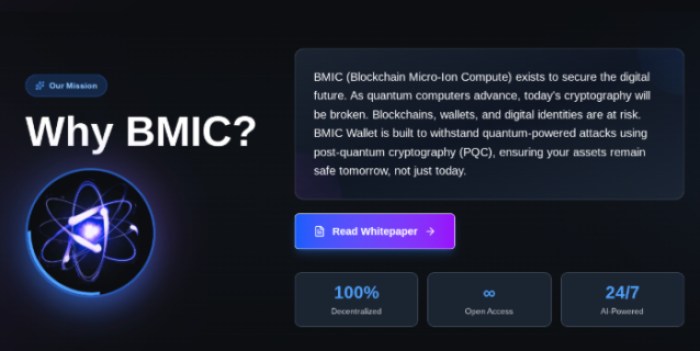
BMIC ($BMIC) isn’t just another wallet and token. It positions itself as the only Post‐Quantum‐Cryptography (PQC)-backed ecosystem for staking and payments on Ethereum.

Its full-stack, RSA-resistant design tackles ‘harvest now, decrypt later’ attacks directly. Sound paranoid? It’s not; it’s a realistic response to advancing quantum capabilities.

With zero public-key exposure, ERC-4337 smart accounts, and AI-enhanced threat detection, the project is building defense for a future that’s approaching faster than most realize.
The numbers are specific: tokens are currently priced at $0.049474, and total raised stands at over $433K.
That suggests solid early demand, nearly half a million dollars, for a security-first offering. We haven’t seen massive whale wallets enter just yet, but that’s typical for this stage. The story here is about preservation and preparedness, not pump mechanics.

The logic is simple. As markets shake, defensive plays aren’t just about ROI; they’re about resilience. BMIC offers asset-level protection that conventional solutions (still relying on old encryption standards) simply lack. The pivot makes sense.

CHEcK OUT THE $BMIC PRESALE

What’s Next and What to Watch

Quantum headlines: Any news about advances in quantum computing, or regulatory chatter on encryption standards, could turbocharge demand for this specific tech stack.
Crypto market stabilization: If $BTC or $ETH recovers, altcoins and infrastructure layers like $BMIC often see inflows shortly after.
Regulatory clarity: Early alignment on post-quantum encryption could deliver institutional confidence and adoption fast.

Risks? Plenty. BMIC faces execution hurdles common to deep-tech projects. Quantum resistance today doesn’t guarantee immunity tomorrow; it’s an arms race that requires continuous evolution. Plus, wallet adoption cycles are notoriously sticky. And let’s be real—even promising token sales can buckle under a deep bear market.

But here’s the second-order effect casual observers might miss: BMIC isn’t just ‘one more alt.’ It’s a modular infrastructure. That positions it for future ecosystem integration, think cold wallets, DeFi rails, and enterprise-grade custody.

LEARN MORE ABOUT THE QUANTUM STACK THAT’S PREPARING FOR THE FUTURE

This article is not financial advice. Presale participation involves high risk, and markets may continue to fall sharply. Evaluate tech maturity and institutional adoption before investing.


İlgili Sorular

QWhat was the primary reason for the significant shift in investor attention from Bullish to the BMIC presale, as mentioned in the article?

AInvestors are repositioning towards infrastructure that promises long-term safety, like quantum-secure wallets, following Bullish's massive Q4 loss and the broader market downturn, seeking asset protection rather than just short-term gains.

QAccording to the article, what specific technological threat does the BMIC project aim to address?

ABMIC aims to address the threat of 'harvest now, decrypt later' attacks by providing a post-quantum-cryptography (PQC)-backed, RSA-resistant ecosystem to protect against the looming risk of quantum decryption.

QWhat are two key technical features of the BMIC wallet mentioned in the report?

ATwo key features are zero public-key exposure and ERC-4337 smart accounts, which are part of its quantum-proof security and AI-enhanced threat detection system.

QWhat market conditions, as described in the article, are driving interest in defensive projects like BMIC?

AThe market is in correction mode, with Bitcoin down roughly 20% and Ethereum off more than 10% since January, due to tech-sector weakness and policy uncertainty, causing capital to rotate towards protocols that address structural risks.

QWhat are some of the major risks associated with investing in the BMIC presale, as outlined in the article?

ARisks include execution hurdles common to deep-tech projects, the need for continuous evolution to maintain quantum resistance, sticky wallet adoption cycles, and the potential for the token sale to struggle in a deep bear market.

İlgili Okumalar

Interpreting Investment Opportunities in the Age of Great Navigation, Invesco Great Wall Fund Releases '2026 Report on Chinese Enterprises Going Global'

Invesco Great Wall Fund has released its "2026 China Corporate Globalization Report," titled "The 'Great Navigation Era' of Chinese Enterprises." The report analyzes the new trends and investment opportunities as Chinese companies expand globally, moving from simple product exports to comprehensive overseas operations involving services, branding, and local production. Driven by factors like trade friction, the pursuit of higher profit margins abroad, and policy support, globalization is becoming essential for Chinese companies. The report outlines an evolution: from early product export ("Globalization 1.0") to the current "Globalization 2.0," characterized by overseas capacity, capital goods investment, consumer brand expansion, and service exports. Chinese firms' competitive advantages are highlighted, including a vast engineer talent pool, low-cost and robust infrastructure, and complete industrial clusters. Specific sectors with significant出海 potential are identified: * **Capital Goods** (e.g., engineering machinery, power equipment): Benefiting from global demand, especially in Belt & Road markets and the AI-driven power grid upgrade cycle. * **Consumer Brands**: Transitioning from cost to brand advantage, leveraging供应链 efficiency. * **Technology & Innovation**: Including AI applications, optical modules within global tech supply chains, and new energy vehicles focusing on local production. * **Pharmaceuticals**: Chinese biotech firms are becoming preferred partners for global pharma, with potential for breakthrough drugs in areas like oncology and weight loss. The report concludes that corporate globalization represents a sustained, core theme for China's capital markets, though companies must navigate challenges like geopolitics and localization.

marsbit10 dk önce

Interpreting Investment Opportunities in the Age of Great Navigation, Invesco Great Wall Fund Releases '2026 Report on Chinese Enterprises Going Global'

marsbit10 dk önce

GitHub, Transfixed by AI

On the night of February 9th, GitHub suffered a major outage caused by a simple configuration change—reducing a cache refresh interval from 12 to 2 hours—that triggered a cascade of failures. This was not an isolated event, but part of a broader pattern. In early 2026, GitHub experienced at least 8 major incidents, failing to meet its promised 99.9% availability. These outages stemmed from structural issues: explosive growth in load, tight service coupling, and insufficient protection against abnormal traffic. This unprecedented load is driven by AI Agents. In 2025, GitHub handled ~1 billion commits. By 2026, weekly commits reached 275 million, projecting to ~14 billion for the year—a 14x increase. AI tools like Claude Code now contribute 4.5% of all public repository commits, with weekly submissions surging 25x in just three months. AI-generated pull requests jumped from 4 million to 17 million per month in half a year. Unlike human developers, AI Agents work continuously, generating commits at a scale that overwhelms infrastructure designed for human rhythms. The surge also shattered GitHub's business model. Copilot's flat-rate pricing, based on assisting human developers, became unsustainable as Agentic AI sessions consumed resources worth hundreds of dollars for a few dollars in fees. In response, GitHub imposed usage limits and, by June 1st, shifted to a pay-per-use "AI Credits" system. Facing this new reality, GitHub realized a 10x scaling plan was insufficient. It announced a need to *redesign* its architecture for 30x current scale—decoupling services, adding fault isolation, and improving change management to prevent cascading failures. Other platforms like Stripe and AWS are facing similar challenges with AI Agents. Fundamentally, GitHub is transitioning from a human collaboration platform to an "exhaust pipe" for automated AI workflows. Its detailed post-mortem reports aim to maintain trust during this turbulent rebuild. The February outage was not just a technical glitch, but a signal of the software industry's entry into a new, AI-driven era.

marsbit50 dk önce

GitHub, Transfixed by AI

marsbit50 dk önce

Both Suffer Massive Losses Exceeding $90 Billion, Which Is in Greater Peril: Strategy or Bitmine?

Facing massive paper losses exceeding $90 billion each amidst a sharp market downturn, "Digital Asset Treasury" (DAT) giants Strategy and Bitmine find themselves in a precarious position, but with different underlying risks. Strategy, heavily invested in Bitcoin (BTC), faces significant financial strain. Its strategy relies heavily on debt, including convertible notes and preferred stock (STRC) requiring substantial dividend payments. With its cash reserves dwindling and BTC offering no staking yield for cash flow, Strategy's high leverage makes it vulnerable. A continued price decline could force asset sales to meet obligations, potentially creating a negative feedback loop. Its market value has already fallen sharply. In contrast, Bitmine, an Ethereum (ETH) holder, appears on firmer financial ground. It primarily funds its purchases through equity offerings (like ATM programs), avoiding debt pressure. It also generates income by staking a large portion of its ETH holdings. While not immune to market drops and shareholder dilution concerns, Bitmine maintains more flexibility, recently announcing a new preferred share offering to raise further capital. The core divergence lies in their financing: Bitmine uses equity (investor money), while Strategy uses debt (borrowed money). Consequently, Bitmine currently faces less immediate liquidity pressure than Strategy, which must navigate the dual challenge of servicing debt/dividends and a declining core asset (BTC) price.

marsbit57 dk önce

Both Suffer Massive Losses Exceeding $90 Billion, Which Is in Greater Peril: Strategy or Bitmine?

marsbit57 dk önce

İşlemler

Spot
Futures
活动图片