Building USDC by Its Own Hands, Why Does Coinbase Turn to Support Competitor OUSD?

Foresight News2026-07-03 tarihinde yayınlandı2026-07-03 tarihinde güncellendi

Özet

Coinbase, a key distributor of the dominant stablecoin USDC, has joined over 140 major companies—including Visa, Mastercard, and BlackRock—as a founding member of the Open USD (OUSD) alliance, a move that directly challenges the current stablecoin economic model. The new project aims to upend the established profit structure by offering zero minting and redemption fees and allocating the majority of reserve interest earnings to distribution partners, rather than the issuer. This shift highlights a growing power struggle in the $320+ billion stablecoin market, where platforms with massive user bases are demanding a larger share of the revenue generated from the underlying reserves. Circle, the issuer of USDC, saw its stock plummet 16% on the day of the OUSD announcement, reflecting investor concern over the potential strain on its crucial partnership with Coinbase. While Coinbase earned over $900 million from its USDC partnership in 2024, its support for a competing model gives it significant leverage as its revenue-sharing agreement with Circle nears expiration in August 2026. Circle CEO Jeremy Allaire defended the USDC model, emphasizing its decade-long development, deep liquidity, and extensive ecosystem integration, which he argues cannot be easily replicated by a large, potentially slow-moving consortium. He also questioned the sustainability of a zero-fee model and warned that diverting all reserve interest would leave issuers without funds for critical compliance and ...


Written by: Oluwapelumi Adejumo

Compiled by: Saoirse, Foresight News


For a long time, the profits in the stablecoin sector have been largely monopolized by stablecoin-issuing companies: these firms take in user cash, invest the reserves in short-term government bonds, and pocket the interest income. However, today, distribution channels responsible for stablecoin dissemination, which control user traffic, want a larger share of the profits. The birth of the Open USD (OUSD) project stems precisely from this conflict of interest. This stablecoin is being jointly established by over 140 financial, technology, and crypto companies, with Coinbase, Visa, Mastercard, Stripe, BlackRock, and Google listed among the alliance members.


The project offers free minting and redemption services to enterprises while designing a new reserve yield distribution mechanism that allocates the majority of the earnings directly to the channel platforms responsible for user acquisition and circulation expansion.


For Circle, the issuer of USDC, the most threatening name on this cooperation list is undoubtedly Coinbase. It was this exchange that allowed USDC to grow into one of the most widely circulated dollar stablecoins in the crypto market. Coinbase's Q1 financial report data shows that the platform holds over 25% of the circulating USDC, averaging around $19 billion; its Layer 2 network, Base, accounted for 62% of the global on-chain stablecoin transaction volume in a single quarter.


This means Coinbase's support for OUSD is far more than a superficial endorsement. Amid the escalating controversy over stablecoin yield distribution rules, Circle's most important distribution partner has turned around to invest in a competing stablecoin system.


The Cost Game of Channel Distribution


The official launch of the OUSD alliance directly shakes the existing market structure of the stablecoin market, which currently boasts a total market capitalization exceeding $320 billion. For a long time, companies like Circle and Tether, focused on issuing stablecoins, have maintained a high-profit model: all interest generated by the hundreds of billions in reserves backing the tokens is kept by the issuer.


However, as stablecoins evolve from mere speculative trading tools to the underlying infrastructure for global settlement and cross-border payments, channel enterprises with access to end-users are demanding a complete overhaul of the profit distribution system. OUSD directly addresses this pain point: it eliminates conventional minting and redemption fees and, at the mechanism level, returns the vast majority of reserve interest directly to distribution partners.


The market responded immediately: on the day of the alliance's announcement, Circle's stock price plummeted by 16%. This drop fully reflects investors' concern—the core business cooperation bond between Circle and Coinbase could break at any moment.


Their previous cooperation was mutually beneficial, but the divergence of interests has been deepening. In 2024, Circle paid Coinbase $908 million under a revenue-sharing agreement, sufficient proof that Coinbase is a crucial circulation and liquidity channel for USDC.


Public financial reports show that Coinbase's share of earnings from USDC far exceeds most market investors' expectations, confirming a fact: in the stablecoin industry chain, the voice of channel distribution has already surpassed that of pure issuance business. For the full year 2025, Coinbase's total revenue related to stablecoins was approximately $1.35 billion, accounting for 19% of the company's annual total revenue.


Coinbase becoming a founding member of OUSD is equivalent to holding a powerful alternative bargaining chip, as its current distribution agreement with Circle is approaching a critical juncture: their three-year contract is set to expire in August 2026. Tiger Research commented: participating in negotiations as a core builder of a competing stablecoin gives Coinbase extremely strong commercial leverage.


Coinbase CEO Brian Armstrong's public statement was brief, merely stating that the company "looks forward to promoting stablecoin adoption and innovating the global financial system." However, behind this business model lies an industry-wide consensus: platforms controlling distribution networks are no longer willing to watch the vast majority of interest income from reserves flow into issuers' pockets.


Circle Defends Its Mature Model


Circle does not agree with the argument that "channels can easily replicate existing mature networks" and has stepped forward to defend the USDC system. Circle CEO Jeremy Allaire posted a lengthy thread on platform X, elaborating on the advantages of the USDC ecosystem. He stated that stablecoins possess platform attributes and network effects, leading to a "winner-takes-most" dynamic in long-term development.


Citing Artemis data, Allaire noted that in Q1 2026, the total on-chain transaction volume of USDC was close to $30 trillion, capturing 80% of all dollar stablecoin transaction volume on major public blockchains. He said: "Today, USDC is firmly among the top three digital assets globally by liquidity, with a significant liquidity gap to the assets following it. BTC, USDT, and USDC possess top-tier liquidity; the liquidity scale of other dollar stablecoins is only about one-tenth of theirs. Moreover, competitor liquidity is mostly concentrated in market-making orders on single exchanges, whereas USDC's liquidity is widely dispersed across dozens of application scenarios. Building this liquidity system has been our deep focus for nearly a decade."
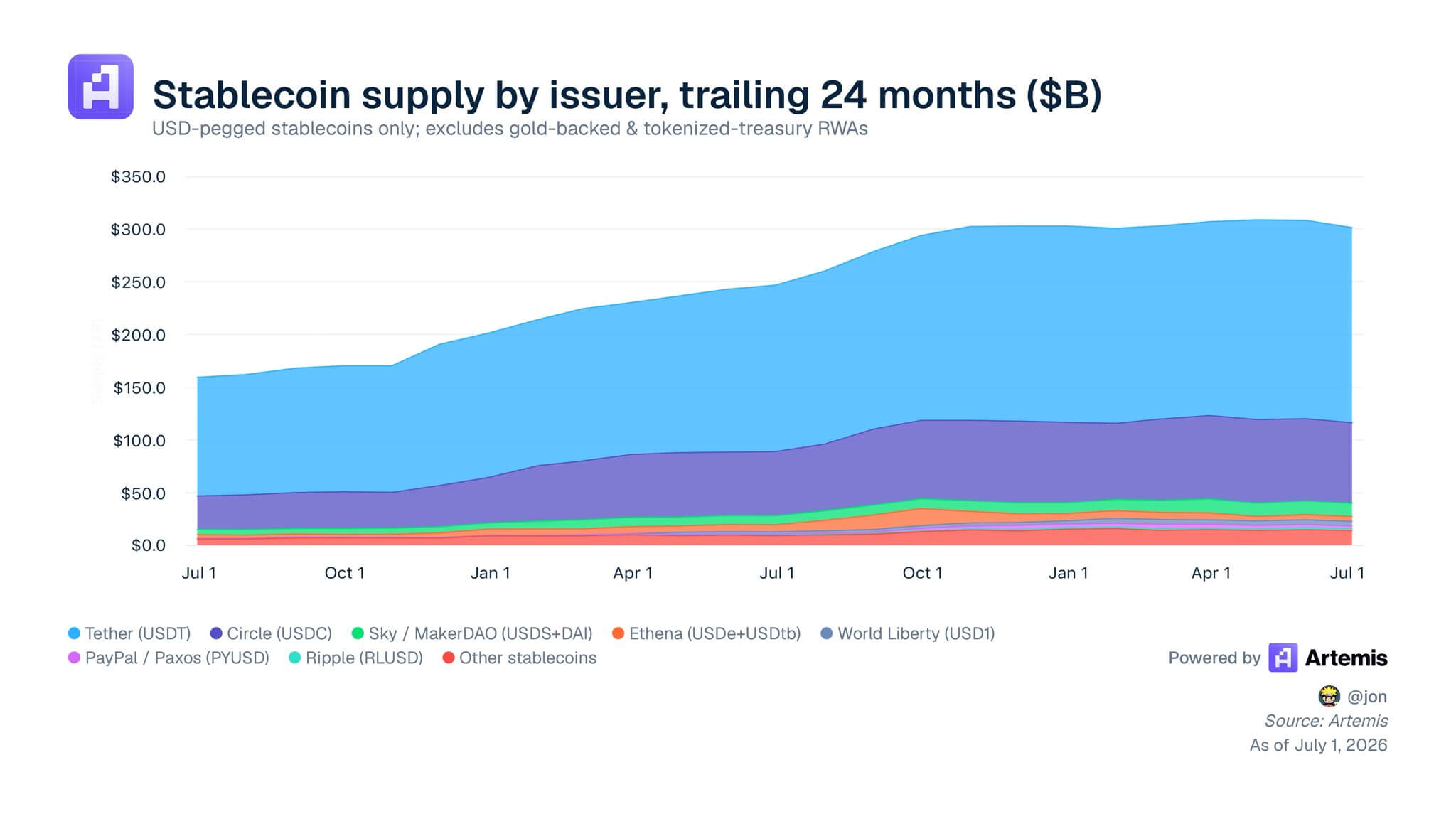

Stablecoin supply from various issuers over the past two years (Data source: Artemis)


Allaire believes that the data above is the result of nearly a decade of deep ecosystem integration, something an enterprise alliance cannot replace overnight. USDC's comprehensive coverage of major global financial trading centers, various DeFi protocols, and global payment service providers has built an insurmountable operational moat.


Addressing OUSD's promoted zero-fee model, Allaire raised doubts: while the zero-fee narrative sounds appealing, implementing it in the real market often requires more mature and structured commercial solutions. He revealed that Circle has long been reducing transaction flow costs by signing customized exclusive contracts with enterprise payment partners, rather than simply eliminating all fees across the board.


Furthermore, Allaire questioned whether large corporate alliances could operate efficiently in the rapidly changing digital asset industry, commenting that past large alliances in the financial sector were generally "slow-moving, with predictable outcomes." He said: "Large alliances composed of many big corporations find it difficult to coordinate. Diverse interest demands are hard to unify, slowing overall progress, making it almost impossible to nurture innovative outcomes with long-term competitiveness."


He also revealed that in the early days of USDC's development, Circle tried a small-scale alliance structure, ultimately finding that a streamlined, autonomous strategic partnership model was far more efficient than a committee-led alliance network.


From an operational cost perspective, Allaire warned: if all reserve earnings are allocated to channels, the stablecoin operator would have no retained funds for infrastructure investments such as global compliance licensing, risk control implementation, and 24/7 treasury fund management.


Multiple Hurdles for OUSD's Large-Scale Adoption


Market analysts remain cautious as well: even with the backing of numerous well-known enterprises, the OUSD alliance will find it difficult to quickly translate that into real on-chain liquidity.


Lorenzo Valente, Head of Digital Assets Research at ARK Invest, pointed out that any new stablecoin faces severe cold-start challenges. Capital markets and crypto exchange trading systems have long been optimized around the mature trading pair depth of USDT and USDC. He wrote: "There is no successful precedent for an alliance composed of hundreds of competing enterprises. Circle and Tether can independently plan product iterations and execute business without compromise to any partners; whereas alliances spanning multiple competing corporations will have extremely slow decision-making and progress."


Valente also raised concerns regarding regulation and antitrust issues: Circle and Tether have spent years obtaining multiple compliance licenses worldwide and building regulatory communication channels, enough to handle regulatory pressures from various countries. However, OUSD simultaneously aggregates global leading card networks, asset management companies, and major banks, making it too conspicuous a target, easily becoming a key subject for antitrust regulatory scrutiny.


At the same time, whether the OUSD founding members can maintain a long-term united front remains unknown. Stripe recently acquired the stablecoin infrastructure firm Bridge, continuously building its own financial service system; major banks are testing self-developed tokenized deposit products; Ripple is also launching its own stablecoin. These enterprises, holding vast distribution channels, are simultaneously deploying multiple digital asset product lines. They will not exclusively divert traffic to OUSD, and this traffic dispersion will significantly weaken OUSD's network expansion speed.


Kayla Phillips from blockchain venture capital firm Hivemind commented on this: "How will so many institutions coordinate governance? For efficient operation, it's impossible to give 140 enterprises equal decision-making power; if some companies cannot enter the core governance layer, how can they be continuously incentivized to stay in the alliance and participate in operations?"


The On-Chain Settlement Sector Moving Towards Fragmentation


The birth of OUSD reflects a larger trend in the stablecoin industry: the sector is gradually splitting, and the underlying stablecoin settlement layer may become more diverse. Large enterprises no longer view stablecoins solely as independent products for ordinary consumers but increasingly as standardized, reusable backend settlement tools.


For Circle, to maintain market share, it must accelerate the promotion of value-added development tools like the Cross-Chain Transfer Protocol (CCTP) and institutional embedded wallets, ensuring its software ecosystem provides added value beyond interest sharing.


Ultimately, the core competition in the stablecoin sector has shifted from a battle of underlying technologies to a direct contest over network profit distribution rights. Currently, channel platforms are banding together, seeking to reclaim the interest income generated by their own user traffic. The issuer-dominated stablecoin model is facing the strongest challenge from the channel side in its history.


Trend Kriptolar

İlgili Sorular

QWhy is Coinbase supporting the OUSD stablecoin project, given its historical role in distributing USDC?

ACoinbase is supporting OUSD to gain greater influence over the revenue distribution model in the stablecoin industry. As a key distributor of USDC, it seeks a larger share of the interest income generated from reserves, which is currently largely retained by the issuer, Circle. Its involvement in OUSD also provides strong negotiation leverage as its revenue-sharing agreement with Circle for USDC nears its renewal date in August 2026.

QWhat is the core innovation of the OUSD project according to the article?

AThe core innovation of OUSD is its new reserve yield distribution mechanism. It offers free minting and redemption services for businesses and is designed to direct the majority of the interest income from reserves directly to the distribution platforms that expand its user base and circulation, addressing the longstanding grievance of channel partners in the stablecoin ecosystem.

QWhat arguments does Circle's CEO, Jeremy Allaire, make in defense of USDC's dominant position?

AJeremy Allaire argues that USDC's dominance is based on deep, decade-long ecosystem integration and powerful network effects. He cites its massive on-chain transaction volume (nearly $30 trillion in Q1 2026, 80% of major chain stablecoin volume), superior liquidity dispersed across dozens of use cases (unlike competitors concentrated on single exchanges), and a global compliance and operational infrastructure that is difficult to replicate quickly by a new consortium.

QWhat are the main challenges analysts identify for the OUSD alliance's success?

AAnalysts identify several challenges: the 'cold start' problem of building liquidity and exchange pairs in a market dominated by USDT and USDC; potential inefficiency and slow decision-making within a large, competitive consortium of over 140 companies; heightened regulatory and antitrust scrutiny due to its high-profile members; and the risk of member companies not exclusively supporting OUSD as they also develop their own digital asset products, fragmenting potential user traffic.

QWhat broader industry trend does the emergence of OUSD represent?

AThe emergence of OUSD represents a trend where the stablecoin industry is fragmenting, and the underlying settlement layer is becoming more diverse. Large enterprises are increasingly viewing stablecoins not as standalone consumer products but as standardized, reusable backend settlement tools. The core competition is shifting from technological prowess to a direct negotiation over the distribution rights of network revenue, with distribution platforms challenging the issuer-led model to reclaim the yield generated by their user bases.

İlgili Okumalar

İşlemler

Spot

Popüler Makaleler

$USDC Nedir

Klasik USDC: Kapsamlı Bir Genel Bakış Klasik USDC'ye Giriş Kripto para piyasasının hızla değişen manzarasında, stabilcoinler kritik bileşenler olarak ortaya çıktı; özellikle dijital varlıkları karakterize eden dalgalanmalara karşı stabilite sağlamada. Bu projelerden biri Klasik USDC’dir; bu dijital para birimi girişimi, stabil ve güvenilir bir değişim aracı sunmayı amaçlamaktadır. ABD doları ile 1:1 oranında bir bağ kurarak, Klasik USDC kullanıcılarına, web3 ve kripto para ekosistemlerinde çeşitli uygulamalar için donatılmış güvenilir bir dijital varlık sunmayı hedeflemektedir. Klasik USDC Nedir? Klasik USDC, temel olarak fiyat dalgalanmasını en aza indirmek üzere tasarlanmış bir kripto para türü olan stabilcoin'dir. Özellikle, Klasik USDC ABD dolarının değerini yakından temsil etmeyi amaçlayarak, kullanıcıların bu dijital para birimini işlemler, tasarruflar ve diğer finansal faaliyetler için kullanabilmelerini sağlamakta; böylece birçok kripto paranın karşılaştığı aniden meydana gelen fiyat dalgalanmalarından dolayı duyacakları korkuyu ortadan kaldırmaktadır. Klasik USDC'nin ana hedefi, ABD dolarının güvenilir ve güvenilir bir dijital eşdeğerini sağlamak; böylece geniş bir yelpazede web3 uygulamalarına, merkeziyetsiz finans (DeFi) platformlarına ve diğer kripto ile ilgili finansal sistemlere sorunsuz bir entegrasyon sağlamaktır. Stabil bir dijital para sunarak, Klasik USDC günlük ticareti kolaylaştırmayı, blok zinciri teknolojisini daha kullanıcı dostu hale getirmeyi ve kripto paraların ana akım kullanıma kabulünü teşvik etmeyi amaçlamaktadır. Klasik USDC'nin Yaratıcısı Klasik USDC'nin yaratıcısının veya geliştirme ekibinin kimliği büyük ölçüde bilinmemektedir ve şeffaflık eksikliği, projenin kökenleri hakkında bir belirsizlik yaratmıştır. Birçok kripto para girişimi kurucularını ve geliştirme ekiplerini öne çıkartırken, Klasik USDC, yaratıcısıyla ilgili kesin bilgi sunmamaktadır; bu durum, potansiyel kullanıcıların veya yatırımcıların projenin güvenilirliğini ve dayanıklılığını değerlendirirken zorluklar yaşamasına neden olmaktadır. Klasik USDC Yatırımcıları Yaratıcılarıyla ilgili belirsizliğin yanı sıra, Klasik USDC’nin yatırımcıları konusunda da spesifiklikten yoksundur. Bir projenin finansal desteği, sıklıkla ona güvenilirlik kazandırabilir ve operasyonlarını stabilize edebilir; ancak Klasik USDC'yi destekleyen belgeye dayalı yatırım fonlarının veya kuruluşlarının yokluğu, fonlama yapısına dair sorular doğurmaktadır. Bu belirsizlik, paydaşların projeye olan güvenini potansiyel olarak baltalayabilir. Klasik USDC Nasıl Çalışır? Klasik USDC'nin operasyonel mekanikleri, bir stabilcoin'in temelini oluşturan rezerv sistemi üzerine yoğunlaşmaktadır. Klasik USDC, dolaşımdaki dijital para biriminin değerine doğrudan karşılık gelen bir varlık rezervi tutmayı taahhüt etmektedir. Özellikle, her bir Klasik USDC token’i için, nakit veya nakit benzeri varlıklar şeklinde, karşılık gelen bir miktar destekleyici varlık rezervde tutulmaktadır. Bu strateji, kullanıcıların token’larını ABD doları karşılığında ne zaman olursa olsun geri alabilecekleri güvenini sunarak Klasik USDC'nin değerini koruyabilmesi için tasarlanmıştır. Bu rezerv yapısı, Klasik USDC’nin stabilitesini ve güvenilirliğini artırmayı amaçlamakta ve onu kripto para piyasasında güvenli bir alternatif haline getirmektedir. Klasik USDC'nin değerinin sürekli olarak ABD doları ile ilişkili olmasını sağlayarak, proje, geniş pazar dinamiklerinden endişe duyan kullanıcılar arasında güven inşa etmeyi hedeflemektedir. Klasik USDC'nin Zaman Çizelgesi Klasik USDC'nin tarihi, kripto para ekosistemindeki yolculuğunu ve evrimini yansıtan birkaç önemli kilometre taşları ile işaretlenmiştir: 2021: Klasik USDC'nin başlangıcı, stabilite için tasarlanmış yeni bir dijital para seçeneği sunmasıyla kaydedilmiştir. Bu yıl, token’in etkinliğine dair ilk kayıtlar ortaya çıkmış ve başlangıç fiyat seviyeleri belirlenmiştir. 2024: Klasik USDC, kripto pazarının genel olarak çeşitli trendlerle ve kullanıcı duyarlılığıyla mücadele etmesiyle dikkat çeken fiyat dalgalanmaları yaşamaya başlamıştır. Gelecek potansiyeline dair tahminler ortaya çıkmakta, pazar gözlemcileri ve analistlerin büyüme fırsatlarına duyduğu güçlü ilgiyi işaret etmektedir. Gelecek Tahminleri Uzmanlar, Klasik USDC'nin önümüzdeki yıllarda daha yüksek kabul ve stabilite seviyelerine ulaşabileceğini, potansiyel olarak 2025 ve 2026 civarında daha fazla gelişme beklenebileceğini speküle etmektedir. Ancak, bu tahminlere temkinli bir iyimserlikle yaklaşılmalıdır; çünkü kripto para piyasası doğası gereği öngörülemezdir ve çeşitli dış faktörler Klasik USDC'nin seyri üzerinde etkili olabilir. Klasik USDC Hakkında Önemli Noktalar Stabilite: Klasik USDC'nin temel tezi, ABD dolarının değeri ile paralel bir dijital para sunmak etrafında döner; böylece sık sık dalgalanan bir pazarda stabilite sağlar. Rezerv Sistemi: Projenin değerini desteklemek için bir varlık rezervi tutma taahhüdü, güvenilirliğini ve operasyonel sağlamlığını vurgulamaktadır. Web3 ve Kripto Entegrasyonu: Klasik USDC, çeşitli uygulamalar içinde kolay entegrasyonu sağlamak üzere tasarlanmış ve kullanıcı deneyimini artırmanın yanı sıra günlük işlemlerde kripto paraların kabulünü genişletmeyi hedeflemektedir. Gelecek Büyüme Potansiyeli: Hala gelişmekte olan Klasik USDC, stabilcoinlerin web3 ve kripto bağlamında kullanımının artmasıyla potansiyel büyüme yolları sunmaktadır. Sonuç Klasik USDC, kripto para alanında dikkate değer bir stabilcoin girişimi olarak kendini göstermekte; kullanıcılarına ABD dolarının stabilitesini temsil eden güvenilir bir dijital para sunmayı hedeflemektedir. Yaratıcıları ve finansal destekle ilgili belirsizliklere rağmen, Klasik USDC'nin arkasındaki ilkeler – rezerv destekli güvenceler etrafında şekillenen – onu dijital ekonomi içinde bireyler ve işletmeler için güvenilir bir seçenek olarak konumlandırma çabasındadır. Geleceğe yönelik bir bakışla, piyasa analistleri Klasik USDC'nin kripto para manzarasındaki değişen dinamiklere nasıl yanıt verdiğini gözlemlemek konusunda heveslidir; bu durum, onu stabilcoinler alanında önemli bir oyuncu haline getirebilir.

54 Toplam GörüntülenmeYayınlanma 2024.05.01Güncellenme 2024.12.03

$USDC Nedir

USDC Nasıl Satın Alınır

HTX.com’a hoş geldiniz! USD Coin (USDC) satın alma işlemlerini basit ve kullanışlı bir hâle getirdik. Adım adım açıkladığımız rehberimizi takip ederek kripto yolculuğunuza başlayın. 1. Adım: HTX Hesabınızı OluşturunHTX'te ücretsiz bir hesap açmak için e-posta adresinizi veya telefon numaranızı kullanın. Sorunsuzca kaydolun ve tüm özelliklerin kilidini açın. Hesabımı Aç2. Adım: Kripto Satın Al Bölümüne Gidin ve Ödeme Yönteminizi SeçinKredi/Banka Kartı: Visa veya Mastercard'ınızı kullanarak anında USD Coin (USDC) satın alın.Bakiye: Sorunsuz bir şekilde işlem yapmak için HTX hesap bakiyenizdeki fonları kullanın.Üçüncü Taraflar: Kullanımı kolaylaştırmak için Google Pay ve Apple Pay gibi popüler ödeme yöntemlerini ekledik.P2P: HTX'teki diğer kullanıcılarla doğrudan işlem yapın.Borsa Dışı (OTC): Yatırımcılar için kişiye özel hizmetler ve rekabetçi döviz kurları sunuyoruz.3. Adım: USD Coin (USDC) Varlıklarınızı SaklayınUSD Coin (USDC) satın aldıktan sonra HTX hesabınızda saklayın. Alternatif olarak, blok zinciri transferi yoluyla başka bir yere gönderebilir veya diğer kripto para birimlerini takas etmek için kullanabilirsiniz.4. Adım: USD Coin (USDC) Varlıklarınızla İşlem YapınHTX'in spot piyasasında USD Coin (USDC) ile kolayca işlemler yapın.Hesabınıza erişin, işlem çiftinizi seçin, işlemlerinizi gerçekleştirin ve gerçek zamanlı olarak izleyin. Hem yeni başlayanlar hem de deneyimli yatırımcılar için kullanıcı dostu bir deneyim sunuyoruz.

386 Toplam GörüntülenmeYayınlanma 2024.12.11Güncellenme 2026.06.02

USDC Nasıl Satın Alınır

Tartışmalar

HTX Topluluğuna hoş geldiniz. Burada, en son platform gelişmeleri hakkında bilgi sahibi olabilir ve profesyonel piyasa görüşlerine erişebilirsiniz. Kullanıcıların USDC (USDC) fiyatı hakkındaki görüşleri aşağıda sunulmaktadır.

活动图片