Broadcom vs AMD: Which is the Most Promising AI Chip Stock to Bet on After Nvidia?

marsbit2026-06-09 tarihinde yayınlandı2026-06-09 tarihinde güncellendi

Özet

Amidst Nvidia's dominance in the AI chip market, Broadcom and AMD are key contenders for the second-place spot. AMD competes directly in general-purpose GPUs, gaining some traction with clients like Meta but facing significant challenges overcoming Nvidia's entrenched CUDA software ecosystem. In contrast, Broadcom pursues a differentiated strategy by designing custom XPU chips tailored to specific AI workloads for major clients like Anthropic, Google, Meta, and OpenAI. This approach offers efficiency advantages and greater customer stickiness, particularly as AI compute shifts from training to inference. Despite a recent stock sell-off following a Q2 revenue guidance miss, Broadcom's CEO reaffirmed the long-term target of $100 billion in annual AI chip revenue by fiscal 2027. With Q2 AI revenue at $10.8 billion, significant growth potential remains as its custom chip projects ramp up. While Broadcom trades at a higher valuation multiple than AMD, analysts argue this premium is justified given its superior competitive positioning and expected faster growth trajectory, making it the more compelling investment choice following its recent pullback.

Author: Justin Pope

Compiled by: Tide Research

Introduction: Beyond Nvidia, the battle for the runner-up position in AI chips is heating up. AMD has chosen to directly challenge Nvidia's general-purpose GPU path, while Broadcom takes a differentiated approach with custom chips (XPU), securing top clients like Anthropic, Google, Meta, and OpenAI.

Following the latest earnings report, Broadcom's stock price fell sharply, but the CEO still maintains the target of reaching $100 billion in annual AI chip revenue by fiscal year 2027. Motley Fool analyst Justin Pope believes that even though Broadcom is more expensive, this premium is worth paying.

Caption: Source Getty Images

Nvidia still firmly holds the top spot in the AI data center chip market. But the AI pie is simply too large, making the runner-up position equally valuable. According to Statista estimates, the AI chip market will grow to $333 billion by 2030.

This means other companies also have the opportunity to make investors a lot of money. Broadcom (AVGO, down 7.49% on the day) and AMD (down 11.01% on the day) are the two most competitive candidates. Both companies have made progress in the AI chip field, but overall, one is clearly more worthy of holding than the other.

AMD Chose a More Difficult Path

The core question is: How can a smaller company compete for market share with an industry giant?

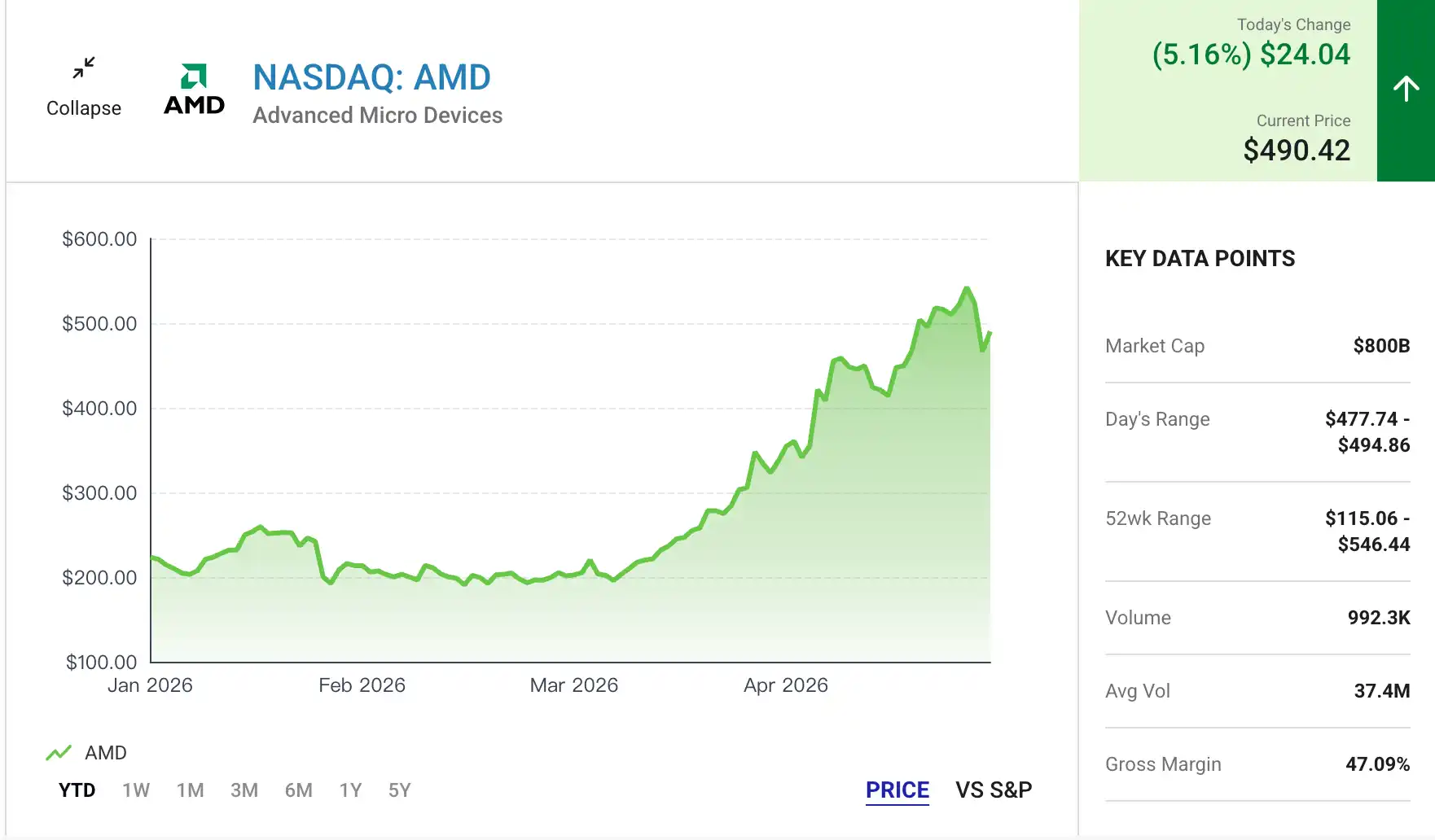
AMD's strategy is to compete head-on with Nvidia in the field of general-purpose AI chips. To be fair, it has indeed achieved some results. Q1 2026 data center revenue grew 57% year-over-year to $5.8 billion.

AMD benefits from AI hyperscalers' natural desire not to put all their eggs in Nvidia's basket. AMD recently announced it will supply Meta with 6 GW of Instinct GPUs, with the first GW being a custom version.

But AMD is unlikely to truly threaten Nvidia's dominance. Meta and other Nvidia customers are deeply entrenched in Nvidia's CUDA software ecosystem. The moat of CUDA cannot be crossed by hardware specifications alone.
Broadcom's Custom Chip Path is the Winner

To breach Nvidia's moat, one must take a different path. Broadcom has achieved this with its XPU chips.

Unlike AMD, which emphasizes general-purpose AI chips, Broadcom tailors chips to each customer's specific AI workloads. This approach brings efficiency advantages and makes customer relationships stickier. Currently, Broadcom is designing custom chips for companies like Anthropic, Alphabet (Google's parent company), Meta, and OpenAI.

As computing demand shifts from training to inference, efficiency becomes even more critical, further amplifying the advantages of custom chips.

Following the latest Q2 earnings report, Wall Street heavily sold off Broadcom, mainly due to Q3 AI revenue guidance falling short of expectations. But CEO Hock Tan reiterated on the earnings call that the company's long-term expectation of reaching $100 billion in annual AI chip sales by fiscal 2027 remains unchanged. Q2 AI revenue was $10.8 billion, and there is still significant growth potential as custom chip projects ramp up.

You Get What You Pay For

With a roster of top-tier AI clients and steady progress toward the $100 billion annual revenue target, Broadcom indeed has a stronger competitive position than AMD. Investors may note that Broadcom's stock is more expensive than AMD's, but this premium is justified.
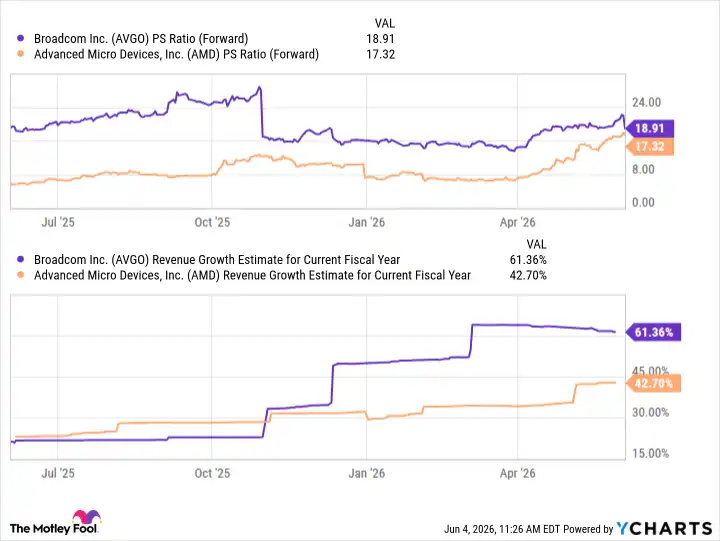
Caption: AVGO vs AMD Forward Price-to-Sales Ratio Comparison, Source YCharts

Analysts expect Broadcom's growth to be significantly faster than AMD's, and the valuation gap between the two is not that large. Especially after the pullback following the earnings report, Broadcom is more worthy of a buy.

İlgili Sorular

QAccording to the article, what are the main differences between AMD's and Broadcom's strategies in the AI chip market?

AAMD is taking a generalist approach, competing directly with Nvidia in the market for general-purpose AI GPUs. In contrast, Broadcom follows a differentiated, custom chip (XPU) strategy, designing chips tailored to the specific AI workloads of individual clients like Anthropic, Google, Meta, and OpenAI.

QWhat reason does the analyst give for Broadcom's stock being more expensive (having a valuation premium) compared to AMD's?

AThe analyst argues that Broadcom's premium valuation is justified because it holds a superior competitive position with a roster of top-tier AI clients and is projected to grow significantly faster than AMD, as it progresses toward its long-term AI revenue target of $100 billion annually by fiscal 2027.

QWhat was the market reaction and the CEO's response following Broadcom's latest quarterly earnings report?

AFollowing its Q2 earnings report, Broadcom's stock fell sharply due to a Q3 AI revenue forecast that fell short of expectations. However, CEO Hock Tan reaffirmed the company's long-term target of achieving $100 billion in annual AI chip sales by fiscal 2027.

QWhat is identified as a key competitive barrier that makes it difficult for AMD to challenge Nvidia's dominance?

AThe article identifies Nvidia's CUDA software ecosystem as a key competitive barrier or 'moat.' Major clients like Meta are deeply entrenched in this ecosystem, making it very difficult for competitors like AMD to overcome through hardware specifications alone.

QWhy might Broadcom's custom chip (XPU) strategy become even more advantageous in the future, according to the article?

AThe article suggests that as the focus of computing demand shifts from AI training to inference, efficiency becomes more critical. Broadcom's custom chips, which are optimized for specific client workloads, offer efficiency advantages that will likely become even more valuable in this evolving market landscape.

İlgili Okumalar

AI Investors' 2026 Anxiety: When Models Devour Everything, What Moat Is Left for Startups?

In 2026, a wave of investor anxiety questions the defensibility of AI startups as models improve, fearing that most companies are just "thin wrappers" destined to be absorbed by foundation models or chipmakers. The author argues against this despair, positing that true moats lie not in benchmark performance but in areas models cannot easily reach. The logic of despair is that if models excel at all measurable tasks, only compute and cutting-edge model weights hold lasting value. However, the essay contends that the most valuable work is inherently "untrainable." Benchmarks measure what can be measured and thus optimized for, but real-world correctness often resides in private, complex systems. Examples include legacy codebases, intricate legal transactions, or hospital workflows. This kind of correctness is proprietary, costly to establish, and cannot be validated quickly—it requires time and trust within an organization. As models commodify visible, measurable tasks from both above (labs absorbing scaffolding) and below (saturation by cheaper models), value shifts to "untrainable ground." This encompasses work where correctness is a private truth, locked behind integration barriers, licenses, liability frameworks, and entrenched user habits. Trust and adoption are slow, human-centric processes that smarter models cannot accelerate. Successful companies defend their position by embedding deeply into client operations, owning the definition of "good" within a specific domain (e.g., Harvey in law, OpenEvidence in medicine), and pricing on outcomes rather than tokens. While labs compete fiercely, they are incentivized to keep the application layer vibrant. The future belongs not to those competing on generic benchmarks but to those navigating unscoreable terrain, doing the "unsexy work" of translation between models and messy human realities. The most cited benchmark scores are thus maps of territory about to become worthless, signaling who will lose the right to define what counts as good.

marsbit29 dk önce

AI Investors' 2026 Anxiety: When Models Devour Everything, What Moat Is Left for Startups?

marsbit29 dk önce

Trump's Crypto Empire: A $2.3 Billion Wealth Transfer Experiment

In June 2026, Reuters investigations revealed that since Donald Trump's return to the White House, his family has accumulated roughly $2.3 billion in profits from four core crypto ventures: World Liberty Financial (WLFI), the $TRUMP meme coin, American Bitcoin, and ALT5 Sigma (later renamed AI Financial). Coincidentally, overall investor losses in these projects were estimated to be a similar amount. The businesses, spanning DeFi, stablecoins, meme coins, Bitcoin mining, and digital payments, largely relied not on technological innovation but on converting the political influence and notoriety of the Trump brand into financial assets sold to the market. This marks a dramatic shift from Trump's earlier skepticism of cryptocurrencies. The ventures operated on a similar logic: leveraging the Trump name to generate market hype and trust, attracting investment through token sales or public listings, and enabling the family to capture profits upfront through equity, token allocations, and fees, while later entrants often bore the brunt of the risk as markets cooled. WLFI, the most profitable venture, generated an estimated $1.6 billion for the family, primarily through sales of its locked, illiquid governance token and its USD1 stablecoin. The $TRUMP meme coin, a direct monetization of the presidential IP, brought in over $600 million for Trump-linked entities before its price crashed nearly 97% from its peak. American Bitcoin gained a "Trump stock" premium for its mining operations, and ALT5 Sigma/AI Financial combined Trump, AI, and crypto themes for a temporary valuation surge. The episode underscores how political influence can be packaged into financial assets, creating substantial wealth for promoters while highlighting the risks for investors who base decisions on hype and brand allegiance over fundamental business models and cash flows.

marsbit1 saat önce

Trump's Crypto Empire: A $2.3 Billion Wealth Transfer Experiment

marsbit1 saat önce

CFTC Proposes New Rules for Prediction Markets, Redefining Which Events Can Be Listed and Who Can Participate

The U.S. Commodity Futures Trading Commission (CFTC) has proposed new rules to establish a clearer regulatory framework for prediction markets. The proposal aims to modify how "event contracts" are reviewed, creating a structured process to determine if contracts involving terrorism, assassination, war, or illegal activities violate the public interest. This moves away from a blanket ban toward a case-by-case assessment of whether a contract's subject matter is acceptable for financial trading. A key focus is distinguishing between predicting the impact of risks and predicting the occurrence of harm. The proposal suggests that many sports-based prediction markets—such as those on game outcomes, scores, or season standings—may be permissible as they can provide price discovery and meaningful information. However, markets on easily manipulated events like specific player injuries, referee calls, or outcomes of youth sports would face stricter scrutiny. The rules directly target insider trading and manipulation risks, highlighting cases where individuals with non-public information or the ability to influence an event's outcome could unfairly profit. This underscores a shift toward ensuring market fairness. The proposal does not end the regulatory debate, particularly with state gambling regulators who argue that sports prediction markets are essentially sports betting and should fall under state jurisdiction. Nonetheless, the CFTC's action signals a move toward formalizing prediction markets, pushing the industry from a phase of rapid, often unregulated expansion into a more institutionalized, rule-based environment that more closely resembles traditional financial markets.

marsbit1 saat önce

CFTC Proposes New Rules for Prediction Markets, Redefining Which Events Can Be Listed and Who Can Participate

marsbit1 saat önce

İşlemler

Spot
Futures

Popüler Makaleler

CHIP Nasıl Satın Alınır

HTX.com’a hoş geldiniz! USD.AI (CHIP) satın alma işlemlerini basit ve kullanışlı bir hâle getirdik. Adım adım açıkladığımız rehberimizi takip ederek kripto yolculuğunuza başlayın. 1. Adım: HTX Hesabınızı OluşturunHTX'te ücretsiz bir hesap açmak için e-posta adresinizi veya telefon numaranızı kullanın. Sorunsuzca kaydolun ve tüm özelliklerin kilidini açın. Hesabımı Aç2. Adım: Kripto Satın Al Bölümüne Gidin ve Ödeme Yönteminizi SeçinKredi/Banka Kartı: Visa veya Mastercard'ınızı kullanarak anında USD.AI (CHIP) satın alın.Bakiye: Sorunsuz bir şekilde işlem yapmak için HTX hesap bakiyenizdeki fonları kullanın.Üçüncü Taraflar: Kullanımı kolaylaştırmak için Google Pay ve Apple Pay gibi popüler ödeme yöntemlerini ekledik.P2P: HTX'teki diğer kullanıcılarla doğrudan işlem yapın.Borsa Dışı (OTC): Yatırımcılar için kişiye özel hizmetler ve rekabetçi döviz kurları sunuyoruz.3. Adım: USD.AI (CHIP) Varlıklarınızı SaklayınUSD.AI (CHIP) satın aldıktan sonra HTX hesabınızda saklayın. Alternatif olarak, blok zinciri transferi yoluyla başka bir yere gönderebilir veya diğer kripto para birimlerini takas etmek için kullanabilirsiniz.4. Adım: USD.AI (CHIP) Varlıklarınızla İşlem YapınHTX'in spot piyasasında USD.AI (CHIP) ile kolayca işlemler yapın.Hesabınıza erişin, işlem çiftinizi seçin, işlemlerinizi gerçekleştirin ve gerçek zamanlı olarak izleyin. Hem yeni başlayanlar hem de deneyimli yatırımcılar için kullanıcı dostu bir deneyim sunuyoruz.

327 Toplam GörüntülenmeYayınlanma 2026.04.21Güncellenme 2026.06.02

CHIP Nasıl Satın Alınır

Tartışmalar

HTX Topluluğuna hoş geldiniz. Burada, en son platform gelişmeleri hakkında bilgi sahibi olabilir ve profesyonel piyasa görüşlerine erişebilirsiniz. Kullanıcıların CHIP (CHIP) fiyatı hakkındaki görüşleri aşağıda sunulmaktadır.

活动图片