Brian Armstrong Praises ‘Diamond Hands’ as Coinbase Reports Strong Retail Activity

bitcoinist2026-02-17 tarihinde yayınlandı2026-02-17 tarihinde güncellendi

Özet

Brian Armstrong, CEO of Coinbase, reports that retail investors are displaying "diamond hands" by continuing to accumulate Bitcoin and Ethereum despite recent market volatility. According to Coinbase data, most retail customers now hold equal or greater amounts of these cryptocurrencies in native units compared to December 2025, indicating accumulation during price declines. This behavior contrasts with previous cycles where retail often sold during corrections. Armstrong's comments come amid his own significant stock sales, totaling over $550 million since April 2025 under a prearranged trading plan. Analysts suggest sustained retail buying could stabilize markets, though sentiment remains sensitive to macro conditions and regulatory challenges.

Retail investors appear to be holding their ground through the latest wave of crypto market volatility, according to new data shared by Brian Armstrong, chief executive of Coinbase.

The exchange says many individual users have continued accumulating major cryptocurrencies despite price swings, a trend Armstrong described as evidence of “diamond hands.”

The remarks arrive at a time when digital asset markets remain uncertain, shaped by macroeconomic pressure, regulatory developments, and leveraged trading activity. While prices have fluctuated sharply, Coinbase’s internal metrics suggest retail traders are behaving differently compared to previous downturns.
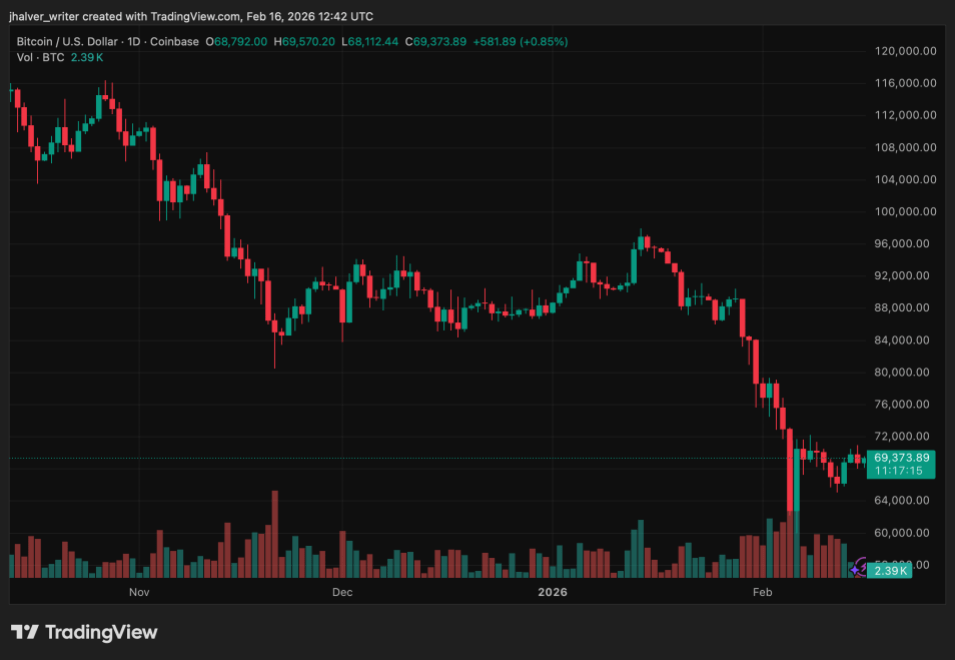
BTC's price trends to the downside on the daily chart. Source: BTCUSD on Tradingview

Retail Investors Buy the Dip During Market Volatility

Armstrong said platform data shows most retail customers now hold equal or greater amounts of Bitcoin and Ethereum than they did in December 2025. The figures track “native units,” meaning the number of coins held rather than their dollar value, indicating accumulation even as prices moved lower.

Bitcoin recently traded near $68,500, while Ethereum hovered around the $2,000 level after a period of declines and rebounds. According to Coinbase, many users responded to the pullback by adding to their positions rather than exiting the market.

The trend contrasts with earlier crypto cycles, when retail investors were often seen selling during sharp corrections. Analysts note that steady spot buying from smaller investors can help counterbalance volatility driven by derivatives markets, where leveraged positions frequently amplify price swings through liquidations.

Coinbase also reported that retail accumulation contributed to renewed activity on the platform, with its stock rising in recent sessions alongside increased trading interest in the two largest cryptocurrencies.

Executive Stock Sales Draw Attention

Armstrong’s praise for retail resilience has coincided with scrutiny over his own share sales. Regulatory filings show the CEO has sold more than $550 million worth of Coinbase stock between April 2025 and January 2026, including transactions exceeding $100 million in recent months.

The sales were executed under a prearranged Rule 10b5-1 trading plan, a mechanism commonly used by public-company executives to schedule stock disposals in advance.

Supporters argue that such plans are standard financial management tools, while critics say the scale of the sales sends mixed signals, encouraging retail investors to hold through volatility.

Similarly, Coinbase continues to navigate broader challenges, including regulatory disputes tied to new product expansions such as prediction markets in several U.S. states.

What Retail Resilience Means for Market Sentiment

Market analysts say sustained retail accumulation could play a stabilizing role if macro conditions improve. Historically, periods where smaller investors continue buying during downturns have sometimes preceded recovery phases in crypto cycles.

However, sentiment remains sensitive to interest rate expectations, geopolitical risks, and institutional flows. For Coinbase, the combination of strong retail engagement and ongoing insider selling highlights the complex balance between leadership messaging, investor perception, and market performance in a volatile environment.

Cover image from ChatGPT, BTCUSD chart from Tradingview

İlgili Sorular

QWhat does Brian Armstrong's praise of 'diamond hands' refer to in the context of Coinbase's recent report?

AIt refers to retail investors holding or accumulating major cryptocurrencies like Bitcoin and Ethereum despite recent market volatility and price declines, rather than selling their positions.

QHow does the current behavior of retail investors on Coinbase differ from previous crypto market downturns?

AUnlike previous cycles where retail investors often sold during sharp corrections, current data shows they are accumulating more coins or holding their ground, demonstrating increased resilience.

QWhat potential market impact does sustained retail accumulation have according to analysts?

AAnalysts suggest that steady spot buying from retail investors can help counterbalance volatility driven by derivatives markets and may play a stabilizing role if macroeconomic conditions improve, sometimes preceding recovery phases.

QWhat controversy has emerged alongside Armstrong's comments about retail investor behavior?

AArmstrong has faced scrutiny for selling over $550 million worth of Coinbase stock between April 2025 and January 2026 through prearranged trading plans, which some say sends mixed signals while encouraging retail investors to hold.

QWhat specific metric does Coinbase use to show retail accumulation despite price declines?

ACoinbase tracks 'native units' - the actual number of coins held by users - rather than dollar value, showing most retail customers hold equal or greater amounts of Bitcoin and Ethereum compared to December 2025 despite lower prices.

İlgili Okumalar

Anthropic's IPO Launch: Commercial Miracle or Valuation Bubble?

Anthropic has confidentially filed for an IPO, led by Morgan Stanley and Goldman Sachs, potentially going public by October. Following its latest $650 billion funding round, its pre-IPO valuation stands at $965 billion, with projections reaching up to $2 trillion at listing, which would make it the highest-valued private company ever. The article, written by Fu Sheng, addresses skepticism that this represents an AI bubble akin to the 2000 dot-com crash. It argues the current situation differs fundamentally. Unlike the internet bubble era, which relied on speculative narratives with little revenue, Anthropic's valuation is backed by unprecedented, measurable financial performance. Key data points include: * **Revenue Growth:** ARR skyrocketed from $10 billion in early 2025 to $470 billion by May 2026, targeting $100 billion by year-end—a growth curve unmatched in business history. * **Profitability:** It achieved operating profitability in Q2 2026 with an estimated $5.6 billion profit. * **Efficiency:** With ~3,000 employees and ~$470 billion ARR, its revenue per employee exceeds $10 million. Products like Claude Code, launched less than a year ago, already generate $25 billion in annualized revenue. * **Enterprise Adoption:** It boasts a strong enterprise client base, with 8 of the Fortune 10 and over 1,000 large firms spending over $1 million annually on Claude. The valuation is framed using a traditional SaaS model (e.g., a 10x Price-to-Sales multiple on $100 billion revenue). The author contends the core question for analysts has shifted from "How big could this be?" to "How much is it earning and will earn next quarter?" The discussion extends beyond Anthropic to a broader paradigm shift: the transition from a "carbon-based" to a "silicon-based" economy. Companies are increasingly prioritizing investment in compute and AI capabilities over human resources, as these directly scale productivity and competitive advantage. Anthropic's IPO is thus positioned not just as a corporate milestone, but as a price anchor for this new economic era.

链捕手2 saat önce

Anthropic's IPO Launch: Commercial Miracle or Valuation Bubble?

链捕手2 saat önce

Near Returns to the AI Stage: Transformation into a Public Chain Due to 'Payroll Difficulties,' Agent and Privacy Emerge as New Growth Narratives

NEAR Returns to AI Origins: From Payroll Struggles to Blockchain, Now Focusing on AI Agents and Privacy NEAR Protocol's journey began not with grand blockchain ambitions, but from a practical hurdle: its AI startup founders, including Transformer paper co-author Illia Polosukhin, couldn't efficiently pay international developers in 2017. This led them to pivot and build a high-performance, scalable blockchain. After years navigating various crypto narratives like sharding and cross-chain interoperability, NEAR is now leveraging its AI roots to re-enter the AI arena. A key driver is its "NEAR Intents" layer, which abstracts complex cross-chain transactions. Users simply state their goal (e.g., swap BTC for ETH), and a solver network finds the optimal route. This system has processed over $20B in cross-chain volume, generating significant fee revenue. A major growth area is private transactions via "Confidential Intents/Swaps," which hide trade details until settlement to protect against MEV and front-running. Remarkably, private swaps recently accounted for over 40% of NEAR's transaction volume, highlighting strong demand but also potential regulatory scrutiny. With its AI-founder pedigree, NEAR is positioning itself at the intersection of blockchain, AI agents, and privacy, aiming to become infrastructure for the emerging agent economy while navigating the challenges of its rapid adoption.

marsbit4 saat önce

Near Returns to the AI Stage: Transformation into a Public Chain Due to 'Payroll Difficulties,' Agent and Privacy Emerge as New Growth Narratives

marsbit4 saat önce

İşlemler

Spot
Futures
活动图片





