Breaking Away from Traditional Investment Paths: Cryptocurrency Emerges as the Primary Battlefield for Wealth Among the Younger Generation

比推2025-12-17 tarihinde yayınlandı2025-12-17 tarihinde güncellendi

Özet

Coinbase's latest industry report, in collaboration with Ipsos, reveals a significant generational shift in investment strategies. Younger investors, including Gen Z and millennials, are increasingly moving away from traditional wealth-building paths like buying real estate and investing in stocks. The survey of over 2,000 U.S. investors found that 73% of young people believe it's harder for their generation to build wealth through conventional means compared to their parents' generation. This sentiment is reflected in their portfolios: younger investors allocate 25% of their investments to non-traditional assets like cryptocurrencies, derivatives, and NFTs—three times the allocation of older investors. Nearly half (45%) of young investors already hold cryptocurrency, compared to just 18% of older investors. They view crypto not as a speculative side investment but as a core component for catching up financially, with 80% believing it offers more opportunities outside the traditional financial system. Younger investors are also more active, trade more frequently, and are willing to take higher risks for greater returns. They express strong interest in emerging crypto products like derivatives, prediction markets, and DeFi lending. This trend is pushing the financial industry toward 24/7, multi-asset platforms that better serve this internet-native generation.

Author: Coinbase

Compiled by: Chopper, Foresight News

Original Title: Moving Beyond Home Buying and Stock Trading, the Younger Generation Embraces Cryptocurrency as the Main Arena for Wealth


For decades, the path to wealth accumulation for Americans has remained largely unchanged: secure a good job, purchase property, invest in stocks, and wait for the power of compound interest to yield returns. However, our latest "Cryptocurrency Industry Report" reveals that the younger generation of investors no longer believes in this traditional path and is adjusting their investment strategies accordingly.

To understand how different generations approach the market and the role cryptocurrency plays in their investment portfolios, Coinbase partnered with Ipsos to conduct a specialized survey. The study interviewed 4,350 American adults, including 2,005 investors with investment accounts. The key findings are as follows: Younger investors, such as Gen Z and Millennials, are more inclined to manage their investments actively, more open to non-traditional assets, and more likely to view cryptocurrency as a core component of their financial future.
A Generation Shut Out of the Traditional Wealth Ladder

Younger investors are far more optimistic about the economy than older generations, but they believe the existing financial system is not designed for them. Survey data shows that nearly seven out of ten (73%) young people believe it is more difficult for their generation to accumulate wealth through traditional means compared to their parents' generation. In contrast, only 57% of older generations share this view.

They have witnessed soaring housing costs, overwhelming student debt, and sluggish wage growth. In this context, an increasing number of young people are seeking alternative wealth accumulation methods beyond the traditional model of "home equity + stock portfolio."

Non-Traditional Asset Allocation Three Times Higher Than Older Generations

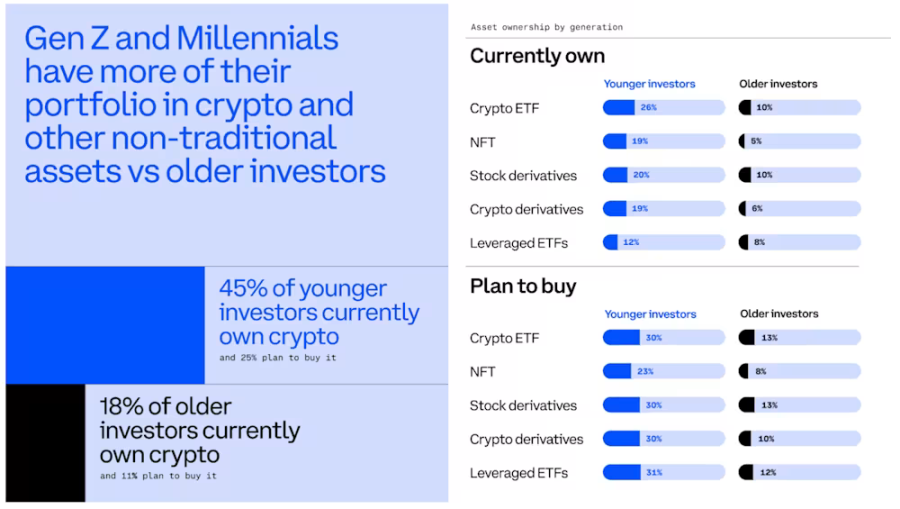
This anxiety is directly reflected in their asset allocation strategies. The survey reveals that younger investors allocate 25% of their investment portfolios to non-traditional asset classes such as cryptocurrencies, financial derivatives, non-fungible tokens (NFTs), and other emerging products. This proportion is three times higher than that of older investors, who allocate only 8% to non-traditional assets.

The proportion of stock holdings is roughly similar across generations, but the key difference lies in the diversification of younger investors' portfolios beyond stocks. They are more actively seeking opportunities for returns beyond traditional stock dividends and are more willing to experiment with new investment tools and emerging markets to narrow the wealth gap.

Cryptocurrency Is Not a Side Hustle but a Core Allocation

This generational shift in investment philosophy is most evident in the acceptance of cryptocurrency. The report shows that 45% of younger investors already hold cryptocurrencies, compared to only 18% of older investors. Additionally, nearly half (47%) of younger investors want to gain early access to new crypto assets before they become mainstream. In contrast, only 16% of older investors express this desire.

For the younger generation, cryptocurrency is not merely a speculative trade but a crucial tool to help them catch up in wealth accumulation. Eighty percent of young people believe that cryptocurrency provides their generation with more financial opportunities outside the traditional financial system. At the same time, another 80% are convinced that cryptocurrency will play a significantly larger role in the future financial system. Among older investors, only about 60% share this view.

The younger generation's enthusiasm for exploring emerging markets extends beyond spot cryptocurrencies; they are also eager to engage with more non-traditional assets. Data shows that 80% of young investors are willing to try new investment opportunities ahead of others, while less than half of older generations share this attitude. Younger investors consistently show strong interest in emerging non-traditional products such as cryptocurrency derivatives, prediction markets, 24/7 stock trading, early token offerings, altcoins, and decentralized finance (DeFi) lending.

Implications of This Trend for Future Markets

The younger generation of investors has already demonstrated distinct characteristics: they trade more frequently, are willing to take greater risks for higher returns, and are shifting a significant portion of their investment portfolios to non-traditional assets, with cryptocurrency at the core. At the same time, they are driving the entire financial industry toward a transformation that better meets the needs of the internet-native generation, creating platforms that operate around the clock and support diverse asset trading.


Twitter: https://twitter.com/BitpushNewsCN

BitPush Telegram Group: https://t.me/BitPushCommunity

BitPush Telegram Subscription: https://t.me/bitpush

Original Link: https://www.bitpush.news/articles/7596437

İlgili Sorular

QWhat is the main finding of the Coinbase and Ipsos research regarding younger investors?

AThe research found that younger investors, such as Gen Z and Millennials, are more likely to actively manage their investments, embrace non-traditional assets, and view cryptocurrency as a core component of their financial future.

QWhy do younger investors feel the traditional wealth-building path is not for them?

AThey believe it is harder to build wealth through traditional means due to rising housing costs, high student debt, and slow wage growth, making alternative paths like cryptocurrency more appealing.

QHow much of their portfolio do younger investors allocate to non-traditional assets compared to older investors?

AYounger investors allocate 25% of their portfolio to non-traditional assets, which is three times the 8% allocated by older investors.

QWhat percentage of younger investors hold cryptocurrency, and how does this compare to older investors?

A45% of younger investors hold cryptocurrency, compared to only 18% of older investors.

QWhat do younger investors believe about the role of cryptocurrency in the future financial system?

A80% of younger investors believe cryptocurrency provides financial opportunities outside the traditional system and that it will play a significantly larger role in the future financial system.

İlgili Okumalar

Polymarket's "2028 Presidential Election" Volume King Is... LeBron James???

An article from Odaily Planet Daily, authored by Azuma, discusses a peculiar phenomenon observed on the prediction market platform Polymarket regarding the "2028 US Presidential Election" event. Despite having a real-time probability of less than 1%, unlikely candidates such as NBA star LeBron James (with $48.41 million in trading volume), celebrity Kim Kardashian ($33.84 million), and even ineligible figures like Elon Musk ($23.14 million) and New York City Mayor Zohran Mamdani ($18.39 million) account for approximately 70% of the total trading volume. In contrast, high-probability candidates like Vice President JD Vance ($10.58 million), California Governor Gavin Newsom ($15.71 million), and Secretary of State Marco Rubio ($9.32 million) have significantly lower trading activity. The article explains that this counterintuitive trend is not driven by irrational speculation but by rational strategies. Polymarket offers a 4% annualized holding reward for certain markets, including the 2028 election, to maintain long-term pricing accuracy. This yield exceeds the current 5-year US Treasury rate (3.98%), attracting large investors ("whales") to hold "NO" shares on low-probability candidates for risk-free returns. Additionally, some users utilize a platform feature that allows converting a set of "NO" shares into corresponding "YES" shares for better liquidity or pricing efficiency, rather than directly buying "YES" shares for their preferred candidates. Thus, the seemingly absurd trading activity is strategically motivated.

marsbit20 dk önce

Polymarket's "2028 Presidential Election" Volume King Is... LeBron James???

marsbit20 dk önce

Dialogue with ViaBTC CEO Yang Haipo: Is the Essence of Blockchain a Libertarian Experiment?

"ViaBTC CEO Yang Haipo: Blockchain as a Hardcore Libertarian Experiment" In a deep-dive interview, ViaBTC CEO Yang Haipo reframes the essence of blockchain, arguing it is not merely a new technology or infrastructure but a hardcore libertarian experiment. This experiment, born from the 2008 financial crisis and decades of cypherpunk ideology, tests a fundamental question: to what extent can freedom and self-organization exist without centralized trust? The discussion highlights the experiment's verified outcomes. On one hand, it has proven its core value of censorship resistance, providing critical financial lifelines for entities like WikiLeaks and individuals in hyperinflationary or sanctioned countries via tools like stablecoins. However, Yang points out a key paradox: the most successful product, USDT, is itself a centralized compromise, showing users prioritize a less-controlled pipeline over pure decentralization. On the other hand, the experiment has exposed the severe costs of this freedom—a "dark forest" without safeguards. Events like the collapses of LUNA, Celsius, and FTX, resulting in massive wealth destruction and prison sentences for founders, underscore the system's fragility and the inherent risks of an unregulated environment. Yang observes that despite decentralized protocols, human nature inevitably recreates centralized power structures, speculative frenzies, and narrative-driven cycles (from ICOs to Meme coins), where emotion and belonging often trump technological substance. Looking forward, he believes blockchain's future is significant but niche. Its real value lies in serving specific, real-world needs for financial sovereignty and bypassing traditional controls, not as a universal infrastructure replacing all centralized systems. For the average participant, Yang's crucial advice is to cultivate independent judgment. True freedom is not holding a crypto wallet, but possessing a mind resilient to groupthink and narrative hype in a high-risk, often irrational market.

marsbit34 dk önce

Dialogue with ViaBTC CEO Yang Haipo: Is the Essence of Blockchain a Libertarian Experiment?

marsbit34 dk önce

İşlemler

Spot
Futures
活动图片