Breaking: Alibaba Bans Claude Entirely, Mandatory Uninstallation Effective July 10th

marsbit2026-07-03 tarihinde yayınlandı2026-07-03 tarihinde güncellendi

Özet

Alibaba has issued an internal notice to completely ban the use of Claude and all other Anthropic products, effective July 10. The decision follows the discovery of a covert user detection mechanism in Claude Code, starting from version 2.1.91 released in April 2026. The mechanism reportedly operated in three steps: secretly identifying users in China by checking system time zones and proxy/API addresses for keywords related to major Chinese tech and AI firms; silently tagging these users by subtly altering date formats and characters in system prompts to encode status information; and transmitting this modified data back to Anthropic's servers with normal requests. This code was intentionally obfuscated and not mentioned in update logs. Anthropic has acknowledged this "experimental" feature and claims to have removed it in a July 2 update. However, the breach of trust, coupled with a recent wave of account bans for Chinese users—often without refunds—prompted Alibaba's decisive action. The company will promote its self-developed Qoder as an alternative. This move signifies a major shift for Chinese tech giants, from actively adopting powerful external AI tools to prioritizing security and control over core business operations.

Just moments ago, Alibaba issued an internal notice—a complete ban on Claude, officially effective July 10th!

The entire suite, including Sonnet, Opus, Fable, and even the popular Claude Code—all Anthropic products—are blacklisted. Not a single one is allowed to remain on employee computers.

It is reported that due to recently exposed security risks involving implanted backdoors in Claude Code, Alibaba has comprehensively assessed the situation and added it to the high-risk software list, recommending the self-developed Qoder as an alternative.

Earlier this year, to promote AI internally, Alibaba not only provided free quotas for its self-developed models but also offered substantial reimbursement for employee expenses on external models.

Many programmers were burning hundreds of dollars weekly on Claude, GPT, and Gemini.

Claude Code Hides a "Stealth Trojan"

What solidified Alibaba's decision was security.

A few days ago, reverse engineering analysis in the developer community revealed: Starting from version 2.1.91 released in April 2026, Claude Code has included a hidden user detection mechanism.
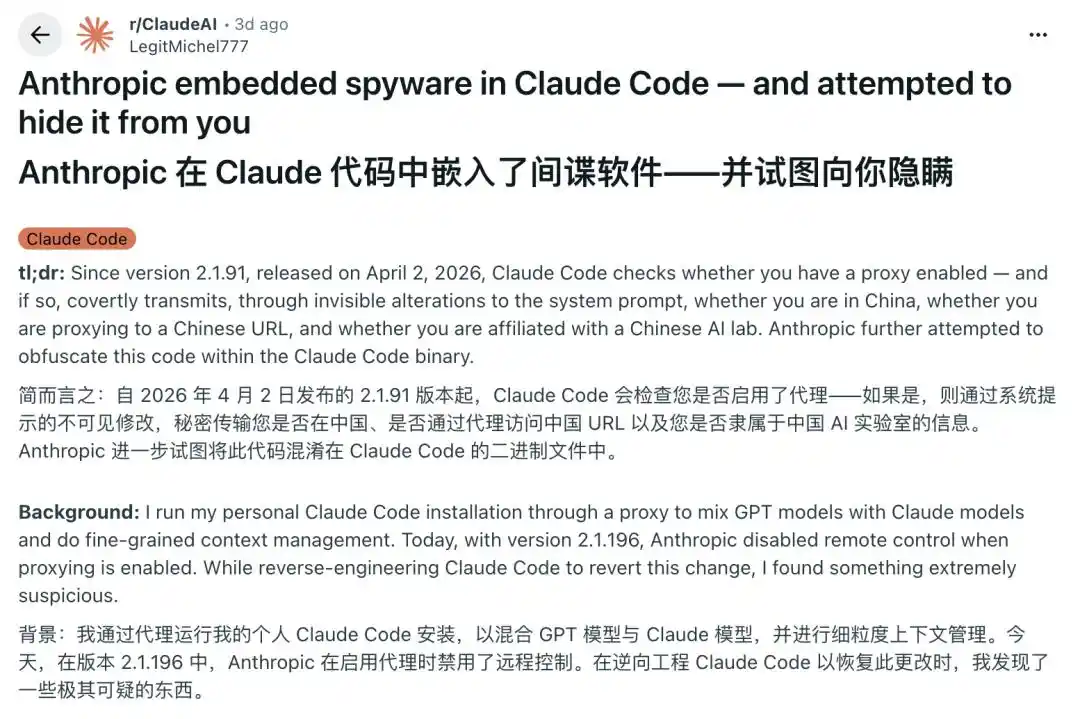
In simple terms, this mechanism does three things—

Step one, quietly checking who you are. It reads your computer's system timezone to see if it's Asia/Shanghai or Asia/Urumqi.

Simultaneously, it checks your proxy address or custom API for keywords related to Chinese cloud providers and AI companies like Alibaba, ByteDance, Baidu, Moonshot AI, and MiniMax.

Step two, tagging you covertly. If a match is found, it won't notify you with a pop-up. Instead, it stealthily alters the system prompt: changing the date format from "2026-06-30" to "2026/06/30".

It replaces the apostrophe in "Today's date is" with Unicode characters that are visually indistinguishable—right single quotation mark (’), modifier letter apostrophe (ʼ), modifier letter prime (ʹ), corresponding to three statuses: "Matched Chinese domain but not AI lab", "Associated with Chinese AI lab", and "Matched both".

Step three, quietly sending it back. These tampered prompts are sent to Anthropic's servers along with your every normal request.

What the user sees is just a normal date; what the server sees is an additional layer of environmental fingerprinting.

What's more unsettling is that this detection code itself was deliberately hidden—the core logic is encrypted and obfuscated, a list of 147 monitored domains is password-protected, and it's never mentioned in the version update logs.

In other words, Anthropic not only did it secretly but also took special care to prevent discovery.

A tool installed on your computer, with filesystem and shell execution permissions, secretly marks and signals your identity, hiding for over two months from deployment until exposure.

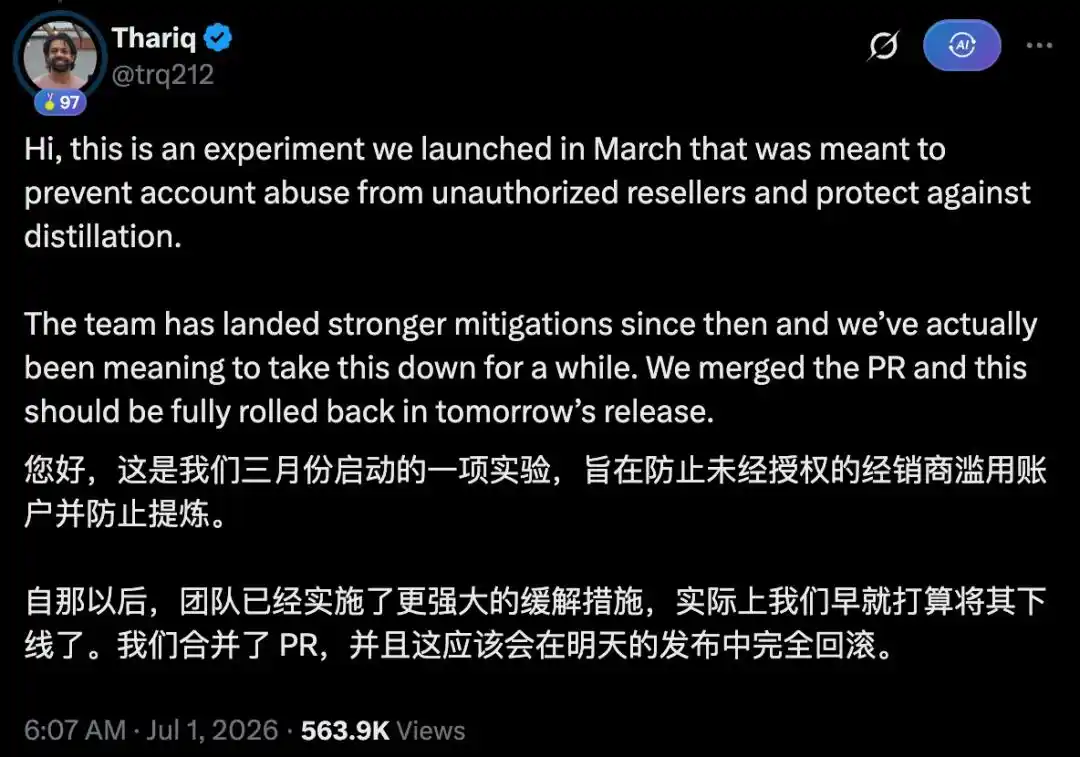
Afterwards, Anthropic Claude Code team member Thariq Shihipar publicly acknowledged this "experimental" measure, stating it was rolled back and removed in the new version released on July 2nd.
For a company that entrusts its most critical engineering code to Claude Code, this is a collapse of trust.

You open up your entire code repository, development environment, and internal logic to it, and it's secretly concerned with who you are, where you're from, and who you're connected to.

Trust, once cracked, cannot be mended by even the strongest model.

Ban Wave Adds Fuel to the Fire

Around the same time this hidden mechanism was exposed, Anthropic launched a new wave of large-scale account bans.

In recent days, a significant number of Chinese users were abruptly locked out, with both personal subscriptions and team accounts affected.

Even more frustratingly, many accounts that paid directly through the official website received no refunds after being deemed non-compliant, with appeal success rates practically zero.

From "Begging to Use" to "Company-Wide Ban"

For the past two years, it was Chinese developers queuing up to "beg to use" Claude: scrambling for quotas, finding relays, enduring the constant risk of bans, all to access that "world's best".

Now, one of China's largest tech companies is the first to decisively show Claude the door.

The once-treasured tool, once used with reimbursement, is now high-risk software. The roles of giver and receiver have been reversed for the first time.

This also signals that leading Chinese tech companies are shifting their attitude towards "building core business on others' closed-source tools" from "borrowing what's available" to "security first".

It's not about not wanting good tools; it's that good tools must also withstand scrutiny.

There are countless tools for writing code, but one principle holds true: Only the tools you can trust in your own hands are truly unremovable.

This article is from the WeChat public account "New Zhiyuan", author: New Zhiyuan

İlgili Sorular

QWhat is the main action that Alibaba is taking regarding Claude's products, and when is it effective?

AAlibaba is implementing a comprehensive ban on all Claude products, including Sonnet, Opus, Fable, and Claude Code. The ban is set to officially take effect on July 10th, requiring all employee computers to have the software uninstalled.

QWhat specific security risk prompted Alibaba to ban Claude Code?

AThe ban was prompted by the discovery that Claude Code, starting from version 2.1.91 released in April 2026, contained a covert user detection mechanism. This mechanism secretly identified users from China, tagged them with hidden markers using modified Unicode characters in prompts, and transmitted this data back to Anthropic's servers without user knowledge.

QHow did Anthropic respond to the discovery of the hidden detection mechanism in Claude Code?

AAnthropic's Claude Code team member, Thariq Shihipar, publicly acknowledged the 'experimental' measure. The company stated it had rolled back and removed the feature in a new version released on July 2nd.

QWhat does Alibaba's decision to ban Claude signal about the approach of major Chinese tech companies towards foreign AI tools?

AAlibaba's decision signals a strategic shift from a 'borrowing approach' to a 'security-first' mentality. It indicates that leading Chinese tech companies are becoming more cautious about building core business operations on closed-source, foreign-developed tools, prioritizing security and trustworthiness over perceived performance advantages.

QWhat alternative solution does Alibaba offer to its employees after banning Claude products?

AFollowing the ban on Claude products, Alibaba recommends its employees use the company's self-developed AI coding tool, Qoder, as an alternative solution.

İlgili Okumalar

How Far Are We from the End of the Crypto Bear Market?

How Much Longer Until the Crypto Bear Market Ends? A persistent negative Coinbase Bitcoin Premium Index, reaching a record 46 consecutive days of negative values, underscores the ongoing crypto bear market. The downturn accelerated in late May/early June when MicroStrategy (referred to as "Strategy" in the text), a major BTC holder, sold a small amount of Bitcoin (32 BTC), shattering market confidence and triggering sharp declines in BTC, ETH, and SOL. This was compounded by sustained net outflows from US spot Bitcoin ETFs. June saw Bitcoin briefly fall below $60,000, its worst weekly performance since 2022, breaking below the critical 200-week moving average—a signal some analysts consider confirmation of a bear market. While some institutional analyses in mid-June suggested the bottom might be near (e.g., around $53,600 based on realized price, or a potential end during the 2026 World Cup summer), further price drops quickly disproved these optimistic forecasts. Key bear market indicators include: the severe de-pegging of MicroStrategy's preferred shares (STRC) from their $100 NAV, which later recovered partly due to company stabilization plans; a record number of BTC (over 10.83 million) and a significant portion of long-term ETH holders now in unrealized loss; and Bitcoin's price trading below its 200-week moving average. Predictions for the bear market's end vary. Some, like investor Yilihua, suggest July-August 2026 could present a final buying opportunity. Others, like miner Jiang Zhu'o'er, predict a bottom between $42,000-$44,000 in October-December 2026, based on the historical lag between MicroStrategy's mNAV ratio bottom and Bitcoin's price bottom. Technical indicators like the BTC 4-year average price index dipped briefly below 1, and the Coinbase Premium Index remains negative, suggesting a need for a price rebound to around $77,000 for a return to positive territory. In the absence of major external catalysts, the consensus leans toward the bear market persisting for another 2-3 months, with late September to early October 2026 being a potential turning point window.

Odaily星球日报1 saat önce

How Far Are We from the End of the Crypto Bear Market?

Odaily星球日报1 saat önce

Solana Ecosystem Shows Signs of Recovery: On-Chain Governance Upgrade, Tokenized Stocks and Meme Coins Heat Up

Solana Ecosystem Shows Signs of Revival: Governance Upgrades, Tokenized Stocks, and Memecoins Heat Up While the broader crypto market faces a downturn, Solana has shown relative strength with its price rising nearly 15% recently. This resilience is attributed to warming ecosystem activity, particularly in tokenized stocks and memecoins, coupled with a major upgrade to its on-chain governance. In the Real World Assets (RWA) sector, Solana now leads all public chains in both the number of unique holder wallets and the quantity of RWA assets. Its tokenized stock weekly trading volume has surged to a record $1.42 billion, capturing about 96% of the market share, largely driven by the Backpack exchange. Simultaneously, the Solana memecoin sector has reignited, fueled by the rapid ascent of the ANSEM token following endorsements from a prominent crypto influencer. This has boosted activity across platforms like Pump.fun and increased fee revenue for several Solana-based exchanges. A key development is the launch of Solana Governance Proposals (SGP), a new on-chain mechanism. It allows validators with at least 100,000 SOL delegated to submit proposals for community vote, enhancing decentralized decision-making. SGP will operate alongside the existing technical proposal process (SIMD), focusing on broader ecosystem governance. Despite these positive signals in specific areas, overall on-chain activity and transaction volumes still lag behind previous bull market peaks, indicating the recovery remains partial rather than ecosystem-wide.

marsbit1 saat önce

Solana Ecosystem Shows Signs of Recovery: On-Chain Governance Upgrade, Tokenized Stocks and Meme Coins Heat Up

marsbit1 saat önce

While Semiconductor Stocks Plunge, Anthropic Plans to Develop a 2nm Chip

Anthropic, the AI company behind Claude, is exploring the development of its own custom AI chip, according to a report from The Information. The company is in early discussions with Samsung Electronics to manufacture the chip using Samsung's most advanced 2-nanometer process and packaging technology. While the project is still in preliminary stages, including defining chip specifications, and could be abandoned, it marks a strategic step for Anthropic. The move comes as the company seeks greater control over its computing costs and hardware optimization, particularly for inference tasks to run its models more efficiently and cheaply. Samsung's potential involvement follows its participation as a strategic investor in Anthropic's recent $65 billion funding round. For Samsung, partnering with a major AI lab represents a significant opportunity for its foundry business to compete with market leader TSMC in advanced semiconductor manufacturing. Anthropic's CEO, Dario Amodei, has previously highlighted the immense financial challenge of securing enough computing power for anticipated growth, making cost-effective inference a critical focus. The company would join other tech giants like Google, Amazon, Microsoft, Meta, and OpenAI in pursuing custom AI silicon. However, analysts note this trend creates deeper interdependencies rather than independence, as US AI labs become more tightly woven into Asian semiconductor supply chains. Despite this move, Anthropic remains heavily reliant on a multi-cloud, multi-vendor strategy for its immediate computing needs. It has secured massive, long-term commitments for capacity from Amazon Web Services (Trainium chips), Google (TPUs), and even leased a large GPU cluster from xAI. For now, Nvidia continues to dominate the AI chip market, with its share reportedly growing to 74%.

链捕手1 saat önce

While Semiconductor Stocks Plunge, Anthropic Plans to Develop a 2nm Chip

链捕手1 saat önce

Korean Companies Following Strategy in Accumulating Cryptocurrency: From Bull Market to Delisting?

Title: Korean DAT Companies Following "Strategy" Bitcoin Hoarding Model Face Delisting Amid Bear Market Summary: Several Korean KOSDAQ-listed companies, known as Digital Asset Trusts (DATs), are at risk of being delisted due to a combination of stricter regulatory thresholds and a downturn in crypto markets. These firms, inspired by models like Strategy and Japan's Metaplanet, raised capital to buy Bitcoin, relying on a cycle of rising crypto prices to boost their stock value. However, recent reforms in Korea have raised the minimum market capitalization required to stay listed from 150 billion won to 200 billion won (approx. $1.3M), with a further increase to 300 billion won set for next January. The new rules also close loopholes like reverse stock splits used to artificially inflate share prices. The situation is exacerbated by a significant drop in Bitcoin's price from its 2025 peak and a weak KOSDAQ market. While the main KOSPI index has surged nearly 95% year-to-date, KOSDAQ has fallen about 10%, draining liquidity from smaller companies. Many DATs now hover near or below the new market cap thresholds and must also book substantial valuation losses on their Bitcoin holdings. Analysts suggest that without a sustained recovery in both crypto prices and broader market interest in KOSDAQ stocks, these companies have limited options to avoid delisting, marking a precarious moment for Korea's crypto-linked public companies.

marsbit2 saat önce

Korean Companies Following Strategy in Accumulating Cryptocurrency: From Bull Market to Delisting?

marsbit2 saat önce

İşlemler

Spot
活动图片