Both Suffer Massive Losses Exceeding $90 Billion, Which Is in Greater Peril: Strategy or Bitmine?

marsbit2026-06-04 tarihinde yayınlandı2026-06-04 tarihinde güncellendi

Özet

Facing massive paper losses exceeding $90 billion each amidst a sharp market downturn, "Digital Asset Treasury" (DAT) giants Strategy and Bitmine find themselves in a precarious position, but with different underlying risks. Strategy, heavily invested in Bitcoin (BTC), faces significant financial strain. Its strategy relies heavily on debt, including convertible notes and preferred stock (STRC) requiring substantial dividend payments. With its cash reserves dwindling and BTC offering no staking yield for cash flow, Strategy's high leverage makes it vulnerable. A continued price decline could force asset sales to meet obligations, potentially creating a negative feedback loop. Its market value has already fallen sharply. In contrast, Bitmine, an Ethereum (ETH) holder, appears on firmer financial ground. It primarily funds its purchases through equity offerings (like ATM programs), avoiding debt pressure. It also generates income by staking a large portion of its ETH holdings. While not immune to market drops and shareholder dilution concerns, Bitmine maintains more flexibility, recently announcing a new preferred share offering to raise further capital. The core divergence lies in their financing: Bitmine uses equity (investor money), while Strategy uses debt (borrowed money). Consequently, Bitmine currently faces less immediate liquidity pressure than Strategy, which must navigate the dual challenge of servicing debt/dividends and a declining core asset (BTC) price.

Original|Odaily Planet Daily(@OdailyChina)

Author|Wenser(@wenser 2010 )

Amid the ongoing market downturn, Strategy and Bitmine, known as the 'Twin Pillars of the DAT Treasury,' have both incurred massive unrealized losses.

This morning, BTC once fell below $62,000 and is currently hovering around $63,800; ETH broke below $1,800, currently trading around $1,780. At current prices, Strategy's unrealized loss has reached a staggering $100 billion; Bitmine's unrealized loss is also around $90 billion. For the moment, Michael Saylor and Tom Lee find themselves 'companions in misfortune,' while Strategy and Bitmine have become the top two 'DAT companies with the most losses.'

However, compared to Strategy, which must continuously pay dividends, Bitmine faces less financial pressure and retains flexibility, such as funding through STRC preferred stock issuance. It is reported that Bitmine plans to raise $300 million by issuing perpetual preferred stock with an annual dividend yield of 9.5%. This suggests that Bitmine continues to increase its ETH holdings; whereas the sword of Damocles hanging over Strategy is—where will the funds for subsequent STRC dividend payments come from? Between the two, who faces greater financial pressure? Odaily Planet Daily will analyze for its readers.

Bitmine VS Strategy: Divergent Paths in Holding DAT

With today's sharp drop in BTC, community members used AI to mock Saylor's 'endorsement' of BTC: 'A sixty-year-old man personally endorses, ancestral BTC price as low as $62,000 per coin.'

Returning to Bitmine and Strategy, currently, Bitmine's financial structure appears safer; whereas Strategy's leverage pressure is greater.

Bitmine's Equity Issuance Game: A Debt-Free DAT Financing Play

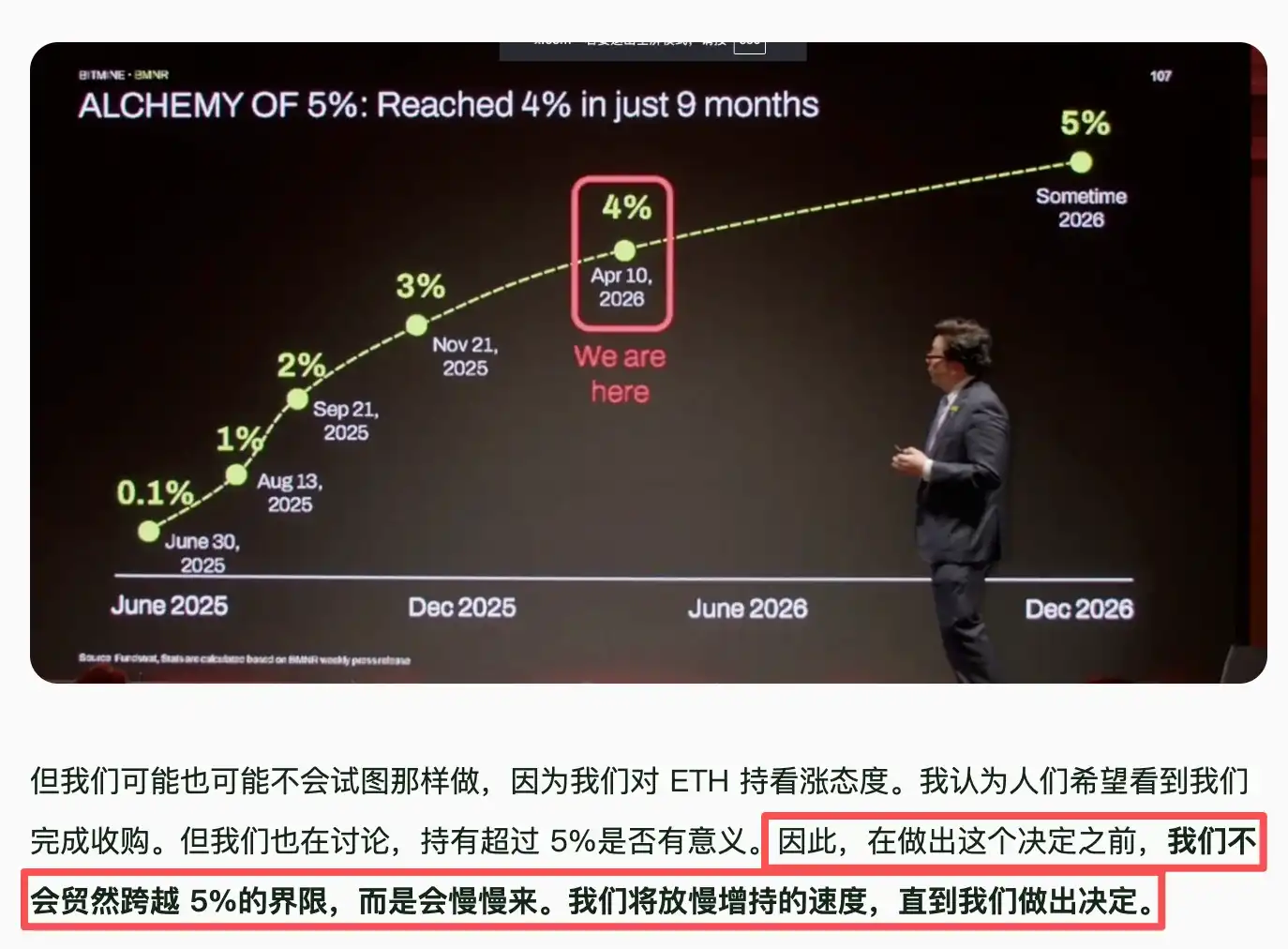
As of June 1st, Bitmine holds 5,416,901 ETH, accounting for approximately 4.49% of ETH's total supply, nearing the '5% upper limit' repeatedly emphasized by Bitmine Chairman Tom Lee. Yesterday, Bitmine acquired another 25,000 ETH via BitGo , valued at $48 million at the time. Currently, its holdings stand at 5,441,901 ETH.

The reason Bitmine maintains the confidence to continue increasing holdings during a market downturn is multifaceted. The primary reason is that Bitmine's funding source is equity issuance:

  • When initiating the establishment of the ETH treasury DAT company in June last year, Bitmine obtained initial startup capital—$250 million—through financing, along with a small PIPE round.
  • After July last year, Bitmine primarily relied on ATM equity offerings, gradually increasing this amount from $2 billion to $24.5 billion.

Ample funds give Tom Lee sufficient confidence, and Bitmine's book capital supports further acquisitions—in its June 1st public announcement, Bitmine also mentioned: The company's stake in Beast Industries is valued at $180 million; its stake in Eightco Holdings is valued at $93 million. The company's total cash amounts to $446 million.

Furthermore, Tom Lee has previously flaunted that Bitmine's Ethereum treasury generates approximately $1 million in daily staking rewards. This refers to Bitmine staking about 87% (approximately 4.71 million ETH) of its ETH holdings through its MAVAN staking network, with an estimated annualized return of about 2.73%-3% (approximately $250-300 million), which also provides a relatively stable cash flow.

In summary, Bitmine's financial condition is sound; and the latest preferred stock financing, offering a 9.5% annual dividend and expected to raise $300 million, will further alleviate its financial pressure. For the company, the greatest risks lie in equity dilution (issuing new shares) and further stock price decline caused by book unrealized losses. If mNVA consistently remains <1, it might trigger stock sell-offs.

Strategy's Debt Leverage Game: Pressure from Convertible Bonds and Preferred Stock Dividends

Compared to Bitmine's 'using investor money to buy ETH,' Strategy faces greater financial pressure in acquiring BTC, as it primarily 'borrows money to increase BTC holdings.'

According to Strategy's official website, the company currently holds approximately $6.7 billion in convertible bond debt, plus about $9.9 billion in STRC preferred stock and STRD, STRK, STRF with varying market capitalizations, requiring substantial annual dividend and interest payments. At the end of May, after repurchasing $1.5 billion in convertible debt, Strategy's cash reserves dropped to about $871 million, covering only about 6 months of its projected $1.7 billion annual preferred dividend obligations.

Moreover, Strategy previously initiated a vote proposing to 'increase STRC dividend payments from once a month to twice a month.' The voting began on April 28th and will conclude on the meeting date of June 8th. If approved, the new schedule's first record date would be June 30th, with the first payment date on July 15th. Eligible voting shareholders (MSTR and STRC shareholders) must have held shares by April 17th.
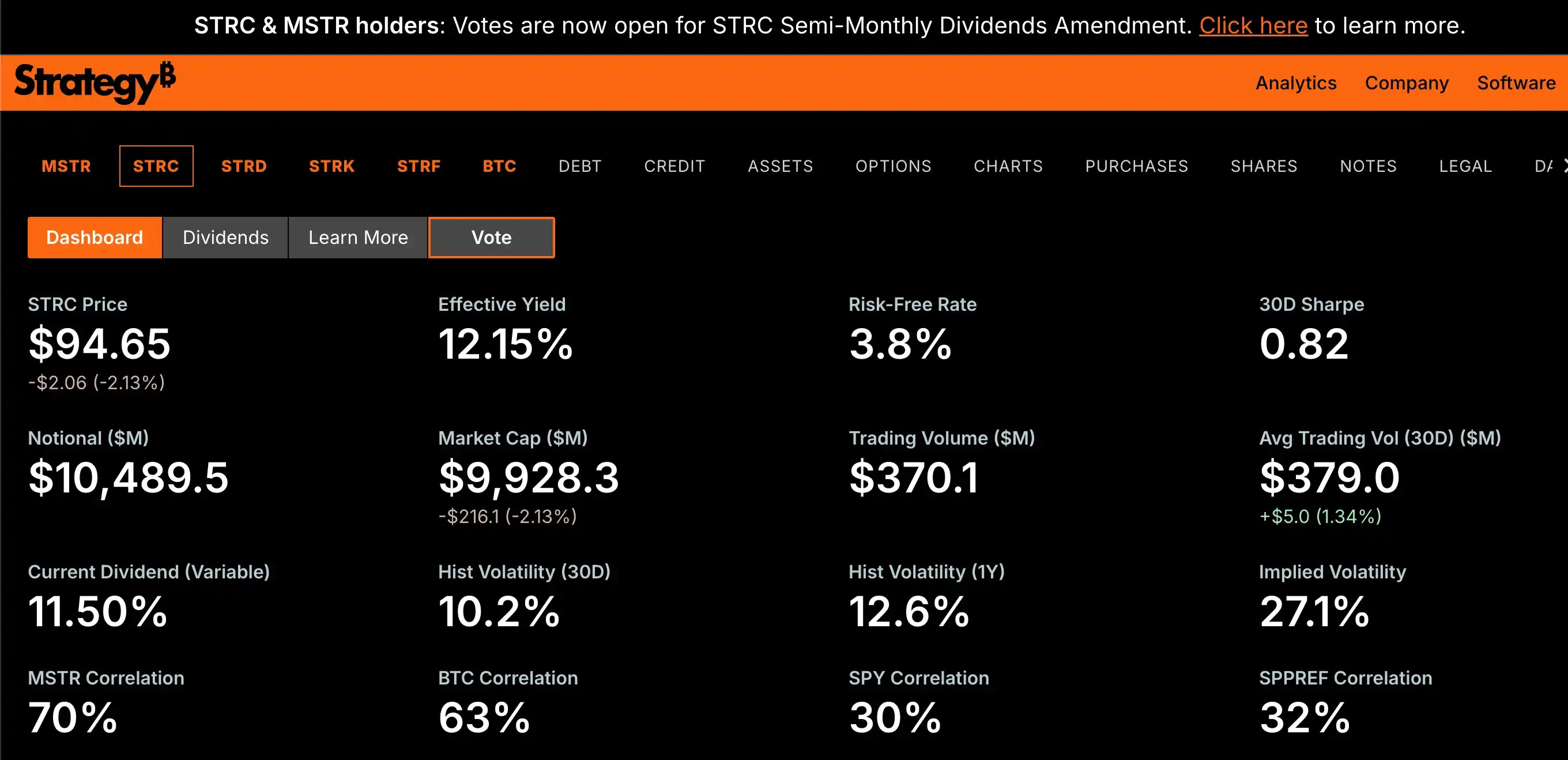
Additionally, it is worth noting that STRC's authorized issuance limit is approximately $283 billion. Possibly affected by BTC's continuous decline and shaken market confidence, STRC fell below $95 this morning, currently trading at $94.65, 'de-pegging' more than 5% from its $100 target price.

Compared to Bitmine, Strategy currently faces a significant gap between high preferred stock financing amounts and dividend payments, exacerbated by BTC's continued decline. Unlike ETH, which has staking ecosystems to generate more liquidity, BTC lacks such options.

Therefore, after Strategy sold 32 BTC last month, the market began to doubt its identity as the 'diamond hands Strategy that only buys and never sells.' During BTC's persistent decline, Strategy may face a series of liquidity crises, leading to an inability to service debt and dividends, and consequently selling more BTC, further depressing the market. Essentially, Strategy is playing a high-leverage game betting that 'BTC's price will not fall below a certain level.'

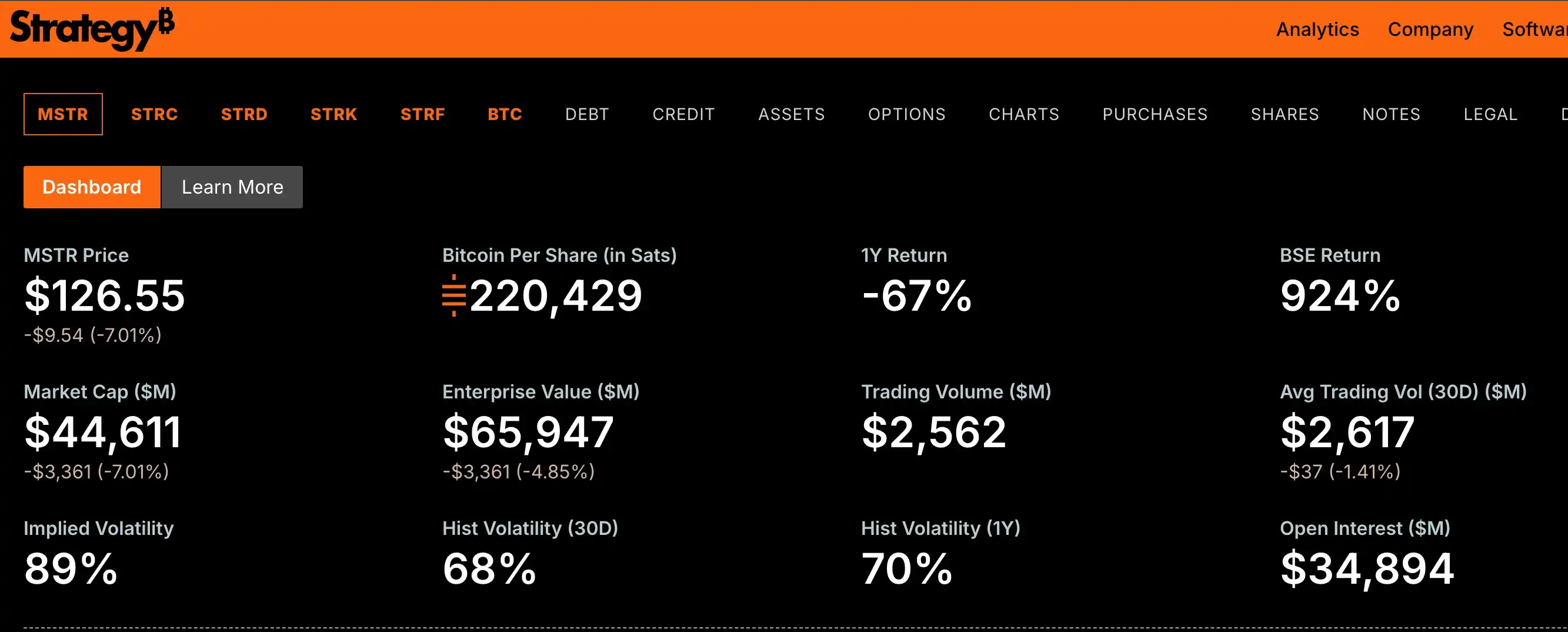
Thus, considering Strategy's current mNAV value of 0.83, the market remains highly skeptical about its future stock performance. Yesterday, its market capitalization already fell out of the top 200 US companies. Currently, Strategy (MSTR) stock is trading at $126, down 7% in 24 hours; market capitalization is approximately $446 billion.
Of course, as a leading DAT treasury company, Bitmine Chairman Tom Lee remains quite optimistic about Strategy, previously stating: 'Strategy selling Bitcoin and ETF outflows are typical bottoming behaviors, not risk signals.' At the recent 'Proof of Talk 2026' conference at the Louvre in Paris, Tom Lee made an even bolder statement: 'With AI and tokenization driving major changes in financial infrastructure, ETH could ultimately reach $250,000.' However, when discussing 'Bitmine's actions after its ETH holdings reach 5% of the total supply,' he also expressed caution about further increasing ETH holdings. (Details in 'Tom Lee Recharges Faith: Crypto Spring Has Arrived, ETH Will Rise to $250,000')
Currently, Bitmine and Strategy find themselves in highly similar market situations, though Bitmine's financial condition is slightly better; Strategy faces the choice between 'selling more BTC for cash flow to pay dividends' and 'standing by as BTC continues to fall, either borrowing more to increase holdings or remaining inactive.'


İlgili Sorular

QWhat are the main financial pressures facing Strategy according to the article?

AStrategy faces significant financial pressure primarily due to its high leverage. It holds approximately $6.7 billion in convertible debt and about $9.9 billion in STRC preferred shares, requiring substantial annual interest and dividend payments. Its cash reserves have dropped to around $871 million, which can only cover about six months of its estimated $1.7 billion annual preferred dividend obligation. The continuous fall in BTC price exacerbates the gap between its high dividend payments and financing needs, potentially leading to a liquidity crisis.

QHow does Bitmine's method of funding its ETH purchases differ from Strategy's method of acquiring BTC?

ABitmine primarily funds its ETH purchases through equity issuance, including an initial raise of $250 million, subsequent ATM equity offerings (increased to $24.5 billion), and a planned $300 million perpetual preferred stock offering. In contrast, Strategy largely relies on debt financing, such as issuing convertible bonds and preferred shares, to acquire BTC. This makes Bitmine's approach a 'debt-free' equity financing model, while Strategy engages in a 'high-leverage debt game'.

QWhat potential risk does Bitmine face despite its relatively safer financial structure?

ADespite its safer financial structure, Bitmine's main risk lies in equity dilution from issuing new shares and a potential further decline in its stock price if its market-to-net asset value (mNAV) ratio remains below 1. A sustained mNAV

QWhat action did Strategy take in May that raised market concerns about its 'diamond hands' reputation?

AIn May, Strategy sold 32 Bitcoins. This action caused the market to doubt its long-held 'diamond hands' identity as a company that 'only buys and never sells' Bitcoin.

QAccording to the article, what is the estimated current floating loss for both Bitmine and Strategy?

AAccording to the article, at current prices, Strategy's floating loss has reached around $100 billion, while Bitmine's floating loss is approximately $90 billion.

İlgili Okumalar

human.tech Launches Clean SDK for Privacy-First Web3 Apps

human.tech has launched the Clean SDK, a toolkit enabling developers to build privacy-first Web3 applications with transparent accountability. Released alongside Aztec's version 5, the SDK provides components for integrating zero-knowledge identity verification, sanctions screening, and private transactions, without developers handling sensitive user data or building compliance infrastructure from scratch. It uses zero-knowledge proofs and programmable verification to allow apps to confirm user legitimacy and sanctions compliance while keeping identities confidential. The first application built on the SDK, Shield, a privacy bridge to Aztec, also launched. It allows users to transfer assets privately while proving a unique human is behind each transfer and that funds have passed sanctions checks, as verified by a May 2026 audit. The SDK offers three core verification techniques: Proof of Innocence (sanctions screening against 23 sources), Proof of Personhood (simpler verification via Human Passport), and Proof of Clean Hands (higher-assurance zero-knowledge government ID checks). This allows apps to authenticate users and transactions without exposing personal data. Designed for Aztec builders, the SDK lets developers add programmable privacy to decentralized apps, eliminating the need to create their own verification and ZK infrastructure. Shield demonstrates its practical use for private bridges, but the SDK aims to enable a wider ecosystem of private, accountable financial apps and services. The launch addresses growing demand for infrastructure that balances privacy and accountability. The SDK avoids traditional identity databases, storing encrypted data off-chain, screening at both entry and exit points, and including a gated disclosure mechanism for legal requests. human.tech's products, including the Clean SDK, focus on using zero-knowledge technology to enable verifiable personhood and privacy in digital systems.

TheNewsCrypto33 dk önce

human.tech Launches Clean SDK for Privacy-First Web3 Apps

TheNewsCrypto33 dk önce

Unlocking $100 Million in Liquidity? Pump.fun's New Policy Tests the 5-Minute Pump Technique

Pump.fun, a popular meme coin launchpad, has introduced a new standard mechanism called BOOST. It aims to address a significant capital efficiency issue: when a newly launched token graduates from its initial bonding curve to a liquidity pool (LP), roughly 20% of its liquidity becomes permanently locked as "dead liquidity," estimated to waste over $100 million annually. Instead of locking these funds permanently, BOOST repurposes them. Upon a token's migration, approximately 20% of the settlement funds (e.g., 17.6 SOL or ~$2516 USDC) are used to buy back the token on the open market over a 5-minute period via a Time-Weighted Average Price (TWAP) mechanism. All purchased tokens are immediately burned. This creates a brief, systematic buy pressure immediately after migration, potentially generating a short-term price surge ("pump") while permanently reducing the token's circulating supply. The goal is to enhance the immediate post-launch trading experience, potentially increasing trader retention and sustainable protocol revenue, which funds ongoing token buybacks. However, concerns exist that this artificial 5-minute boost could lower the barrier for launching low-quality tokens and lead to steeper price crashes once the buy pressure stops, if followed by large sell-offs. The feature automatically applies to tokens migrating after July 21, 2024, but not to previously migrated tokens or those launched via the Mayhem AI Agent lab.

marsbit41 dk önce

Unlocking $100 Million in Liquidity? Pump.fun's New Policy Tests the 5-Minute Pump Technique

marsbit41 dk önce

Podcast Notes | Conversation with GSR Asset Management Head: To Determine if This Crypto Rally is Real, Just Watch the Lending Rates on Aave

Podcast Summary: Dialogue with GSR's Head of Asset Management: To Determine if This Crypto Rally is Real, Just Check Lending Rates on Aave Andy Baehr, Managing Director of Asset Management at GSR, discusses the current crypto market, characterizing it as stuck in a state of "ambivalence" with short-lived, unsustainable rallies. He outlines a simple framework: the market moves between "ambivalence" and "conviction" (sustained upward momentum). Currently, every rally resembles a single-stage rocket booster that quickly fizzles out. Baehr identifies three key signals to watch: 1) DeFi lending rates, 2) the potential passage of the CLARITY Act, and 3) the market forming a consensus on the "Fed hawkish peak." He emphasizes that the most immediate indicator for the sustainability of the recent CPI-triggered rally is the USDC borrowing rate on Aave, currently around 3.75%—close to U.S. Treasury yields. The absence of a credit spread indicates low leverage demand and a lack of market energy. He explains that a healthy, sustained rally requires layered buying pressure. Last year's rally progressed from an ETH short squeeze to crypto-native trader influx and finally to ETF inflows. Currently, this structure is missing. Other potential structural buyers like Digital Asset Treasury (DAT) companies are absent, and ETF flows have proven transient. Baehr notes that while small-cap crypto tokens outperformed large caps in Q2—a potential sign of capitation in major assets—capital is also flowing to more exciting opportunities like AI stocks and tech IPOs, leaving crypto sidelined. Regarding DeFi, he highlights that platforms like Aave provide a clear, real-time signal of leverage demand through their supply/demand-driven interest rates. A significant, sustained rate increase would signal genuine market conviction. He also observes the quiet emergence of fixed-income-like products and vaults in DeFi. On regulation, the probability of the CLARITY Act passing before the August 7th deadline has dropped linearly from 75% to below 40% on Polymarket. Baehr suggests its passage would be treated as a bullish surprise, a potent driver for price movement. However, political hurdles, including ethical clause debates and disclosures about the First Family's crypto profits, remain significant obstacles. Ultimately, the market awaits clarity on the Fed's terminal rate under Chair Warsh. Until the "Fed Solstice"—the point where the market collectively understands the peak of hawkish policy—sustained conviction will be difficult to achieve.

marsbit1 saat önce

Podcast Notes | Conversation with GSR Asset Management Head: To Determine if This Crypto Rally is Real, Just Watch the Lending Rates on Aave

marsbit1 saat önce

İşlemler

Spot
活动图片