BONK.fun relaunches after domain hijack, confirms $30K in losses

ambcrypto2026-03-20 tarihinde yayınlandı2026-03-20 tarihinde güncellendi

Özet

BONK.fun has restored its website following a domain hijack incident that resulted in approximately $30,000 in user losses. The breach, caused by a social engineering attack targeting its domain service provider, led to an unauthorized domain transfer. The attackers did not compromise BONK.fun’s internal systems or codebase. A phishing interface was deployed, tricking users into signing malicious transactions. The team will reimburse affected users at 110% of their losses. Full functionality was restored by March 19, though some antivirus providers still flag the domain. BONK’s price remains weak, trading near $0.0000059. The incident underscores vulnerabilities in third-party infrastructure rather than protocol-level flaws.

BONK.fun has restored its website following last week’s domain hijack. They confirm that the incident stemmed from a third-party provider breach and resulted in approximately $30,000 in user losses.

In an update shared on 20 March, the team said the attack was caused by a social engineering exploit targeting its domain service provider, which led to the domain being transferred to an external registrar.

The provider has since accepted responsibility for the incident.

The team added that there was no compromise of BONK. fun’s internal systems, codebase, or team accounts. They framed the attack as an external infrastructure breach rather than a protocol-level failure.

BONK phishing attack traced to domain takeover

The breach allowed attackers to take control of the BONK.fun website and deploy a phishing interface that prompted users to sign malicious transactions.

Earlier reports linked the attack to a fake terms-of-service signature request, which enabled unauthorized wallet access.

Blockchain analytics platform Bubblemaps had initially estimated losses at around $23,000, but the BONK.fun team has now revised that figure to $30,000.

In response, the team said it will reimburse affected users at 110% of their losses, covering both direct losses and opportunity costs.

Recovery delayed by registrar transfer

BONK.fun said the unauthorized domain transfer significantly slowed its ability to respond, as the domain was temporarily beyond its reach.

The domain was eventually restored on 18 March, with full functionality — including wallet integrations — returning by 19 March.

Wallet providers, including Phantom, MetaMask, and Solflare, were among those that helped flag the compromised domain.

Site relaunches, but warnings remain

Although BONK.fun is now back online, the team noted that some antivirus providers still flag its primary domain.

As a workaround, users experiencing access issues have been directed to an alternative domain, which mirrors the platform’s functionality.

BONK price shows continued weakness

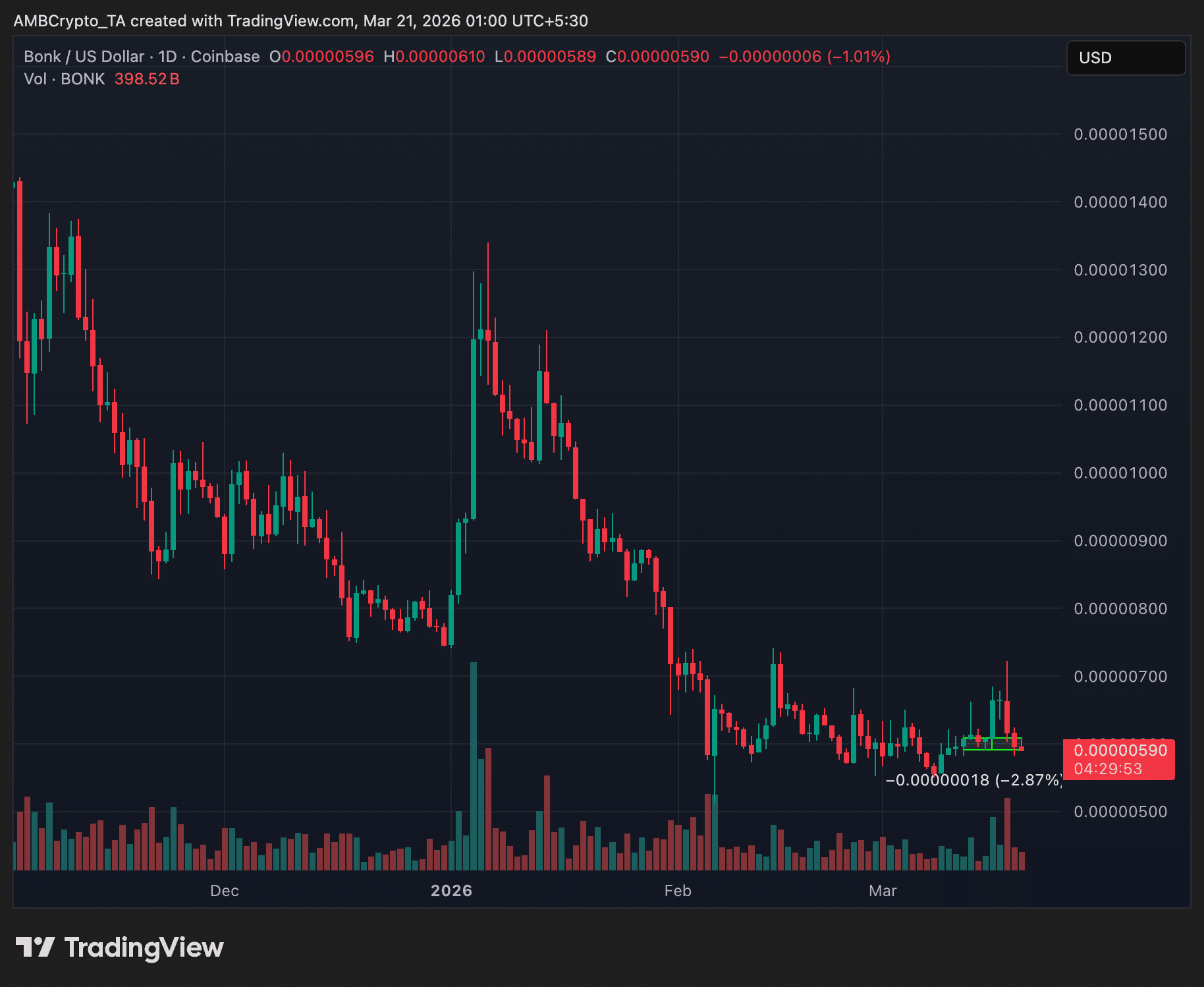
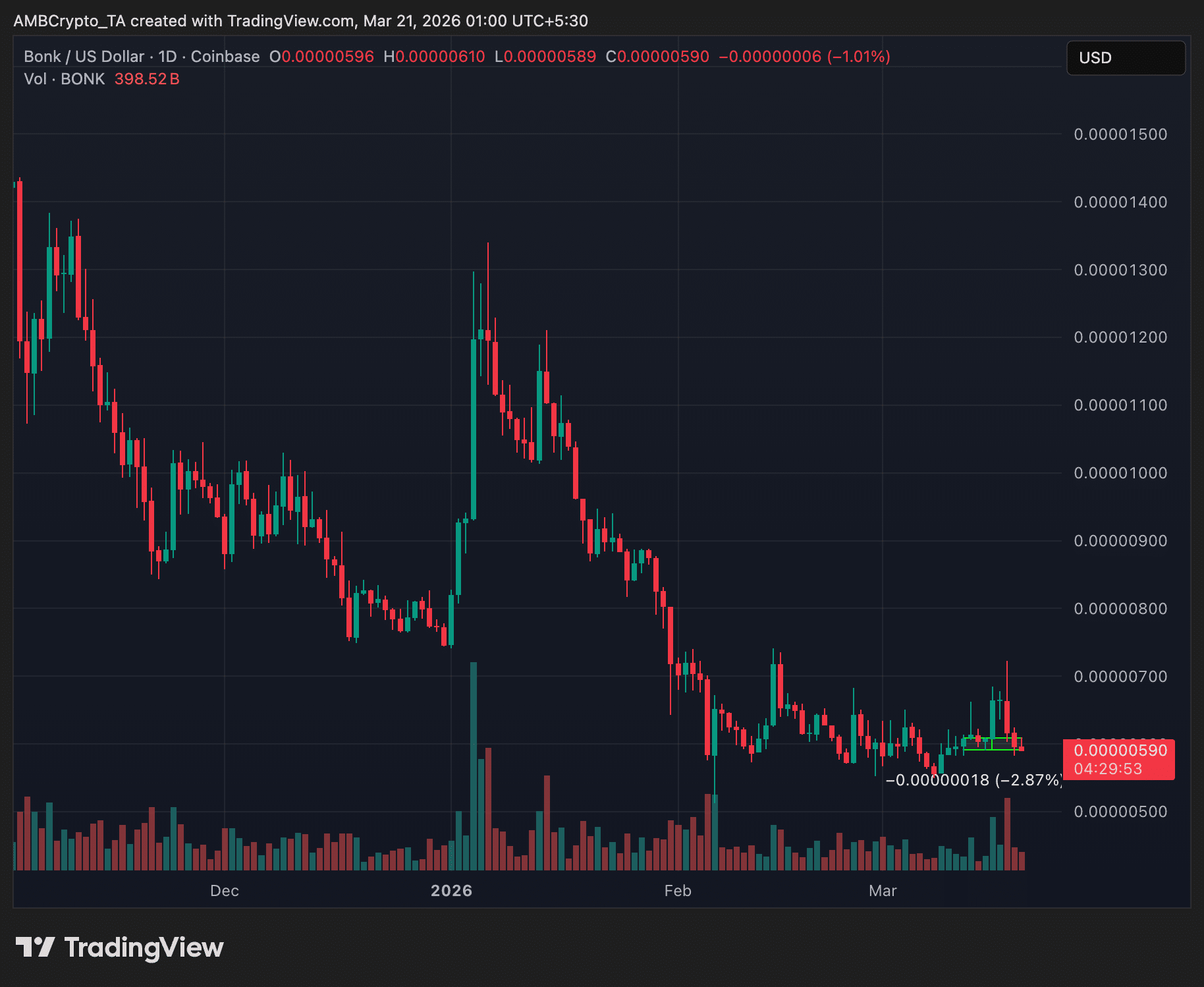
Market reaction to the incident has remained muted, with BONK’s price continuing a broader downtrend.

At the time of writing, the token was trading near $0.0000059, reflecting ongoing weakness since early March highs.
Source: TradingView

The chart shows limited recovery momentum following the exploit, suggesting that sentiment remains cautious despite the platform’s relaunch.


Final Summary

BONK.fun has relaunched after a domain-level breach, confirming $30K in losses and offering full reimbursement to affected users.

The incident highlights how third-party infrastructure, not smart contracts, remains a key vulnerability in crypto platforms.



İlgili Sorular

QWhat was the cause of the BONK.fun domain hijack and how much were the user losses?

AThe domain hijack was caused by a social engineering exploit targeting BONK.fun's domain service provider, which led to the domain being transferred to an external registrar. The incident resulted in approximately $30,000 in user losses.

QDid the attack compromise any of BONK.fun's internal systems or codebase?

ANo, the team confirmed there was no compromise of BONK.fun's internal systems, codebase, or team accounts. They framed the attack as an external infrastructure breach.

QHow did the attackers exploit the hijacked domain, and what was the initial loss estimate?

AThe attackers deployed a phishing interface on the hijacked website that prompted users to sign malicious transactions. Blockchain analytics platform Bubblemaps initially estimated losses at around $23,000, which was later revised to $30,000 by the BONK.fun team.

QWhat compensation is BONK.fun providing to affected users and why was the recovery delayed?

ABONK.fun will reimburse affected users at 110% of their losses, covering both direct losses and opportunity costs. The recovery was delayed because the unauthorized domain transfer temporarily put the domain beyond the team's reach, slowing their response.

QWhat is the current status of the BONK.fun website and the BONK token's market performance?

AThe BONK.fun website has been restored with full functionality, though some antivirus providers still flag the primary domain, leading the team to provide an alternative domain for access. The BONK token continues to show weakness, trading near $0.0000059 with limited recovery momentum.

İlgili Okumalar

Must-Watch Events Next Week|CLARITY Act Could Face Senate Vote; SpaceX, Circle to Report Earnings (8.3-8.9)

**Summary: Key Events and Developments to Watch (August 3-9)** The upcoming week is marked by significant financial disclosures, key legislative deadlines, and notable product updates. **Major Financial Events:** Several companies are scheduled to release their Q2 2026 earnings. American Bitcoin (ABTC) will report on August 3, followed by SpaceX and Hut 8 Mining Corp. on August 4, and Circle on August 5. Notably, a significant portion of SpaceX shares (up to 12% of total shares) will be unlocked on August 6 following their earnings release. **Key Legislative Deadline:** The U.S. Senate faces an August 7 deadline to secure 60 votes for the CLARITY Act, a bipartisan bill aiming to establish a federal regulatory framework for cryptocurrencies. The Senate may hold a full vote on the bill during the week. **Economic Data:** The U.S. July Non-Farm Payrolls report will be released on August 7, providing crucial labor market data. **Technology & Product Updates:** * **Shutdowns:** DeFi portfolio tracker Zapper and wallet app Ctrl Wallet will cease operations on August 3. * **Upgrades:** LayerZero will deprecate its v1 relayers on August 3. XRP Ledger's new version 3.3.0, featuring five new functions, is expected next week. * **AI:** Elon Musk announced that the advanced Grok 4.6 AI model is set for release around August 7. * **Bitcoin:** The BIP-110 forced signaling for a potential Bitcoin network change is scheduled to begin around August 8. **Other Notable Events:** Chinese robotics firm Unitree Tech has set its preliminary price inquiry for its IPO for August 5. South Korean exchange Upbit will delist AQT and AERGO tokens on August 3.

marsbit23 dk önce

Must-Watch Events Next Week|CLARITY Act Could Face Senate Vote; SpaceX, Circle to Report Earnings (8.3-8.9)

marsbit23 dk önce

Stocks Are Plummeting More Sharply Than Cryptocurrencies. Where Has the Money Gone?

Stock Markets Plunge Deeper Than Cryptocurrencies: Where Did the Money Go? In late July, Seoul's Kospi index triggered circuit breakers for two consecutive days, plummeting over 40% from its June high. The collapse was led by heavyweight stocks like SK Hynix, whose record profits still disappointed investors, and devastating leveraged ETFs, with one major product losing over 83% of its value. This signaled a global, forced deleveraging targeting the most crowded trades. Interestingly, while stocks exhibited extreme volatility akin to crypto markets, Bitcoin rose nearly 15% in July after a prior steep drop. Analysis shows the money fleeing equities did not flow into Bitcoin. Instead, Bitcoin had already absorbed its sell-off in May-June, when U.S. spot Bitcoin ETFs saw historic outflows. The true safe-haven beneficiary was gold, whose price rose over 20% year-on-year, highlighting a decoupling between Bitcoin and gold as "digital gold." The sell-off was a targeted unwinding of leveraged positions in tech and semiconductors, accelerated by broker-dealer risk management and shifts in the AI narrative, including new competition from Chinese memory chipmakers. The retreat path was clear: from high-valuation tech stocks to cash and U.S. Treasuries, then to gold. For Bitcoin to attract sustained institutional inflows, conditions like eased global liquidity pressure, a "soft-landing" Fed rate cut, and U.S. regulatory clarity via legislation like the stalled CLARITY Act are needed. Currently, Bitcoin is not a safe haven but an already-cleared asset. Its low correlation with tech stocks, however, makes it a potential diversification play for institutional portfolios once the storm passes. The money isn't here yet, but the positioning is underway.

marsbit23 dk önce

Stocks Are Plummeting More Sharply Than Cryptocurrencies. Where Has the Money Gone?

marsbit23 dk önce

In Conversation with Ray Dalio: We Are Currently in an AI Bubble, with 1% of My Portfolio in Bitcoin

Ray Dalio, founder of Bridgewater Associates, warns in an interview that the current AI boom shows classic bubble characteristics, which could lead to significant economic downturns as seen in past cycles like 1929 or 2000. He explains that speculative enthusiasm, fueled by debt and overvaluation, often precedes a crash when rising rates or taxation force asset sales, causing widespread losses and recession. Dalio also outlines his "Big Cycle" theory, describing an approximate 80-year pattern where widening wealth gaps, massive government deficits, and shifting geopolitical power (like China's rise) create internal conflict and global instability. He emphasizes that we are in a late-cycle, transitional phase where traditional powers like the US and UK face decline. For personal wealth protection, Dalio advises diversification beyond cash into assets like stocks, bonds, real estate, and particularly gold, which he prefers over Bitcoin. While he holds about 1% of his portfolio in Bitcoin as a non-printable hard asset, he views gold as more secure from technological or governmental threats. Regarding AI's impact, Dalio believes it will disproportionately benefit capital owners, worsening inequality by replacing both physical and cognitive labor. He suggests that human intuition and emotional intelligence, combined with AI, will be key for future workers. On taxation, Dalio argues that wealth taxes are impractical and risk triggering asset sell-offs, reducing productive investment. He points to the UK as a cautionary example of debt, low productivity, and political strife. Geopolitically, Dalio foresees a more regionalized world, with the US showing weakness in prolonged conflicts like with Iran, akin to past imperial declines. The ideal outcome, he suggests, is coexisting powerful blocs (e.g., Americas, China-Asia Pacific) without major war.

marsbit4 saat önce

In Conversation with Ray Dalio: We Are Currently in an AI Bubble, with 1% of My Portfolio in Bitcoin

marsbit4 saat önce

Daily 7.2 Trillion KRW: Foreign Capital's Record Net Buying on Friday! Wall Street Says Headwinds for Korean Stock Fund Flows Have Subsided

South Korean stock market sees a dramatic shift in fund flows. On July 31, foreign investors made a record net purchase of approximately KRW 7.2 trillion in KOSPI stocks, marking a fundamental reversal from the persistent large-scale net outflows seen in previous months. This contributed to a significant narrowing of foreign net selling in July to KRW 9.8 trillion, down sharply from KRW 48.4 trillion in June and KRW 44.5 trillion in May. Simultaneously, domestic institutional pressure eased. South Korean pension funds and asset managers turned to a net buying position in July, purchasing KRW 1.0 trillion worth of KOSPI shares, contrasting with net sales in May and June. Market volatility is expected to be dampened by new financial regulations. Effective July 31, the Financial Services Commission tightened access for retail investors to single-stock leveraged ETFs by raising the minimum cash deposit requirement. Trading volumes for these products subsequently dropped to about 50% of their monthly average. Citigroup Research maintains its year-end KOSPI target of 10,000 points. The firm cites several supportive factors: the substantial easing of headwinds from capital outflows, a robust fundamental outlook for the semiconductor sector, historically low market valuations, strong economic fundamentals, and the potential for policy support from financial authorities if needed.

marsbit4 saat önce

Daily 7.2 Trillion KRW: Foreign Capital's Record Net Buying on Friday! Wall Street Says Headwinds for Korean Stock Fund Flows Have Subsided

marsbit4 saat önce

İşlemler

Spot
活动图片



