Author: Rita
A new custom chip agreement from Google has redrawn the division of labor between Marvell and Broadcom in the TPU supply chain.
On August 19, Bank of America (BofA) released a quick industry comment report. Marvell has entered into a new warrant agreement with Google, establishing a custom chip partnership. This corresponds to a maximum cumulative purchase volume of $120 billion from Google, and Marvell will receive approximately 60 million shares.
Investors are concerned that Broadcom's share in Google's TPU supply may be eroded. BofA offers a different assessment: Marvell is securing chips for the XPU peripherals, while the core computing chips remain under Broadcom's control.
Value Concentration Tilts Towards Broadcom's Core Chips
The supply chain for Google's TPU systems is undergoing differentiation, but the core computing chips are not part of this shift.
BofA breaks down the division of labor in its report. Broadcom is responsible for the core ASIC and advanced packaging design, HBM integration, high-speed SerDes, as well as network switching and physical layer connectivity around the chip. These four components constitute the highest-value parts of the TPU system's Bill of Materials (BOM).
Marvell's role is XPU-attach, meaning custom chips connected to the TPU ecosystem, including AI inference accelerators, storage controllers, NICs, memory interface controllers, and near-memory computing. Specific details are not yet clear. BofA judges that Marvell's value content within the TPU is confined to the XPU-attach items, with the core computing chips still belonging to Broadcom.
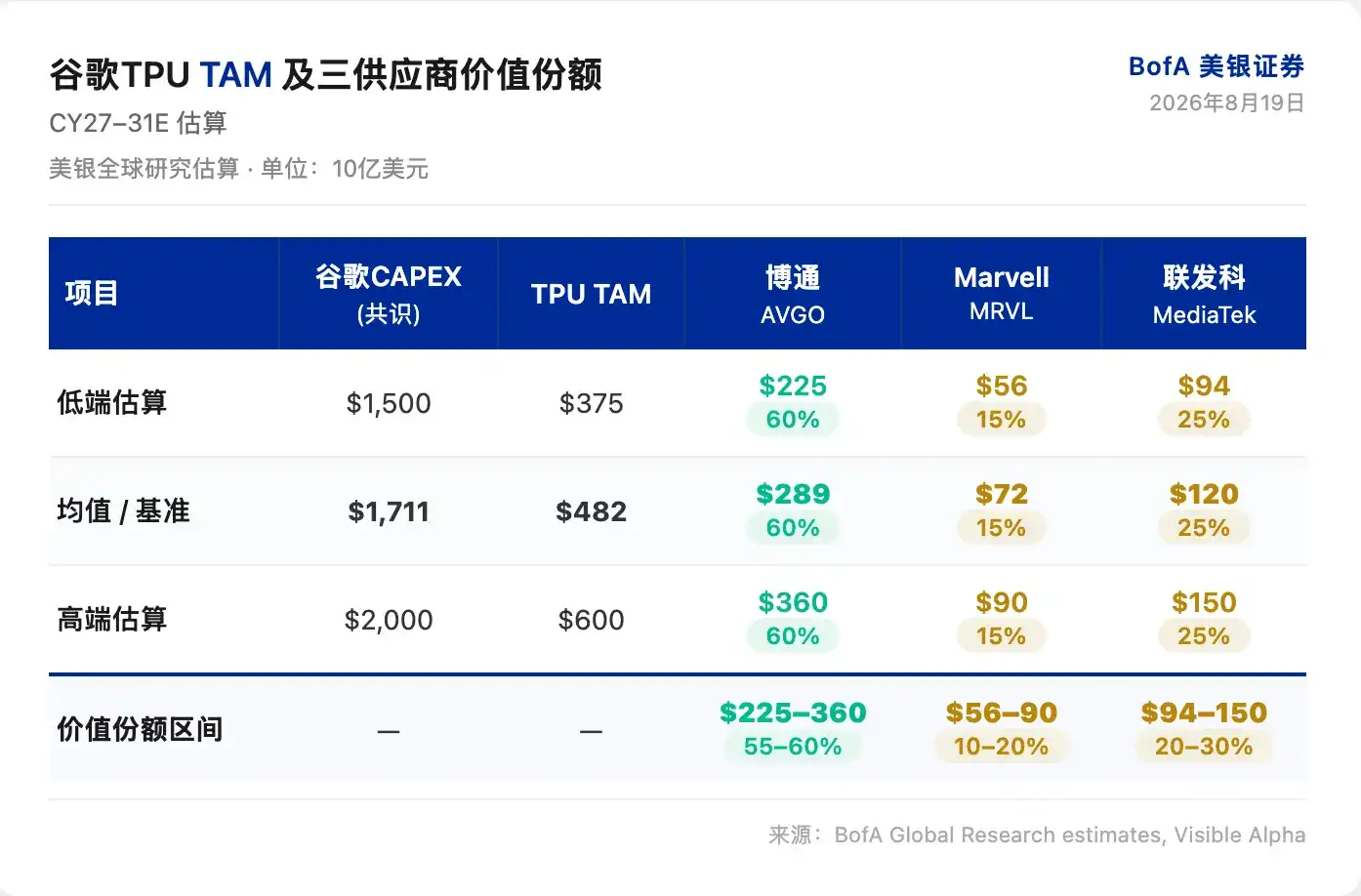
BofA estimates Google's total capital expenditure over the next 5 years will be in the range of $1.5 trillion to $2 trillion, with TPU systems accounting for 25% to 30%, corresponding to a Total Addressable Market (TAM) of $400 billion to $600 billion. Broadcom holds a 55% to 60% value share, amounting to $250 billion to $350 billion. Marvell captures a 10% to 20% share through XPU-attach, corresponding to $50 billion to $100 billion. MediaTek takes 20% to 30% for cost-optimized chips. The three suppliers each have their share, with the value center clearly tilted towards Broadcom.
High BOM Content of Core Chips Forms a Value Barrier
Broadcom's value advantage in TPUs stems from high unit value, not merely share proportion.
These four areas are locked in through long-term agreements until CY31, making it difficult for competitors to break through in the short term. Marvell's XPU-attach also holds value, but its program is more fragmented with lower unit value, and design partnerships are subject to change.
MediaTek's entry validates BofA's judgment. BofA expects MediaTek to hold a 20% to 30% share in cost-optimized chips, which have lower unit value and fall into the "low-value inference/peripheral content" category. The landscape among the three suppliers redistributes the low-value peripheral content, while the high-value core chips remain with Broadcom.
Another easily overlooked variable is silicon content expansion. BofA believes that as system complexity continues to increase, Broadcom's silicon content in each generation of TPU is growing, similar to the path of Nvidia's GPUs. This means absolute revenue continues to grow even if the share proportion remains unchanged.
Valuation Remains Attractive Amid Competitive Pressure
BofA sets a $530 price target for Broadcom, based on a 30x CY27 expected P/E ratio. This multiple sits in the mid-range of Broadcom's historical range (11x to 41x) and aligns with the 0.5x to 2x PEG (Price/Earnings to Growth ratio) framework for high-growth computing chips.
The valuation's attractiveness comes from growth certainty. Broadcom's current stock price corresponds to a CY27 expected P/E ratio of about 21x and a CY28 expected P/E ratio of about 16x, with a PEG of -0.5x, reflecting earnings growth significantly outpacing the valuation multiple. With AI revenue expansion and TPU content leadership locked until CY31, this valuation is not aggressive.
Downside risks listed by BofA include a semiconductor cycle reversal, customer concentration on Apple and Google, competitive pressures across markets, and the financial risk of approximately $60 billion in net debt. TPU demand remains strong, management is expected to reaffirm the custom chip growth trajectory in the September 2 earnings call, and new projects from Meta and OpenAI (each about 1GW) are set to commence in CY27.
The competitive narrative is changing the landscape of the TPU supply chain, but the core structure of value distribution remains unshaken. The impact of Marvell and MediaTek on Broadcom is overestimated, while customer stickiness and BOM depth of core chips are underestimated. Competition in peripheral chips intensifies, highlighting the scarcity of the computing core.

Disclaimer
This article is a collation and interpretation by Chaoxiang Research of a third-party brokerage research report (Bank of America Securities, August 19, 2026), combined with the organization of publicly available market information. The ratings, price targets, earnings forecasts, and related judgments cited in the article are the views of that brokerage's analyst, representing only the position of their affiliated institution. They do not represent the views of Chaoxiang Research and do not constitute any investment advice.
The market carries risks, and investment decisions should be made independently. This article should not be used as the basis for trading any securities.