BNB Chain 2025 Year-End Review: Self-Transcendence, Trading Everything

marsbit2026-01-09 tarihinde yayınlandı2026-01-09 tarihinde güncellendi

Özet

BNB Chain 2025 Year-End Review: Self-Transformation and Trading Everything In 2025, BNB Chain underwent a qualitative transformation, evolving from a low-cost alternative to a robust infrastructure capable of handling real-world financial and payment scenarios. Key achievements include a 40.5% growth in TVL, a 100% increase in on-chain stablecoin market cap to $14.7 billion, and over $1.8 billion in RWA assets. The network maintained zero downtime despite high transaction loads, processing a record 31 million daily transactions. Technical upgrades through Lorentz and Maxwell hard forks reduced block time to sub-second levels and increased throughput to 133 million gas/second, significantly improving speed, reducing MEV attacks by 95%, and lowering costs. These enhancements enabled high-frequency applications like stablecoin payments and DEX interactions, driving daily active addresses to 4.4 million, the highest among blockchains. Stablecoin adoption flourished, with BNB Chain becoming a leading network for efficient, low-cost payments. Initiatives like United Stables' multi-collateral model and a $1 billion Builder Fund fostered ecosystem growth. RWA integration accelerated with major institutions like BlackRock and Franklin Templeton tokenizing assets on-chain, leveraging BNB Chain’s user base and liquidity for deeper adoption. BNB Chain’s 2025 progress validated its capacity as reliable infrastructure under sustained demand, setting the stage for 2026 goals: enhancing ...

In recent days, with the listing effect of Binance, Meme tokens on BSC have once again gained market attention. The massive wealth effect and traffic have refocused the market on this five-year-old public chain. However, looking beyond the surface and re-examining, what we see is actually a qualitative transformation of an ecosystem.

If the initial BNB Chain in 2020 primarily accumulated its initial users and transactions from the spillover due to high gas fees and low efficiency on ETH, then 2025 was a critical year for BNB Chain to proactively achieve self-transcendence.

Looking back on this year, BNB Chain is no longer just a cheaper alternative but has begun to possess the fundamental capability to stably and sustainably host real financial and payment scenarios.

New highs were reached in users, liquidity, and trading volume. TVL grew by 40.5%, the on-chain stablecoin market cap increased by over 100% to $14 billion, and RWA asset scale exceeded $1.8 billion.

From the results, the on-chain activity of BNB Chain is not a short-term burst but shows a continuous and stable growth trend.

Core scenarios such as annual transactions, stablecoins, payments, and RWA maintained high-frequency usage. The network had to operate continuously under long-term high load, rather than relying on occasional peaks to prove its performance. It was in this real production environment that BNB Chain withstood the test, achieving zero downtime for the year and maintaining stable operation amidst high-intensity transactions and asset transfers.

Supporting these figures is not a single technological breakthrough but a year-long continuous advancement in underlying engineering capabilities. In 2025, BNB Chain underwent deep iterations of its underlying protocols and clients. Block time and throughput capacity were systematically restructured, endowing the chain itself with high concurrency, low latency, and long-term scalable execution capabilities. Block time was compressed from the previous 3-second level to sub-second levels, finality was significantly advanced, and network bandwidth was expanded to over 133 million gas/second, enabling the chain to continuously handle daily loads as high as 5 trillion gas in high-concurrency environments. Coupled with the seamless integration of the stablecoin payment network and the large-scale introduction of compliant RWA assets, this helped BNB Chain achieve key leaps in technology, assets, and ecology.

Driven by multiple factors, BNB Chain has been able to touch the threshold of infrastructure for billions of users. Moreover, it is no longer just serving crypto-native users but has begun to provide a blockchain foundation that can be accepted and used by the broader public and the real financial system.

The significance of 2025 for BNB Chain lies not in any single extreme metric, but in validating one thing: under real, sustained, high-intensity usage conditions, a public chain can be operated as infrastructure, rather than remaining in the theoretical performance stage. It is this experience that forms the practical foundation for the 2026 technical roadmap—higher TPS, lower latency, fairer execution, and more完善的 middleware and development tools.

2025: With the Highest Daily Active Users, Is Technology Still Important?

During the AMA at BNB Chain's fifth-anniversary celebration, CZ stated that attracting more Web3 users requires powerful and attractive products for projects.

This statement aptly summarizes the strategic主线 (main thread) of BNB Chain's development throughout 2025.

Going back to the beginning of 2025, in the context of modularization significantly reducing costs and L2s being everywhere, BNB Chain's narrative was not particularly sexy, and its moat was not wide. BNB Chain did not rush to chase trends but focused on underlying technological restructuring, laying the groundwork for its explosion in the second half of the year and its climb to the top in daily active users.

Through the Lorentz and Maxwell hard forks, BNB Chain's block time was compressed from 3 seconds to 0.75 seconds, and with the upcoming Fermi fork, further down to 0.45 seconds. Network throughput capacity increased to the level of 133 million gas/s, transaction confirmation time entered the sub-2-second range, MEV sandwich attacks were reduced by 95%, and transaction costs were significantly lowered in high-concurrency environments.

For some users, these changes might seem like mere parameter improvements—'faster'. But in practical operation, the shortening of block time made high-frequency interactive applications usable for the first time. The increase in throughput capacity meant the chain no longer had to throttle during sudden traffic spikes. The reduction in confirmation time and fees directly changed the psychological expectation of whether on-chain operations are worth it for ordinary users.

In other words, the work in the first half of the year solved a core contradiction for BNB Chain: how to achieve performance comparable to centralized servers without sacrificing decentralization.

The effects were also evident. High-frequency behaviors such as stablecoin trading, DEX interactions, and on-chain transfers grew rapidly. BNB Chain became one of the public chains with the highest number of daily active addresses during multiple time windows. The latest data from Token Terminal shows that BNB Chain's daily active addresses reached 4.4 million, ranking at the top among blockchains. The average daily number of on-chain transactions in 2025 stabilized at tens of millions, hitting a historical high of 31 million transactions in a single day in October, a 150% year-on-year increase in peak value. Meanwhile, TVL increased by 40.5% year-on-year, the stablecoin market cap on-chain doubled, peaking at $14 billion.
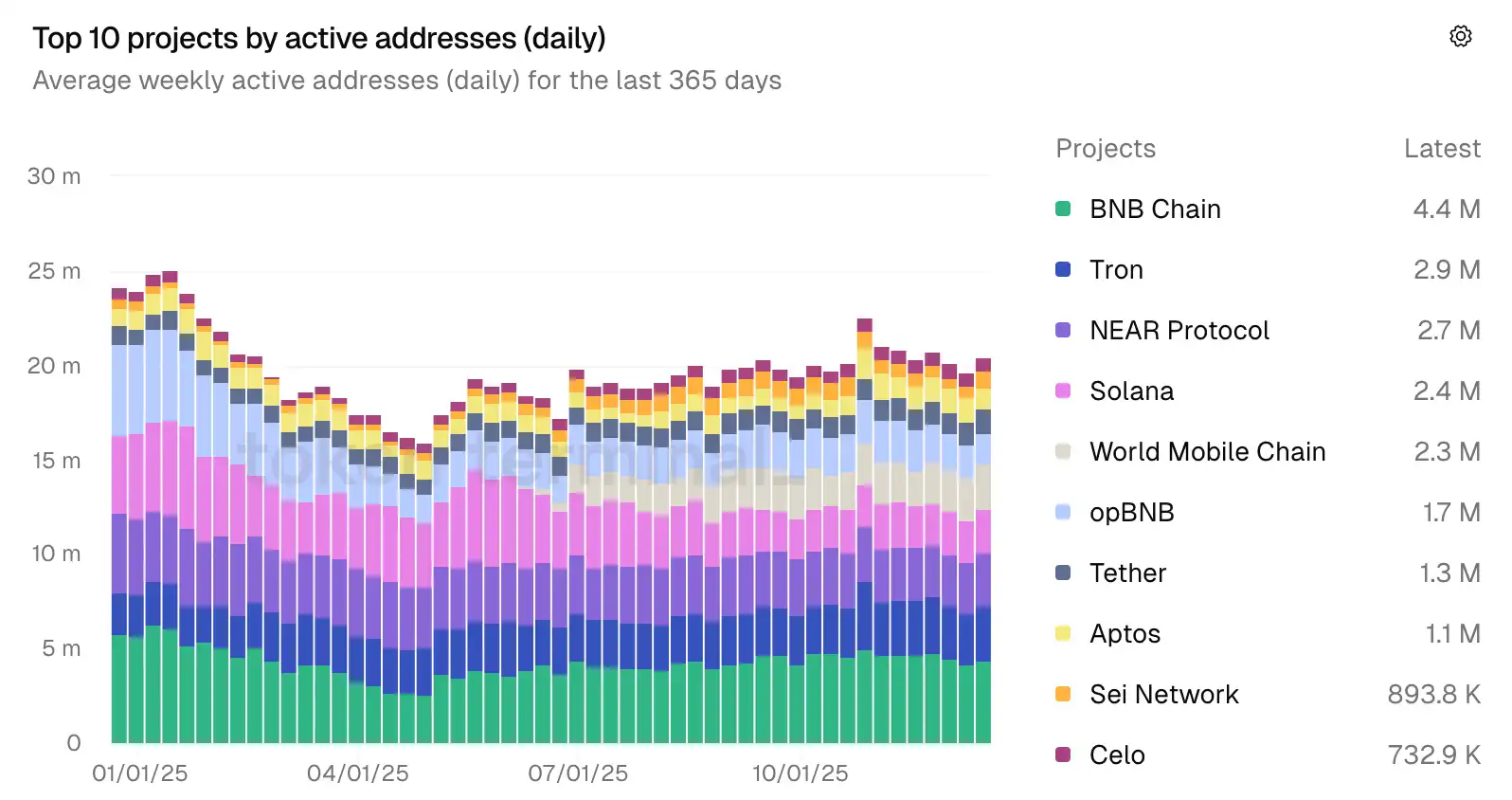
Entering the second half of 2025, BNB Chain quickly switched modes, transitioning from an engineer to a product manager. Leveraging the solid foundation laid in the first half, it successfully accommodated massive stablecoin payment and RWA demands.

$14.7 Billion in Stablecoins and 4 Million Daily Active Users

If crypto before 2024 was driven by speculation, then 2025 transformed into an era dominated by utility, primarily stablecoins. This year, USDC issuer Circle went public, and Franklin Templeton, with $1.6 trillion in assets under management, launched JUSD.

Stablecoins are evolving from mere trading mediums into channels connecting traditional finance and the Web3 world. Stablecoins are no longer just tools for DeFi but are beginning to assume roles closer to real-world payments and capital turnover.

In this transformation, BNB Chain, with its 2-second settlement and transaction fees as low as $0.005, became the fastest-growing platform. Latest data shows that the value of stablecoins on the BNB Chain network exceeds $14.7 billion, with BSC and opBNB serving over 4 million daily active users.
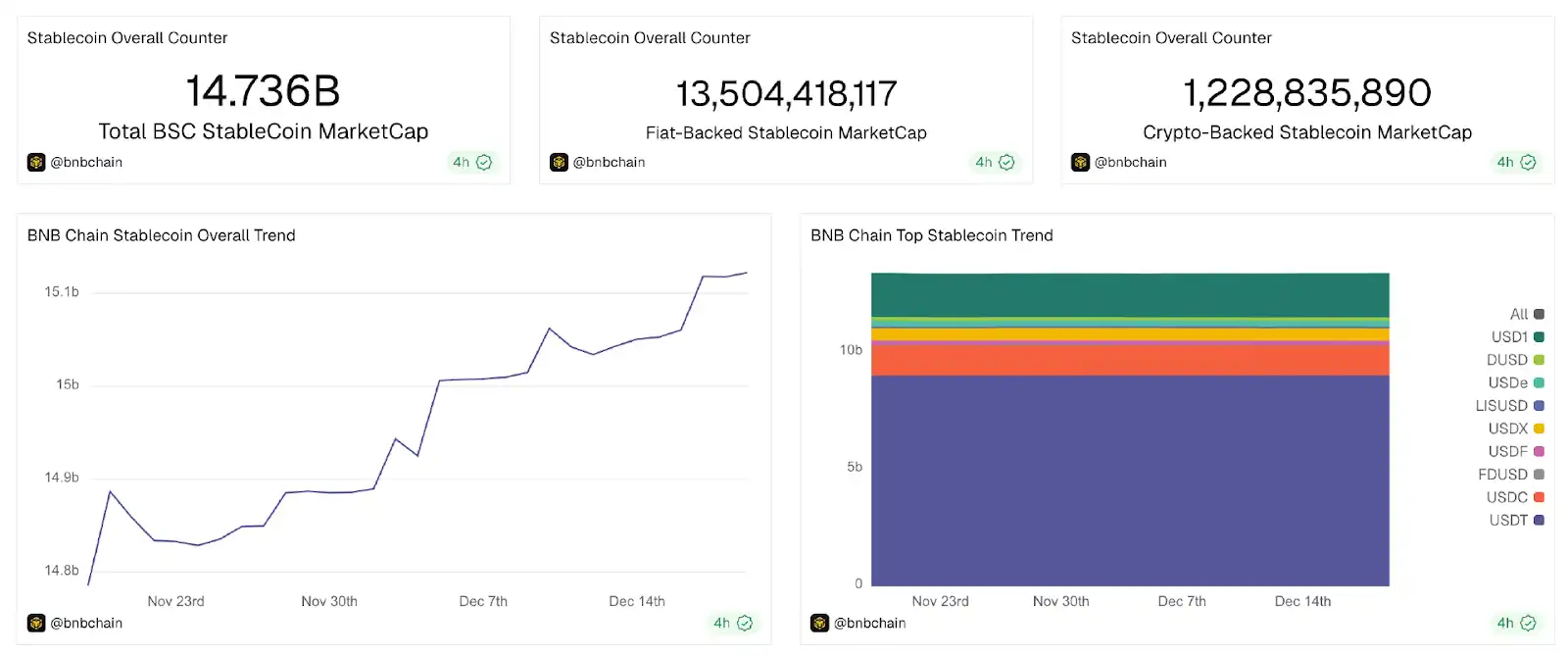
The adoption of stablecoins depends not only on the assets themselves but also on their operating environment. If stablecoins are to serve billions of users, the underlying chain must be cheap, fast, and seamless. The upgrades BNB Chain implemented in the first half laid the foundation for stablecoin普及 (popularization).

Through gas-free transactions, opBNB, and other scaling solutions, the cost of stablecoin transfers was compressed to near zero, significantly lowering the barrier to using stablecoins for payments. On BSC and opBNB, stablecoin transfers are completed almost instantly, providing a near-Web2 experience for on-chain payments, salary disbursements, and merchant settlements.

The supply of stablecoins on BNB Chain has doubled to approximately $14 billion, making it one of the most active stablecoin networks globally. Against this backdrop, the stablecoin ecosystem itself began to change. United Stables chose to natively issue its stablecoin, U, on BNB Chain. Unlike traditional stablecoins reliant on a single collateral asset, U employs a multi-stablecoin reserve model, allowing mainstream dollar stablecoins including USDT, USDC, and USD1 to be directly used as collateral to mint U.

From an ecological perspective, the introduction of U is not an isolated event but a natural outcome of the maturation of BNB Chain's stablecoin system. As the scale of on-chain stablecoins continues to expand and address activity keeps increasing, the demand for unified liquidity and higher capital efficiency also grows. United Stables' multi-collateral model is a response to this demand. Its design reduces the efficiency loss caused by repeatedly splitting different stablecoins, helps consolidate on-chain liquidity, and simplifies the usage path of funds in trading, payments, and DeFi applications.

Another landmark event in 2025 was Abu Dhabi's MGX investing $2 billion in Binance through the stablecoin USD1. USD1 is a dollar-pegged stablecoin supported by the Trump family's World Liberty Financial, backed by highly liquid asset reserves and deployed on mainstream blockchains like BNB Chain and ETH.

This investment sent a clear signal: stablecoins are no longer confined to the crypto industry but have become a tool connecting traditional capital with on-chain finance. And BNB Chain is an important carrier network for this channel.

Furthermore, BNB Chain, in collaboration with YZi Labs, launched a massive $1 billion Builder Fund to accelerate the development of existing and future developers on BNB Chain, particularly those building applications that can make stablecoins truly流动起来 (flow). The fund provides not only capital but also technical incubation and compliance consulting.

According to the development blueprint disclosed by BNB Chain, sectors such as on-chain payroll systems, programmable vaults, stablecoin-native credit cards, invoice tokenization, CBDC bridging and custody, green finance, and supply chain automation are poised for explosive growth. These upcoming booming sectors share common characteristics: they are efficient, automated, and globally accessible, rather than focusing on crypto attributes. The positioning of stablecoins therein is closer to a universal unit of the digital economy, and BNB Chain aims to become the underlying operating system hosting these functions.

It is worth noting that the growth of the stablecoin ecosystem on the BNB Chain network is not an isolated爆发 (outbreak) but is deeply intertwined with RWA.

BNB Chain and RWA Mutually Enable Each Other

This year, we no longer debate the feasibility of asset tokenization. Traditional financial giants like BlackRock, CMBI (China Merchants Bank International), VanEck, and Franklin Templeton are moving hundreds of billions of dollars in assets on-chain. In this on-chain movement, BNB Chain,凭借 (relying on) its massive user base and ecological strategy, has become one of the largest infrastructures承载 (hosting) RWA capital.

BlackRock deployed its USD Institutional Digital Liquidity Fund, BUIDL Fund, to BNB Chain with technical support from Securitize and Wormhole. Moreover, this fund can also be used as collateral on the Binance exchange. This means on-chain funds are no longer obscure financial products but have become a liquidity layer for the crypto market.

CMBI tokenized its US dollar money market fund, with assets under management exceeding $3.8 billion, on BNB Chain. It is reported that this fund ranks first among its peers in the Asia-Pacific region according to Bloomberg. Investors can subscribe to shares on BNB Chain using stablecoins.

The deployment of a series of RWA assets on BNB Chain is not a one-sided benefit but a deeper two-way promotional relationship. RWA and BNB Chain are forming a positive feedback flywheel that complements and amplifies each other.

Asset tokenization is only the first step. Without sufficient trading depth and turnover, these tokens are merely on-chain digital certificates, unable to unleash real financial value. Illiquidity is the biggest pain point hindering the large-scale爆发 (explosion) of RWA.

As a mature ecosystem, BNB Chain provides three key elements for RWA assets: high throughput, low fees, and a庞大的 (massive) user base. Compared to other expensive public chains (public chains), BNB Chain's low gas fees and high TPS make high-frequency trading and instant settlement possible, significantly lowering the barrier for user participation in RWA investments. Simultaneously, BNB Chain users are among the most active groups in Web3, meaning RWA assets can directly reach a vast pool of potential investors upon launch.

In fact, CZ had already revealed the key to RWA's prosperity on BNB Chain during the BNB Chain 5th-anniversary AMA: without users, there are no trades; without trades, there is no liquidity.

When Ondo Global Markets announced the introduction of 100+ US stocks and ETFs to BNB Chain, with deep integration into Binance Wallet, a剧烈的化学反应 (violent chemical reaction) occurred in the market. Thanks to BNB Chain's large number of daily active users, the trading volume of Ondo's tokenized stocks surged from a previous single-day peak of $84 million to $170 million.

Standing at the beginning of 2026 and looking back on the entirety of 2025, this was a milestone year for BNB Chain. It moved from participating in public chain competition with performance and cost, towards benchmarking itself against global traditional finance and internet payment systems with real usage scale, stable operational capability, and compliant accessibility. Over the past year, zero downtime under sustained high load, the规模化增长 (scaled growth) of stablecoins and RWA, and the systematic optimization of underlying performance and cost structure collectively proved that BNB Chain is no longer in the stage of technological feasibility.

Looking forward, BNB Chain's development focus will no longer be solely on chasing higher metrics but on further improving execution quality and user experience on top of the existing scale—faster confirmation speeds, lower usage costs, a fairer trading environment, and middleware and tool systems more friendly to complex scenarios like stablecoins, RWA, payments, and AI.

Looking ahead to 2026, BNB Chain's goal is to truly solidify sub-second performance, global payment capability, and compliant asset hosting into a default capability, enabling developers to build applications with near-Web2 experience on top of it, and allowing ordinary users to utilize blockchain services without perceiving the underlying complexity. When blockchain is no longer seen as a new technology but naturally integrates into daily economic activities like the internet or payment systems, the大规模采用 (mass adoption) of Web3 will truly arrive. And 2025 was a decisive step taken by BNB Chain in this direction.


İlgili Sorular

QWhat were the key performance indicators (KPIs) that demonstrated BNB Chain's growth in 2025?

AKey KPIs included a 40.5% growth in TVL, over 100% growth in on-chain stablecoin market cap reaching $14 billion, RWA asset scale exceeding $1.8 billion, daily active addresses peaking at 4.4 million, and a record 31 million daily transactions.

QHow did BNB Chain's technical upgrades in 2025 improve its performance?

AThrough the Lorentz and Maxwell hard forks, BNB Chain reduced block time from 3 seconds to 0.75 seconds, increased network throughput to over 133 million gas/second, achieved sub-2-second transaction finality, reduced MEV sandwich attacks by 95%, and significantly lowered transaction costs in high-concurrency environments.

QWhat role did stablecoins play on BNB Chain in 2025, and what was a significant development in its stablecoin ecosystem?

AStablecoins evolved into a channel connecting traditional finance and Web3, with the on-chain value exceeding $14.7 billion. A significant development was the native issuance of the multi-collateral stablecoin 'U' by United Stables on BNB Chain, which uses a basket of major dollar stablecoins (like USDT, USDC) as collateral to improve capital efficiency and unify liquidity.

QHow did the integration of Real World Assets (RWA) and BNB Chain create a mutually beneficial relationship?

ABNB Chain's high throughput, low fees, and large user base provided the necessary liquidity and accessibility for RWA assets. In turn, major institutions like BlackRock (with its BUIDL Fund) and CMB International brought billions in traditional assets onto the chain, boosting transaction volume and cementing BNB Chain's role as key infrastructure for tokenized real-world assets.

QWhat was the overarching strategic goal for BNB Chain in 2025, as highlighted by CZ?

AThe overarching strategic goal, as highlighted by CZ during the 5th-anniversary AMA, was to attract more Web3 users by building powerful and attractive products, focusing on underlying technology重构 (restructuring) and utility (like stablecoin payments and RWA) rather than chasing short-term hype.

İlgili Okumalar

North Korean Hackers Loot $500 Million in a Single Month, Becoming the Top Threat to Crypto Security

North Korean hackers, particularly the notorious Lazarus Group and its subgroup TraderTraitor, have stolen over $500 million from cryptocurrency DeFi platforms in less than three weeks, bringing their total theft for the year to over $700 million. Recent major attacks on Drift Protocol and KelpDAO, resulting in losses of approximately $286 million and $290 million respectively, highlight a strategic shift: instead of targeting core smart contracts, attackers are now exploiting vulnerabilities in peripheral infrastructure. For instance, the KelpDAO attack involved compromising downstream RPC infrastructure used by LayerZero's decentralized validation network (DVN), allowing manipulation without breaching core cryptography. This sophisticated approach mirrors advanced corporate cyber-espionage. Additionally, North Korea has systematically infiltrated the global crypto workforce, with an estimated 100 operatives using fake identities to gain employment at blockchain companies, enabling long-term access to sensitive systems and facilitating large-scale thefts. According to Chainalysis, North Korean-linked hackers stole a record $2 billion in 2025, accounting for 60% of all global crypto theft that year. Their total historical crypto theft has reached $6.75 billion. Post-theft, they employ specialized money laundering methods, heavily relying on Chinese OTC brokers and cross-chain mixing services rather than standard decentralized exchanges. Security experts, while acknowledging the increased sophistication, emphasize that many attacks still exploit fundamental weaknesses like poor access controls and centralized operational risks. Strengthening private key management, limiting privileged access, and enhancing coordination among exchanges, analysts, and law enforcement immediately after an attack are critical to improving defense and fund recovery chances. The industry's challenge now extends beyond secure smart contracts to safeguarding operational security at the infrastructure level.

marsbit57 dk önce

North Korean Hackers Loot $500 Million in a Single Month, Becoming the Top Threat to Crypto Security

marsbit57 dk önce

Circle CEO's Seoul Visit: No Korean Won Stablecoin Issuance, But Met All Major Korean Banks

Circle CEO Jeremy Allaire's recent activities in Seoul indicate a strategic shift for the company, moving away from issuing a Korean won-backed stablecoin and instead focusing on embedding itself as a key infrastructure provider within Korea’s financial and crypto ecosystem. Despite Korea accounting for nearly 30% of global crypto trading volume—with a market characterized by high retail participation and altcoin dominance—Circle has chosen not to compete for the role of stablecoin issuer. Instead, Allaire met with major Korean banks (including Shinhan, KB, and Woori), financial groups, leading exchanges (Upbit, Bithumb, Coinone), and tech firms like Kakao. This approach reflects a broader industry transition: the core of stablecoin competition is shifting from issuance rights to systemic positioning. With Korean regulators still debating whether banks or tech companies should issue stablecoins, Circle is avoiding regulatory uncertainty by strengthening its role as a service and technology partner. The company is deepening integration with trading platforms, building connections, and promoting stablecoin infrastructure. This positions Circle to benefit regardless of which entity eventually issues a won stablecoin. Allaire also noted the potential for a Chinese yuan stablecoin in the next 3–5 years, underscoring a regional trend of stablecoins becoming more regulated and integrated with traditional finance. Ultimately, Circle’s strategy highlights that future influence in the stablecoin market will belong not necessarily to the issuers, but to the foundational infrastructure layers that enable cross-system transactions.

marsbit1 saat önce

Circle CEO's Seoul Visit: No Korean Won Stablecoin Issuance, But Met All Major Korean Banks

marsbit1 saat önce

SpaceX Ties Up with Cursor: A High-Stakes AI Gambit of 'Lock First, Acquire Later'

SpaceX has secured an option to acquire AI programming company Cursor for $60 billion, with an alternative clause requiring a $10 billion collaboration fee if the acquisition does not proceed. This structure is not merely a potential acquisition but a strategic move to control core access points in the AI era. The deal is designed as a flexible, dual-path arrangement, allowing SpaceX to either fully acquire Cursor or maintain a binding partnership through high-cost collaboration. This "option-style" approach minimizes immediate regulatory and integration risks while ensuring long-term alignment between the two companies. At its core, the transaction exchanges critical AI-era resources: SpaceX provides its Colossus supercomputing cluster—one of the world’s most powerful AI training infrastructures—while Cursor contributes its AI-native developer environment and strong product adoption. This synergy connects compute power, models, and application layers, forming a closed-loop AI capability stack. Cursor, founded in 2022, has achieved rapid growth with over $1 billion in annual revenue and widespread enterprise adoption. Its value lies in transforming software development through AI agents capable of coding, debugging, and system design—positioning it as a gateway to future software production. For SpaceX, this move is part of a broader strategy to evolve from a aerospace company into an AI infrastructure empire, integrating xAI, supercomputing, and chip manufacturing. Controlling Cursor fills a gap in its developer tooling layer, strengthening its AI narrative ahead of a potential IPO. The deal reflects a shift in AI competition from model superiority to ecosystem and entry-point control. With programming tools as a key battleground, securing developer loyalty becomes crucial for dominating the software production landscape. Risks include questions around Cursor’s valuation, technical integration challenges, and potential regulatory scrutiny. Nevertheless, the deal underscores a strategic bet: controlling both compute and software development access may redefine power dynamics in the AI-driven future.

marsbit2 saat önce

SpaceX Ties Up with Cursor: A High-Stakes AI Gambit of 'Lock First, Acquire Later'

marsbit2 saat önce

İşlemler

Spot
Futures

Popüler Makaleler

BNB WHALES Nedir

BNB Balinalarını Anlamak: Kripto Para Manzarasına Derin Bir Dalış BNB Balinalarına Giriş Kripto para dünyasında yeni projeler düzenli olarak ortaya çıkmakta ve genellikle yenilikçi çözümler ve benzersiz deneyimler vaat etmektedir. Bu projelerden biri, 2023 yılında başlatılmış olan ve BNB Akıllı Zinciri (BEP20) üzerinde inşa edilmiş BNB Balinalarıdır. BNB Balinaları, kripto para ekosisteminde kendine özgü bir varlık oluşturmayı amaçlayarak, blockchain teknolojisinin faydalarını sosyal ve oyun etkileşimleriyle birleştiren etkileşimli bir platform yaratmaya odaklanmaktadır. Bu makale, BNB Balinalarına daha derinlemesine bir bakış atmayı, temel bileşenlerini, mekaniklerini ve gelişim yolunu keşfetmeyi hedeflemektedir. BNB Balinaları Nedir? BNB Balinaları, büyüyen Web3 ortamında kullanıcılarına çeşitli özellikler ve fırsatlar sunmayı amaçlayan bir kripto para girişimidir. BEP20 standartını kullanarak, projenin toplam token arzı 100 trilyon (100.000.000.000.000.000) olarak belirlenmiştir. Bu önemli rakama rağmen, şu anda dolaşımda olan hiçbir token bulunmamaktadır; bu durum, projenin muhtemelen henüz erken gelişim aşamalarında olduğunu göstermektedir. BNB Balinalarının birincil hedefi, kullanıcıların çeşitli etkileşimli etkinliklere katılabilecekleri, aynı zamanda blockchain teknolojisinin sağladığı güvenlik ve şeffaflıktan faydalanabilecekleri bir platform oluşturmaktır. Benzersiz ve çekici bir ortam oluşturarak, BNB Balinaları, projeye ve gelişimine yatırım yapan güçlü bir kullanıcı topluluğu oluşturmayı amaçlamaktadır. BNB Balinalarının Yaratıcısı Kimdir? BNB Balinalarının yaratıcısının kimliği şu anda açıklanmamıştır; bu durum, projenin kurucu prensiplerini ve vizyoner bakış açılarını anlamaya çalışanlar için bir zorluk teşkil etmektedir. Projenin liderliğiyle ilgili kamuya açık bilgi eksikliği, potansiyel yatırımcılar ve kullanıcılar arasında yönetişim ve hesap verebilirlik yapısı hakkında soru işaretleri doğurabilir. BNB Balinalarının Yatırımcıları Kimdir? BNB Balinaları gelişmeye devam ettikçe, belirli yatırımcılar veya yatırım fonlarından gelen destekle ilgili bilgiler şu anda mevcut değildir. Projenin resmi belgeleri, beyaz kağıdı da dahil olmak üzere, bireysel veya kurumsal finansal destekçileri açıklamamaktadır. Bu konuda şeffaflık eksikliği, bazen cryptocurrency ekosistemindeki yeni projelerin meşruiyeti ve sürdürülebilirliği hakkında soru işaretlerine neden olabilir. BNB Balinaları Nasıl Çalışır? BNB Balinaları, BEP20 standardını kullanarak BNB Akıllı Zinciri üzerinde çalışmaktadır; bu standart, verimliliği ve düşük işlem ücretleri ile tanınmakta, çeşitli geliştirici ve projeleri çekmektedir. BNB Balinalarının benzersiz yönü, topluluk odaklı bir platform oluşturma konusundaki odaklanmasıdır. Kesin operasyonel detaylar sınırlı olsa da, proje etkileşimi ve katılımı vurgulamaktadır; bu, muhtemelen sunduğu öğelere oyunlaştırılmış unsurların entegre edilmesini içermektedir. Topluluk vurgusu, kripto para alanındaki mevcut eğilimlerle uyumlu olduğu için çok önemlidir; burada kullanıcı girdisi ve katılımı genellikle bir projenin başarısını belirler. Daha fazla yenilik beklenebilir, ancak şu anda BNB Balinalarını diğer kripto girişimlerden ayıran belirli mekanizmalar ve özellikler henüz tam olarak açıklanmamıştır. İşlevselliği hakkında detaylı bilgi olmadan, projenin farklılaştırıcı unsurlarını kapsamlı bir şekilde değerlendirmek zordur. BNB Balinalarının Zaman Çizelgesi BNB Balinalarının gelişimi, kripto para manzarasında yolculuğunu işaretleyen önemli kilometre taşları boyunca gerçekleşmiştir. Projeye ilişkin önemli olayların zaman çizelgesi aşağıda verilmiştir: 2023: BNB Balinalarının piyasaya girişi. 2023: Projenin bulgularını ve operasyonel çerçevesini ortaya koyan beyaz kağıdının yayımlanması. Devam Ediyor: BNB Balinaları, sağlam bir kullanıcı tabanı oluşturmayı ve sunduğu hizmetleri genişletmeyi hedefleyerek özelliklerini geliştirmeye devam etmektedir. BNB Balinaları Hakkında Ana Noktalar Platform: BNB Akıllı Zinciri (BEP20) Toplam Arz: 100 trilyon token (100.000.000.000.000.000) Dolaşımdaki Arz: 0 token (yeni bir aşamaya işaret eder) Proje Hedefi: Etkileşim ve topluluk oluşturma için çekici bir kripto para platformu geliştirmek. Yaratıcı: Bilinmiyor Yatırımcılar: Açıklanmamış Operasyonel Durum: Sürekli gelişim ve genişlemeyle aktif Sonuç BNB Balinaları rekabetçi kripto para manzarasında navigasyon yaparken, blockchain teknolojisinin temellerine dayalı topluluk odaklı projelerin potansiyeline bir bakış sunmaktadır. Katılım ve etkileşime odaklanarak, girişim Web3 alanındaki yeniliklerin ön safında yer almaktadır. Ancak, projenin başarısı nihayetinde operasyonel mekaniklerinin netliği, yönetişim yapısının açıklanması ve sağlam bir kullanıcı topluluğunun kurulmasına bağlıdır. Potansiyel kullanıcılar ve yatırımcılar için BNB Balinaları, kripto para projelerinin evrilen doğasına dair bir örnek teşkil etmekte—hem heyecan verici olanakları hem de yeni girişimlerle ilgili karmaşıklıkları göstermektedir. Manzara gelişmeye devam ederken, BNB Balinalarının ilerlemesini ve daha geniş kripto para ekosistemindeki etkisini izlemek önemlidir.

340 Toplam GörüntülenmeYayınlanma 2024.04.05Güncellenme 2024.12.03

BNB WHALES Nedir

BNB Nasıl Satın Alınır

HTX.com’a hoş geldiniz! Binance Coin (BNB) satın alma işlemlerini basit ve kullanışlı bir hâle getirdik. Adım adım açıkladığımız rehberimizi takip ederek kripto yolculuğunuza başlayın. 1. Adım: HTX Hesabınızı OluşturunHTX'te ücretsiz bir hesap açmak için e-posta adresinizi veya telefon numaranızı kullanın. Sorunsuzca kaydolun ve tüm özelliklerin kilidini açın. Hesabımı Aç2. Adım: Kripto Satın Al Bölümüne Gidin ve Ödeme Yönteminizi SeçinKredi/Banka Kartı: Visa veya Mastercard'ınızı kullanarak anında Binance Coin (BNB) satın alın.Bakiye: Sorunsuz bir şekilde işlem yapmak için HTX hesap bakiyenizdeki fonları kullanın.Üçüncü Taraflar: Kullanımı kolaylaştırmak için Google Pay ve Apple Pay gibi popüler ödeme yöntemlerini ekledik.P2P: HTX'teki diğer kullanıcılarla doğrudan işlem yapın.Borsa Dışı (OTC): Yatırımcılar için kişiye özel hizmetler ve rekabetçi döviz kurları sunuyoruz.3. Adım: Binance Coin (BNB) Varlıklarınızı SaklayınBinance Coin (BNB) satın aldıktan sonra HTX hesabınızda saklayın. Alternatif olarak, blok zinciri transferi yoluyla başka bir yere gönderebilir veya diğer kripto para birimlerini takas etmek için kullanabilirsiniz.4. Adım: Binance Coin (BNB) Varlıklarınızla İşlem YapınHTX'in spot piyasasında Binance Coin (BNB) ile kolayca işlemler yapın.Hesabınıza erişin, işlem çiftinizi seçin, işlemlerinizi gerçekleştirin ve gerçek zamanlı olarak izleyin. Hem yeni başlayanlar hem de deneyimli yatırımcılar için kullanıcı dostu bir deneyim sunuyoruz.

1.1k Toplam GörüntülenmeYayınlanma 2024.12.12Güncellenme 2025.03.21

BNB Nasıl Satın Alınır

BNB CARD Nedir

BNB Kartı Anlamak: Web3'te Dijital Kimliği Devrimleştirmek Hızla gelişen blockchain teknolojisi ve kripto para manzarasında, BNB Kartı veya $BNBCARD dikkate değer bir proje olarak öne çıkıyor. Bu topluluk odaklı fayda meme token'ı, meme kültürünü yenilikçi dijital kimlik çözümleri ile entegre etmeyi amaçlayarak BNB Akıllı Zinciri'nden (BSC) yararlanıyor. Daha fazla kullanıcı merkeziyetsizlik alanlarına daldıkça, BNB Kartı'nın sunduklarını, operasyonel nüanslarını ve potansiyel piyasa etkisini incelemek kritik önem taşıyor. BNB Kartı Nedir ($BNBCARD)? BNB Kartı'nın özü, önemli bir faydaya sahip bir meme token'ı temsil etmesidir. Kullanıcıların hem ifade edici hem de işlevsel kişiselleştirilmiş dijital kimlik kartları oluşturmasına olanak tanıyarak onları güçlendirmek için tasarlanmıştır. Proje, birkaç anahtar özelliği kapsar: Özelleştirilebilir Kimlik Kartları: Kullanıcılar, kendilerine özelleştirilmiş Binance temalı dijital kimlik kartları tasarlama yeteneğine sahiptir, bu da onlara kendilerini ifade etme ve topluluk etkileşimini artırma platformu sunar. Merkeziyetsiz Çerçeve: BSC üzerinde geliştirilen BNB Kartı, güvenlik, şeffaflık ve kullanıcı egemenliği gibi temel özelliklere vurgu yapar. Çerçevenin merkeziyetsiz doğası, hem verimli hem de güvenli işlemler yapılmasına olanak tanır. Topluluk Merkezli Model: Laboratuvar odaklı finansal modeller yerine tabandan katılım vurgusu, kullanıcılar için ilgi çekici bir ortam yaratır. Meme kültürünün doğuştan gelen viralliğinden yararlanarak, BNB Kartı sağlam bir topluluk hareketini teşvik eder. BNB Kartı'nın birincil amacı, Web3'te dijital kimlik araçlarını demokratikleştirmek, kullanıcıların yararına olan erişilebilir çözümler sunmaktır; bu çözümler genellikle geleneksel kimlik yönetim sistemleriyle ilişkili yüklerden uzaktır. Yaratıcı ve Yatırımcılar BNB Kartı'nın arkasındaki kimliği araştırırken, hiçbir tek yaratıcının açıkça kredilendirilmediğini belirtmek önemlidir. Bunun yerine, proje topluluk odaklı görünmektedir ve Binance'ın “Erken Geliştirici Kartı” fikrinden ilham alan kolektif bir çabayı önermektedir. Bu organik gelişim yaklaşımı, genellikle topluluğun tutkusundan etkilenen meme token spektrumundaki projelerde yaygındır; burada gelişim genellikle merkezi bir otoriteden ziyade topluluğun katılımıyla şekillenir. Yatırım açısından, kamusal olarak açıklanan kurumsal destekçilerin yokluğu, projenin taban temelli yapısını daha da vurgular. Organik topluluk desteği üzerine gelişir ve bu, genellikle sosyal kanallar aracılığıyla izleyicilerini dahil eden meme odaklı projelerin alışılmadık bir özelliğidir. Nasıl Çalışır BNB Kartı, işleyişini ve yenilikçi ruhunu belirleyen birkaç mekanizma kullanır: Token Kullanımı: BNBCARD token'ı, kullanıcılara kimlik oluşturma araçlarına erişim sağlarken aynı zamanda topluluk yönetimi için bir platform sunar. Token, bu işlevsellikleri mümkün kılan temel unsurdur. Blockchain Entegrasyonu: BSC'yi kullanarak, BNB Kartı Ethereum Sanal Makinesi (EVM) tabanlı uygulamalarla uyumluluğu garanti eder. Bu entegrasyon, kullanıcılara düşük işlem ücretleri ve erişilebilirlik avantajları sunar. Kendin Yap Ekosistemi: BNB Kartı'nın çekiciliğinin merkezinde, dijital kimlik kartı oluşturma konusundaki kendin yap (DIY) yaklaşımı bulunmaktadır. Bu katılımcı unsur, kullanıcıları yaratıcı ifade ile etkileşime girmeye teşvik eder ve katkı ve işbirliği üzerine gelişen kapsayıcı bir kültürü besler. Zaman Çizelgesi Zaman çizelgesi, BNB Kartı'nın seyrini anlamak için hayati öneme sahiptir. Projenin tarihindeki önemli kilometre taşları şunlardır: 18 Mart 2025: BNB Kartı LBank'ta listelendi ve bu, borsa yolculuğunda önemli bir adım atarak likidite ve kullanıcı erişimi için kapılar açtı. 19 Mart 2025: Token, 24 saat içinde %26,000'lik astronomik bir artış yaşadığı kritik bir an yaşadı ve potansiyeli ile topluluğun heyecanını topladı. Devam Eden Gelişmeler: Proje, PancakeSwap gibi merkeziyetsiz borsalar (DEX'ler) ile ortaklıklarını sürekli olarak genişletiyor ve bu da likiditeyi ve kullanıcı etkileşimini artırıyor. Yenilik ve Farklılaşma BNB Kartı'nın neyin onu farklı kıldığını anlamak, yenilikçi çerçevesine daha derinlemesine bir keşif gerektirir: Meme-Fayda Hibriti: BNB Kartı, meme kültürünün eğlenceli cazibesini dijital kimlik yönetimindeki pratik uygulamalarla başarılı bir şekilde birleştirir. Bu niş yaklaşım, hem teknoloji meraklısı kullanıcıları hem de kriptoya yeni olanları çekerek geniş bir demografiye hitap eder. Merkeziyetsiz Yönetim: Merkezi kontrol olmadan işletilmesi, projenin topluluk katkısını doğrudan kullanmasına olanak tanır. Topluluk katılımıyla desteklenen kolektif karar alma süreci, kullanıcıları güçlendirir ve seslerinin projenin gelişimine ve yönüne katkıda bulunmasını sağlar. Ölçeklenebilirlik: BNB Kartı, 2025 yol haritası BNB Zinciri'nde yapılacak iyileştirmelerden büyük ölçüde fayda sağlayacaktır; bu iyileştirmeler arasında işlem hızlarının artırılması ve yapay zeka araçlarının entegrasyonu bulunmaktadır. Bu iyileştirmeler, projeyi son derece rekabetçi bir ortamda avantajlı bir konuma getirir. Sonuç BNB Kartı, Web3 ekosisteminde yeni bir dijital kimlik çözümleri dalgasının sembolüdür. Eğlence, topluluk katılımı ve pratik faydayı birleştirerek, kullanıcıları dijital kimliklerini şekillendirmeye aktif olarak katılmaya davet eder. Proje, dinamik kripto para manzarasında ilerlerken, başarısı muhtemelen güçlü topluluk desteğini sürdürmeye ve teknolojik gelişmelere ve kullanıcı ihtiyaçlarına uyum sağlamaya bağlı olacaktır. Merkeziyetsizlik ile meme kültürünün entegrasyonu, yalnızca kullanıcı odaklı katılım için bir araç değil, aynı zamanda blockchain çağında dijital kimlik etrafındaki gelişen anlatının temeli olarak hizmet eder. Özetle, BNB Kartı, kripto alanında yaratıcılık ve faydanın birleşimini temsil etmekle kalmaz, aynı zamanda merkeziyetsiz teknolojilerin geleceğini yönlendirmede topluluğun önemini de vurgular.

279 Toplam GörüntülenmeYayınlanma 2025.03.26Güncellenme 2025.03.26

BNB CARD Nedir

Tartışmalar

HTX Topluluğuna hoş geldiniz. Burada, en son platform gelişmeleri hakkında bilgi sahibi olabilir ve profesyonel piyasa görüşlerine erişebilirsiniz. Kullanıcıların BNB (BNB) fiyatı hakkındaki görüşleri aşağıda sunulmaktadır.

活动图片