BLUFF Raises $21 Million to Power Betting Innovation

TheNewsCrypto2026-02-03 tarihinde yayınlandı2026-02-03 tarihinde güncellendi

Özet

BLUFF, a next-generation betting and entertainment platform, has raised $21 million in a funding round led by blockchain fund 1kx, with participation from Makers Fund, Delphi Ventures, and sports investor Tristan Thompson. The platform, built by former executives from major betting companies like Stake and Bet365, focuses on speed, transparency, and social engagement for modern users. It has already processed over 125 million bets during its beta phase, attracting 600,000 sign-ups. BLUFF combines sports betting, prediction markets, and creator-led events, offering instant onboarding, real-time settlements, and a VIP program. The funds will support platform development and large-scale launch.

Los Angeles, California, February 3rd, 2026, Chainwire

Backed by Top Consumer, Crypto and Cultural Investors, BLUFF Quickly Emerges as a Fast-Growing Betting Platform Boasting More Than 125M Bets in Beta

BLUFF, the next-generation betting and entertainment platform, has raised $21 million in strategic investment led by global blockchain technology fund 1kx, with participation from Makers Fund, Maximum Frequency Ventures, Delphi Ventures Founders and other high-profile backers, including sports champion & tech investor, Tristan Thompson. The team includes former senior executives from Stake, Bet365, William Hill and Bodog, drawing on experience operating the world’s leading betting platforms to deliver a truly novel gaming experience. The team will use the funds to advance the innovative betting platform and launch at scale.

BLUFF is building a social centric betting platform and sportsbook designed for the next generation of players. The platform prioritizes speed, transparency and player alignment, with instant onboarding, real-time settlement, provably fair games and reward systems that allow users to participate directly in the ecosystem they help grow.

“When we began building BLUFF, we set out to create a betting platform for the new generation of betters who prioritise fast, high-engagement gameplay, real-time experiences, real stakes and the social energy that defines how players engage online today,” said BLUFF’s Founder. “This funding, and the investors who have backed us, validates our mission of what the future of online betting can look like. Novel content, user-experience obsessed, deep community focus, and hyper-engaging for all users.”

The raise follows an exceptional pre-release phase, during which BLUFF has attracted over 600,000 sign-ups, sustained tens of thousands of daily active users and processed over 125,000,000 bets through its beta in 3 months alone. This early traction positions BLUFF as one of the fastest-scaling new betting platforms in the market with strategic partners across crypto, gaming and consumer entertainment.

“The speed of execution and level of organic demand we’ve seen from BLUFF is rare,” said Peter Pan, Partner at 1kx. “They’re building a category-defining platform with the potential to become the number one destination in betting and entertainment. BLUFF is exactly what the next generation of users is demanding.”
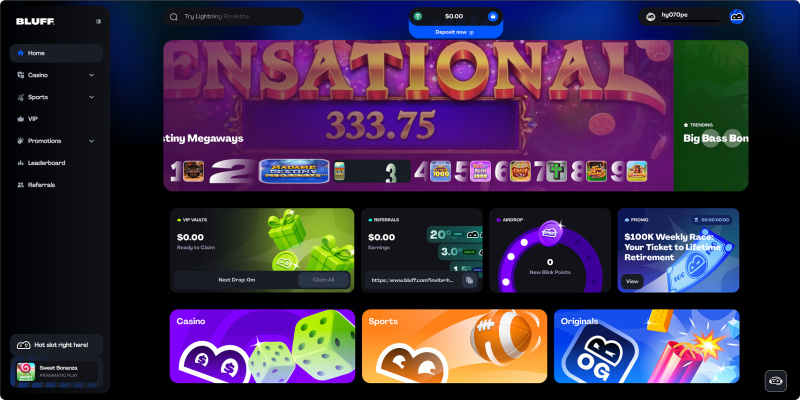
Beyond traditional iGaming and sports betting, BLUFF is building a unified experience that blends betting, live prediction markets, binary outcomes, and creator-led community events within a single platform. Bluff also provides a VIP matching program to make the transition from legacy platforms such as Stake, Shuffle and Rollbit to Bluff as seamless as possible, offering market-leading bonuses, rewards and world-class VIP service through a 24/7 VIP concierge.

“We are thrilled to back the BLUFF team,” said Andrew Willson, Partner at Makers Fund. “They bring a deep, nuanced understanding of player needs combined with an innovative approach to company building and platform design. By prioritizing players and offering a differentiated experience, we expect BLUFF to become a disruptive brand in the betting space.”

To learn more and play now, visit Bluff.com.

####

About BLUFF

BLUFF is built for the new generation of players. A global sports betting and iGaming platform where gaming, real stakes, culture, and community merge into a single, continuous loop to meet today’s users’ demands. It starts as a betting platform and sportsbook and evolves into something much bigger, with novel bet types, loot boxes, and trading that make for a unique betting experience. Backed by global blockchain technology fund 1kx, the founding team includes senior executives and operators from Stake, Bet365, William Hill, Bodog, YOLO and other category-defining platforms, bringing decades of experience at the highest levels of betting and gaming.

About 1kx

1kx is a research-driven, fundamentals-focused global investment firm. Founded in 2018 by tech entrepreneurs Lasse Clausen and Chris Heymann, 1kx invests at key inflection points for blockchain technologies to create breakthrough opportunities across industries. The firm’s mission is to develop the domain expertise and thought leadership required to accelerate the most consequential markets emerging at the intersection of blockchain and the broader economy. As one of the top-performing and most institutionalized funds in the blockchain space, 1kx partners with a diverse global investor base, including sovereign wealth funds, pension funds, endowments, foundations, fund of funds, corporations, and family offices. Renowned for its hands-on approach, technical rigor, and unwavering long-term commitment to founders, 1kx has empowered over 150 visionary startups to scale transformative projects while delivering enduring returns for its investors.

To learn more, visit https://1kx.capital/ or @1kxnetwork on X.

Contact

BLUFF
[email protected]

İlgili Sorular

QHow much funding did BLUFF raise and who led the investment round?

ABLUFF raised $21 million in a strategic investment round led by global blockchain technology fund 1kx.

QWhat are the key features of BLUFF's betting platform?

ABLUFF's platform prioritizes speed, transparency, and player alignment with instant onboarding, real-time settlement, provably fair games, and reward systems that allow users to participate directly in the ecosystem.

QWhat notable traction did BLUFF achieve during its beta phase?

ADuring its beta phase, BLUFF attracted over 600,000 sign-ups, sustained tens of thousands of daily active users, and processed over 125 million bets in just 3 months.

QWhich companies' former executives are part of BLUFF's team?

ABLUFF's team includes former senior executives from Stake, Bet365, William Hill, and Bodog.

QWhat types of betting experiences does BLUFF aim to unify on its platform?

ABLUFF aims to unify traditional iGaming, sports betting, live prediction markets, binary outcomes, and creator-led community events within a single platform.

İlgili Okumalar

Gensyn AI: Don't Let AI Repeat the Mistakes of the Internet

In recent months, the rapid growth of the AI industry has attracted significant talent from the crypto sector. A persistent question among researchers intersecting both fields is whether blockchain can become a foundational part of AI infrastructure. While many previous AI and Crypto projects focused on application layers (like AI Agents, on-chain reasoning, data markets, and compute rentals), few achieved viable commercial models. Gensyn differentiates itself by targeting the most critical and expensive layer of AI: model training. Gensyn aims to organize globally distributed GPU resources into an open AI training network. Developers can submit training tasks, nodes provide computational power, and the network verifies results while distributing incentives. The core issue addressed is not decentralization for its own sake, but the increasing centralization of compute power among tech giants. In the era of large models, access to GPUs (like the H100) has become a decisive bottleneck, dictating the pace of AI development. Major AI companies are heavily dependent on large cloud providers for compute resources. Gensyn's approach is significant for several reasons: 1) It operates at the core infrastructure layer (model training), the most resource-intensive and technically demanding part of the AI value chain. 2) It proposes a more open, collaborative model for compute, potentially increasing resource utilization by dynamically pooling idle GPUs, similar to early cloud computing logic. 3) Its technical moat lies in solving complex challenges like verifying training results, ensuring node honesty, and maintaining reliability in a distributed environment—making it more of a deep-tech infrastructure company. 4) It targets a validated, high-growth market with genuine demand, rather than pursuing blockchain integration without purpose. Ultimately, the boundaries between Crypto and AI are blurring. AI requires global resource coordination, incentive mechanisms, and collaborative systems—areas where crypto-native solutions excel. Gensyn represents a step toward making advanced training capabilities more accessible and collaborative, moving beyond a niche controlled by a few giants. If successful, it could evolve into a fundamental piece of AI infrastructure, where the most enduring value in the AI era is often created.

marsbit8 saat önce

Gensyn AI: Don't Let AI Repeat the Mistakes of the Internet

marsbit8 saat önce

Why is China's AI Developing So Fast? The Answer Lies Inside the Labs

A US researcher's visit to China's top AI labs reveals distinct cultural and organizational factors driving China's rapid AI development. While talent, data, and compute are similar to the West, Chinese labs excel through a pragmatic, execution-focused culture: less emphasis on individual stardom and conceptual debate, and more on teamwork, engineering optimization, and mastering the full tech stack. A key advantage is the integration of young students and researchers who approach model-building with fresh perspectives and low ego, prioritizing collective progress over personal credit. This contrasts with the US culture of self-promotion and "star scientist" narratives. Chinese labs also exhibit a strong "build, don't buy" mentality, preferring to develop core capabilities—like data pipelines and environments—in-house rather than relying on external services. The ecosystem feels more collaborative than tribal, with mutual respect among labs. While government support exists, its scale is unclear, and technical decisions appear driven by labs, not state mandates. Chinese companies across sectors, from platforms to consumer tech, are building their own foundational models to control their tech destiny, reflecting a broader cultural drive for technological sovereignty. Demand for AI is emerging, with spending patterns potentially mirroring cloud infrastructure more than traditional SaaS. Despite challenges like a less mature data industry and GPU shortages, Chinese labs are propelled by vast talent, rapid iteration, and deep integration with the open-source community. The competition is evolving beyond a pure model race into a contest of organizational execution, developer ecosystems, and industrial pragmatism.

marsbit9 saat önce

Why is China's AI Developing So Fast? The Answer Lies Inside the Labs

marsbit9 saat önce

3 Years, 5 Times: The Rebirth of a Century-Old Glass Factory

Corning, a 175-year-old glass company, is experiencing a dramatic revival as a key player in AI infrastructure, driven by surging demand for high-performance optical fiber in data centers. AI data centers require vastly more fiber than traditional ones—5 to 10 times as much per rack—to handle high-speed data transmission between GPUs. This structural demand shift, coupled with supply constraints from the lengthy expansion cycle for fiber preforms, has created a significant supply-demand gap. Nvidia has invested in Corning, along with Lumentum and Coherent, in a $4.5 billion total commitment to secure the optical supply chain for AI. Corning's competitive edge lies in its expertise in producing ultra-low-loss, high-density, and bend-resistant specialty fiber, which is critical for 800G+ and future 1.6T data rates. Its deep involvement in co-packaged optics (CPO) with partners like Nvidia further solidifies its position. While not the largest fiber manufacturer globally, Corning's revenue from enterprise/data center clients now exceeds 40% of its optical communications sales, and it has secured multi-year supply agreements with major hyperscalers including Meta and Nvidia. Financially, Corning's optical communications revenue has surged, doubling from $1.3 billion in 2023 to over $3 billion in 2025. Its stock price has risen nearly 6-fold since late 2023. Key future catalysts include the rollout of Nvidia's CPO products and the scale of undisclosed customer agreements. However, risks include high current valuations and potential disruption from next-generation technologies like hollow-core fiber. The company's long-term bet on light over electricity, maintained even through the telecom bubble crash, is now being validated by the AI boom.

marsbit10 saat önce

3 Years, 5 Times: The Rebirth of a Century-Old Glass Factory

marsbit10 saat önce

İşlemler

Spot
Futures
活动图片





