Author: C Labs Crypto Watch
Recent new regulations on overseas investment have sparked intense discussions both domestically and internationally. Bloomberg has also published an article revealing that, despite the State Administration of Foreign Exchange (SAFE) setting an annual individual foreign exchange quota of $50,000, an estimated $150 billion still flows out of the country each year through various gray and underground channels.
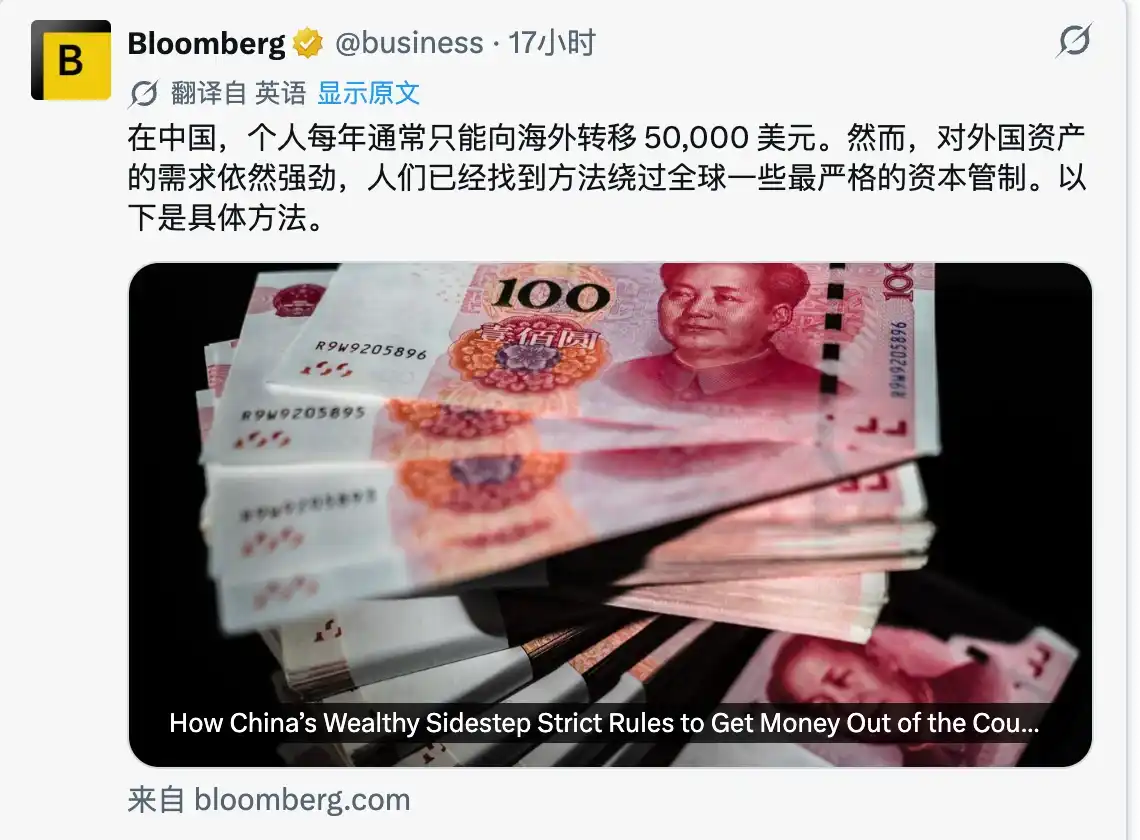
How Was This "Wall" Built
1994: The Starting Point of the Wall
The foundation of China's current foreign exchange control system is the dual-track framework established in 1994: "current account convertibility with strict capital account controls."
Simply put: money for trade in goods can go out, but money for individuals and capital must be strictly controlled.
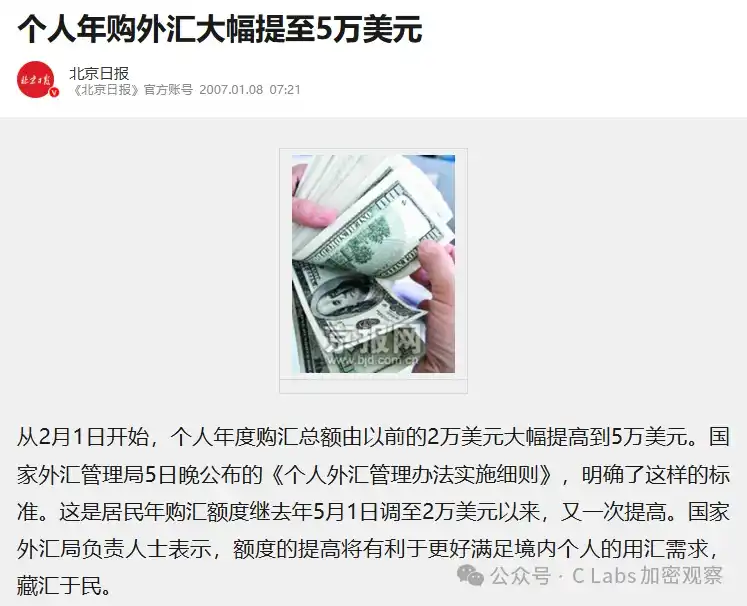
2007, SAFE formally set the unified annual individual foreign exchange purchase quota at $50,000 per person, a figure that remains unchanged and has never been increased.
However, for a long time, this rule was largely nominal and not strictly enforced.
2015: The First Real Stress Test
The August 2015 foreign exchange reform, which led to a sudden depreciation of the RMB, triggered a wave of panic-driven foreign exchange purchases. From the second half of 2015 to 2016, China's foreign exchange reserves plummeted from nearly $4 trillion to below $3 trillion, with a maximum single-month outflow of nearly $100 billion.
SAFE's response was to tighten controls rapidly:
Requiring individuals to fill out detailed declaration forms when purchasing foreign exchange, explicitly pledging not to use the funds for overseas property purchases, securities investment, or life insurance;
-
Banks were required to conduct "substantive" reviews of large foreign exchange purchases and could not process them based solely on declarations;
-
Organized crackdowns began on "smurfing" behavior.
2017: Channels Like Hong Kong Insurance and Overseas Property Gradually Blocked
Another popular channel for capital outflows—using UnionPay cards to pay large premiums for Hong Kong insurance policies—was directly cut off in 2017: UnionPay explicitly prohibited the use of mainland cards for paying premiums on Hong Kong savings and investment insurance products.
Around the same time, regulatory authorities launched special campaigns targeting the "illegal outflow of foreign exchange funds for overseas property purchases."
2024—2026: Comprehensive Digital Blockade Upgrade
The core of this latest round of tightening is the substantial upgrade of algorithms and data infrastructure.
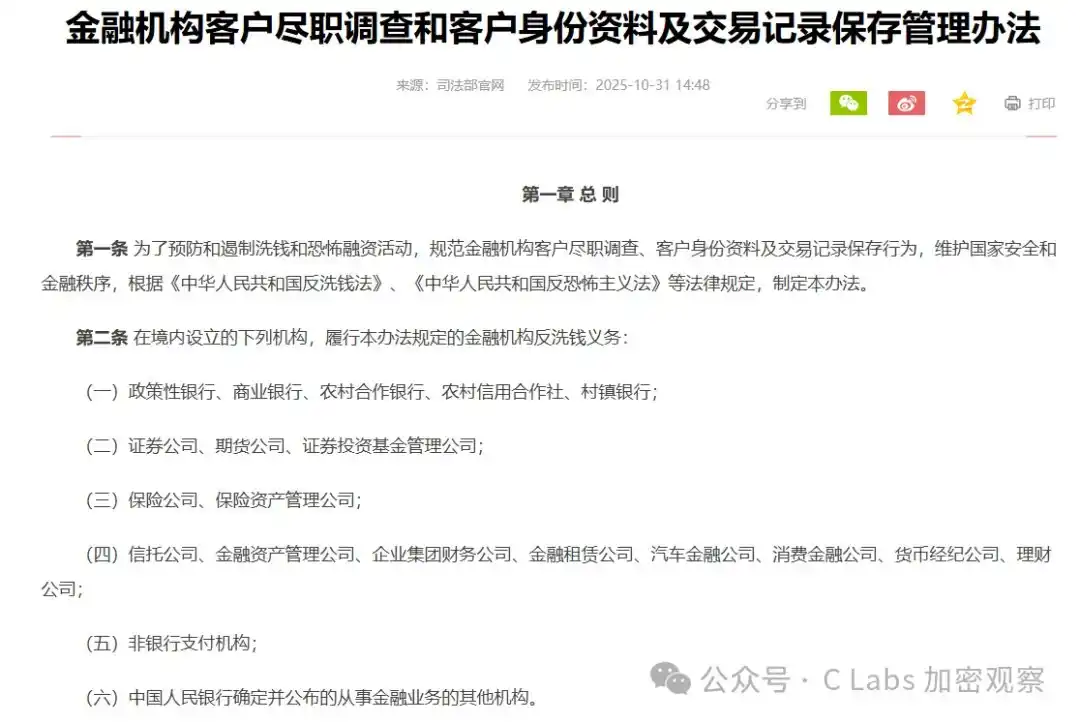
Effective January 1, 2026, the "Measures for the Due Diligence of Customers of Financial Institutions and the Preservation of Customer Identity Information and Transaction Records" officially came into effect. A key change: for cross-border remittances exceeding RMB 5,000 or the foreign currency equivalent of $1,000, banks must verify the accuracy of the remitter's identity information.
This threshold appears very low—and indeed, it is intentionally set low.
The regulatory intent is clear: not to block genuine small cross-border needs, but to ensure every fund transfer leaves a traceable digital footprint, making the "cost" of large-scale, dispersed transfers rise sharply.
Simultaneously, China formally incorporated the Common Reporting Standard (CRS) into its domestic enforcement framework in 2024. This means over 100 signatory countries regularly and automatically report the overseas account balances and earnings of Chinese residents to China's tax authorities. Accounts hidden in Singapore, Canada, the UK, etc., are theoretically already "transparent" to Chinese tax authorities.
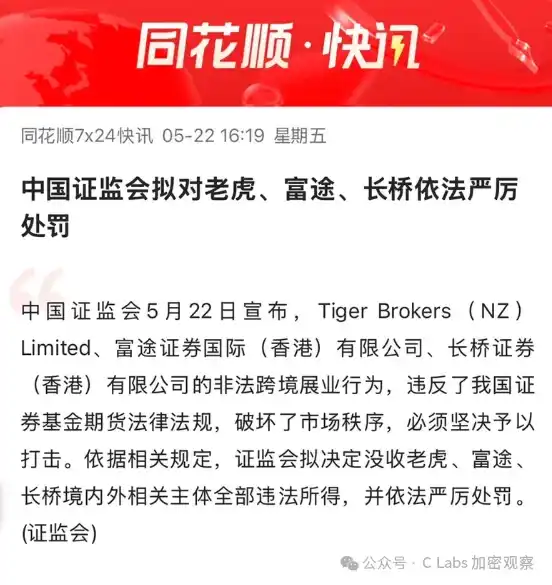
In May 2026, the China Securities Regulatory Commission (CSRC) named Futu Securities, Tiger Brokers, and Longbridge Securities, identifying them as operating cross-border businesses without proper licenses and demanding rectification—the latest link in the regulatory chain.
How the Money Gets Out: Bloomberg's Five Major Pathways
As the wall grows higher, the flow of money never stops. The core value of this Bloomberg report lies in systematically deconstructing the "counter-wall" engineering employed unofficially.
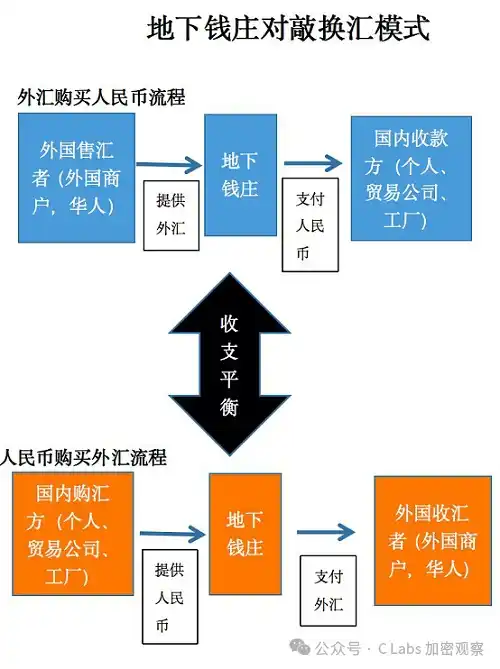
Pathway One: The Underground Banking Network ("Duiqiao") – Largest Scale, No RMB Crosses the Border
This is currently the main channel for high-net-worth individuals to transfer large sums, known in the circle as "Duiqiao," corresponding to the term Hawala in the international anti-money laundering system.
The operating logic is extremely ingenious: not a single cent of RMB physically crosses China's border.
Specific process: Domestic investors transfer RMB to a domestic account controlled by an underground bank; the bank's associated entity overseas (typically in Hong Kong, Singapore, Vancouver) directly deposits the equivalent amount in foreign currency into the client's overseas account. Both ends settle separately; only "information" crosses the border, not "funds."
This system is logically flawless—precisely because there is no real cross-border fund movement, SAFE's traditional monitoring methods have difficulty directly detecting it.
Where are the risks? First, fees: as regulation tightens, costs are far from the 1% level of earlier years. Second, the foreign currency funding pools of underground banks have complex sources; once mixed with funds from international crime, clients' overseas accounts may be frozen directly by local judicial authorities without their knowledge. Third, if caught domestically, they face administrative fines of over 30% of the transfer amount and potential criminal prosecution.
A typical case disclosed by the Beijing People's Procuratorate in 2025 showed: Lin and four others received illegal foreign exchange funds through bank cards under their names, using cryptocurrency to complete cross-border settlement, ultimately sentenced to two to four years imprisonment for illegal business operations and fined.
Pathway Two: Smurfing – "Distributed Computing" Using Legal Quotas
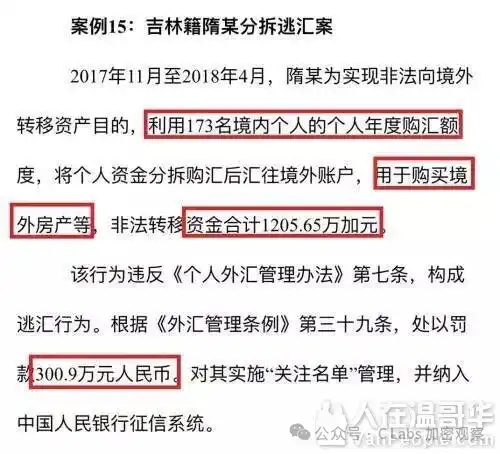
Better known than underground banking is so-called "smurfing"—using the legal $50,000 annual quota per person for "distributed" transfers.
Method: A core investor mobilizes relatives, employees, or even pays unrelated individuals. Each uses their own ID and banking app to legally exchange $50,000, then remits the foreign currency to the same overseas account during the same period.
This route is being besieged by algorithms. SAFE's deployed anti-money laundering models specifically identify the pattern of "multiple unrelated domestic accounts remitting funds to the same overseas account within a short period." Once triggered, related accounts are frozen, and individuals may face multi-year bans on foreign exchange transactions.
Pathway Three: Falsifying Trade Invoices – The Legitimate Cloak of the "Current Account"
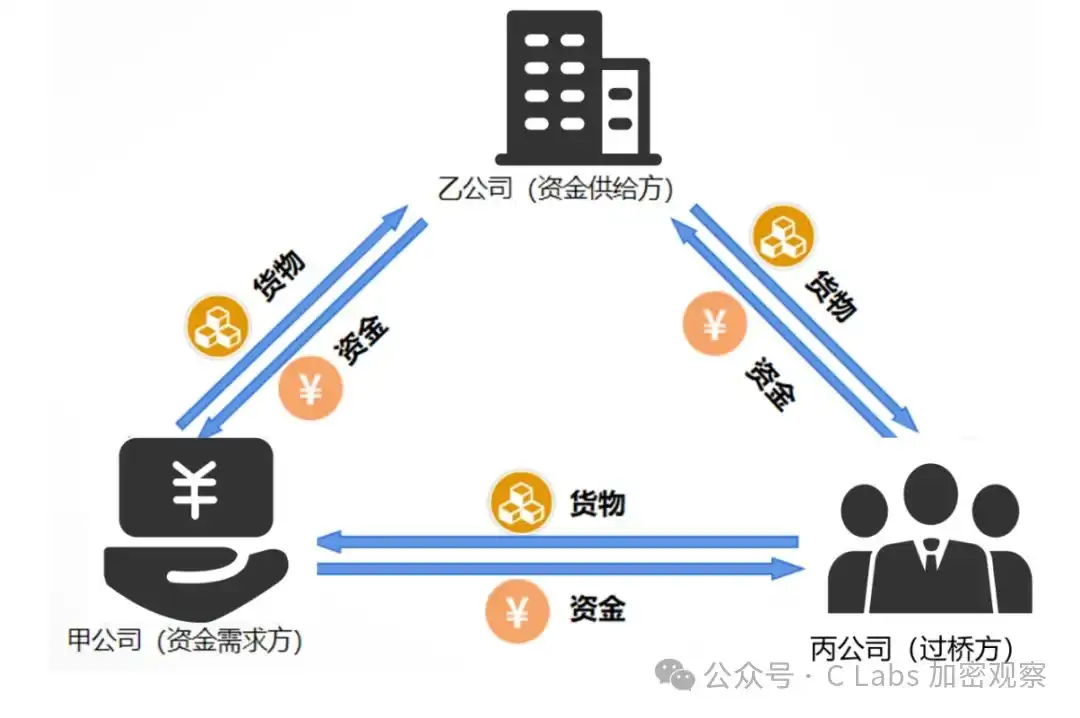
This is the most commonly used tool for private entrepreneurs with import-export businesses, technically called Trade-Based Capital Flight. It exploits a system loophole: remittances under the current account for trade in goods are not subject to the $50,000 individual limit; banks must approve them upon seeing compliant trade invoices.
Over-invoicing imports: A domestic company purchases equipment from a secretly controlled shell company in Hong Kong or the Cayman Islands. The actual value is $500,000, but the invoice is inflated to $1 million. The bank compliantly releases $1 million, and the extra $500,000 sits safely in the overseas shell company's account.
-
Under-invoicing exports: The reverse operation. Goods worth $1 million are "under-sold" for $200,000 to an overseas related party, which then sells them to the real buyer at market price, leaving $800,000 in profits directly overseas.
The core advantage of this path is its cloak of complete legality. Its drawback is the need for genuine trade operations as cover, and in recent years, cross-referencing of data between customs and SAFE has become increasingly sophisticated.
Pathway Four: Channel Migration – From Internet Brokers to State Bank Wealth Channels
After the regulatory crackdown on Futu, Tiger, and Longbridge, fund flows have clearly migrated to other channels.
According to Bloomberg's observations, the wealthy are shifting in two directions: First, towards cross-border wealth management services of large institutions like Bank of China (Hong Kong) and HSBC, which have high compliance costs, requiring detailed proof of fund sources and tax payments, but the operational path is fully legal. Second, utilizing state-approved QDII (Qualified Domestic Institutional Investor) quotas to invest in overseas funds, but these quotas are strictly controlled by the state and cannot directly hold overseas property or customized assets.
In simpler terms: the wealthy are spending higher costs to walk through narrower, compliant doors to send the same money out.
Pathway Five: Structural Arrangements – Trusts, Insurance, Immigrant Investment
This is the preferred path for the ultra-high-net-worth, involving the highest technical expertise, combining various tools like offshore family trusts, Hong Kong life insurance (small premium portions can still be paid by card), and immigrant investment programs (EB-5, various Canadian provincial investor programs, etc.).
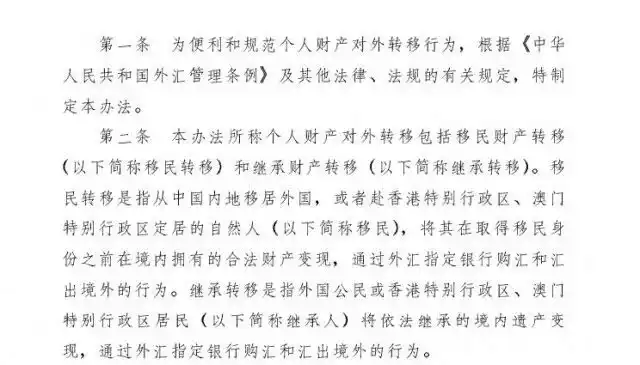
All Chinese citizens who legally immigrate to other countries/regions have one and only one opportunity to apply to SAFE for the transfer of emigrant assets.
A notable feature of this path is the extremely high compliance cost, but relatively fewer legal gray areas. When done correctly, what is transferred is not the "money" itself, but the legal ownership structure of the assets.
Regulation's Ultimate Response: Extending the Wall to People
Faced with the never-ending flow of money year after year, the core strategy of regulators has undergone a qualitative shift in this round—no longer just focusing on money, but starting to focus on people.
From "Managing Enterprises" to "Managing Individuals"
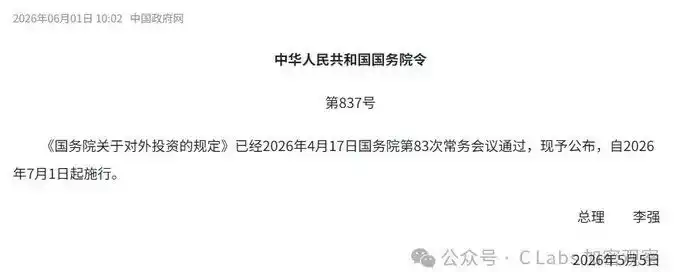
The previous overseas investment regulatory framework mainly targeted corporate legal entities. Asset transfers by individuals through complex nominee agreements, overseas technical consulting contracts (remitting funds abroad under the guise of "consulting fees"), intellectual property transfers, etc., have long operated in a regulatory gray area.
The State Council's revised regulations on overseas investment explicitly extend regulatory reach to "resident individuals," bringing all such individual-level structural arrangements under the national security review and anti-money laundering monitoring frameworks.
CRS: The Sharpest "Retrospective" Weapon
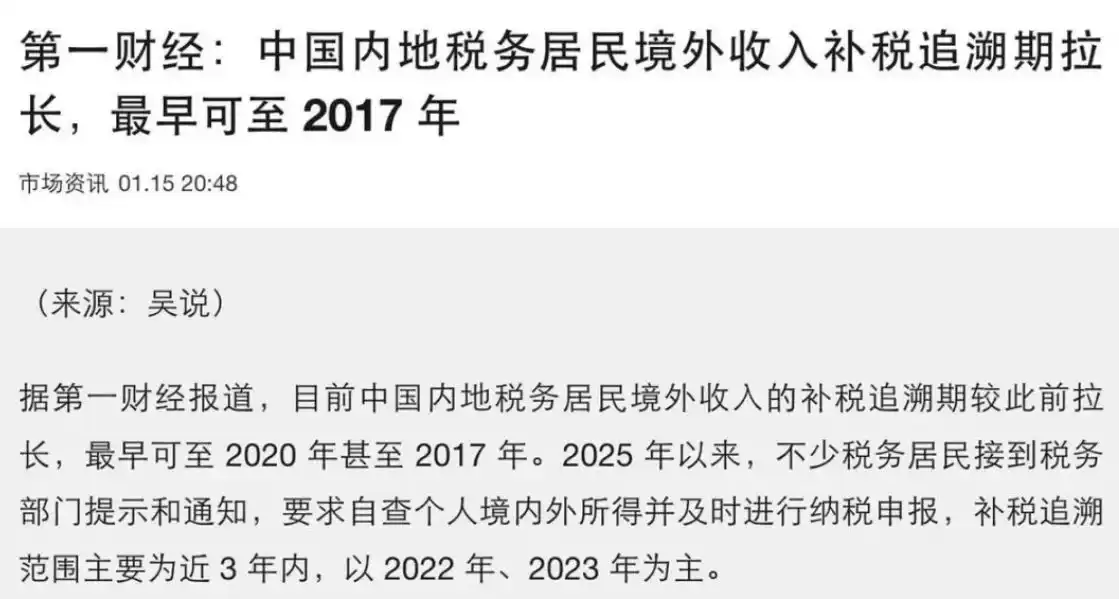
The full integration of CRS into the domestic enforcement system in 2024 is the most technologically advanced step in this round of containment.
CRS operates on this logic: Over 100 participating countries/regions annually and automatically report to China's tax authorities information on Chinese residents' account balances, interest, dividends, proceeds from sales of financial assets, etc., in their jurisdictions.
This means: Assets transferred overseas over the past decade through various channels, lying quietly abroad, are now exposed to the view of Chinese tax authorities. It's not "might be discovered," but already on record.
Cryptocurrency: A "New Channel" Already Under Judicial Scrutiny
In Bloomberg's report, the cryptocurrency channel received little attention. But this is precisely the most noteworthy gap in the report.
Judging from existing Chinese judicial precedents, using stablecoins like USDT for cross-border foreign exchange has already become a key target for prosecution. The 2025 Beijing procuratorate's typical case explicitly defined "using virtual currency to complete cross-border settlement" as the crime of illegal business operations.
This means cryptocurrency is not a "hole" in the wall, but a special channel already under surveillance and being systematically closed.

Bloomberg's report concludes by citing a background figure: China has over 6.2 million affluent families with personal assets exceeding $1 million.
Against the backdrop of the real estate myth collapsing, declining returns on domestic assets, and rising geopolitical uncertainty, the motivation for this vast group to allocate wealth overseas will not disappear because of a wall.