Blockchain trial on Canton Network tests collateral reuse with tokenized US Treasurys

cointelegraph2025-12-09 tarihinde yayınlandı2025-12-09 tarihinde güncellendi

Özet

Digital Asset and a group of major financial institutions have successfully conducted a second round of onchain US Treasury financing trials on the Canton Network. The test introduced real-time collateral reuse using tokenized US Treasurys and expanded the use of multiple stablecoins, including USDC, to enhance onchain liquidity. This innovation bypasses traditional operational delays associated with rehypothecation. Participants included Bank of America, Citadel Securities, Cumberland DRW, Virtu Financial, Société Générale, Tradeweb, Circle, Brale, and M1X Global. The Canton Network, a blockchain built for institutional finance, continues to grow in the tokenized real-world assets (RWA) space, with over $370 billion represented onchain, leading the market significantly.

Digital Asset and a group of financial institutions have completed a second round of onchain US Treasury financing on the Canton Network, introducing real-time collateral reuse and expanding the number of stablecoins involved.

Five transactions were executed in the newest phase, building on the July pilot, which first demonstrated that US Treasurys and the USDC (USDC) stablecoin could be combined to finance and settle transactions on the blockchain.

In the latest trial, the companies used multiple stablecoins to finance positions against tokenized US Treasurys, widening the pool of onchain liquidity available for financing transactions.

The trial showed that tokenized US Treasurys could be passed between counterparties and reused as collateral in real-time, sidestepping the operational delays that typically accompany rehypothecation in traditional finance.

The effort brought together Bank of America, Citadel Securities, Cumberland DRW, Virtu Financial, Société Générale, Tradeweb, Circle, Brale and M1X Global, which are all a part of the Canton Network’s Industry Working Group.

Kelly Mathieson, chief business development officer at Digital Asset — the company behind the Canton Network — said in a statement that the test was “part of a thoughtful progression toward a new market model.”

Justin Peterson, chief technology officer of Tradeweb, added that “demonstrating real-time collateral reuse and expanded stablecoin liquidity isn’t just a technical achievement — it’s a blueprint for what the future of institutional finance can look like.”

Related: ‘We refused to do an ICO’: The truth behind Canton’s tokenomics

Canton Network expands footprint in tokenized RWAs

The Canton Network, a layer-1 blockchain built for institutional finance, has been expanding its presence across the tokenization sector this year.

On Dec. 4, its developer Digital Asset secured roughly $50 million in strategic backing from BNY, iCapital, Nasdaq and S&P Global. The new funding followed a $135 million raise earlier this year and is intended to support the network’s scaling efforts.

In October, asset manager Franklin Templeton said it would migrate its Benji Investments platform — which tokenizes shares of the firm’s flagship US money market fund — to the Canton Network.

Data from RWA.xyz also shows the Canton Network now leads the market for tokenized real-world assets by a wide margin, with more than $370 billion represented onchain, far outpacing popular networks such as Ethereum, Polygon, Solana and other public chains.
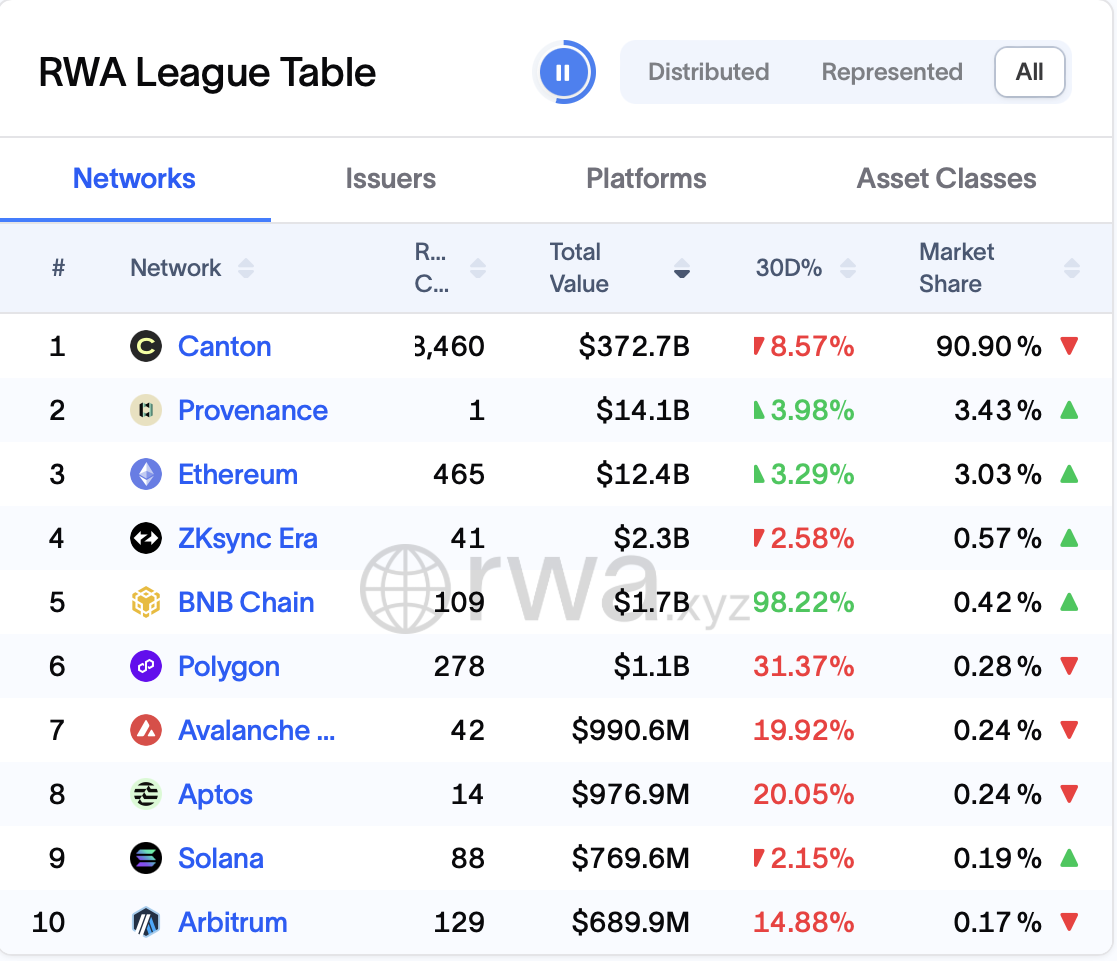
Top blockchains for RWA. Source: RWA.xyz

Magazine: 6 reasons Jack Dorsey is definitely Satoshi... and 5 reasons he’s not

İlgili Okumalar

Bitcoin Withdrawals Continue: 8 Years of Storage in a Coldcard Cold Wallet Ended in Zero

Coldcard Hardware Wallet Hacked: Losses Mount Due to Vulnerable Seed Generation A critical vulnerability in Coldcard hardware wallets has led to a continued wave of fund thefts. According to Galaxy Research, the total stolen has reached 1,367.05 BTC (approx. $88.6 million) from 4,585 addresses, a significant increase from the initial 594.5 BTC reported on July 30, 2026. Most of the stolen funds remain on the attackers' addresses. The issue is not with the current firmware, which Coinkite has updated, but with seed phrases generated on vulnerable devices between March 2021 and the release of fixed firmware versions. Due to a programmer error, devices switched from using a hardware random number generator to the software-based Yasmarang generator, which was initialized with publicly accessible data like the chip's serial number. This made the seed phrases predictable through offline brute-force attacks, meaning wallets remain at risk until funds are moved to a new wallet generated with the patched firmware. Affected devices include Mk2/Mk3 with firmware 4.0.1–4.1.9 (and up to 5.0.3), Mk4/Mk5 up to version 5.6.0, and Q models up to 1.5.0Q. The only exceptions are seeds created with a high-entropy method like at least 50 independent dice rolls or a strong unique BIP-39 passphrase. All other owners must generate a new seed on the fixed firmware and transfer their assets. A case highlighting the human impact involves a 39-year-old long-term investor who lost 2 BTC (approx. $130,000) in minutes. He had accumulated the Bitcoin over eight years through physical labor, viewing it as a financial lifeline and a retirement plan in a country suffering from hyperinflation. His story underscores that even conservative "buy and hold in cold storage" strategies can be compromised by such underlying technical flaws. From a technical perspective, this incident echoes historical failures where weak random number generators undermined cryptographic security, challenging the assumption that offline storage is automatically foolproof.

cryptonews.ru2 saat önce

Bitcoin Withdrawals Continue: 8 Years of Storage in a Coldcard Cold Wallet Ended in Zero

cryptonews.ru2 saat önce

İşlemler

Spot
活动图片




