Blockchain trial on Canton Network tests collateral reuse with tokenized US Treasurys

cointelegraph2025-12-09 tarihinde yayınlandı2025-12-09 tarihinde güncellendi

Özet

Digital Asset and a group of major financial institutions have successfully conducted a second round of onchain US Treasury financing trials on the Canton Network. The test introduced real-time collateral reuse using tokenized US Treasurys and expanded the use of multiple stablecoins, including USDC, to enhance onchain liquidity. This innovation bypasses traditional operational delays associated with rehypothecation. Participants included Bank of America, Citadel Securities, Cumberland DRW, Virtu Financial, Société Générale, Tradeweb, Circle, Brale, and M1X Global. The Canton Network, a blockchain built for institutional finance, continues to grow in the tokenized real-world assets (RWA) space, with over $370 billion represented onchain, leading the market significantly.

Digital Asset and a group of financial institutions have completed a second round of onchain US Treasury financing on the Canton Network, introducing real-time collateral reuse and expanding the number of stablecoins involved.

Five transactions were executed in the newest phase, building on the July pilot, which first demonstrated that US Treasurys and the USDC (USDC) stablecoin could be combined to finance and settle transactions on the blockchain.

In the latest trial, the companies used multiple stablecoins to finance positions against tokenized US Treasurys, widening the pool of onchain liquidity available for financing transactions.

The trial showed that tokenized US Treasurys could be passed between counterparties and reused as collateral in real-time, sidestepping the operational delays that typically accompany rehypothecation in traditional finance.

The effort brought together Bank of America, Citadel Securities, Cumberland DRW, Virtu Financial, Société Générale, Tradeweb, Circle, Brale and M1X Global, which are all a part of the Canton Network’s Industry Working Group.

Kelly Mathieson, chief business development officer at Digital Asset — the company behind the Canton Network — said in a statement that the test was “part of a thoughtful progression toward a new market model.”

Justin Peterson, chief technology officer of Tradeweb, added that “demonstrating real-time collateral reuse and expanded stablecoin liquidity isn’t just a technical achievement — it’s a blueprint for what the future of institutional finance can look like.”

Related: ‘We refused to do an ICO’: The truth behind Canton’s tokenomics

Canton Network expands footprint in tokenized RWAs

The Canton Network, a layer-1 blockchain built for institutional finance, has been expanding its presence across the tokenization sector this year.

On Dec. 4, its developer Digital Asset secured roughly $50 million in strategic backing from BNY, iCapital, Nasdaq and S&P Global. The new funding followed a $135 million raise earlier this year and is intended to support the network’s scaling efforts.

In October, asset manager Franklin Templeton said it would migrate its Benji Investments platform — which tokenizes shares of the firm’s flagship US money market fund — to the Canton Network.

Data from RWA.xyz also shows the Canton Network now leads the market for tokenized real-world assets by a wide margin, with more than $370 billion represented onchain, far outpacing popular networks such as Ethereum, Polygon, Solana and other public chains.
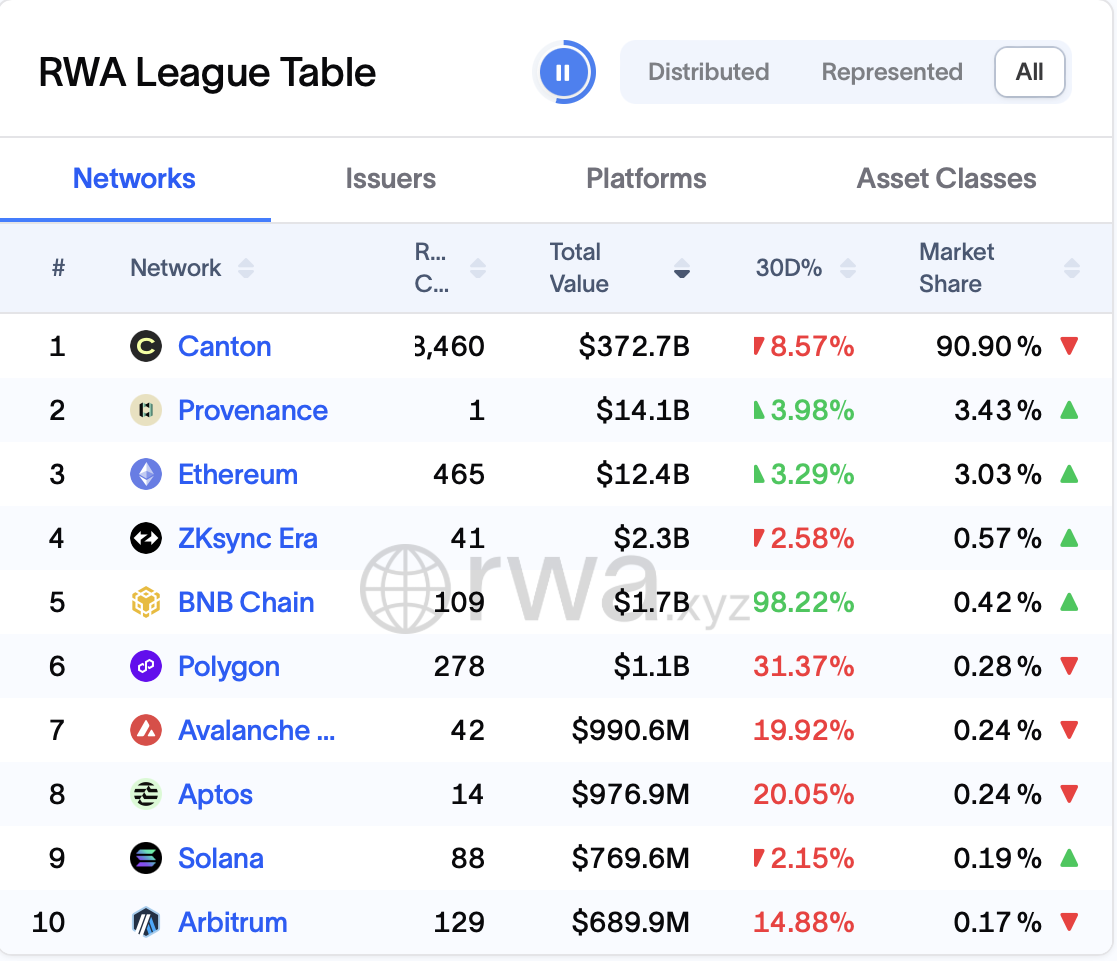
Top blockchains for RWA. Source: RWA.xyz

Magazine: 6 reasons Jack Dorsey is definitely Satoshi... and 5 reasons he’s not

İlgili Okumalar

Within Strategy's Framework, STRC's Dividend Yield Remains at 12% as Share Price Stays Below Par Value

Michael Saylor, Executive Chairman of Strategy (MSTR), confirmed that the dividend rate for its STRC perpetual preferred shares will remain at 12.00% through August 2026. The rate has increased from 9% at its July 2025 launch to the current high via a "ratchet" mechanism, which permanently raises the rate by 0.5% whenever the share price falls below $95. This mechanism is intended to push the price back toward its $100 par value and support Strategy's "at-the-market" (ATM) program for issuing new shares to fund Bitcoin purchases. However, the mechanism has not worked as intended. STRC shares closed at $89.46 on July 31, remaining about 10-11% below par value despite the record-high dividend. Competition from rival Strive's higher-yielding SATA securities has pressured demand. The persistent discount has forced Strategy to suspend new STRC issuances via its ATM program, limiting this funding channel for Bitcoin acquisitions. STRC's struggles reflect Bitcoin's own volatility, as the preferred shares historically move in tandem. Analysts have warned the ratchet structure carries long-term, one-way risk. A law firm is investigating Strategy's ability to maintain dividend payments if Bitcoin's price stays low. Retail investors own roughly 83% of outstanding STRC shares, a group seen as prone to panic selling during downturns. In response, Strategy has established financial reserves, including a liquidity cushion covering about 26 months of dividend/interest obligations, and a $2 billion share buyback program alongside a Bitcoin monetization framework, though the company emphasized it is not obligated to sell any Bitcoin.

cryptonews.ru27 dk önce

Within Strategy's Framework, STRC's Dividend Yield Remains at 12% as Share Price Stays Below Par Value

cryptonews.ru27 dk önce

Analyst: Bitcoin's Price Will Drop to $60k in August, Then Rebound to $70k

Financial analyst Andrey Poroshin has provided a new forecast for Bitcoin's price dynamics in August. Poroshin, an analyst at the Bitbanker exchange, expects the cryptocurrency market to experience a downturn this month, with prices retesting the $60,000 level due to a lack of supportive macroeconomic catalysts. He noted that the recent US Federal Reserve decision to hold interest rates did not significantly impact the market, while inflation remains above the 2% target. Poroshin stated that Bitcoin is ending July under pressure from moderate volatility and a lack of new macroeconomic stimuli, leading to continued market caution. According to his base scenario, Bitcoin will drop to a range of $60,000 to $62,000 before recovering to $70,000. He pointed out that even $70,000 remains below the cost of mining in the US, which has prompted some miners to shift towards AI data center operations. Poroshin cited the winding down of BitMEX's operations as a potential catalyst for a price rebound, suggesting the exit of weaker players often coincides with market reversals and reduced short-term selling pressure. He believes Bitcoin is currently less susceptible to geopolitical shocks, such as the Iran-US conflict, and does not expect significant market changes in August related to the pending CLARITY Act. Looking ahead, Poroshin forecasts that September will bring more active price fluctuations driven by potential Fed rate decisions and possible discussions or approval of the CLARITY Act.

cryptonews.ru27 dk önce

Analyst: Bitcoin's Price Will Drop to $60k in August, Then Rebound to $70k

cryptonews.ru27 dk önce

İşlemler

Spot
活动图片




