Author: Chloe, ChainCatcher
Recently, Lily Liu, President of the Solana Foundation, posted on X stating that "games on the blockchain will not return," and declared that blockchain games are dead.
Her judgment stems from a Polymarket post: "Mark Zuckerberg's Meta is gradually abandoning its metaverse vision after spending $80 billion." Although Meta's blueprint did not explicitly involve blockchain or crypto assets, its strategy highly overlaps with the future depicted by Web3 blockchain games in recent years: virtual worlds, digital asset ownership, and immersive online economies.
Even the wealthiest player has quit. As the crypto industry's most promising "breakout" narrative, are blockchain games today on their last legs?
The Collapse of the Entire Sector: Blockchain Game Projects Shutting Down One After Another?
Last August, Proof of Play released an announcement that seemed like a confession to the market: its fully on-chain pirate RPG "Pirate Nation" would shut down within 30 days. Two dedicated blockchains went offline, token rewards zeroed out, and community players could only burn their assets in exchange for so-called "certificates" that might one day be useful—but probably won't be. This game studio had raised $33 million two years prior, vowing to build the future of on-chain gaming.
After the announcement, the PIRATE token plummeted 92% in a few days. Co-founder Adam Fern admitted: "Shutting down Pirate Nation was one of the toughest decisions I've ever been part of. But the truth is, it could never become a breakthrough mass-market title."
Pirate Nation is not an isolated case; it is just a small part of the great blockchain game collapse of 2025.
Let's review the list of blockchain games that announced shutdowns last year. "Ember Sword," an Ethereum game that attracted $203 million through NFT land sales, announced its closure in May last year, with developer Bright Star Studios citing a lack of funds.
"Nyan Heroes," a third-person shooter battle royale game built on Solana, was once on the wishlist of over 250,000 PC platform players but also ended operations in May last year due to broken financing. Its NYAN token fell over 99% from its peak. Square Enix, creator of "Final Fantasy," also saw its Ethereum-based game "Symbiogenesis" come to an end in July.
Gala Games' MMORPG, officially licensed by "The Walking Dead," also went offline in July. The NFT-based mechanized combat game "MetalCore" shut down its servers in March and then vanished without a trace, with the developer quietly shifting to release a new game on Steam that has nothing to do with blockchain.
The most recent case that left the market sighing was "Wildcard." After its TGE in March this year, its market cap peaked at only $1.1 million, with the community widely questioning the project's irresponsibility and soft rug. According to crypto asset data platform RootData, Wildcard had raised $46 million in funding, led by Paradigm.
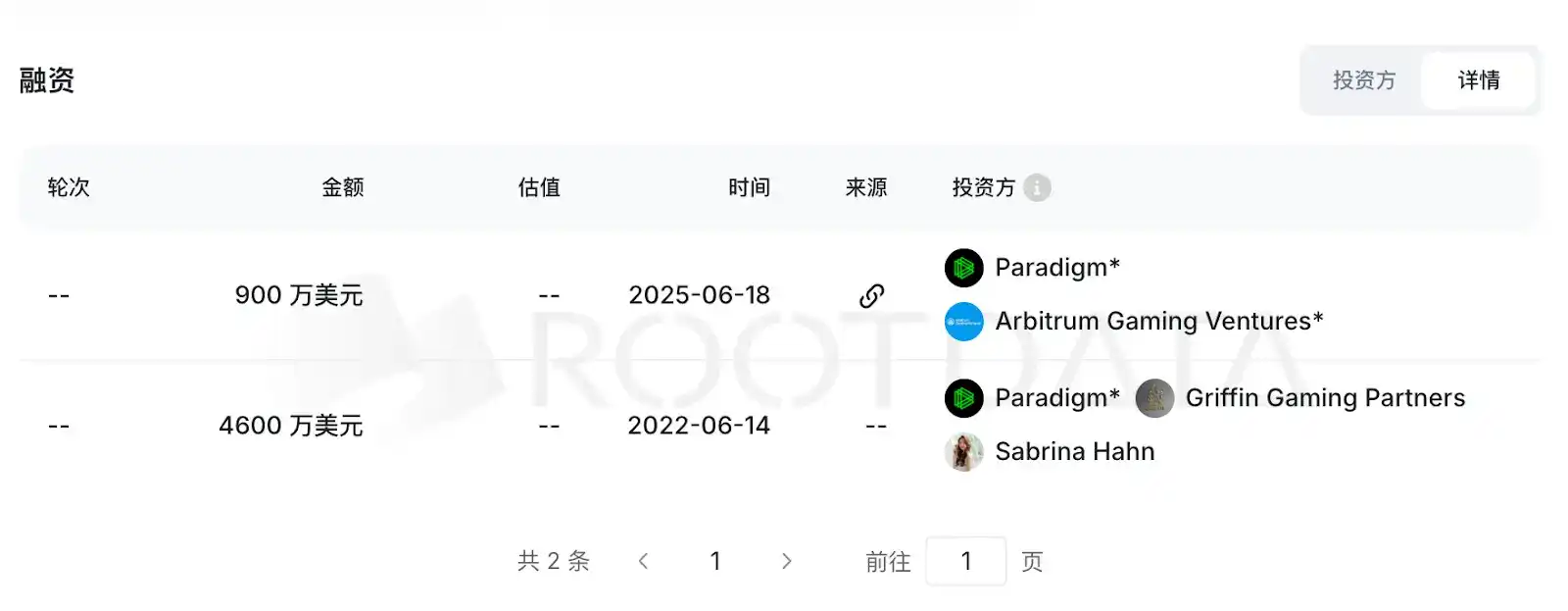
Its founder, Paul Bettner, had previously worked on well-known games like "Words With Friends" and "Lucky's Tale." But now, even with top VC backing and veteran game developers at the helm, the collapse of the entire blockchain gaming sector could not be stopped.
In addition, there are "Deadrop," "Blast Royale," "Mojo Melee," "Tokyo Beast," "OpenSeason," "Captain Tsubasa Rivals"—each project背后是数百万甚至数千万美元的投资、无数游戏用户的积累,以及最终化为乌有的承诺。
Web2 Players Want a Good Game, Web3 Players Only Want Profits
Most founders have real game development backgrounds, and their visions for on-chain games during fundraising were not entirely empty talk. Why did they still end up shutting down or returning to Web2?
"Web3 games built an entire investor-driven capital structure through tokens and NFTs before validating player demand." In other words, the people funding these games and the people who ultimately need to stay in the games were not the same group from the start.
When development revealed that the on-chain player base was smaller and more short-term arbitrage-oriented than expected, with tokens continuously falling and development costs rising, studios were left with only the choices of shutting down or abandoning their blockchain identity to turn to the traditional market. Either way, early Web3 investors and NFT holders ended up footing the bill.
The farm simulation game "Moonfrost" is a typical case. Developer Oxalis Games raised $6.5 million, ran a Play-to-Airdrop campaign for over a year, and sold 1,833 NFT boxes at $150 each. Then, in November 2025, the team announced leaving Web3 and relaunched on Steam as a paid PC game, with no NFTs, tokens, or blockchain.
And just the day before the announcement, CEO Ric Moore was still publicly talking about how to build "slow and meaningful Web3 games." The team's reason: "Web3 players want to make money, Web2 players just want a good game." It took them three years and millions of real dollars to see the real rules.
The 2025 Blockchain Game Alliance (BGA) industry report also confirmed the ebb tide of blockchain games: annual investment in blockchain games dropped to about $293 million, a惊人 drop compared to $4 billion in 2021 and the peak of $10 billion in 2022. DWF Labs described the current phase as a "necessary reset." The biggest aftermath of the sector's failure may be the credibility crisis of the entire blockchain gaming space.
The BGA report showed that 36% of respondents listed "scams, fraud, or rug pulls" as the biggest threat to the industry. Even though most project shutdowns were not intentional scams, from an external perspective, the repeated cycle of "fundraising, token issuance, collapse" is almost indistinguishable from rug pulls. "This industry needs real game developers and real users who want to play games. Both are indispensable."
Infrastructure and Market Conditions as Advantages, Stablecoins and AI Bring New Opportunities
The collapse of the blockchain gaming narrative does not mean consumer-level applications in the crypto industry have come to an end. The BGA report shows that 65.8% of industry practitioners remain optimistic about the next 12 months, with this optimism based on deliverable products and sustainable revenue models. Meanwhile, stablecoins processing large-scale transfer volumes, AI tools compressing game development costs to a fraction of what they were, etc.—infrastructure and market conditions have never disappeared.甚至从不少开发者的观点中,可以看到几条可能的路径。
NEXPACE CEO Sunyoung Hwang, when discussing their "MapleStory Universe," proposed a core principle: Wallets, gas fees, and tokenomics are obstacles, not value-adds, for most players. The blockchain layer should do meaningful work behind the scenes, such as enabling true asset ownership and driving open economies, while players focus on the game itself. "If the operation of the infrastructure渗透到了游戏体验中, the game design has failed."
Animoca Brands CEO Robby Yung and PLAY Network CEO Christina Macedo believe retention rate is the only truth. D1, D7, D30 retention data was crucial in the console era, the mobile game era, and remains so in the crypto industry. Macedo pointed out that the standard benchmark for mobile games is 35-45% D1 retention, 15-25% D7, and 5-10% D30, while most Web3 games simply don't meet these basic health metrics.
Yield Guild Games co-founder Gabby Dizon believes the industry failed because it "spent too long measuring the wrong things," including outdated metrics like VC funding amount, token price, and NFT sales volume. The real metric is simply whether players are willing to pay because they see value in the game experience.
Finally, there are the opportunities brought by stablecoins and AI.
The BGA report indicated that over a quarter of respondents see stablecoins as key to the industry's success. Compared to highly volatile game tokens, stablecoins are more user-friendly and easier to understand for new users, and are increasingly used for tournament prizes, in-game rewards, and cross-border payments. Sequence further pointed out that smart game developers are paying attention to stablecoin payments, whether for on-chain assets or other scenarios, due to the significant advantages of lower fees, instant settlement, and easier profit sharing.
And AI is changing the cost structure. Simon Davis of Mighty Bear Games noted that AI-native teams are surpassing the output of traditional studios with a fraction of the cost and manpower. Animoca Brands also believes that sustainability in 2026 will hinge on AI-driven or AI-assisted development practices, which will彻底改变 the economic model of producing quality game content.
Blockchain Games Aren't Dead Yet, Is the Current Phase a Necessary Reset?
The core contradiction of the past blockchain game cycle has never changed: investor-driven capital structures ran ahead of player demand validation. When retention rates couldn't support the token economy, when development costs devoured funding figures, project方's endgame was only shutdown or de-blockchainization, with early holders always footing the bill.
But this shake-up has also led to a more pragmatic consensus among game developers: make blockchain invisible, measure success by retention rates rather than token prices, use stablecoins instead of highly volatile tokens as the payment layer, and leverage AI to重构 development costs. The common thread in these directions is: first make a game that can withstand the检验 of traditional market metrics, then let blockchain发挥 its true value underlyingly.
Blockchain games may not be dead as Lily Liu said, but the market is indeed saying goodbye to the old cycle of using tokens to drive user numbers until development funds are exhausted, ultimately forcing a return to Web2.