Blockchain Association says no to expanding stablecoin yield prohibition

cointelegraph2025-12-19 tarihinde yayınlandı2025-12-19 tarihinde güncellendi

Özet

The Blockchain Association, along with over 125 crypto industry groups, has written to the US Senate Committee on Banking opposing a proposed expansion of the ban on offering yield rewards to stablecoin holders. The letter argues that extending the prohibition—originally targeting stablecoin issuers under the GENIUS Act to include third-party platforms—would stifle innovation, increase market concentration, and unfairly disadvantage crypto services compared to traditional financial providers like banks and credit card companies that offer similar rewards. The Association contends that stablecoin rewards help consumers offset inflation and are a standard feature of competitive markets. It also challenges banking industry claims that yield-bearing stablecoins threaten bank lending, stating there is no evidence to support such concerns. Additionally, the letter comes as the FDIC proposes rules allowing banks to issue stablecoins through subsidiaries, subject to reserve requirements and regulatory oversight.

The Blockchain Association, a non-profit crypto advocacy organization, wrote a letter to the US Senate Committee on Banking, signed by over 125 crypto industry groups and companies, opposing the ban on third-party service providers and platforms offering customer rewards to stablecoin holders.

Expanding the prohibition on stablecoin issuers sharing yield directly with customers, outlined in the GENIUS stablecoin regulatory framework, to include third-party service providers stifles innovation and leads to “greater market concentration,” the letter said.

The letter compared the rewards offered by crypto platforms to those offered by credit card companies, banks and other traditional payment providers.
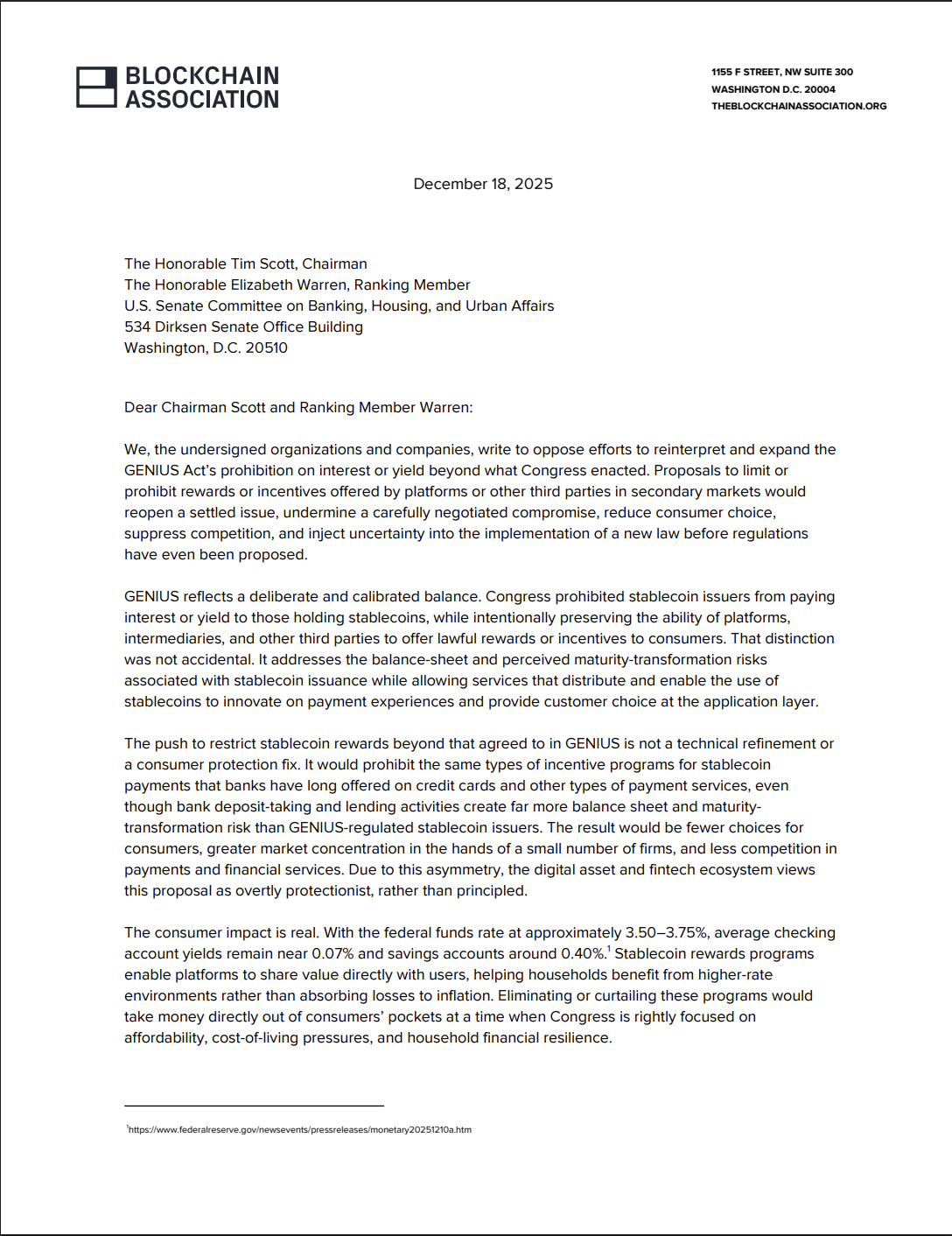
The letter opposes efforts to stop crypto platforms from sharing yield with customers. Source: The Blockchain Association

Prohibiting crypto platforms from offering similar rewards for stablecoins gives an unfair advantage to incumbent financial service providers, the Blockchain Association said.

“The potential benefits of payment stablecoins will not be realized if these types of payments cannot compete on a level playing field with other payment mechanisms. Rewards and incentives are a standard feature of competitive markets.”

The Blockchain Association has issued several statements and letters pushing back against efforts to prohibit crypto platforms from sharing yield-bearing opportunities with customers, arguing that these rewards help consumers offset inflation.

Related: Bank of Canada lays out criteria for ‘good money’ stablecoins

FDIC paves the way for banks to issue stablecoins, industry group says stables aren’t a threat

The Federal Deposit Insurance Corporation (FDIC), the US regulatory agency that oversees and insures the banking sector, published a proposal on Tuesday that would allow banks to issue stablecoins through subsidiaries.

Under the proposal, both the bank and its stablecoin subsidiary would be subject to FDIC rules and assessments for financial fitness, including reserve requirements.
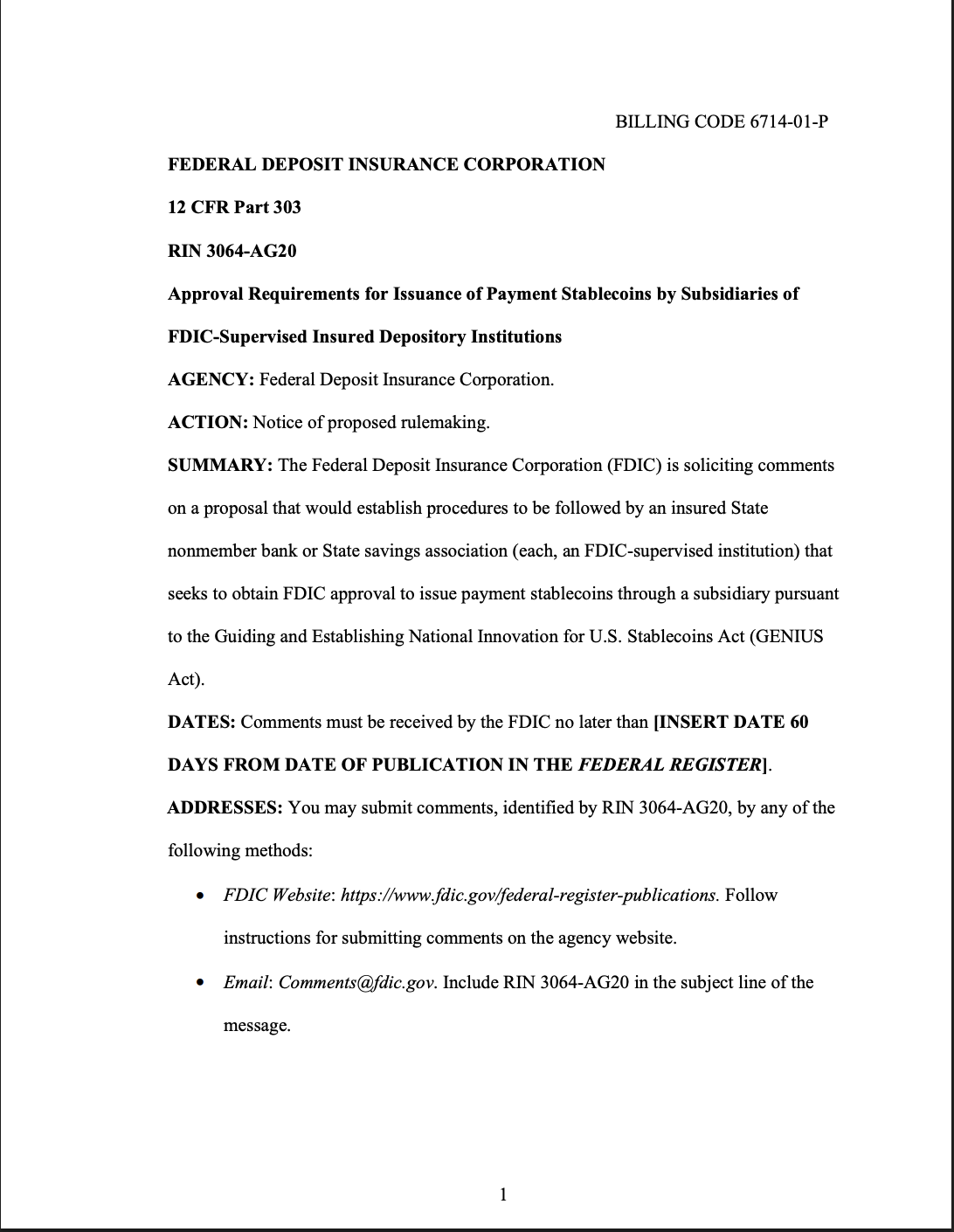
The FDIC proposal to allow banks to issue stablecoins. Source: FDIC

The Blockchain Association continues to push back on claims that yield-bearing stablecoins and sharing rewards with customers threaten the banking sector and bank lending.

“Evidence does not support claims that stablecoin rewards threaten community banks or lending capacity,” the Blockchain Association said, adding that it is difficult to make the case that bank lending is actually constrained by customer deposits.

Despite this, the banking industry has lobbied against yield-bearing stablecoins and crypto platforms sharing yield with clients over fears that interest offered on digital asset products will erode the market share of banks.

Magazine: Unstablecoins: Depegging, bank runs and other risks loom

İlgili Sorular

QWhat is the Blockchain Association's main argument against expanding the stablecoin yield prohibition to third-party service providers?

AThe Blockchain Association argues that expanding the prohibition to third-party service providers stifles innovation, leads to greater market concentration, and gives an unfair advantage to traditional financial service providers by preventing crypto platforms from competing on a level playing field.

QHow does the Blockchain Association compare the rewards offered by crypto platforms to those in traditional finance?

AThe letter compares the rewards offered by crypto platforms to the rewards offered by credit card companies, banks, and other traditional payment providers, stating that such incentives are a standard feature of competitive markets.

QWhat recent proposal did the FDIC make regarding banks and stablecoins?

AThe FDIC published a proposal that would allow banks to issue stablecoins through subsidiaries, with both the bank and its subsidiary being subject to FDIC rules, assessments for financial fitness, and reserve requirements.

QWhat is the banking industry's primary concern regarding yield-bearing stablecoins, according to the article?

AThe banking industry fears that the interest offered on digital asset products like yield-bearing stablecoins will erode their market share, leading them to lobby against these products and platforms sharing yield with clients.

QWhat reason does the Blockchain Association give for supporting the ability of platforms to share yield with stablecoin holders?

AThe Blockchain Association argues that these rewards help consumers offset inflation and are necessary for the potential benefits of payment stablecoins to be realized in a competitive market.

İlgili Okumalar

Casper Network Publishes the Casper Manifest, a Multi-Year Roadmap to Power Regulated Real-World Assets and the Machine Economy

The Casper Association has published "The Casper Manifest," a multi-year technical roadmap for Casper Network. Introduced at the Digital Finance Forum in Bermuda, the roadmap outlines nine coordinated initiatives designed to position the layer-1 blockchain as the infrastructure for regulated real-world asset (RWA) tokenization and the machine-to-machine economy. Key initiatives focus on: 1. **Developer Access:** Adding full Ethereum Virtual Machine (EVM) compatibility alongside its existing WebAssembly (Wasm) execution layer. 2. **User Experience:** Implementing gasless transactions, batch operations, and smart accounts with biometric authentication. 3. **Institutional Compliance & Privacy:** Building compliant security tokens aligned with the ERC-3643 standard and a multi-phase roadmap for confidential transactions with built-in audit tools. 4. **Machine Economy:** Implementing the X402 open payment standard to enable AI agents and machines to make autonomous, programmatic micropayments. 5. **Token Infrastructure:** Creating a Native Token Registry to give all tokens protocol-level status with fixed, predictable costs. 6. **Quantum Safety:** Developing hybrid accounts with both classical and quantum-resistant keys. The first initiative, X402 micropayments, is expected within weeks. Subsequent releases through 2026 and 2027 will include EVM compatibility, compliant security tokens, the Native Token Registry, gasless transactions, and quantum-safe features. The goal is to create a blockchain that is frictionless for users, trusted by institutions, and native for machines.

TheNewsCrypto4 saat önce

Casper Network Publishes the Casper Manifest, a Multi-Year Roadmap to Power Regulated Real-World Assets and the Machine Economy

TheNewsCrypto4 saat önce

İşlemler

Spot
Futures
活动图片





