Blockchain Association Rejects Proposal To Widen Stablecoin Yield Restrictions

bitcoinist2025-12-21 tarihinde yayınlandı2025-12-21 tarihinde güncellendi

Özet

The Blockchain Association, along with over 125 crypto and fintech groups, is urging Senate Banking leaders to oppose efforts to expand a ban on stablecoin yields beyond what is explicitly stated in the GENIUS Act. The law prohibits stablecoin issuers from paying yields directly to holders but allows third-party platforms to offer rewards. The association argues that broadening the ban would harm competition and innovation, favoring larger financial firms. In contrast, banking groups, led by the American Bankers Association, are pushing for the ban to extend to partners and affiliates, warning that stablecoin rewards could circumvent the law and drain trillions from traditional bank deposits. The debate centers on consumer protection, financial stability, and the future competitive landscape of digital payments. Senate Banking staff are reviewing both sides as they consider potential legislative clarifications.

The Blockchain Association led a broad industry push this week, asking Senate Banking leaders to resist efforts that would widen a ban on stablecoin yields beyond what Congress wrote into law.

According to the association, the letter was signed by more than 125 crypto and fintech groups and companies and was sent to lawmakers to warn against reinterpreting the new rules in a way that would also bar exchanges and apps from offering rewards tied to stablecoin holdings.

Preserving Platforms’ Ability To Offer Rewards

The coalition’s argument rests on the text of the GENIUS Act, which was signed into law earlier this year by US President Donald Trump and explicitly bars permitted stablecoin issuers from paying interest or yield directly to holders.

Reports have disclosed that the statute nevertheless leaves room for third-party platforms to provide incentives, a distinction industry groups say is intentional and important for competition.

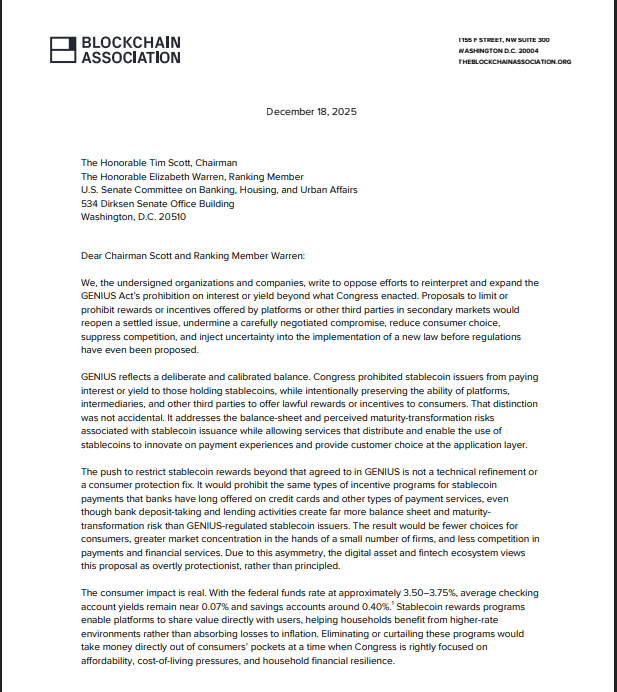
The letter pushes back against attempts to bar crypto platforms from offering yield to customers. Source: The Blockchain Association
Banks Call For Closing A Loophole

Banking groups have pushed back hard. A coalition led by the American Bankers Association and other banking trade groups asked Congress to clarify that the prohibition should extend to partners and affiliates, arguing that third-party rewards could circumvent the law and drain deposits from traditional banks.

According to recent coverage, Treasury analyses cited by bank advocates estimate that stablecoins could, in some scenarios, pull over $6 trillion from bank deposits — a figure that has become central to the banks’ case for tightening the rules.

What Industry Leaders Say

Industry spokespeople say expanding the ban would chill new services that rely on stablecoins and would tilt the market toward larger, incumbent financial firms that already control many payment rails.

BTCUSD currently trading at $88,063. Chart: TradingView

Based on reports, the Blockchain Association and partner groups contend that changing the law’s interpretation now would reopen negotiations the GENIUS Act resolved and would sow regulatory confusion before agencies finish writing implementing rules.

Competition And Consumer Choice At Stake

Supporters of stronger limits say the aim is consumer protection — to stop stablecoin arrangements from becoming de-facto interest accounts that could undermine the banking system and reduce loans to households and businesses.

Other observers point out the issue could also shape which firms win in payments going forward, since restrictions on rewards would affect the commercial incentives of exchanges and fintechs.

Next Steps In Washington

Senate Banking staff are weighing letters from both sides as they consider potential fixes or clarifying language during upcoming hearings.

Regulators who must implement the GENIUS Act have been urged to issue rules that prevent evasion of the ban, and lawmakers may face pressure to either leave the law as written or to craft narrow changes aimed at banks’ concerns.

Featured image from Unsplash, chart from TradingView

İlgili Sorular

QWhat is the main action taken by the Blockchain Association this week?

AThe Blockchain Association led a broad industry push by sending a letter to Senate Banking leaders, asking them to resist efforts to widen a ban on stablecoin yields beyond the text of the GENIUS Act.

QAccording to the coalition's argument, what does the GENIUS Act explicitly prohibit?

AThe GENIUS Act explicitly bars permitted stablecoin issuers from paying interest or yield directly to holders.

QWhy are banking groups, like the American Bankers Association, pushing for a broader interpretation of the ban?

ABanking groups argue that third-party rewards could circumvent the law and drain deposits from traditional banks, with estimates suggesting stablecoins could pull over $6 trillion from bank deposits in some scenarios.

QWhat is the potential market impact if the ban on stablecoin yields is expanded to third parties, according to industry spokespeople?

AIndustry spokespeople say expanding the ban would chill new services that rely on stablecoins and would tilt the market toward larger, incumbent financial firms that already control many payment rails.

QWhat are the next steps for Senate Banking staff regarding this issue?

ASenate Banking staff are weighing letters from both sides as they consider potential fixes or clarifying language during upcoming hearings.

İlgili Okumalar

Monero Price Forecast for August 2026: Will XMR’s Cup and Handle Pattern Break Out and Rally to $427?

**Monero (XMR) Price Forecast for August 2026: Can XMR Reach $427?** The price forecast for Monero (XMR) in August 2026 is shaped by a bullish technical pattern against significant regulatory headwinds. Currently trading around $371, XMR is testing the neckline of a "cup and handle" pattern, with a confirmed breakout above $370-$371 potentially targeting a measured move up to $427 (a ~15.5% gain). Technical indicators like the RSI above 60 and EMA alignment support this upward momentum. However, major regulatory challenges threaten this rally. Monero has been delisted from 73 centralized exchanges in 2025-2026, and the EU's MiCA regulations will fully ban privacy coin listings on regulated platforms starting July 2027. To counter this, the Monero ecosystem is accelerating decentralized infrastructure development. Key August 2026 releases include Cuprate (a new Rust-based node client for faster syncing) and code for Serai, a decentralized exchange designed for private cross-chain swaps. Historically, August has been Monero's strongest month on average, but median returns are negative, indicating volatility. The bullish case for August 2026 sees XMR breaking above the $370-371 neckline, overcoming the psychological $400 level, and pushing toward the $427 target, supported by technicals and new protocol developments. The bearish risk is a rejection at the neckline, leading to a fall toward the 50-day EMA support near $346-$345, driven by regulatory fears and shrinking CEX liquidity. The short-term price action around the $370-371 level is the key signal determining the monthly direction.

cryptonews.ru48 dk önce

Monero Price Forecast for August 2026: Will XMR’s Cup and Handle Pattern Break Out and Rally to $427?

cryptonews.ru48 dk önce

Bitcoin and Ethereum ETFs Attract $220 Million, with Blackrock Leading Again

As the week progressed, capital continued flowing into major cryptocurrency ETFs. Bitcoin funds attracted another nine-figure sum, demand for Ethereum surged, and several altcoin products found new buyers. Overall market sentiment remained positive, though Solana ETFs saw moderate outflows. Bitcoin ETFs recorded a net inflow of $128.69 million across six funds. BlackRock's IBIT led again, attracting $128.33 million, followed by Morgan Stanley's MSBT ($14.94M) and Fidelity's FBTC ($11.20M). Grayscale's GBTC and Bitcoin Mini Trust added $7.48M and $6.83M respectively, while Bitwise's BITB attracted $1.75M. These gains were partially offset by outflows from VanEck's HODL (-$32.77M) and Valkyrie's BRRR (-$9.07M). Bitcoin ETF trading volume reached $1.36 billion, extending their inflow streak to four sessions. Ethereum ETFs posted some of the day's best results, drawing $92.15 million into five funds. BlackRock's ETHA led with $81.14M, followed by Grayscale's Ether Mini Trust ($4.55M) and ETHE ($3.07M). BlackRock's ETHB and Fidelity's FETH added $1.96M and $1.42M respectively, with no Ethereum ETFs experiencing outflows. Altcoin ETFs showed mixed results. XRP ETFs returned to positive territory with a $3.45 million inflow. Hyperliquid ($HYPE) ETFs continued their recovery with a $2.84M inflow into Bitwise's BHYP. In contrast, Solana ETFs saw outflows, with Fidelity's FSOL losing $859,450. Thursday's flows confirmed the week's main trend: institutional demand remains concentrated on Bitcoin and Ethereum, with BlackRock continuing to capture the largest share of new capital.

cryptonews.ru49 dk önce

Bitcoin and Ethereum ETFs Attract $220 Million, with Blackrock Leading Again

cryptonews.ru49 dk önce

İşlemler

Spot
活动图片