Blockchain and no-code tools challenge AWS' dominance: Crypto exec

cointelegraph2025-12-20 tarihinde yayınlandı2025-12-20 tarihinde güncellendi

Özet

The rise of AI-powered no-code tools and blockchain technology is challenging Amazon Web Services' dominance in cloud computing, according to Lomesh Dutta of the Dfinity Foundation. These tools democratize app creation and enable AI-driven, continuously updated user experiences without relying on centralized servers. Blockchain provides a secure, tamper-resistant infrastructure that operates without constant human intervention. Despite promoting decentralization, many crypto and Web3 projects still depend on AWS, as seen in multiple 2025 outages that disrupted major platforms like Binance, Coinbase, and MetaMask. Industry executives argue that true decentralization must extend beyond the ledger to infrastructure to avoid reliance on centralized providers.

The rise of AI-powered no-code tools that allow users to create applications through linguistic prompts rather than computer code, decentralized through blockchain technology, will challenge Amazon Web Services’ (AWS) dominance of the cloud computing market.

No-code tools will democratize access to app creation and custom-tailored user experiences that will require constant updates and maintenance from AI, Lomesh Dutta, vice president of growth at the Dfinity Foundation, a non-profit organization that guides development of the Internet Computer Protocol (ICP) ecosystem, told Cointelegraph.

This rise of user-created applications eliminates the need for centrally managed software solutions stored on centralized servers.
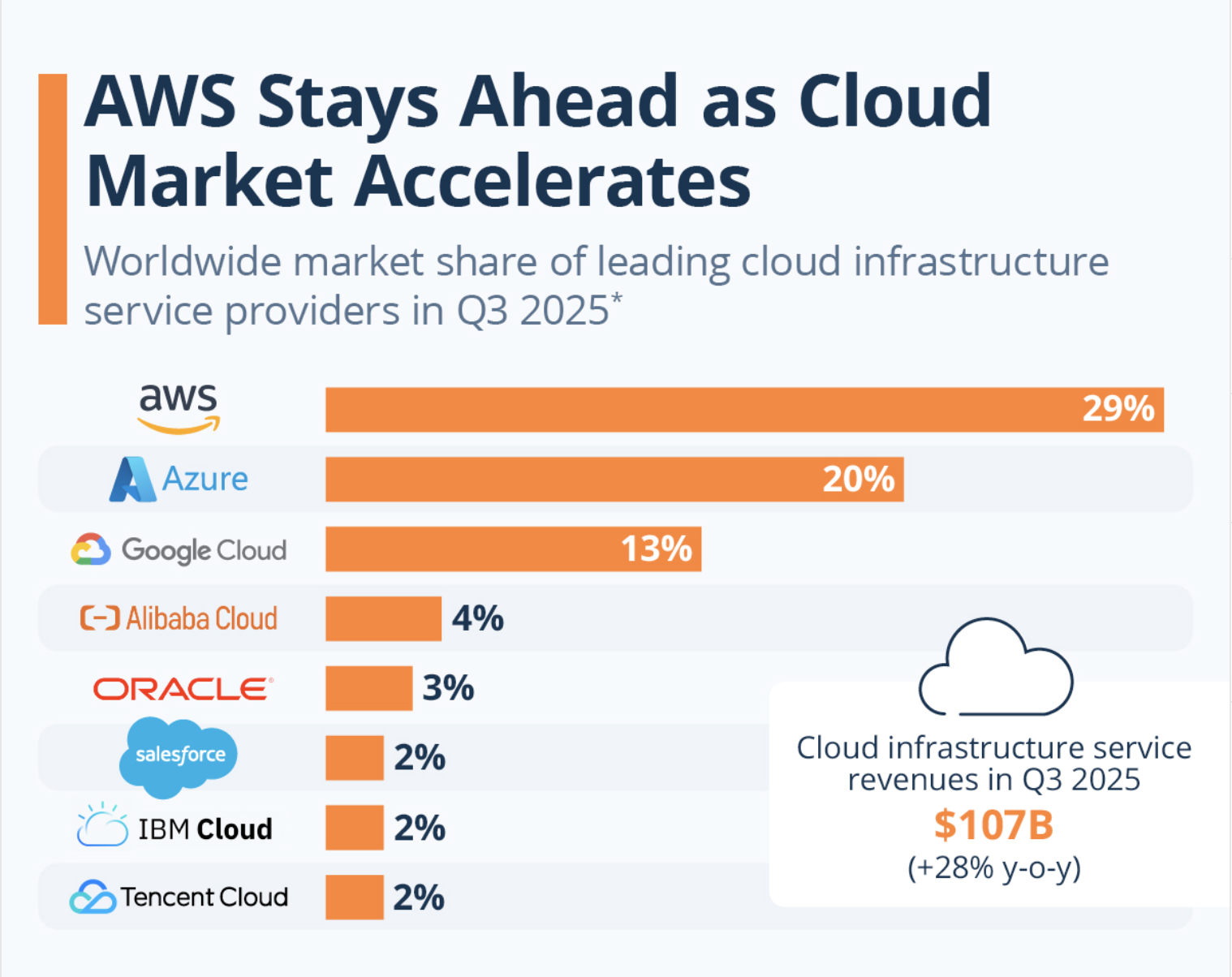
AWS continues to dominate the cloud-computing market in 2025. Source: Statista

“When applications are continuously generated and evolved by AI, you need infrastructure that is secure, tamper-resistant, and able to stay online without constant human intervention,” he said. Lomesh added:

“Decentralized blockchain networks introduced a revolutionary computing paradigm: by eliminating central points of control, they enable the creation of secure, reliable, and fault-tolerant software.”

A significant portion of crypto companies and Web3 projects rely on centralized AWS infrastructure to power their consumer-facing applications and websites, Internet Computer founder Dominic Williams told Cointelegraph.

Related: Cloudflare outage shows why crypto needs end-to-end decentralization

AWS outages rock the crypto industry in 2025

Several AWS outages occurred in 2025, impacting multiple crypto platforms and exchanges using AWS servers and data centers to host their applications.

The first outage occurred in April, causing disruptions to centralized crypto exchanges, including Binance, KuCoin and MEXC. At the time, Binance temporarily paused withdrawals until normal service was restored.

AWS experienced another outage in October, causing disruptions in crypto exchange Coinbase’s mobile application, with users reporting login problems, slowdowns and withdrawal issues.
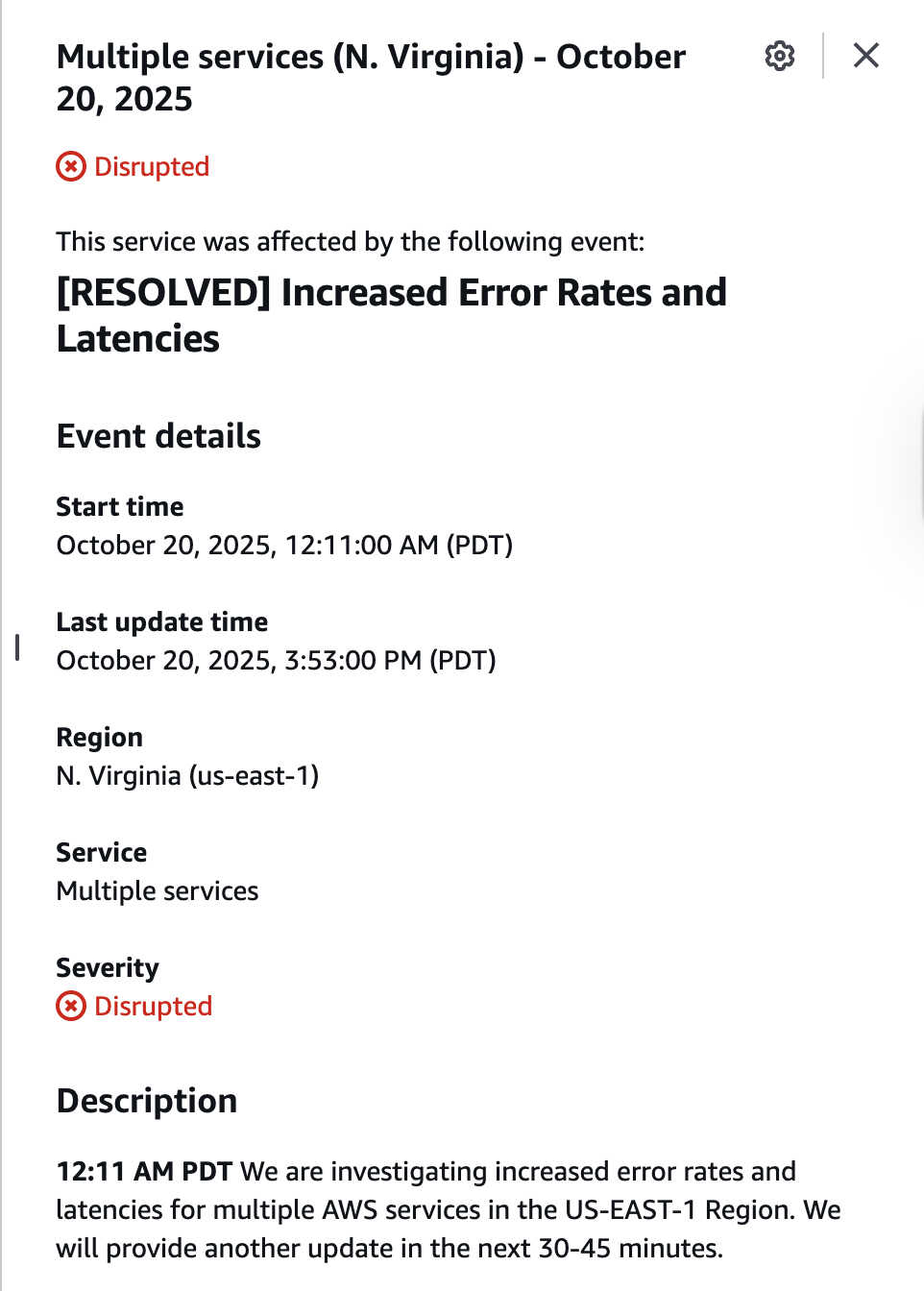
AWS reports an outage on October 20. Source: AWS Health Dashboard

Other financial applications were impacted by the outage, including the mixed-asset brokerage platform Robinhood and Web3 wallet MetaMask.

The October AWS outage lasted for about 15 hours and underscored the level of reliance crypto and Web3 projects, which market themselves as decentralized alternatives, have on centralized cloud infrastructure providers.

Crypto’s reliance on centralized infrastructure has drawn criticism from several crypto industry executives, including Jamie Elkaleh, chief marketing officer at crypto wallet company Bitget Wallet, and Carlos Lei, co-founder of decentralized physical infrastructure network (DePIN) marketplace Uplink.

“Decentralization has succeeded at the ledger layer but not yet at the infrastructure layer,” Elkaleh told Cointelegraph in October.

Magazine: Meet the onchain crypto detectives fighting crime better than the cops

İlgili Sorular

QAccording to the article, how will no-code tools and blockchain technology challenge AWS' dominance in cloud computing?

ANo-code tools democratize app creation through AI-powered linguistic interfaces, while blockchain provides decentralized, secure, and tamper-resistant infrastructure that eliminates reliance on centralized servers and reduces need for constant human maintenance.

QWhat specific problems did AWS outages cause for crypto platforms in 2025 as mentioned in the article?

AAWS outages in April and October 2025 caused disruptions including Binance pausing withdrawals, Coinbase experiencing login problems and withdrawal issues, and affecting platforms like KuCoin, MEXC, Robinhood, and MetaMask.

QWhat criticism did crypto executives have regarding the industry's infrastructure according to the article?

AExecutives like Jamie Elkaleh criticized that 'decentralization has succeeded at the ledger layer but not yet at the infrastructure layer,' highlighting the contradiction between Web3's decentralized ideals and its reliance on centralized cloud providers like AWS.

QWhat advantages does Lomesh Dutta attribute to decentralized blockchain networks for AI-generated applications?

AHe stated decentralized blockchain networks provide 'a revolutionary computing paradigm' by eliminating central points of control, enabling the creation of secure, reliable, and fault-tolerant software that can stay online without constant human intervention.

QWhich major companies and projects were mentioned as being affected by the AWS outages in the article?

AThe affected entities included crypto exchanges Binance, KuCoin, MEXC, and Coinbase; mixed-asset brokerage Robinhood; and Web3 wallet MetaMask.

İlgili Okumalar

Cross-Chain Bridges Actively Adapt, LI.FI Leverages Intent Architecture to Become the Liquidity Hub for TradFi Institutions

Cross-Chain Bridge LI.FI Transforms with Intents Architecture to Serve as Liquidity Hub for TradFi Institutions Facing declining cross-chain transaction volumes and overall crypto market liquidity, cross-chain bridge protocol LI.FI is proactively shifting its strategy. Moving beyond its role as a "liquidity transfer protocol," LI.FI is targeting new assets, clients, and operational systems. Key to this transformation is the launch of LI.FI Intents, an intent-based execution architecture. This product positions itself as a foundational layer for stablecoin payments, Real World Assets (RWA), and compliant on-chain liquidity, catering specifically to fintech companies, neobanks, wallets, and regulated financial institutions. LI.FI Intents simplifies user experience by offering a turnkey solution. It leverages a solver network for market-maker level execution, enabling precise cross-chain swaps (e.g., between USDC and USDT) without users managing gas tokens or complex blockchain steps. It lowers barriers to entry by integrating with applications like Jumper and Rabby, allowing enterprise users to bypass direct wallet interactions for transactions like payments and asset transfers. The architecture emphasizes compliance. Its network consists of verified legal entities, and enterprises can review and approve orders within their compliance frameworks before processing. All interacting wallets undergo OFAC screening. For ecosystem coverage, LI.FI Intents supports major networks including EVM chains, Solana, and Tron, mitigating risks associated with single-chain dependency. In essence, as tokenized assets like RWAs gain traction, LI.FI Intents focuses on efficiently integrating stablecoin payments and compliant liquidity into enterprise ecosystems. By automating complex execution steps—allowing users to simply declare their intent (the "destination")—it aims to enhance operational efficiency and capital utilization for institutional clients.

Odaily星球日报7 dk önce

Cross-Chain Bridges Actively Adapt, LI.FI Leverages Intent Architecture to Become the Liquidity Hub for TradFi Institutions

Odaily星球日报7 dk önce

İşlemler

Spot
Futures
活动图片