BlackRock, Apollo, Citadel Enter the Market in the Same Week, Investing Real Money in DeFi Governance Tokens

marsbit2026-03-25 tarihinde yayınlandı2026-03-25 tarihinde güncellendi

Özet

In February 2026, major financial institutions including BlackRock, Apollo, and Citadel made significant moves into DeFi by directly purchasing governance tokens and integrating their products with decentralized infrastructure. Citadel invested in LayerZero’s ZRO token, BlackRock listed its $2.5B BUIDL fund on UniswapX and acquired UNI tokens, and Apollo committed to acquiring up to 9% of Morpho’s token supply over four years. These actions mark a shift from exploratory partnerships to tangible on-chain engagement, emphasizing economic alignment through token ownership and the use of live, revenue-generating DeFi protocols. The trend reflects growing institutional confidence in public, permissionless DeFi infrastructure, driven by proven scalability and network effects. Regulatory developments, such as the potential passage of the CLARITY Act, could further accelerate this institutional adoption of DeFi.

Author: José Sanchez & Kelvin Koh

Compiled by: Deep Tide TechFlow

Deep Tide Introduction: In February 2026, the way traditional financial institutions entered DeFi underwent a qualitative change: no longer through strategic partnership announcements, but by directly purchasing governance tokens and routing products to decentralized infrastructure.

Within five days, Citadel bought ZRO, BlackRock bought UNI and listed BUIDL on UniswapX, Apollo committed to acquiring 9% of Morpho's token supply over four years. Spartan Group believes this is the true inflection point for the institutionalization of DeFi.

Full Text Below:

Inflection Point for DeFi Institutionalization

February 2026, within just five days, a cluster of landmark institution-crypto collaborations emerged, which we believe marks a qualitative change in how traditional finance participates in on-chain infrastructure.

Citadel Securities announced an investment in LayerZero's ZRO token; BlackRock listed its $2.5 billion BUIDL fund on UniswapX and purchased UNI tokens; Apollo Global Management committed to acquiring up to 9% of Morpho's total governance token supply over four years.

Previously, the NYSE had already announced on January 19th the launch of a tokenized securities platform supporting 24/7 on-chain settlement. The pattern is clear: institutional capital is shifting from exploration to real on-chain execution—buying tokens, acquiring governance rights, routing products to decentralized infrastructure.

This wave of entry differs from previous cycles in three ways.

First, these are direct token purchases that create economic alignment, not advisory arrangements or pilot declarations.

Second, the related products are actively operating with real revenue: BUIDL manages $2.5 billion, Morpho supports over $900 million in active loans for Coinbase, LayerZero has settled over $70 billion in USDT0 cross-chain transfers.

Third, institutions chose public, permissionless protocols, not proprietary closed systems, indicating that the composability and network effects of existing DeFi infrastructure are more valuable than the control offered by custom systems.

The NYSE kicked off this show on January 19th, announcing plans to build a blockchain-based venue supporting 24/7 trading and instant on-chain settlement of tokenized stocks and ETFs, combining its Pillar matching engine with a blockchain post-trade system. Although still subject to regulatory approval and implementation details are relatively limited, this is the highest-level directional signal: the world's most iconic stock exchange is targeting on-chain settlement as core infrastructure.

LayerZero followed on February 10th with Zero, a new L1 designed for institutional-grade financial infrastructure. Citadel Securities made a strategic ZRO token purchase, significant for a firm handling about 35% of US retail stock trading.

DTCC will explore using Zero to expand its tokenization and collateral management capabilities; ICE is evaluating the chain for 24/7 trading infrastructure; Google Cloud joined to explore AI Agent micropayments; ARK Invest holds both equity and token positions, with Cathie Wood joining the advisory board.

Tether also announced a separate strategic investment in LayerZero Labs on the same day. Zero is expected to launch in Fall 2026, with three zones: a general EVM environment, a privacy-focused payments zone, and a dedicated trading zone.

Institutional interest reflects proven throughput capability. USDT0—Tether's omnichain stablecoin built on LayerZero's OFT standard—has facilitated over $70 billion in cross-chain transfers since January 2025.

As shown in the figure below, daily settled value accelerated sharply after USDT0's launch, transforming LayerZero from a messaging layer into critical financial infrastructure.
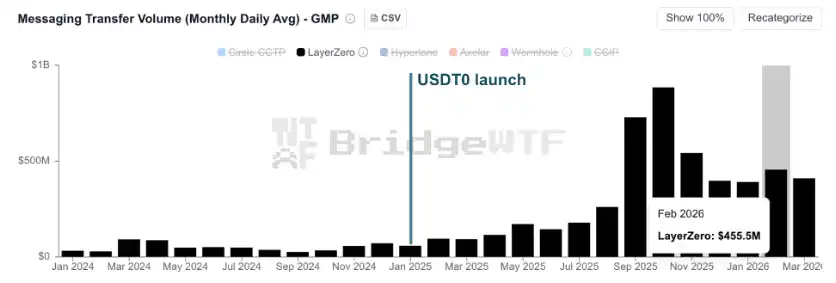
Figure: USDT0 has facilitated over $70 billion in cross-chain transfers since launch

Source: BridgeWTF

The next day, BlackRock's $2.4 billion BUIDL fund (the largest tokenized US Treasury product) was listed and made tradable on UniswapX, marking the first time a BlackRock product became accessible via decentralized exchange infrastructure.

Securitize handles compliance and whitelisting, while Wintermute, Flowdesk, and Tokka Labs compete for quotes through UniswapX's RFQ framework. BlackRock also disclosed a strategic UNI token purchase (specific terms not yet public), its first DeFi governance token on its balance sheet.

Although BUIDL's access is still limited to qualified purchasers with a minimum of $5 million, Securitize CEO Carlos Domingo stated that the infrastructure is designed to scale to retail products over time.

The decision to list on Uniswap reflects BUIDL's evolution from a niche experiment to an institutional-scale product. Since launching in March 2024 with a $40 million size, the fund peaked at nearly $2.9 billion in mid-2025 and currently has a TVL of around $2.5 billion.
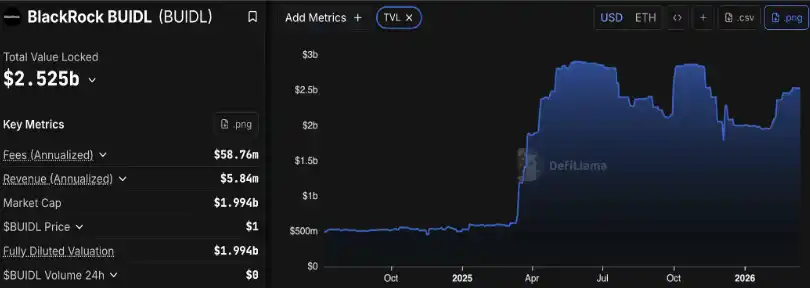
Figure: BlackRock's BUIDL fund currently has a TVL of $2.5 billion

Source: Defillama

On February 13th, Apollo Global Management signed a cooperation agreement, committing to acquire up to 90 million MORPHO tokens over 48 months, approximately 9% of the total supply.

In addition to the token acquisition (valued at approximately $110 million at mid-February prices), Apollo will also collaborate to build on-chain lending markets, extending its blockchain footprint—part of its credit strategies are already tokenized via Securitize (ACRED) and Anemoy (ACRDX).

This deal is one of the most significant collaborations to date between an institution and a native DeFi protocol.

The opportunities for institutions within Morpho extend beyond token ownership. The protocol's architecture allows any entity to become a vault curator, building lending markets with customized risk parameters. Curators can earn performance fees from generated yield and management fees (capped at 5%) from AUM, creating a sustainable revenue model for institutional participants.

Perhaps the most convincing validation of the infrastructure is the CeFi-DeFi "Mohawk" model pioneered by Coinbase: retail users borrow against BTC and ETH collateral through the Coinbase interface, while Morpho acts as the lending engine on the backend, currently supporting over $900 million in active loans and $1.7 billion in collateral.

This proves that institutional-grade DeFi can be abstracted and scaled to operate behind familiar consumer interfaces, with users not needing to interact with the underlying protocol.

For Apollo, the vault curator economics, the validated distribution channel via Coinbase, and the governance influence gained through token accumulation together form a strong positioning in the on-chain credit space.

This convergence validates the design choices of permissionless, composable protocols and suggests sustained demand for governance tokens of infrastructure layer projects.

Key risks remain in execution: regulatory approval for the NYSE platform and Zero is pending, institutional token purchases may test protocol governance, and the gap between announcements and sustained on-chain activity remains significant. Nonetheless, the directional signal is unmistakable.
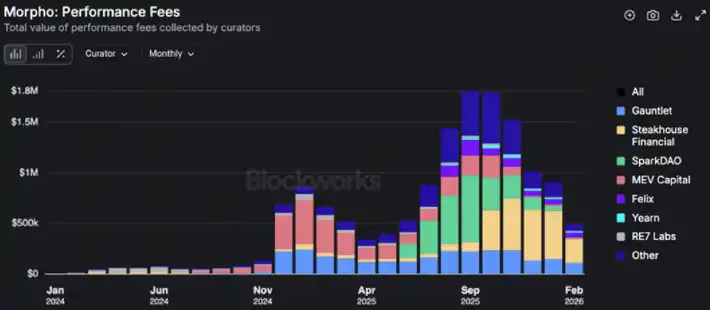
Figure: Morpho vault curators have generated substantial fee revenue

Source: Blockworks Research

Looking ahead, we expect these partnerships to deepen further once the CLARITY Act is passed. The Act passed the House in July 2025 by a vote of 294 to 134 and is now advancing in the Senate, where the Banking and Agriculture Committees need to reconcile their respective draft versions before a full vote.

The main point of contention is the treatment of stablecoin yield: the banking side is pushing to restrict interest payments on stablecoin balances, while crypto firms argue this would push innovation overseas.

July is widely seen as a key deadline before the August recess; if missed, the next window will be delayed until the fall. Once enacted, the CLARITY Act will provide the US's first comprehensive digital asset regulatory framework, clarify SEC/CFTC jurisdiction, establish a registration path for digital commodity exchanges, and provide legal certainty for tokenized products.

For protocols like Morpho and Uniswap, this will remove the regulatory ambiguity that currently constrains the scope of institutional cooperation. We believe this will unlock a second, broader wave of TradFi-crypto integration.


İlgili Sorular

QWhat significant shift in how traditional financial institutions engage with DeFi occurred in February 2026?

AThe shift was a move from strategic partnership announcements to directly purchasing governance tokens and routing products to decentralized infrastructure, marking a qualitative change in their participation.

QWhich three major institutions made significant moves into DeFi within a five-day period, and what did each do?

ACitadel Securities invested in LayerZero's ZRO token; BlackRock listed its $2.5B BUIDL fund on UniswapX and purchased UNI tokens; Apollo Global Management committed to acquiring up to 9% of Morpho's token supply over four years.

QWhat are the three key differences between this wave of institutional entry into DeFi and previous cycles?

A1. They involve direct token purchases creating economic alignment, not just advisory roles or pilot announcements. 2. The involved products are actively operating with real revenue. 3. Institutions chose public, permissionless protocols over proprietary closed systems, valuing composability and network effects.

QWhat is the significance of the 'Mohawk' model pioneered by Coinbase, as mentioned in the context of Morpho?

AThe 'Mohawk' model is a CeFi-DeFi hybrid where retail users borrow against BTC and ETH through the Coinbase interface, while Morpho acts as the lending engine on the backend. It proves that institutional-grade DeFi can be abstracted and scaled behind a consumer interface.

QWhat potential future development does the article suggest could further deepen these TradFi-DeFi partnerships, and what is a key point of contention surrounding it?

AThe passage of the CLARITY Act is expected to deepen partnerships. A key point of contention is the treatment of stablecoin yield, with banks pushing to restrict interest payments on stablecoin balances, while crypto firms argue this would push innovation overseas.

İlgili Okumalar

In Conversation with Ray Dalio: We Are Currently in an AI Bubble, with 1% of My Portfolio in Bitcoin

Ray Dalio, founder of Bridgewater Associates, warns in an interview that the current AI boom shows classic bubble characteristics, which could lead to significant economic downturns as seen in past cycles like 1929 or 2000. He explains that speculative enthusiasm, fueled by debt and overvaluation, often precedes a crash when rising rates or taxation force asset sales, causing widespread losses and recession. Dalio also outlines his "Big Cycle" theory, describing an approximate 80-year pattern where widening wealth gaps, massive government deficits, and shifting geopolitical power (like China's rise) create internal conflict and global instability. He emphasizes that we are in a late-cycle, transitional phase where traditional powers like the US and UK face decline. For personal wealth protection, Dalio advises diversification beyond cash into assets like stocks, bonds, real estate, and particularly gold, which he prefers over Bitcoin. While he holds about 1% of his portfolio in Bitcoin as a non-printable hard asset, he views gold as more secure from technological or governmental threats. Regarding AI's impact, Dalio believes it will disproportionately benefit capital owners, worsening inequality by replacing both physical and cognitive labor. He suggests that human intuition and emotional intelligence, combined with AI, will be key for future workers. On taxation, Dalio argues that wealth taxes are impractical and risk triggering asset sell-offs, reducing productive investment. He points to the UK as a cautionary example of debt, low productivity, and political strife. Geopolitically, Dalio foresees a more regionalized world, with the US showing weakness in prolonged conflicts like with Iran, akin to past imperial declines. The ideal outcome, he suggests, is coexisting powerful blocs (e.g., Americas, China-Asia Pacific) without major war.

marsbit35 dk önce

In Conversation with Ray Dalio: We Are Currently in an AI Bubble, with 1% of My Portfolio in Bitcoin

marsbit35 dk önce

Daily 7.2 Trillion KRW: Foreign Capital's Record Net Buying on Friday! Wall Street Says Headwinds for Korean Stock Fund Flows Have Subsided

South Korean stock market sees a dramatic shift in fund flows. On July 31, foreign investors made a record net purchase of approximately KRW 7.2 trillion in KOSPI stocks, marking a fundamental reversal from the persistent large-scale net outflows seen in previous months. This contributed to a significant narrowing of foreign net selling in July to KRW 9.8 trillion, down sharply from KRW 48.4 trillion in June and KRW 44.5 trillion in May. Simultaneously, domestic institutional pressure eased. South Korean pension funds and asset managers turned to a net buying position in July, purchasing KRW 1.0 trillion worth of KOSPI shares, contrasting with net sales in May and June. Market volatility is expected to be dampened by new financial regulations. Effective July 31, the Financial Services Commission tightened access for retail investors to single-stock leveraged ETFs by raising the minimum cash deposit requirement. Trading volumes for these products subsequently dropped to about 50% of their monthly average. Citigroup Research maintains its year-end KOSPI target of 10,000 points. The firm cites several supportive factors: the substantial easing of headwinds from capital outflows, a robust fundamental outlook for the semiconductor sector, historically low market valuations, strong economic fundamentals, and the potential for policy support from financial authorities if needed.

marsbit35 dk önce

Daily 7.2 Trillion KRW: Foreign Capital's Record Net Buying on Friday! Wall Street Says Headwinds for Korean Stock Fund Flows Have Subsided

marsbit35 dk önce

Thanks to Dice Rolls, Bitcoin Keys Are Stored Offline, But Not Everyone Will Do It

The article discusses using dice rolls to generate secure Bitcoin wallet seeds, providing entropy independent of potentially flawed hardware random number generators. It explains that each fair dice roll offers about 2.585 bits of entropy, with around 50 rolls needed for a standard 12-word seed phrase and 99+ recommended for higher security. This method gained attention after a vulnerability was revealed in some Coldcard hardware wallets, where a faulty firmware RNG (dating back to 2021) compromised generated keys. The analysis notes that while a dice-generated main seed was safe from this specific flaw, other Coldcard functions (like creating paper wallets, backup keys, or passwords) could still be vulnerable if they used the defective RNG. The piece argues that while dice-based entropy is technically robust, the manual process is error-prone, tedious, and unrealistic for most new users, who might make mistakes in recording or inputting rolls. It concludes that while manual entropy generation should remain an option for advanced users, the long-term goal is to develop reliable, user-friendly hardware and software that securely generates randomness without requiring specialized knowledge. Coldcard users are advised to check their firmware version and replace any secondary secrets (like paper wallet keys) created with vulnerable devices, while also considering multi-signature setups with devices from different manufacturers for added security.

cryptonews.ru5 saat önce

Thanks to Dice Rolls, Bitcoin Keys Are Stored Offline, But Not Everyone Will Do It

cryptonews.ru5 saat önce

İşlemler

Spot
活动图片




