Bitwise: The Institutional Wave Has Arrived, Why Is the Market Still Asleep?

marsbit2026-02-25 tarihinde yayınlandı2026-02-25 tarihinde güncellendi

Özet

The biggest alpha opportunities in financial markets come from behavioral biases like anchoring, where investors cling to initial impressions. This is why the crypto market is currently mispriced: traditional investors still anchor crypto to its early, counterculture image, while crypto natives suffer from "crying wolf" fatigue after years of promised institutional adoption. Yet, the institutional wave is already here. Wall Street is loudly announcing its move on-chain. SEC Chair Paul Atkins has initiated a commission-wide project to modernize securities regulation for blockchain. BlackRock’s Larry Fink declared we are at the beginning of asset tokenization, evidenced by the firm’s $2+ billion BUIDL tokenized treasury fund on Uniswap and an investment in UNI. Apollo is tokenizing a credit fund on six blockchains and acquiring a stake in Morpho. JPMorgan, Bank of America, Citi, and Wells Fargo are collaborating on a stablecoin. JPMorgan has issued a deposit token on Base, and Fidelity is hiring for a DeFi treasury role. The potential market is enormous: a $30 trillion ETF market, $110 trillion in equities, and $145 trillion in bonds. In contrast, the entire tokenized market is just $20 billion, suggesting potential for exponential growth. The chart of tokenized real-world assets (RWA) value shows a near-vertical growth trajectory, yet this reality is disconnected from market perception. The key challenge is determining how to capture this opportunity, as unanswered question...

Author: Matt Hougan, Chief Investment Officer of Bitwise

Compiled by: Saoirse, Foresight News

The greatest excess returns (Alpha) in financial markets often come from behavioral biases. Investors always make mistakes, and if you can exploit these mistakes, you can achieve substantial returns.

One of my favorite behavioral biases to exploit is anchoring: people cling to the first piece of information they receive and are reluctant to change. This is why retailers price items at $9.99 instead of $10.00—you remember the '9' first, and your brain struggles to let go.

Anchoring was one of the reasons I decided to dive into the crypto industry full-time in 2018.

At that time, most people still viewed cryptocurrency as a joke. They first learned about it through the 2013 Silk Road scandal, the 2014 Mt. Gox exchange collapse, and witnessed its extreme boom-and-bust cycles.

Fortunately, a few people I trusted urged me to take crypto seriously.

When I looked beyond the surface, to see it for what it truly is rather than what people thought it was, I was completely astonished. The technology was far more mature than most people realized, and the opportunities were much greater. Yet people were still stuck with the old impressions from 2014.

Right now, I feel like I'm back in that moment.

The Whole World Is Shouting at You

Look around, Wall Street is loudly proclaiming: the financial industry is moving on-chain. Not just a small part, but all of it.

Last July, SEC Chairman Paul Atkins launched the 'Crypto Project,' a committee-wide initiative aimed at modernizing securities regulation. In his words, it's about enabling the U.S. financial markets to 'run on-chain.' And indeed, the markets have already started moving on-chain:

  • In October, BlackRock CEO Larry Fink publicly stated that we are at the starting point of tokenizing all assets. Two weeks ago, BlackRock launched the BUIDL tokenized treasury fund on Uniswap, the world's largest decentralized exchange; it has already grown to over $2 billion in size. As part of the collaboration, BlackRock also invested in Uniswap's native token, UNI.
  • Apollo, a credit institution managing $700 billion, partnered with Securitize to tokenize its diversified credit fund and list it on six public blockchains. Since January 2025, the product has attracted over $100 million. The company recently also announced plans to acquire a 9% stake in the leading global decentralized lending protocol, Morpho.
  • JPMorgan Chase, Bank of America, Citigroup, and Wells Fargo are in talks to jointly launch a stablecoin.

At the same time, JPMorgan issued a deposit token on Coinbase's Base network; Fidelity is hiring a head of decentralized finance treasury... Similar moves are emerging one after another.

The scale of the related markets is enormous: the ETF market is $30 trillion, the stock market is $110 trillion, and the bond market is $145 trillion.

In contrast, the current total global tokenized market is only $20 billion.

If Larry Fink is right—'every stock, every bond... will eventually be tokenized'—this means the market has tens of thousands of times more room to grow.

The Disconnect in Perception

Yet traditional investors just can't hear it.

They can't hear it because of anchoring.

When they think of cryptocurrency, the image that comes to mind is still that of the tattooed, punk, skateboarding figure. They don't realize that this person has long shaved his beard, put on a suit, and is building the infrastructure that will support the next generation of capital markets.

Amusingly, crypto investors themselves also seem unable to hear it.

They suffer from 'wolf cry' syndrome. Having heard promises of 'institutions are coming' for so long, now that they are actually here, they feel numb and unresponsive.

But the data doesn't lie.

Look at the growth curve of tokenized real-world assets (RWAs)—it's as steep as Mount Everest.

Value of Tokenized Real-World Assets (RWAs):
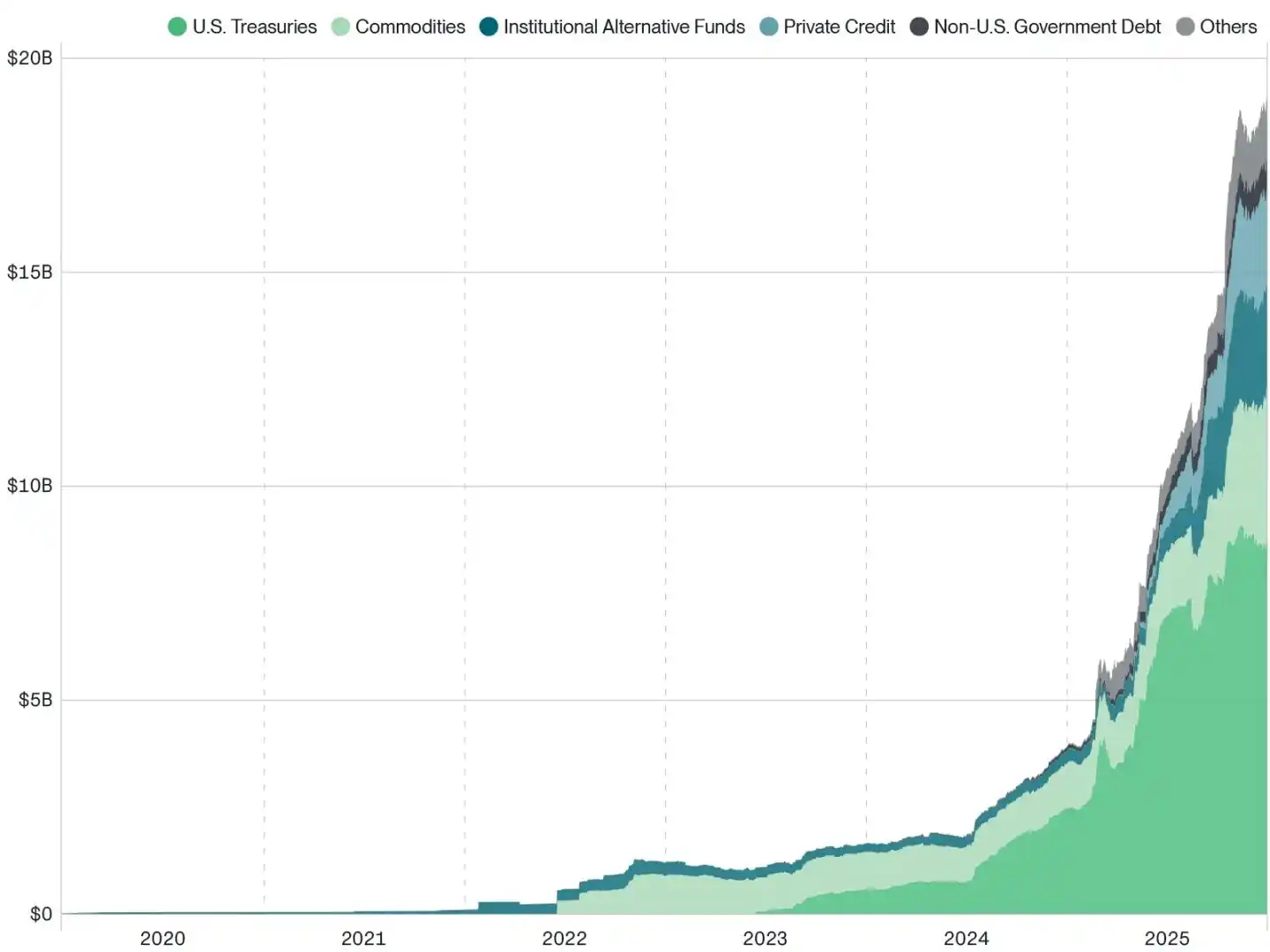
Source: Bitwise Asset Management, data from RWA.xyz. Data timeframe is from January 1, 2020, to December 31, 2025.

Note: Stablecoin issuers like Circle and Tether are intentionally omitted.

Seizing the Opportunity

The challenge is that it's difficult to know precisely how to profit from this.

Because the crypto industry still has a series of key questions unanswered, such as:

  • Will the value created by tokenization flow to underlying protocols like Ethereum and Solana, or is the underlying block space becoming commoditized?
  • If value settles on the underlying public chains, will new quasi-private chains like Canton Network and Tempo outperform public chains?
  • As institutions like BlackRock and Apollo embrace DeFi en masse, will DeFi tokens explode, or will the economic model challenges of DeFi tokens themselves be difficult to overcome?
  • If the value ultimately flows to the builder companies rather than the blockchain itself, will the beneficiaries be traditional giants like BlackRock and JPMorgan, or crypto-native institutions?

I have my own judgments on these questions and will share them in articles over the coming months. But honestly, for most of these questions, the answer right now is: no one knows.

The only thing I am certain of is:

There is a huge gap between what people think the crypto market is and what the crypto market actually is.

In my view, this gap represents a major opportunity—not to rush to pick winners in advance, but to broadly position across the entire sector while the market is still mispricing this structural shift.

The greatest opportunities for alpha often arise when market consensus is outdated, reality has moved forward, and investors are still anchored to the old narrative.

The crypto industry is at that point right now.

If you can see it for what it is, opportunities abound.

İlgili Sorular

QWhat behavioral bias does the author identify as a key source of alpha in financial markets, and how does it relate to the current state of crypto?

AThe author identifies anchoring bias as a key source of alpha. Investors are anchored to their initial impressions of crypto from events like the Silk Road scandal and Mt. Gox bankruptcy, failing to see that it has matured into a technology building the infrastructure for the next generation of capital markets.

QAccording to the article, what major Wall Street developments signal that the entire financial industry is moving on-chain?

AMajor developments include: the SEC's 'Crypto Project' to modernize securities regulation; BlackRock's CEO stating all assets will be tokenized and the launch of their BUIDL fund on Uniswap; Apollo tokenizing a credit fund and investing in Morpho; and major banks like JPMorgan, Bank of America, Citi, and Wells Fargo planning to launch a joint stablecoin.

QWhat is the current size of the tokenized market compared to the potential market, illustrating the growth opportunity?

AThe current global tokenized market is valued at only $20 billion. In contrast, the potential market for tokenizing ETFs, stocks, and bonds is massive, with the ETF market at $30 trillion, the stock market at $110 trillion, and the bond market at $145 trillion, representing a potential growth of thousands of times.

QWhy are both traditional investors and crypto investors failing to recognize the current institutional adoption of crypto, according to the author?

ATraditional investors are held back by anchoring bias, clinging to old stereotypes of crypto. Crypto investors suffer from a 'boy who cried wolf' syndrome, having heard promises of institutional adoption for so long that they have become numb to it now that it is actually happening.

QWhat is the author's recommended investment strategy to capitalize on the current disconnect between perception and reality in crypto?

AThe author recommends not trying to pick individual winners prematurely, but instead taking a broad-based approach to invest across the entire sector while the market is still mispricing this structural shift, as the greatest alpha is found when consensus is outdated.

İlgili Okumalar

Macroeconomic Origins of the African Payments Market Structure

Africa’s payment landscape exhibits the world’s highest mobile money penetration and fastest cryptocurrency adoption. This is not a market anomaly but a macroeconomic inevitability driven by deep structural factors: a vast, young population, heavy reliance on commodity exports and remittances generating massive cross‑border payment needs, and a chronically underdeveloped formal banking system plagued by de‑risking, high inflation, and currency instability. This vacuum has allowed mobile money (e.g., M‑Pesa) to become the primary payment channel domestically, while cryptocurrencies—particularly stablecoins—serve as a store of value against local‑currency depreciation and a lower‑cost cross‑border medium. The key divide is the Sahara: North Africa integrates with the MENA oil‑centric financial system, while Sub‑Saharan Africa, facing acute dollar shortages and fragmented currencies, is the epicenter of this fintech surge. Structural reliance on dollars, driven by trade deficits and weak local currency credibility, creates persistent dollar scarcity, which crypto and mobile payments effectively address. Efforts like the Pan‑African Payment and Settlement System (PAPSS) aim at de‑dollarization, but these alternatives will remain essential as long as underlying economic constraints—commodity dependence, limited industrialization, and financial exclusion—persist.

marsbit5 dk önce

Macroeconomic Origins of the African Payments Market Structure

marsbit5 dk önce

AAOI Defies Trend with Over 10% Surge, 'New Stock God' Serenity Predicts Potential to Double Again

On June 4th, despite a significant sell-off in the broader AI and semiconductor sector triggered by Broadcom's disappointing guidance, Applied Optoelectronics (AAOI) surged over 11%, showcasing a sharp divergence in market sentiment. Broadcom's warning about potential supply chain diversification by key customer Google and a weaker-than-expected outlook punctured the high-flying AI valuation narrative. This led to heavy selling in names like Broadcom (-12.6%) and Micron (-7%), with funds rotating into traditional industrial stocks. AAOI defied this trend. The stock has experienced high volatility recently, driven by bullish analyst coverage, notably from Rosenblatt which raised its price target to $220. Key catalysts include initial 800G optical module revenue from Amazon, potential certification from Oracle, and strong demand across its product portfolio. The company has reported cumulative orders for 800G/1.6T modules exceeding $324 million and is aggressively expanding manufacturing capacity in Texas, targeting an annualized run-rate of $1.4 billion for its module business by Q3 2027. However, AAOI's fundamentals present a mixed picture. Its Q1 2026 results missed expectations, showing a GAAP net loss, and Q2 guidance points to merely breakeven adjusted EPS. Risks include a delayed 800G production ramp to the second half of the year and high dependence on a few key cloud customers. Recent stock sales by company executives near price highs also noted. The article suggests AAOI's rally reflects a market beginning to differentiate within the AI ecosystem. While Broadcom's issues prompted a reassessment of custom ASIC and customer concentration risks, funds flowing into AAOI indicate a belief that the "physical bottleneck" narrative for optical connectivity—where supply remains tight—remains intact and is somewhat decoupled from the current sector weakness. The sustainability of AAOI's premium valuation now hinges on the successful execution of its production plans and upcoming quarterly results.

marsbit11 dk önce

AAOI Defies Trend with Over 10% Surge, 'New Stock God' Serenity Predicts Potential to Double Again

marsbit11 dk önce

Worried about AI's Self-Evolution, Anthropic Intends to Stop Training?

In early 2026, Anthropic signaled a significant shift in its public narrative regarding AI development timelines and safety. In June, its Anthropic Institute published a detailed article, "When AI builds itself," presenting internal data suggesting accelerating AI self-improvement. Key figures included over 80% of merged code being written by Claude and a 52x speedup in certain optimization tasks. The article outlined three future scenarios, with the most speculative being full recursive self-improvement (RSI), where AI autonomously builds better successors. Anthropic stated RSI is "possible" and may arrive faster than most institutions are prepared for. This narrative pivot followed a series of strategic moves. In January, CEO Dario Amodei wrote about a powerful self-improvement feedback loop. In February, Anthropic revised its Responsible Scaling Policy, removing a core commitment to pause training if capabilities outstripped safety controls, citing the risk of falling behind competitors. This change coincided with reported pressure from the US Department of Defense. By May, Anthropic's valuation had soared to $965 billion. Anthropic's stance was mirrored by other industry leaders. DeepMind CEO Demis Hassabis adjusted his AGI timeline to "by 2029" and admitted to using provocative language like "foothills of the singularity" to create urgency. OpenAI also released a model claiming a key role in its own creation process. The article's carefully calibrated tone—presenting dramatic data alongside qualifying footnotes—exemplifies a balancing act between signaling technological acceleration and managing commercial, regulatory, and safety imperatives. External experts offered contrasting interpretations of the same data, from warnings of catastrophic risk akin to Chernobyl to skepticism that current automation merely handles "grunt work," not genius. The coordinated narrative shift among top labs highlights the complex interplay between perceived technical inflection points and strategic communication aimed at investors, regulators, and the public.

marsbit14 dk önce

Worried about AI's Self-Evolution, Anthropic Intends to Stop Training?

marsbit14 dk önce

İşlemler

Spot
Futures

Popüler Makaleler

F Nasıl Satın Alınır

HTX.com’a hoş geldiniz! Synfutures (F) satın alma işlemlerini basit ve kullanışlı bir hâle getirdik. Adım adım açıkladığımız rehberimizi takip ederek kripto yolculuğunuza başlayın. 1. Adım: HTX Hesabınızı OluşturunHTX'te ücretsiz bir hesap açmak için e-posta adresinizi veya telefon numaranızı kullanın. Sorunsuzca kaydolun ve tüm özelliklerin kilidini açın. Hesabımı Aç2. Adım: Kripto Satın Al Bölümüne Gidin ve Ödeme Yönteminizi SeçinKredi/Banka Kartı: Visa veya Mastercard'ınızı kullanarak anında Synfutures (F) satın alın.Bakiye: Sorunsuz bir şekilde işlem yapmak için HTX hesap bakiyenizdeki fonları kullanın.Üçüncü Taraflar: Kullanımı kolaylaştırmak için Google Pay ve Apple Pay gibi popüler ödeme yöntemlerini ekledik.P2P: HTX'teki diğer kullanıcılarla doğrudan işlem yapın.Borsa Dışı (OTC): Yatırımcılar için kişiye özel hizmetler ve rekabetçi döviz kurları sunuyoruz.3. Adım: Synfutures (F) Varlıklarınızı SaklayınSynfutures (F) satın aldıktan sonra HTX hesabınızda saklayın. Alternatif olarak, blok zinciri transferi yoluyla başka bir yere gönderebilir veya diğer kripto para birimlerini takas etmek için kullanabilirsiniz.4. Adım: Synfutures (F) Varlıklarınızla İşlem YapınHTX'in spot piyasasında Synfutures (F) ile kolayca işlemler yapın.Hesabınıza erişin, işlem çiftinizi seçin, işlemlerinizi gerçekleştirin ve gerçek zamanlı olarak izleyin. Hem yeni başlayanlar hem de deneyimli yatırımcılar için kullanıcı dostu bir deneyim sunuyoruz.

206 Toplam GörüntülenmeYayınlanma 2024.12.21Güncellenme 2026.06.02

F Nasıl Satın Alınır

Tartışmalar

HTX Topluluğuna hoş geldiniz. Burada, en son platform gelişmeleri hakkında bilgi sahibi olabilir ve profesyonel piyasa görüşlerine erişebilirsiniz. Kullanıcıların F (F) fiyatı hakkındaki görüşleri aşağıda sunulmaktadır.

活动图片













