Bitwise Reports Third Consecutive Crypto Market Decline as Tokenized Assets Reach Record Highs

TheNewsCrypto2026-07-10 tarihinde yayınlandı2026-07-10 tarihinde güncellendi

Özet

Bitwise's Q2 2026 report details a third consecutive quarterly decline for the broader crypto market, with its Large Cap Crypto Index falling 15.4%. This downturn was marked by significant outflows from Spot Bitcoin ETFs, decreased trading activity, and heightened correlation with traditional stock markets. However, the report highlights a stark divergence from this negative price action, showcasing record growth in several blockchain sectors. Prediction markets saw trading volume surge to a historic $43.2 billion, while the total value of tokenized real-world assets grew over 50% year-to-date to nearly $32.89 billion. Key infrastructure also expanded, with stablecoin adoption and settlement volume outpacing major networks like Visa. Despite crypto asset prices underperforming, metrics such as Ethereum transaction activity and DeFi TVL have risen substantially from their 2022 lows, indicating robust and advancing underlying blockchain technology adoption.

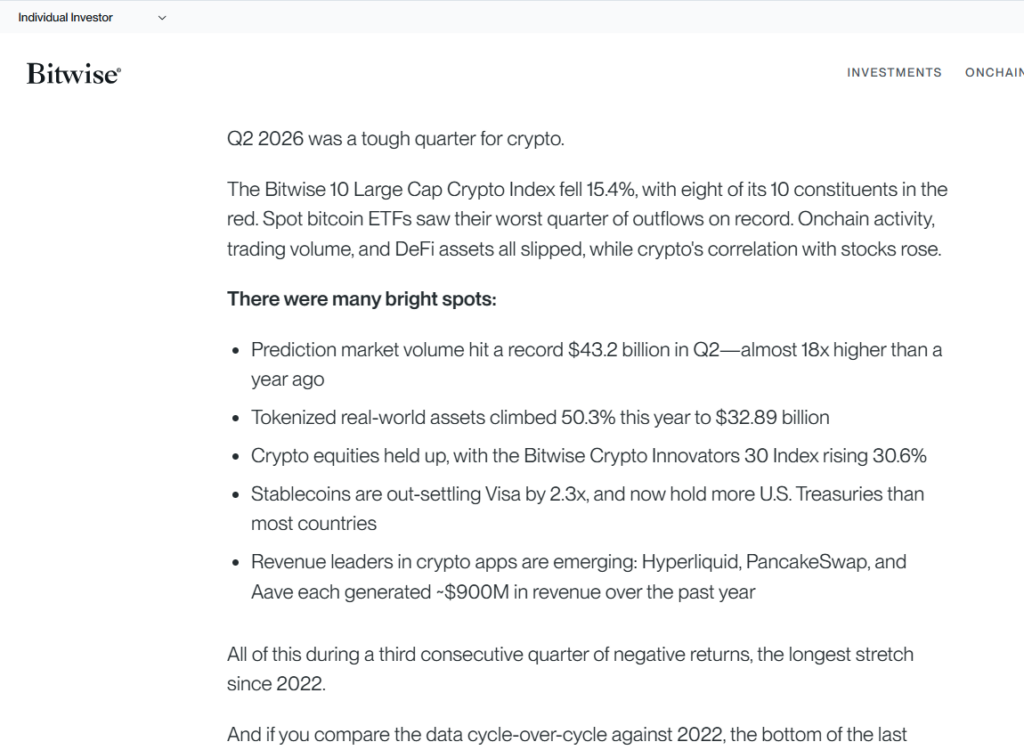
In its report on Q2 2026, Bitwise noted that it was another tough quarter for digital assets despite growth in a number of blockchain verticals. The Bitwise 10 Large Cap Crypto Index fell by 15.4% in Q2 2026, marking another quarter in a row of crypto declines. Out of the ten constituent assets that form the index, eight saw declines over the course of the quarter. According to Bitwise, it is crypto’s third consecutive quarter in negative territory since late 2025.

There were record outflows from Spot Bitcoin ETFs since the introduction of such financial instruments by the regulators. The Fear and Greed Index signaled increased wariness on behalf of investors amid the cryptocurrency markets. Activity within blockchain transactions, decentralized finance assets, and cryptocurrency trading volume also dropped compared to prior quarters. In addition, the report showed that there was greater correlation between cryptocurrency prices and the stock markets. The mixed results were also because, despite poor market performance, Bitwise emphasized continued growth across different blockchain sectors.
Prediction Markets and Tokenization Continue Expanding

Prediction markets were among the most rapidly expanding industries of blockchain in the second quarter. The trading volume grew to its historical high of $43.2 billion, marking almost eighteen-fold year-on-year growth. Tokenized assets saw their total value grow by 50.3% year-to-date and reached a total of about $32.89 billion.

According to Bitwise, the Bitwise Crypto Innovators 30 Index grew by 30.6%, surpassing the performance of the cryptocurrency market as a whole. Adoption of stablecoins was increasing, with the growth of settlement volume reaching 2.3 times more than Visa. The issuers of stablecoins were holding more U.S. Treasury securities than many nations.

At the same time, Hyperliquid, PancakeSwap, and Aave all managed to earn around $900 million in annual protocol revenue. In comparison to the 2022 market bottom, Bitwise stated that the activity of transactions on the Ethereum network is up thirteen times, DeFi TVL is up more than 60%, and the AUM of stablecoins doubled.

According to Bitwise’s quarterly report, there seems to be a widening gap between the performance of cryptocurrencies and blockchain technology usage. Despite the third quarter decline for digital assets, many sectors of blockchain experienced rapid growth. Prediction markets, tokenization of real-world assets, stablecoins, and decentralized finance saw growth even amidst negative sentiment. This reflects that blockchain technology is advancing even though cryptocurrency prices have been underperforming.

Highlighted Crypto News:
Sony Bank Advances US Dollar Stablecoin Plans With Conditional OCC Trust Approval


TagsBitwiseBlockchainCryptocurrencyexchangeMarket downprediction marketrealworldassets

İlgili Sorular

QAccording to the Bitwise report, what was the performance of the Bitwise 10 Large Cap Crypto Index in Q2 2026 and what does this represent for the overall market?

AThe Bitwise 10 Large Cap Crypto Index fell by 15.4% in Q2 2026, marking the third consecutive quarter of crypto market declines.

QDespite the general market decline, which two specific blockchain sectors showed significant growth in Q2 2026 according to the article?

APrediction markets and the tokenization of real-world assets showed significant growth. Prediction market trading volume hit a historical high, and the total value of tokenized assets increased by over 50% year-to-date.

QWhat evidence does the report provide to illustrate the growing adoption and scale of stablecoins?

AThe report states that stablecoin settlement volume grew to 2.3 times more than Visa's, and stablecoin issuers now hold more U.S. Treasury securities than many nations.

QHow does the performance of the Bitwise Crypto Innovators 30 Index compare to the broader cryptocurrency market in the reported quarter?

AThe Bitwise Crypto Innovators 30 Index grew by 30.6%, significantly outperforming the declining broader cryptocurrency market.

QWhat key divergence or gap does Bitwise's quarterly report highlight about the current state of the crypto and blockchain industry?

AThe report highlights a widening gap between the poor performance of cryptocurrency prices and the continued advancement and growth in blockchain technology usage across various sectors like DeFi, prediction markets, and tokenization.

İlgili Okumalar

In Jinjiang, Fujian, a Storage Super Unicorn Lies Quiet

In Fujian's Jinjiang, a city known for sportswear, lies a quiet semiconductor giant: Fujian Jinhua Integrated Circuit Co. (JHICC). Once a promising domestic DRAM manufacturer alongside Yangtze Memory and ChangXin Memory Technologies (CXMT), its journey was derailed in 2018 when the U.S. placed it on an Entity List and filed criminal charges for alleged trade secret theft. This halted production for years. A turning point came in February 2024 when a U.S. federal court found JHICC not guilty. However, it had lost crucial time. While CXMT soared to become a top-valued A-share company in 2024, JHICC, with an estimated valuation of 80 billion RMB, was just restarting. Its current output is primarily customized DDR4 chips, not the advanced DDR5/HBM demanded for AI, but it still benefits from the broader memory chip upcycle. JHICC's story is tied to Chen Zhengkun, a veteran engineer who left Micron to lead the venture. Founded in 2016 with state-backed funding, JHICC partnered with Taiwan's UMC to develop DRAM technology. Rapid progress was cut short by the U.S. actions, which Micron initiated, partly due to its heavy reliance on the Chinese market. Post-sanctions, Chen's team worked to rebuild the production line with reduced reliance on U.S. technology. According to its records, JHICC achieved small-scale production and revenue growth under immense pressure. It now focuses on the stable "niche" DRAM market (e.g., TVs, routers) with a monthly capacity of ~40,000 wafers, aiming for 60,000 by 2026. It holds over 1,000 patents but remains on the Entity List. For Jinjiang, investing in JHICC was a bold industrial leap. The local government provided unwavering financial and logistical support during the crisis, helping the company survive. JHICC has become the anchor for a growing local semiconductor cluster. Though its scale lags behind domestic peers, JHICC's persistence symbolizes a hard-won foothold in a global market long dominated by Samsung, SK Hynix, and Micron. Having missed one boom, it seeks a place in the new AI-driven memory supercycle.

marsbit2 saat önce

In Jinjiang, Fujian, a Storage Super Unicorn Lies Quiet

marsbit2 saat önce

İşlemler

Spot
活动图片




