Bitwise crypto index fund moves from over-the-counter to NYSE Arca for trading

cointelegraph2025-12-09 tarihinde yayınlandı2025-12-09 tarihinde güncellendi

Özet

Bitwise Asset Management's 10 Crypto Index Fund (BITW) is transitioning from the over-the-counter market to NYSE Arca, marking a significant step toward mainstream adoption. The fund, which offers diversified exposure to the top 10 cryptocurrencies like Bitcoin and Ethereum, will now trade as an exchange-traded product on a major regulated securities exchange. This move is expected to reduce investment friction and provide a safer, more accessible entry point for investors hesitant about direct crypto exposure. Bitwise, an early issuer of a spot Bitcoin ETF, has seen growing institutional interest amid regulatory developments and market volatility, including recent large liquidations and subsequent inflows into crypto ETPs.

Bitwise Asset Management’s 10 Crypto Index Fund (BITW) is moving from the over-the-counter market to NYSE Arca, a shift that brings crypto exposure further into mainstream trading infrastructure.

Beginning Tuesday, BITW is officially uplisted to NYSE Arca — one of the New York Stock Exchange’s electronic markets for exchange-traded products — where it will trade as an exchange-traded product, the company announced.

Launched in 2017, BITW offers diversified exposure to the 10 largest cryptocurrencies by market capitalization, including Bitcoin (BTC), Ether (ETH), Solana (SOL) and XRP (XRP). The fund rebalances monthly to reflect changes in the broader crypto market.

Listing on NYSE Arca places a crypto-linked product on a major regulated securities exchange, the same type of venue where traditional exchange-traded funds (ETFs) trade. The move is expected to reduce friction for investors who may be hesitant to navigate crypto exchanges.

“Most investors we meet are convinced crypto is here to stay, but they don't know who the winners will be or how many will succeed," said Bitwise CIO Matt Hougan. “The index approach is a way for people to invest in the thesis without having to predict the future.”

Source: Matt Hougan

Bitwise was among the first issuers to receive approval for a spot Bitcoin ETF in January 2024. Its Bitwise Bitcoin ETF Trust (BITB) was one of the fastest 25 exchange-traded products to reach $1 billion in assets, hitting the milestone roughly a month after launch.

Related: Bitwise files for stablecoin, tokenization ETF with US SEC

Institutional adoption and market volatility

Institutional interest in digital assets has expanded rapidly since the approval of US spot Bitcoin ETFs in early 2024. The arrival of the more crypto-friendly Trump administration has further accelerated adoption through increased regulatory attention, new legislation and a federal mandate to support the industry’s development.

At the same time, institutional investors have been reminded of the sector’s inherent volatility, which remains elevated even as larger and more established participants enter the market.

Crypto markets saw their largest-ever liquidation event on Oct. 10, when roughly $19 billion in positions were wiped out. The resulting turbulence over the following month triggered sharp withdrawals and significant outflows from crypto exchange-traded products.

However, inflows have resumed in the last two weeks, with ETP inflows exceeding $1.7 billion over that period, according to CoinShares data.
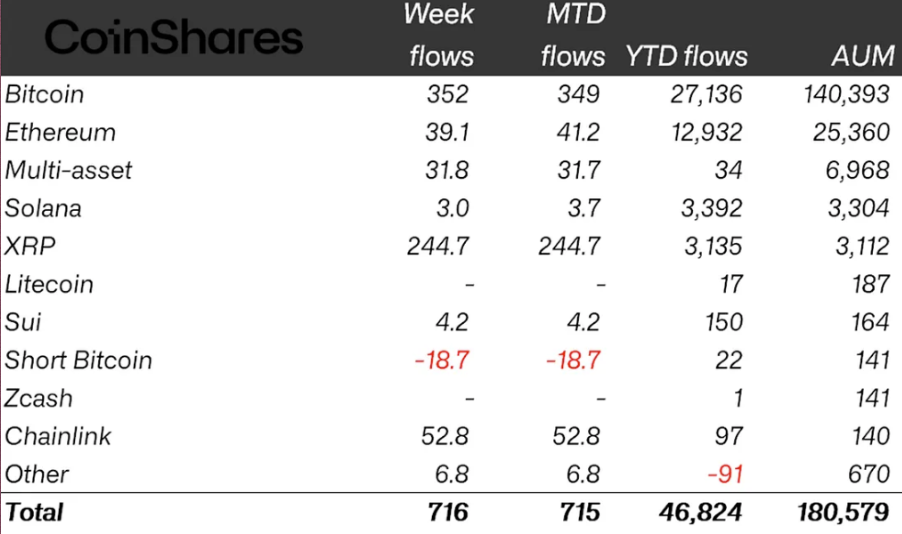
Inflows into crypto ETPs flip positive for two consecutive weeks. Source: CoinShares


Magazine: Decade after Ethereum ICO: Blockchain forensics end double-spending debate

İlgili Okumalar

Wall Street Morning News: V-shaped Rebound at Month-end, but Nasdaq Suffers Worst July in 12 Years; Funds Accelerate Concentration Towards Cloud Giants

Despite a V-shaped rebound at the end of July, the Nasdaq posted its worst July since 2004, while the S&P 500 had its worst July since 2014. Markets were jolted by geopolitical shifts, as President Trump canceled a planned strike on Iran, leading WTI crude to plunge over 8%. This, alongside OPEC+ announcing a supply increase, reversed crude's sharp July gains. Treasury yields surged, with the 10-year yield rising over 30 basis points in July—its largest July increase since 2005. In a rare move, the US and Japan jointly intervened to weaken the USD/JPY, aiming to prevent potential Japanese sales of US Treasuries. While the tech sector faced deleveraging pressure throughout July, cloud giants staged a massive rally on strong earnings. Microsoft, Amazon, and Google collectively added nearly $1.5 trillion in market value last week. Amazon soared over 15% on accelerating AWS growth, Microsoft extended historic gains, Google fully recovered post-earnings losses, and Meta ended an 11-day losing streak. In contrast, Apple tumbled over 7% on supply chain and guidance concerns, ceding its "world's most valuable company" title to Nvidia. The memory and storage sector corrected sharply. Gold edged up 0.91% in July, with analysts viewing the ~30% pullback from January highs as a potential basing period, supported by long-term central bank demand. Key events to watch this week include earnings from Palantir, AMD, SpaceX (its first post-IPO report), and memory giants like Western Digital. The US July non-farm payrolls report on Friday will be critical for gauging the Fed's policy path. SpaceX also faces a significant lock-up expiration, testing market liquidity.

marsbit54 dk önce

Wall Street Morning News: V-shaped Rebound at Month-end, but Nasdaq Suffers Worst July in 12 Years; Funds Accelerate Concentration Towards Cloud Giants

marsbit54 dk önce

Rubin Ultra Makes Major Cuts, Even Nvidia Can't Handle Memory Price Hikes?

NVIDIA's Rubin Ultra, the top-tier variant of the newly announced Rubin AI accelerators, has reportedly seen significant specification downgrades, according to an industry report from SemiAnalysis. Initially designed with four compute dies (4-die), the Rubin Ultra is now said to be reduced to a 2-die design. Key changes highlighted in the report include: * **No increase in peak theoretical compute performance**, remaining at 35 PFLOPs like the standard Rubin. * **Severe reduction in memory capacity** to 192GB using 8-Hi HBM stacks, which is less than the standard Rubin's 288GB using 12-Hi stacks. * **Negligible memory bandwidth improvement** of only 1 TB/s. * **Slightly higher chip-level power consumption**. * The **primary upgrade is a massive increase in scale-up interconnect capacity**, supporting connections for up to 576 GPUs via NVLink, compared to 72 for the standard Rubin. The report suggests the redesign is primarily a cost-optimization move driven by the sharp rise in HBM (High-Bandwidth Memory) prices. By reducing the expensive HBM content and shifting investment towards enhanced system-scale networking, NVIDIA aims to maintain the platform's value for large-scale AI training clusters while managing soaring material costs. The news reportedly triggered a sell-off in South Korean memory stocks, with SK Hynix and Samsung shares falling around 8%, as markets grew concerned that NVIDIA—a major HBM buyer—might be reducing its reliance on high-capacity memory, potentially capping future pricing power for memory makers.

Odaily星球日报1 saat önce

Rubin Ultra Makes Major Cuts, Even Nvidia Can't Handle Memory Price Hikes?

Odaily星球日报1 saat önce

İşlemler

Spot
活动图片