Bitwise crypto index fund moves from over-the-counter to NYSE Arca for trading

cointelegraph2025-12-09 tarihinde yayınlandı2025-12-09 tarihinde güncellendi

Özet

Bitwise Asset Management's 10 Crypto Index Fund (BITW) is transitioning from the over-the-counter market to NYSE Arca, marking a significant step toward mainstream adoption. The fund, which offers diversified exposure to the top 10 cryptocurrencies like Bitcoin and Ethereum, will now trade as an exchange-traded product on a major regulated securities exchange. This move is expected to reduce investment friction and provide a safer, more accessible entry point for investors hesitant about direct crypto exposure. Bitwise, an early issuer of a spot Bitcoin ETF, has seen growing institutional interest amid regulatory developments and market volatility, including recent large liquidations and subsequent inflows into crypto ETPs.

Bitwise Asset Management’s 10 Crypto Index Fund (BITW) is moving from the over-the-counter market to NYSE Arca, a shift that brings crypto exposure further into mainstream trading infrastructure.

Beginning Tuesday, BITW is officially uplisted to NYSE Arca — one of the New York Stock Exchange’s electronic markets for exchange-traded products — where it will trade as an exchange-traded product, the company announced.

Launched in 2017, BITW offers diversified exposure to the 10 largest cryptocurrencies by market capitalization, including Bitcoin (BTC), Ether (ETH), Solana (SOL) and XRP (XRP). The fund rebalances monthly to reflect changes in the broader crypto market.

Listing on NYSE Arca places a crypto-linked product on a major regulated securities exchange, the same type of venue where traditional exchange-traded funds (ETFs) trade. The move is expected to reduce friction for investors who may be hesitant to navigate crypto exchanges.

“Most investors we meet are convinced crypto is here to stay, but they don't know who the winners will be or how many will succeed," said Bitwise CIO Matt Hougan. “The index approach is a way for people to invest in the thesis without having to predict the future.”

Source: Matt Hougan

Bitwise was among the first issuers to receive approval for a spot Bitcoin ETF in January 2024. Its Bitwise Bitcoin ETF Trust (BITB) was one of the fastest 25 exchange-traded products to reach $1 billion in assets, hitting the milestone roughly a month after launch.

Related: Bitwise files for stablecoin, tokenization ETF with US SEC

Institutional adoption and market volatility

Institutional interest in digital assets has expanded rapidly since the approval of US spot Bitcoin ETFs in early 2024. The arrival of the more crypto-friendly Trump administration has further accelerated adoption through increased regulatory attention, new legislation and a federal mandate to support the industry’s development.

At the same time, institutional investors have been reminded of the sector’s inherent volatility, which remains elevated even as larger and more established participants enter the market.

Crypto markets saw their largest-ever liquidation event on Oct. 10, when roughly $19 billion in positions were wiped out. The resulting turbulence over the following month triggered sharp withdrawals and significant outflows from crypto exchange-traded products.

However, inflows have resumed in the last two weeks, with ETP inflows exceeding $1.7 billion over that period, according to CoinShares data.
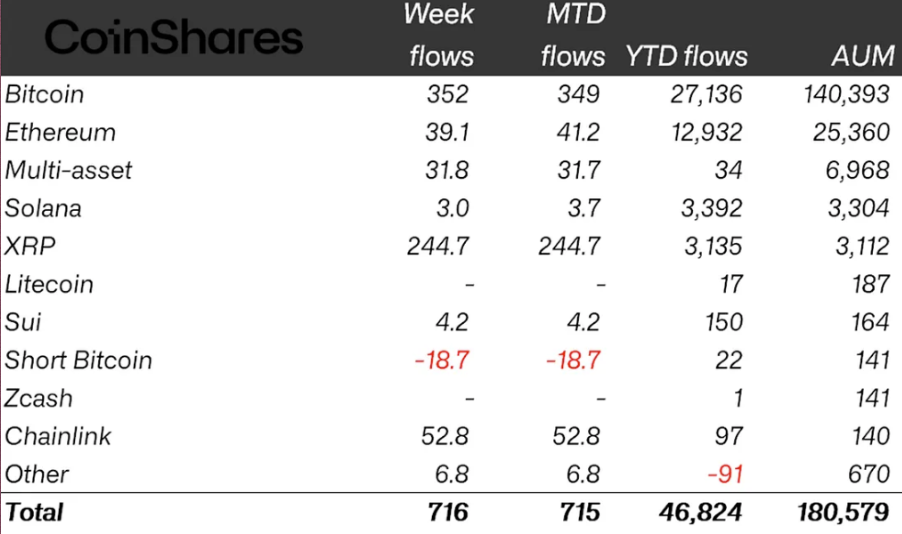
Inflows into crypto ETPs flip positive for two consecutive weeks. Source: CoinShares


Magazine: Decade after Ethereum ICO: Blockchain forensics end double-spending debate

İlgili Okumalar

From Robinhood to Polymarket: Is the Era of Integrating All Assets on a Single Platform Coming?

From Robinhood to Polymarket: The Era of All-in-One Asset Platforms Is Coming Asset classes are rapidly converging. Platforms that once specialized in single categories—such as stocks, cryptocurrencies, or prediction markets—are now moving toward offering all three. Robinhood pioneered this model, starting with equities, adding crypto in 2018, and prediction markets in 2025. This strategy has proven resilient: when crypto revenues fell, other segments like options and stocks filled the gap. Now, prediction market leaders Polymarket and Kalshi are moving in the same direction, both announcing perpetual futures trading on April 21, 2026, pending regulatory approval. These futures will cover assets like Bitcoin, gold, and stocks such as Nvidia. This trend mirrors the consolidation seen in consumer tech, like smartphones replacing dedicated cameras and MP3 players. Younger users, accustomed to interacting with multiple asset types from an early age, will increasingly demand unified platforms. A key competitive advantage in prediction markets is collateral utilization—idle assets locked during betting periods. Polymarket’s move into perpetuals may be a strategy to generate yield from that capital, similar to earlier DeFi integrations like PolyAave. As the regulatory landscape evolves, traditional finance is also likely to incorporate crypto and prediction markets, further accelerating this convergence.

marsbit28 dk önce

From Robinhood to Polymarket: Is the Era of Integrating All Assets on a Single Platform Coming?

marsbit28 dk önce

OpenAI Goes Left, DeepSeek Goes Right

On April 24, 2026, DeepSeek released V4, a Chinese large language model offering a free "million-token context window," enabling it to process vast amounts of data like entire books or years of corporate documents in one go. In contrast, OpenAI’s GPT-5.5, released around the same time, is more powerful but significantly more expensive, charging up to $180 per million output tokens. DeepSeek’s strategy represents a shift from a pure AI research firm to a heavy-infrastructure player, building data centers in Inner Mongolia’s Ulanqab to bypass U.S. chip export restrictions. This move, supported by Huawei’s Ascend chips and China’s cheap green electricity, highlights a fundamental divergence in AI development models: U.S. firms focus on high-cost, high-margin services, while Chinese players like DeepSeek prioritize accessibility and affordability. Facing intense talent poaching from tech giants, DeepSeek is seeking a $44 billion valuation funding round to retain researchers and scale infrastructure. Meanwhile, Chinese manufacturers are compressing AI models to run on smartphones, making AI accessible offline and across the Global South. Through open-source models and localized solutions, Chinese AI is empowering non-English speakers and low-income users, driving a form of "digital equality." While Silicon Valley builds walled gardens, DeepSeek and others are turning AI into a public utility—like tap water—flowing freely to those previously left behind.

marsbit54 dk önce

OpenAI Goes Left, DeepSeek Goes Right

marsbit54 dk önce

İşlemler

Spot
Futures
活动图片