Bittensor Goes Left, Virtuals Goes Right: Two Flywheel Paradigms of AI Crypto Projects

marsbit2026-03-26 tarihinde yayınlandı2026-03-26 tarihinde güncellendi

Özet

The article compares two AI crypto project models: Bittensor's subnet ecosystem and Virtuals' agent-based system. Bittensor uses TAO emissions to incentivize subnets, which compete for daily TAO rewards. Subnets require significant capital to launch (e.g., 871 TAO for a subnet slot) and focus on infrastructure like decentralized computing and AI research. Its ecosystem has high entry barriers, complex onboarding, and targets technical users. Virtuals employs a pump.fun-like model where agent tokens gain value through trading volume, enabling rapid capital accumulation during speculative cycles. It has low entry costs for teams, supports quick iteration via a 60-day trial program, and excels at retail distribution due to its Base chain integration and consumer-friendly concepts. Both models share a liquidity flywheel: demand for subnet tokens boosts TAO, while demand for agent tokens boosts VIRTUAL. Bittensor is infrastructure-oriented with high funding potential, while Virtuals is application-focused, leveraging market momentum for consumer AI agents.

Original Author: 0xJeff

Original Compilation: AididiaoJP, Foresight News

This article aims to provide a brief comparison between Bittensor subnets and Virtuals agents to help understand their respective flywheel mechanisms, differences, and similarities.
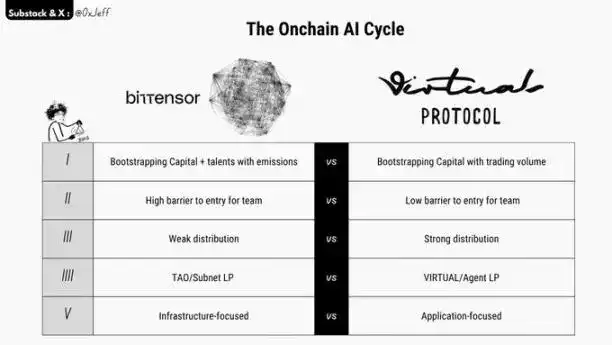
I. Guiding Capital and Talent Through Emissions Mechanism vs. Guiding Capital Through Trading Volume

Bittensor guides subnet development through its TAO emissions mechanism. Subnets are responsible for introducing the most innovative projects (or revenue-generating businesses) and compete for a share of the daily 3,600 TAO distribution.

Subnets also guide contributors (including miners performing tasks and validators verifying the miners' work) through their alpha token emissions mechanism. The emissions mechanism and the incentive coordination mechanism across stakeholders have been embedded since the project's inception.

Virtuals adopts a model similar to pump.fun, guiding development through trading volume. High trading activity translates into capital accumulation for the agent project. Agent teams can use their own emissions mechanisms to incentivize user participation.

In market cycles with high speculative token demand, this model has significant advantages—teams can quickly accumulate capital, gain product attention and market interest, thereby driving project launch and development.

II. High Entry Barrier vs. Low Entry Barrier (For Teams)

Launching a subnet on Bittensor requires substantial investment. Currently, acquiring a subnet slot requires 871 TAO (approximately $300,000), with the price fluctuating based on demand and the auction mechanism. This means subnet teams typically need mature ideas, clear plans, and solid execution capabilities.

To successfully operate a subnet, owners must ensure that the set tasks or objectives contribute to the R&D of their AI product/solution, prevent miner fraud, ensure validators effectively perform verification duties, generate revenue through business development and customer partnerships, and maintain investor confidence through buyback mechanisms.

The subnet token price needs to maintain an upward trend to attract more TAO inflow, increase the subnet's emission share, and thereby attract higher-level contributors to participate in mining.

In contrast, the barrier to launching an AI agent token on Virtuals is lower, requiring no initial cost, making it easier to test new ideas with less capital.

Virtuals also has a "60-day program" that allows founders to test new ideas and issue tokens during this period. If product-market fit is not found within 60 days, the relevant funds are reclaimed, and investors can retrieve a portion of their invested capital.

III. Weaker Distribution Capability vs. Stronger Distribution Capability

Bittensor operates independently on a blockchain built using the Polkadot Substrate framework. Cross-chain bridging is difficult, it lacks DeFi infrastructure components, and is not equipped with common infrastructure like the Ethereum Virtual Machine or Solana.

This results in a high entry barrier for the Bittensor ecosystem. Furthermore, relevant learning materials are filled with complex terminology, increasing the difficulty for new users to learn and understand. Consequently, its community members are mostly technical professionals willing to invest time in deep research, with relatively low retail participation.

In comparison, the understanding threshold for Virtuals is lower. Its team excels in marketing, branding, and distribution. Retail users can relatively intuitively understand concepts like AI agents, agent payments, and bots.

Since Virtuals is deployed on the Base chain, the process of purchasing AI agent tokens is convenient. The time from learning about a project, forming a bullish judgment, to making a purchase decision is short, which is a key reason for its rapid popularity from late 2024 to 2025 (earlier than Bittensor).

Currently, Bittensor is gradually entering the mainstream spotlight with pushes from Jason, Chamath, Barry Silbert (DCG & Yuma), and the community, leading to increased attention. However, the purchase process for subnet tokens remains relatively complex, and the issue has not been fundamentally resolved.

IV. TAO/Subnet Liquidity Pool vs. VIRTUAL/Agent Liquidity Pool

Bittensor and Virtuals share a key similarity in their liquidity pool flywheel mechanisms.

Investors wishing to purchase subnet alpha tokens need to hold TAO to do so. Therefore, rising demand for alpha tokens will drive up the price of TAO.

Similarly, within the Virtuals ecosystem, rising demand for AI agent tokens will drive up the price of VIRTUAL.

If the core tokens (TAO or VIRTUAL) can circulate within the ecosystem without outflow (e.g., through project teams trading goods and services to retain value), the advantages of this mechanism become more pronounced.

V. Infrastructure-Oriented vs. Application-Oriented

Bittensor subnets mostly focus on infrastructure or capital-intensive businesses, such as decentralized computing, inference, training, drug discovery, and quantum experiments.

Since Bittensor can provide over $10 million annually in funding for quality subnets and attract high-end talent, its model is suitable for driving ambitious, high-difficulty, high-investment ideas.

Virtuals agent teams, however, mostly focus on the application layer and consumer-facing agent products. Since agent tokens have a low initial price, if a team can launch a quality consumer product, it can leverage the token's market heat to quickly attract attention and drive project development.

Thanks to Virtuals' advantages in distribution, the flywheel effect of AI agent tokens demonstrated faster growth rates and higher price increases during periods of extreme market activity (such as late 2024 to early 2025).


İlgili Sorular

QWhat are the two main AI crypto projects compared in the article, and what are their core flywheel mechanisms?

AThe two main AI crypto projects compared are Bittensor and Virtuals. Bittensor's core flywheel mechanism is guided by TAO emissions to fund subnet development. Virtuals' core flywheel mechanism is guided by trading volume, similar to the pump.fun model, to accumulate capital for AI agent projects.

QHow does the entry barrier for launching a project differ between Bittensor and Virtuals?

ALaunching a subnet on Bittensor has a high entry barrier, currently requiring a significant investment (e.g., 871 TAO, ~$300k) to acquire a subnet slot. In contrast, launching an AI agent token on Virtuals has a low entry barrier, requiring no initial cost, allowing teams to test new ideas with minimal capital outlay.

QWhat is a key similarity in the liquidity pool flywheel mechanism between Bittensor and Virtuals?

AA key similarity is that demand for the ecosystem's project tokens drives the price of the core native token. In Bittensor, demand for subnet alpha tokens drives the price of TAO. In Virtuals, demand for AI agent tokens drives the price of VIRTUAL.

QAccording to the article, what is the primary focus of projects built on Bittensor versus those on Virtuals?

AProjects on Bittensor are primarily infrastructure-oriented, focusing on areas like decentralized computing, inference, training, drug discovery, and quantum experiments. Projects on Virtuals are primarily application-oriented, focusing on consumer-facing AI agent products.

QWhat advantage does Virtuals have over Bittensor in terms of distribution and user accessibility?

AVirtuals has a significant advantage in distribution and user accessibility. It has lower comprehension barriers, strong marketing, and is deployed on the Base chain, making the purchase process for AI agent tokens simple and intuitive for retail users. Bittensor has a higher learning curve, complex terminology, and a more difficult token purchase process, making it less accessible to the average retail participant.

İlgili Okumalar

The Semiconductor Industry's Most Obscure Chokepoint Material: It Has Multiplied in Price Unnoticed, and China Just Banned Its Export

"Helium: The Silent Choke Point in Semiconductors" Helium, despite being the universe's second most abundant element, is critically scarce on Earth. It cannot be synthesized artificially and escapes Earth's gravity once released, making it a non-renewable resource. Yet, it is indispensable for advanced semiconductor manufacturing, requiring ultra-high purity (99.9999%) for processes like wafer etching, leak detection, and thermal management in lithography tools, with no viable substitutes. This low-profile resource, whose price has doubled unnoticed, suddenly gained attention when China imposed an export ban on July 10th. The ban is a response to a severe global shortage triggered months earlier. In March, missile attacks damaged the world's largest helium production hub in Qatar's Ras Laffan, halting a third of global supply with repairs expected to take 3-5 years. Concurrently, Russia tightened export controls, and the US sold off its federal helium reserve. Approximately 200 specialized transport containers, each worth ~$1 million, were stranded with perishable cargo. Global spot prices skyrocketed, and chipmakers like TSMC warned of potential impacts. China, which imports over 84% of its helium (primarily from Qatar and Russia), faces a severe squeeze. Despite being helium-poor, China has developed domestic extraction technology over five years, processing byproduct gases from LNG plants to produce ultra-pure helium. Domestic output, while still only covering less than 20% of demand, enabled the recent export ban aimed at securing domestic supply for its own expanding chip industry. The industry now faces "Helium Shortage 5.0." With key global sources constrained for years, this invisible gas—once wasted on party balloons—has become a critical, geopolitically charged bottleneck for chips, healthcare (MRI machines), and beyond, forcing the world to finally treat it as the finite strategic resource it is.

marsbit16 dk önce

The Semiconductor Industry's Most Obscure Chokepoint Material: It Has Multiplied in Price Unnoticed, and China Just Banned Its Export

marsbit16 dk önce

Early Investor of Unitree Bets on a Brain-Computer Interface Company

"Wabo Technologies, a brain-computer interface (BCI) startup, has secured new funding from Vertex Ventures (under Temasek), Hongtai Fund, Chengdu Future Industry Fund, and Huifengda Capital. Vertex Ventures is known for its early bet on Unitree Robotics. Inspired by the sci-fi film "Avatar," founder Zhang Xingzhi has pursued human-machine interaction for over a decade. He established Wabo in late 2025, coinciding with China's push for BCI as a future industry. Unlike companies focused solely on medical hardware, Wabo positions itself as a model company. Its core mission is to develop a "Human Neural Intent Model" that decodes EEG, EMG, and behavioral signals to understand a user's goals, confirmations, corrections, and stop intentions before physical action, translating them into standardized control signals for machines, robots, or smart devices. The young, full-stack team, backed by academic collaborators from Tianjin University and Fudan University, quickly attracted investors. The company had previously raised a seed round from Ceyuan Capital. Investors were impressed by Wabo's systematic capabilities in data collection, signal processing, and engineering, seeing potential beyond a single hardware product toward a reusable layer of human intent interpretation. Applications span medical rehabilitation, smart homes, embodied AI, and even space exploration, with Wabo partnering with Tianjin University on pioneering "space BCI" research. Wabo plans a dual-headquarters strategy, with Shanghai focusing on high-end R&D and model development, and Chengdu handling hardware, product development, and supply chain. The BCI sector in China is heating up, with over 30 financing deals in early 2026. Zhang believes future competition will center on who can build a sustainable data-model-scenario loop. He predicts industry consolidation within three years, with only companies that master this闭环 surviving. The vision from "Avatar" is inching closer to reality."

marsbit31 dk önce

Early Investor of Unitree Bets on a Brain-Computer Interface Company

marsbit31 dk önce

ChangXin Technology: A Cyclical Stock Standing Atop the Cycle Peak

Changxin Technology: A Cyclical Stock at the Peak On July 27, 2026, Changxin Technology topped the A-share market with a market capitalization of 3.28 trillion yuan, surging 465% on its first trading day. The company, which lost 16.3 billion yuan in 2023, reported an estimated net profit of 50-57 billion yuan for the first half of 2026. Its dramatic reversal mirrors the volatile DRAM (Dynamic Random Access Memory) cycle. The DRAM industry is inherently cyclical, with booms and busts every 3-4 years. This is due to product standardization and a significant time lag in supply adjustment. When prices rise, manufacturers expand capacity, but new production takes 2-3 years to come online, often leading to oversupply and price crashes when demand cools. Changxin's performance perfectly tracks this cycle. It recorded deep losses in 2023-2024 during the industry downturn, turned its first annual profit in 2025, and saw profits skyrocket in Q1 2026. This surge is primarily price-driven. The AI boom has led major players like Samsung and SK Hynix to shift 70-80% of new capacity to high-margin HBM (High Bandwidth Memory), creating a severe shortage and price explosion in general-purpose DRAM markets where Changxin competes. However, a massive global capacity expansion is underway. The top three manufacturers have announced nearly $70 billion in capital expenditure for 2026. Changxin itself plans to expand from three to seven 12-inch wafer fabs. This investment will translate into significant new supply in 2-3 years. While DRAM prices are expected to remain high through 2026-2027, price growth is already slowing, and a potential downturn is forecast for around 2028 as new capacity ramps up. A key challenge for Changxin is catching up in the critical HBM segment. While it has delivered HBM3 samples, leaders are already mass-producing more advanced HBM3E. Success in HBM is crucial for gaining true cyclical resilience. In conclusion, Changxin is a commendable company that has broken foreign monopolies in DRAM. Its long-term growth narrative—driven by import substitution and AI—is valid. Yet, its current valuation of 5-6x forward P/E, typical for a cyclical stock at its peak, suggests much future growth is already priced in. AI may extend the current cycle but cannot eliminate the industry's inherent volatility. For investors, the critical question is preparedness for the inevitable downturn when the cycle turns.

marsbit36 dk önce

ChangXin Technology: A Cyclical Stock Standing Atop the Cycle Peak

marsbit36 dk önce

What If the CLARITY Act Ultimately Fails to Pass?

This article examines the potential consequences if the CLARITY Act, a major US crypto market structure bill, fails to pass in the Senate. Having cleared the House in July 2025 and a key committee in May 2026, the bill's passage into law this year is now considered uncertain, with prediction markets showing its probability dropping from 82% in February to 35%. The article analyzes three main areas of impact should the bill fail. First, for the crypto market, analysts believe a negative reaction is limited and partially priced in already, with Bitcoin's recent weakness attributed more to macro factors. The specific details of the failed bill would matter more than its failure alone. Second, for US stocks, Coinbase (COIN) could see short-term pressure, with analysts citing a potential drop to the $140-$160 range, though its long-term thesis is not solely tied to the bill. For Circle, failure might be neutral or even positive long-term, as a passed bill could invite more stablecoin competition. Bitcoin-treasury firms like Strategy (MSTR) are seen as more directly tied to Bitcoin's price than the legislation. Third, in Washington, the failure is framed within a broader political struggle. Democratic resistance is partly linked to concerns over former President Trump's crypto holdings, making the bill a political tool. If it fails in 2026, the industry would likely rely on existing frameworks like the GENIUS Act and agency-level rules. Missing the August window likely pushes any significant progress to 2027, a period of political reshuffling after midterm elections, making consensus harder to achieve.

Odaily星球日报1 saat önce

What If the CLARITY Act Ultimately Fails to Pass?

Odaily星球日报1 saat önce

İşlemler

Spot
活动图片