Author: Feixiaohao
On August 17, 2026, BitMart once again became the focus of attention in the cryptocurrency market.
This time, the reason was no longer simply "an exchange is about to shut down." With just 9 days left before BitMart stops trading, a controversy surrounding user withdrawals, platform assets, employee compensation, and reserve transparency was suddenly thrust into the spotlight.
According to public reports, a group of individuals claiming to represent BitMart users and employees publicly demanded that BitMart management disclose platform assets, liabilities, wallets, and reserves available for user withdrawals. They also demanded an explanation for the withdrawal restrictions some users were experiencing, and proposed user compensation plans and third-party independent audits. The relevant parties set August 19th as the deadline for a response, stating that if a satisfactory reply could not be obtained, they might further submit materials to regulatory authorities and law enforcement agencies.

At the same time, BitMart CEO Sheldon Lee denied the related claims, stating that some accusations against the platform were false or fabricated information. In other words, based solely on the allegations on social media, one cannot directly conclude that BitMart is already insolvent or unable to repay user assets.
But this is precisely what makes the situation even more noteworthy.
Because when an exchange that has already announced its exit from the market starts being asked by users, "Where exactly are your assets?", the nature of the matter has fundamentally changed.
This is no longer just a story about a business exit.
It is beginning to turn into a story about the core issue of centralized exchanges: when all users want to take their money out, does this platform actually have the ability to let them exit safely?
From Orderly Shutdown to Today's Asset Controversy
To understand today's controversy, we must first lay out the timeline.
On July 26th, BitMart announced it would gradually cease platform operations. Judging from the official arrangements, this was supposed to be an orderly exit. The platform stopped new user registrations, gradually halted deposits and new business, and required users to close related positions, complete identity verification, and handle asset withdrawals before trading stopped.
According to BitMart's plan, spot, futures, and other trading services would stop on August 26th, and the platform was scheduled to end operations by January 31st, 2027.

Based solely on this timeline, it's not incomprehensible for an exchange that has operated for many years to decide to exit the market.
Internet companies can shut down products, financial institutions can exit certain businesses, and trading platforms can cease operations. As long as user assets can be fully liquidated and the platform can complete its exit according to the established process, "shutting down" itself does not necessarily mean a serious problem has occurred.
The real point of concern is that as users began to withdraw their funds en masse, the market's question gradually shifted from "Why is BitMart closing?" to "When can BitMart users get their money out?"
Between these two questions lies a very important chasm.
The former is a business problem.
The latter is an asset security problem.
And for a centralized exchange, the most dangerous moment often arrives when these two begin to overlap.
An Exchange's Real Stress Test is When Everyone Withdraws at Once
When an exchange operates normally, users rarely seriously contemplate where their assets actually are.
A user deposits 10,000 USDT, and the account shows 10,000 USDT; a user buys BTC, and the account shows a BTC balance; when the user needs it, they click withdraw, and the asset moves from the platform's wallet to their address.
The entire process seems very natural.
Over time, people develop a strong psychological perception: the numbers in the account *are* their money.
But from a technical and asset control perspective, the two are not entirely the same thing.

What truly exists on the blockchain are the assets in the wallet addresses. The balance a user sees in their centralized exchange account is essentially a record of the user's claim or account balance in the exchange's internal database.
As long as the exchange can process withdrawals normally, the difference between these two states is almost imperceptible to the average user.
But once an exchange announces its shutdown, things become completely different.
Because at that point, users no longer consider "when is it convenient to withdraw," but instead start thinking, "Should I withdraw all my assets now?"
The normal daily flow of funds suddenly turns into a mass exodus.
This is also why an exchange's most dangerous moment isn't necessarily a market crash; sometimes it's after it announces its exit.
Because a crash only affects asset prices, while an exit directly changes the behavior of all users.
When more and more people withdraw simultaneously, the platform's true liquidity undergoes a stress test.
If the platform possesses sufficient liquid assets, then withdrawals are just a normal migration of funds.
If the platform's asset structure is complex, containing a large amount of illiquid assets, or if the platform's actual liabilities are higher than market perception, then concentrated withdrawals may expose all the hidden problems from the past.
So the real question is never "Does BitMart still have assets?"
The Real Question Should Be:
Exactly how many assets does BitMart have that can be immediately used to repay users? And what is the relationship between these assets and the actual claims users possess?
Is the 10,000 USDT in the account really your 10,000 USDT?
This is key to understanding the entire CEX industry.
When many people first encounter cryptocurrency, the easiest concept to grasp is the "private key."
Whoever holds the private key controls the on-chain assets.
But when users transfer assets into a centralized exchange, the situation changes.
Users entrust their assets to the exchange for custody. The exchange is responsible for recording balances, matching trades, and processing withdrawals. What users obtain is a balance in the exchange's internal account, not direct control of the private key for the corresponding on-chain wallet.
This is also why the crypto industry has long emphasized "Not your keys, not your coins."
This saying doesn't mean centralized exchanges are inherently unsafe, nor does it mean all users should keep all their assets in their own cold wallets.
The value of centralized exchanges is very evident. They offer higher trading efficiency, better liquidity, richer financial products, and a simpler user experience.
The problem is that convenience itself implies trust.
You no longer need to manage your private keys, but you also must trust that the exchange will return the corresponding assets to you when needed.
Therefore, centralized exchanges actually form a very special structure: the blockchain itself attempts to make asset ownership trustless, while exchanges, in order to provide convenience, re-establish a layer of trust between the blockchain and the user.
Under normal circumstances, this layer of trust is hardly noticed.
It's only when a platform exits that it suddenly becomes incredibly important.
Because users begin to realize that between the numbers in their account and the assets in their wallet, there is actually a platform.
And if this platform encounters problems, users cannot bypass it to retrieve their assets.
Why Users Now Demand More Than Just a "We're Fine" Statement
This is also the most intriguing aspect of today's BitMart controversy.
According to public reports, the questioning party demands that BitMart disclose assets, liabilities, wallets, and available reserves, and further requests user compensation arrangements and third-party independent audits.
On the surface, this is just a demand for the exchange to publish proof of reserves.
But if we dig deeper into the issue, we find it's far more complex than "showing a few wallet addresses."
Suppose an exchange publicly discloses $1 billion in on-chain reserves.

What does that prove?
At the very least, it proves that at a specific point in time, there were assets worth approximately $1 billion in these public wallets.
But this does not automatically prove user asset safety.
Because there's an even more important question:
Exactly how much does this exchange owe its users?
If total user assets are $1.2 billion, then $1 billion in reserves clearly cannot fully cover user claims.
If part of that $1 billion in assets is borrowed, or has already been pledged to other institutions, then the actual assets available for repayment might be even less.
Therefore, Proof of Reserves cannot fully solve the problem of exchange asset transparency.
Proof of Reserves answers "What do I have?"
But what truly determines whether users can get their money back is the relationship between "What do I have?" and "How much do I owe?"
This is why a truly mature asset transparency system should simultaneously focus on assets, liabilities, user claims, wallet control, related-party transactions, borrowing, collateral, and independent audits.
If you only tell the market "Our wallets hold $1 billion" but don't tell the market "How much we actually owe," then this number itself cannot constitute a complete proof of safety.
Thus, the reason the demands raised by users and employees today are noteworthy is not because they simply want to see wallet balances, but because they are essentially demanding that BitMart answer a question closer to traditional finance:
Exactly how many assets do you have, and how many people do you owe?
Why is an Exchange's Credit Most Fragile When Exiting?
During normal operation, an exchange can continuously attract new users and funds.
Every day, people deposit, withdraw, and trade.
In this environment, the platform's funds are in a dynamic cycle.
But when an exchange announces it will cease operations, this cycle changes.
New users will no longer continuously join, new capital inflows will gradually decrease, while existing users will begin to exit en masse.
At this point, the platform faces a completely different environment.
It no longer needs to prove "Can I continue to grow?" but needs to prove "Can I completely handle all the accumulated assets?"
These are actually two completely different capabilities.
An exchange can have very high trading volume and many users, but this does not necessarily mean it possesses good exit capabilities.
Because expansion and liquidation are inherently opposite directions.
Expansion means continuously absorbing new liquidity.
Liquidation means continuously releasing existing liquidity.
If we imagine an exchange as a huge reservoir, then during normal operation, inflow and outflow are continuous. The real danger is when everyone suddenly opens the drainage outlets—can the reservoir withstand it?
This is why "mass user withdrawals" is one of the most important stress tests for a centralized exchange.
It tests not trading matching capabilities, but ultimate solvency.
Behind the BitMart Incident Lies an Old Problem of the Entire CEX Industry
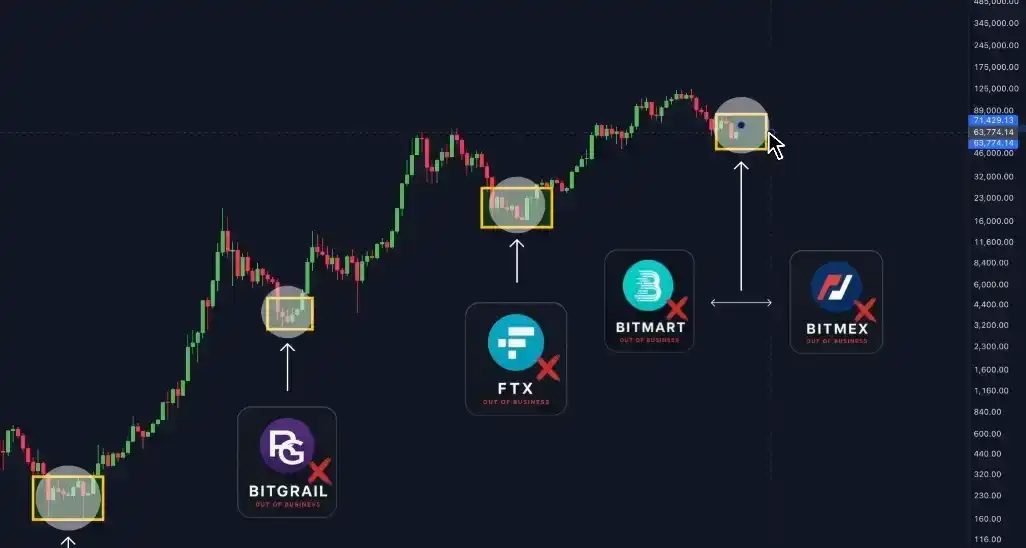
If we broaden our perspective, BitMart is not an isolated story.
Over the past few years, the crypto industry has continuously experienced centralized platform risk events, constantly prompting the market to ponder a question:
What exactly should users trust?
Trust the exchange brand?
Trust the founder?
Trust the trading volume?
Trust how long the platform has existed?
Or trust a verified set of asset-liability data?
In recent years, Proof of Reserves has gained increasing attention, essentially because the market is trying to shift from "Trust me" to "Let me prove it to you."
This is a very important step forward.
But if we take one more step forward, what the industry truly needs may not be merely Proof of Reserves, but a more complete asset-liability transparency mechanism.
Because the real credit of a financial institution is never built on the statement "I have money."
It's built on an entire set of systems that can be inspected, audited, and verified.
How many assets you have, how much debt you owe, whether client assets are segregated, where assets are held, who is responsible for custody, who has priority in case of risk—all these together constitute a true credit system.
For centralized exchanges, this is especially important.
Because they effectively play the dual role of trading platform and asset custodian.
No matter how good the trading is, if it ultimately cannot prove client assets are safe, then the most important value of the trading platform loses its foundation.
A More Worthy Question for Discussion: CEXs Have "Opening Mechanisms," but Rarely Discuss "Shutdown Mechanisms"
This may be the most reflective point for the entire industry regarding the BitMart incident.
Over the past decade-plus, the crypto industry has extensively studied how exchanges can develop.
How to list new assets, how to acquire users, how to increase liquidity, how to boost trading volume, how to enter different markets, how to launch new financial products.
But few have seriously discussed:
If an exchange decides to stop operating, how exactly should it wind down?
This is actually a more complex problem than starting up.
Because when an exchange ends operations, it's not just about shutting down a website.
It needs to handle user assets, platform debts, employees, partners, institutional clients, wallets, data, and various historical transaction records and compliance requirements.

Especially user assets.
If an exchange can easily hand over assets to users, then shutting down is just an operational issue.
But if users cannot smoothly retrieve their assets, then the platform's "exit" is no longer just a business decision; it becomes a financial liquidation problem.
Therefore, truly mature centralized exchanges in the future may not only need to prove they "can start up" but also prove they "can exit safely."
This sounds pessimistic, but it is actually a sign of maturity.
Banks need to have bankruptcy and liquidation mechanisms.
Securities firms need to have client asset protection mechanisms.
Funds need to have liquidation mechanisms.
Then, as a financial infrastructure managing large amounts of client assets, exchanges should also consider their own endgame.
An Exchange's True Credit is Established When the Last User Successfully Withdraws
It's still too early to judge what final outcome BitMart will face.
Currently, there are public queries from users and employees, and there are denials from BitMart management regarding the related allegations. There is a clear discrepancy between the two sides' narratives. What can truly end the controversy is not who has a louder voice on social media, but whether sufficiently transparent, verifiable information can be provided in the future.
If BitMart ultimately can smoothly complete withdrawals, resolve user and employee disputes, and complete platform liquidation according to the established plan, then this may just be a business exit full of controversy.
But if issues of asset transparency, withdrawals, and repayment continue to worsen, then the significance of this event will be entirely different.
Because it will once again remind the entire crypto industry:
An exchange's true credit is not established at the moment a user deposits funds, but is tested when all users simultaneously demand withdrawals.
The moment an exchange is most trustworthy is not when it has many users, generates high daily trading volume, or is most glorious during a bull market.
It's when it decides to leave this market and can still clearly tell users: Where are my assets? How much do I owe you? When can you get your money back? And who can prove what I'm saying is true.
This is the true credit of a financial institution.
BitMart has entered its final countdown.
August 19th is the most noteworthy node in the current controversy; August 26th is the key date when the platform stops trading.
But what will ultimately determine the nature of this event may not be a particular announcement or statement.
It's whether the last user's money can truly leave the exchange.
Because for a centralized exchange, how many users it has when opening doesn't represent its strength. What truly proves its strength is whether it can send every single user out the door when closing.