Bithumb Issues Statement Over Reward Payment Error – Details

bitcoinist2026-02-07 tarihinde yayınlandı2026-02-07 tarihinde güncellendi

Özet

South Korean cryptocurrency exchange Bithumb has addressed a significant internal error that resulted in the accidental distribution of 620,000 BTC (worth billions) to 695 users during a promotional event, instead of the intended 2,000 KRW reward. The mistake caused a flash crash of approximately 10% on the exchange as some recipients immediately sold the Bitcoin. Bithumb responded by freezing affected accounts within 35 minutes and has since recovered 99.7% of the overpaid BTC. The exchange confirmed the incident was an operational error, not a security breach, and assured users that all customer assets remain safe. The broader crypto market is also noted to have recovered slightly, with its total capitalization rising to $2.34 trillion.

Korean exchange Bithumb has cleared the air over an internal error that credited certain user wallets with a “concerning” amount of BTC. Notably, this mishap resulted in significant price volatility on the exchange, drawing attention from observing crypto enthusiasts.

Bithumb Moves To Wrap Up Recovery After Overpayment Error

On February 6, Lookonchain, among many crypto commentary accounts, shared that Bithumb had accidentally transferred 2,000 BTC ($134 million) each to users, instead of 2000 KRW ($1.34) in a reward payout. Some recipients immediately sold, causing a 10% flash crash on the Korean exchange, pushing prices briefly to around $55,000.

In a blog post, Bithumb explained the incident as an overpayment that occurred during a promotional event process involving 695 recipients. The exchange stated it had mistakenly transferred 620,000 BTC to these wallets, an error that was immediately noticed, resulting in a swift ban on withdrawals for all affected wallets within 35 minutes of the transaction.
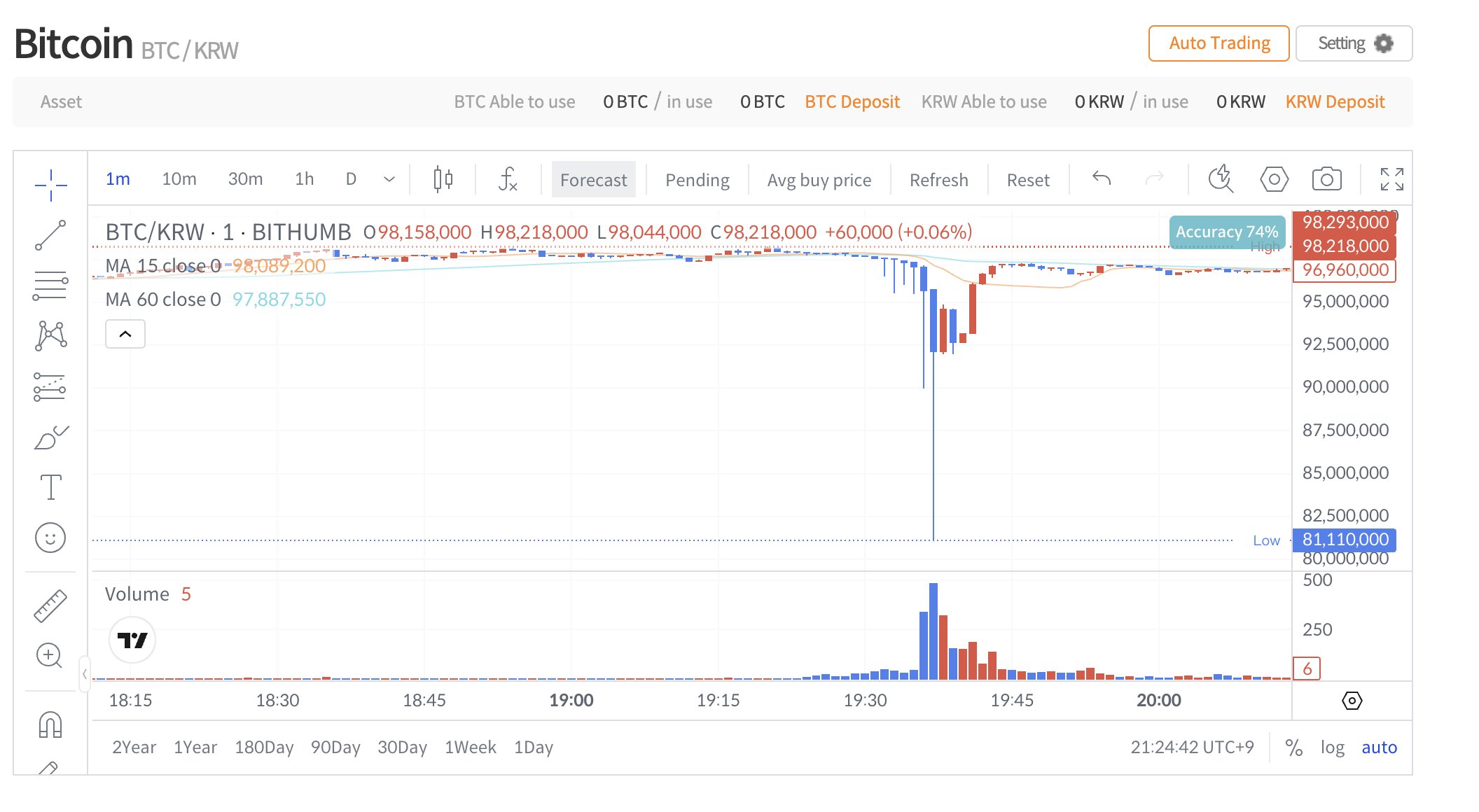
Source: @lookonchain on X

Notably, Bithumb sharply recovered 618,212 BTC, representing 99.7% of the total overpayment amount. Meanwhile, 93% of the 1788 BTC already sold have also been recovered in KRW and other digital assets. According to the exchange, the remaining sold amount that hasn’t been recovered will be covered using company assets. Meanwhile, efforts are underway to ensure such operational errors never recur.

A statement from the exchange said:

Bithumb takes this incident very seriously and will do its utmost to prevent recurrence by redesigning the entire asset payment process and enhancing the internal control system.

Bithumb also kicked against suspicion of external or malicious interference, assuring users that their system remains uncompromised:

They said:

We want to make it clear that this incident is unrelated to any external hacking or security breach, and does not pose any issues with system security or customer asset management. Customer assets are being safely managed as before, and transactions and deposits/withdrawals are currently operating normally.

Crypto Market Overview

In other news, the total crypto market cap has now climbed to $2.34 trillion after a 5.68% gain in the past day. This follows an earlier bloodbath in the week, during which the market cap fell to around $2.19 trillion.

Despite the recent recovery, data from CoinMarketCap shows the digital asset market remains about 45% away from its present cycle all-time high at $4.28 trillion. Market sentiment also continues to reflect caution, with the Crypto Fear and Greed Index currently reading 8, signaling extreme fear among investors.

Total crypto market cap valued at $2.31 trillion on the daily chart | Source: TOTAL chart on Tradingview.com

Featured image from Blocktempo, chart from Tradingview

İlgili Sorular

QWhat was the nature of the error that occurred on the Bithumb exchange?

ABithumb accidentally transferred 2,000 BTC (worth $134 million) to 695 users instead of the intended 2,000 KRW (worth $1.34) as part of a reward payout.

QWhat immediate action did Bithumb take after discovering the overpayment error?

ABithumb swiftly banned withdrawals for all affected wallets within 35 minutes of the transaction to prevent further loss of funds.

QHow much of the overpaid BTC has Bithumb successfully recovered?

ABithumb has recovered 618,212 BTC, which is 99.7% of the total overpayment amount. Additionally, 93% of the 1,788 BTC that were already sold have been recovered in KRW and other digital assets.

QDid Bithumb confirm if this incident was a result of a hack or security breach?

ANo, Bithumb explicitly stated that the incident was unrelated to any external hacking or security breach and that it does not pose any issues with system security or customer asset management.

QWhat was the impact of the error on the price of Bitcoin on the Bithumb exchange?

AThe error caused a 10% flash crash on the exchange, briefly pushing Bitcoin prices down to around $55,000 as some recipients immediately sold the BTC they received.

İlgili Okumalar

Google and Amazon Simultaneously Invest Heavily in a Competitor: The Most Absurd Business Logic of the AI Era Is Becoming Reality

In a span of four days, Amazon announced an additional $25 billion investment, and Google pledged up to $40 billion—both direct competitors pouring over $65 billion into the same AI startup, Anthropic. Rather than a typical venture capital move, this signals the latest escalation in the cloud wars. The core of the deal is not equity but compute pre-orders: Anthropic must spend the majority of these funds on AWS and Google Cloud services and chips, effectively locking in massive future compute consumption. This reflects a shift in cloud market dynamics—enterprises now choose cloud providers based on which hosts the best AI models, not just price or stability. With OpenAI deeply tied to Microsoft, Anthropic’s Claude has become the only viable strategic asset for Google and Amazon to remain competitive. Anthropic’s annualized revenue has surged to $30 billion, and it is expanding into verticals like biotech, positioning itself as a cross-industry AI infrastructure layer. However, this funding comes with constraints: Anthropic’s independence is challenged as it balances two rival investors, its safety-first narrative faces pressure from regulatory scrutiny, and its path to IPO introduces new financial pressures. Globally, this accelerates a "tri-polar" closed-loop structure in AI infrastructure, with Microsoft-OpenAI, Google-Anthropic, and Amazon-Anthropic forming exclusive model-cloud alliances. In contrast, China’s landscape differs—investments like Alibaba and Tencent backing open-source model firm DeepSeek reflect a more decoupled approach, though closed-source models from major cloud providers still dominate. The $65 billion bet is ultimately about securing a seat at the table in an AI-defined future—where missing the model layer means losing the cloud war.

marsbit13 dk önce

Google and Amazon Simultaneously Invest Heavily in a Competitor: The Most Absurd Business Logic of the AI Era Is Becoming Reality

marsbit13 dk önce

Computing Power Constrained, Why Did DeepSeek-V4 Open Source?

DeepSeek-V4 has been released as a preview open-source model, featuring 1 million tokens of context length as a baseline capability—previously a premium feature locked behind enterprise paywalls by major overseas AI firms. The official announcement, however, openly acknowledges computational constraints, particularly limited service throughput for the high-end DeepSeek-V4-Pro version due to restricted high-end computing power. Rather than competing on pure scale, DeepSeek adopts a pragmatic approach that balances algorithmic innovation with hardware realities in China’s AI ecosystem. The V4-Pro model uses a highly sparse architecture with 1.6T total parameters but only activates 49B during inference. It performs strongly in agentic coding, knowledge-intensive tasks, and STEM reasoning, competing closely with top-tier closed models like Gemini Pro 3.1 and Claude Opus 4.6 in certain scenarios. A key strategic product is the Flash edition, with 284B total parameters but only 13B activated—making it cost-effective and accessible for mid- and low-tier hardware, including domestic AI chips from Huawei (Ascend), Cambricon, and Hygon. This design supports broader adoption across developers and SMEs while stimulating China's domestic semiconductor ecosystem. Despite facing talent outflow and intense competition in user traffic—with rivals like Doubao and Qianwen leading in monthly active users—DeepSeek has maintained technical momentum. The release also comes amid reports of a new funding round targeting a valuation exceeding $10 billion, potentially setting a new record in China’s LLM sector. Ultimately, DeepSeek-V4 represents a shift toward open yet realistic infrastructure development in the constrained compute landscape of Chinese AI, emphasizing engineering efficiency and domestic hardware compatibility over pure model scale.

marsbit50 dk önce

Computing Power Constrained, Why Did DeepSeek-V4 Open Source?

marsbit50 dk önce

İşlemler

Spot
Futures
活动图片