Bithumb Issues Statement Over Reward Payment Error – Details

bitcoinist2026-02-07 tarihinde yayınlandı2026-02-07 tarihinde güncellendi

Özet

South Korean cryptocurrency exchange Bithumb has addressed a significant internal error that resulted in the accidental distribution of 620,000 BTC (worth billions) to 695 users during a promotional event, instead of the intended 2,000 KRW reward. The mistake caused a flash crash of approximately 10% on the exchange as some recipients immediately sold the Bitcoin. Bithumb responded by freezing affected accounts within 35 minutes and has since recovered 99.7% of the overpaid BTC. The exchange confirmed the incident was an operational error, not a security breach, and assured users that all customer assets remain safe. The broader crypto market is also noted to have recovered slightly, with its total capitalization rising to $2.34 trillion.

Korean exchange Bithumb has cleared the air over an internal error that credited certain user wallets with a “concerning” amount of BTC. Notably, this mishap resulted in significant price volatility on the exchange, drawing attention from observing crypto enthusiasts.

Bithumb Moves To Wrap Up Recovery After Overpayment Error

On February 6, Lookonchain, among many crypto commentary accounts, shared that Bithumb had accidentally transferred 2,000 BTC ($134 million) each to users, instead of 2000 KRW ($1.34) in a reward payout. Some recipients immediately sold, causing a 10% flash crash on the Korean exchange, pushing prices briefly to around $55,000.

In a blog post, Bithumb explained the incident as an overpayment that occurred during a promotional event process involving 695 recipients. The exchange stated it had mistakenly transferred 620,000 BTC to these wallets, an error that was immediately noticed, resulting in a swift ban on withdrawals for all affected wallets within 35 minutes of the transaction.
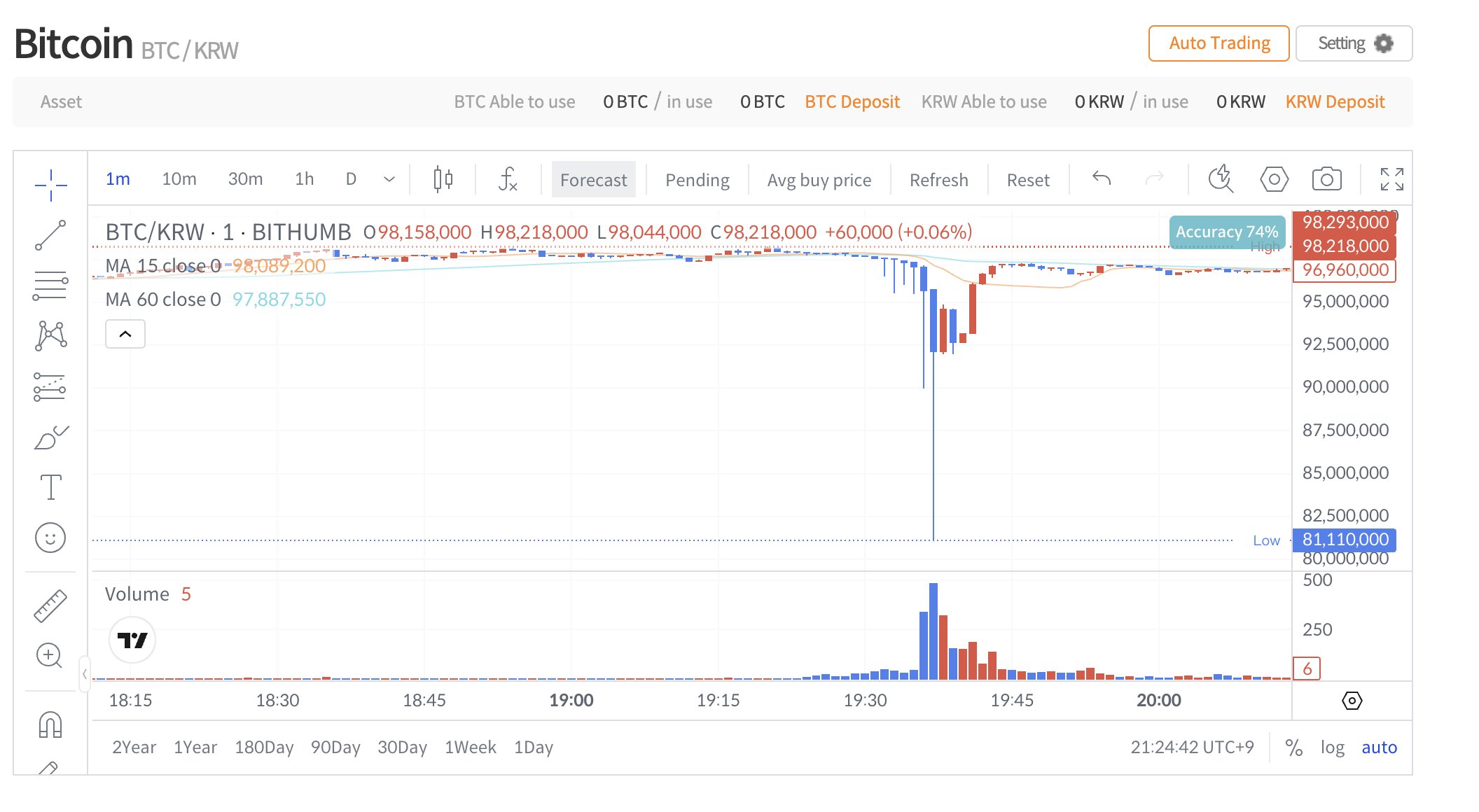
Source: @lookonchain on X

Notably, Bithumb sharply recovered 618,212 BTC, representing 99.7% of the total overpayment amount. Meanwhile, 93% of the 1788 BTC already sold have also been recovered in KRW and other digital assets. According to the exchange, the remaining sold amount that hasn’t been recovered will be covered using company assets. Meanwhile, efforts are underway to ensure such operational errors never recur.

A statement from the exchange said:

Bithumb takes this incident very seriously and will do its utmost to prevent recurrence by redesigning the entire asset payment process and enhancing the internal control system.

Bithumb also kicked against suspicion of external or malicious interference, assuring users that their system remains uncompromised:

They said:

We want to make it clear that this incident is unrelated to any external hacking or security breach, and does not pose any issues with system security or customer asset management. Customer assets are being safely managed as before, and transactions and deposits/withdrawals are currently operating normally.

Crypto Market Overview

In other news, the total crypto market cap has now climbed to $2.34 trillion after a 5.68% gain in the past day. This follows an earlier bloodbath in the week, during which the market cap fell to around $2.19 trillion.

Despite the recent recovery, data from CoinMarketCap shows the digital asset market remains about 45% away from its present cycle all-time high at $4.28 trillion. Market sentiment also continues to reflect caution, with the Crypto Fear and Greed Index currently reading 8, signaling extreme fear among investors.

Total crypto market cap valued at $2.31 trillion on the daily chart | Source: TOTAL chart on Tradingview.com

Featured image from Blocktempo, chart from Tradingview

İlgili Sorular

QWhat was the nature of the error that occurred on the Bithumb exchange?

ABithumb accidentally transferred 2,000 BTC (worth $134 million) to 695 users instead of the intended 2,000 KRW (worth $1.34) as part of a reward payout.

QWhat immediate action did Bithumb take after discovering the overpayment error?

ABithumb swiftly banned withdrawals for all affected wallets within 35 minutes of the transaction to prevent further loss of funds.

QHow much of the overpaid BTC has Bithumb successfully recovered?

ABithumb has recovered 618,212 BTC, which is 99.7% of the total overpayment amount. Additionally, 93% of the 1,788 BTC that were already sold have been recovered in KRW and other digital assets.

QDid Bithumb confirm if this incident was a result of a hack or security breach?

ANo, Bithumb explicitly stated that the incident was unrelated to any external hacking or security breach and that it does not pose any issues with system security or customer asset management.

QWhat was the impact of the error on the price of Bitcoin on the Bithumb exchange?

AThe error caused a 10% flash crash on the exchange, briefly pushing Bitcoin prices down to around $55,000 as some recipients immediately sold the BTC they received.

İlgili Okumalar

How Difficult is Chip Making? A Division Error Costs 475 Million Dollars

How Hard Is It to Make a Chip? A Division Error Cost $475 Million Chip expert Shi Kan, a researcher at the Chinese Academy of Sciences and a popular tech creator, explains the immense challenges of chip development. Chips are foundational to modern technology, but their creation is extraordinarily difficult. The journey from sand to a functional chip involves complex design and manufacturing, but a critical bottleneck is verification—ensuring the design works flawlessly before costly production. A single, undetected bug can have catastrophic consequences, as illustrated by the infamous 1994 Intel Pentium FDIV bug. A flaw in the floating-point division unit forced a recall costing $475 million. Unlike software, chips cannot be easily patched after manufacture, making "first-time success" paramount. However, industry surveys show only 24% of chip projects achieve this; over three-quarters require at least one costly re-spin due to design flaws. Verification has thus become the dominant phase, consuming up to 70% of the design cycle. The core challenge is a "verification impossible triangle" between high performance, good debuggability, and low cost. Exhaustively verifying a modern CPU core could take 15,000 years with software simulation, or 30 years with advanced hardware emulation—timeframes utterly impractical for development. Despite being essential, verification is often seen as unglamorous "dirty work," receiving less academic attention than fields like AI. Shi and his team are tackling this by developing an agile verification research framework called ENCORE, based on FPGA technology, to improve verification efficiency and debug capability. Beyond research, Shi engages in public science communication through long-form video content, aiming to demystify chip technology, AI, and computer science. He argues for the value of pursuing "hard and long-term" endeavors, whether in the meticulous world of chip verification or in creating substantive educational content, believing such sustained effort is likely the right path forward.

marsbit10 dk önce

How Difficult is Chip Making? A Division Error Costs 475 Million Dollars

marsbit10 dk önce

Blockchain Has Finally Started to Sail into the Mainstream After 18 Years

Blockchain Finds Its True Path After 18 Years: Becoming the Financial Backbone for AI Agents and Autonomy This analysis explores a pivotal shift in the blockchain and crypto investment landscape, driven by the dominance of AI. Major venture capital firms, including Variant, Paradigm, Haun Ventures, and YZi Labs, are moving beyond pure "crypto" investment theses. They are expanding their focus to AI, robotics, and frontier tech, signaling that blockchain is no longer seen as a standalone sector but as an underlying infrastructure layer. The core argument is that blockchain's killer application may not be user-facing apps, but rather providing the economic rails for the coming wave of AI agents, autonomous robots, and automated systems. Key capabilities like self-custody wallets, programmable stablecoins for micropayments, on-chain identity, and verifiable smart contracts are positioned as essential for a future where machines conduct economic activity. The recent $1.4 billion investment by Tether (via its venture arm) in German robotics company NEURA Robotics exemplifies this, aiming to embed Tether's wallet tools directly into robots for autonomous transactions. While many "AI + Crypto" projects remain superficial, the article concludes that true value lies where crypto is a necessary component—enabling machine-to-machine payments, agent autonomy, verifiable data provenance, and open financial settlement for the AI era. For crypto venture capital, this convergence with AI represents both an adaptation to shifting capital flows and a potential path to unlocking the large-scale, non-speculative utility the industry has long sought.

marsbit31 dk önce

Blockchain Has Finally Started to Sail into the Mainstream After 18 Years

marsbit31 dk önce

Blockchain has finally begun sailing toward the main channel after 18 years

After 18 years of development, blockchain technology is beginning to move from a specialized niche into mainstream adoption, according to a recent industry analysis. The shift is reflected in the changing strategies of major crypto venture capital firms, which are expanding their focus beyond pure "digital ownership" towards broader themes like "autonomy." The report highlights that leading VC firms like Variant, Paradigm, Haun Ventures, and YZi Labs are broadening their investment mandates to include not only crypto but also artificial intelligence (AI), robotics, biotech, and other frontier technologies. This reflects a recognition that the isolated "crypto investment" narrative is losing appeal to limited partners (LPs) as capital and attention increasingly flow toward AI and other high-growth tech sectors. A key emerging thesis is that blockchain's most significant future application may not be as a consumer-facing product, but as the underlying economic and settlement infrastructure for the AI era. As AI agents and autonomous systems become more prevalent, they will require programmable, global, and low-cost payment networks (like stablecoins), verifiable digital identities, and secure wallets to manage transactions and assets on behalf of users. The investment by stablecoin issuer Tether into robotics company NEURA, with plans to integrate its wallet technology, is cited as a prime example of this convergence. However, the article cautions that simply labeling projects as "AI + Crypto" is insufficient. True value lies in integrations where blockchain technology is essential—such as enabling machine-to-machine micropayments, verifiable data provenance for AI, or transparent governance for autonomous organizations—rather than being a superficial marketing add-on. In conclusion, while AI currently dominates the tech narrative and capital flows, it may ultimately create the real-world, high-frequency demand that the crypto industry has long sought. For crypto VCs and projects, the path forward is to position blockchain not as a competing sector, but as a critical foundational layer powering autonomy and economic activity in an AI-driven future.

链捕手37 dk önce

Blockchain has finally begun sailing toward the main channel after 18 years

链捕手37 dk önce

Y Combinator Co-founder: How to Make a Billion Dollars?

The Y Combinator co-founder argues that becoming a billionaire by founding a successful startup is not only possible but demonstrably achievable without unfair or unethical practices. He disputes a politician's claim to the contrary, using the example of a founder whose company grew at 93% monthly solely through creating a product users loved and recommended. The core mechanism is exponential growth. A conservative 15% monthly growth rate compounds to a 4384x increase over five years, which can easily lead to billion-dollar valuations and founder wealth. The process depends on two key variables: the growth rate and the duration it can be sustained. A high growth rate stems from a great product that users naturally promote, while a long duration requires a large enough market. For aspiring founders, especially young ones, the simplest path is to build something they and their friends genuinely need. Young people's current needs often predict future mass-market trends. He advises against actively "searching" for ideas, as this tends to filter out unconventional but promising ones. Instead, inspiration should come from working on interesting projects with friends, as many iconic companies (e.g., Apple, Facebook) started this way. Ultimately, building a massively valuable startup is not about exploitation but empathy: deeply understanding a user group and building a product that significantly improves their lives. This, powered by exponential growth in a large market, is the legitimate path to immense wealth creation.

Foresight News40 dk önce

Y Combinator Co-founder: How to Make a Billion Dollars?

Foresight News40 dk önce

İşlemler

Spot
Futures
活动图片