Bitcoin Trades in Tight Range as Analysts Debate Whether the Four-Year Cycle Is Officially Over

bitcoinist2025-12-12 tarihinde yayınlandı2025-12-12 tarihinde güncellendi

Özet

Bitcoin (BTC) is trading in a narrow range around $90,000–$93,000 amid mixed market signals and ongoing debate among analysts about the validity of its traditional four-year cycle. Some major firms, including Bernstein and ARK Invest, suggest the cycle may be elongating due to institutional adoption, reducing extreme volatility. Bernstein raised its 2026 price target to $150,000. However, a cautious Federal Reserve and bearish derivatives and on-chain data—such as increased put/call ratios and declining bullish momentum—signal rising uncertainty. Traders are watching key levels: holding above $90,000 is critical to avoid further downside, while a break above $94,500 could open a path toward $100,000.

Bitcoin (BTC) is once again moving within a narrow band, with price swings contained despite shifting macro signals and fresh debate over whether the cryptocurrency’s long-observed four-year cycle still applies.

Related Reading: Upcoming Crypto Market Structure Bill Markup Likely Pushed To Post-Holiday

As traders react to mixed Federal Reserve messaging, institutional flows, and rising caution across risk markets, analysts remain split on whether Bitcoin’s latest consolidation represents stability, or a deeper shift in how the asset behaves.
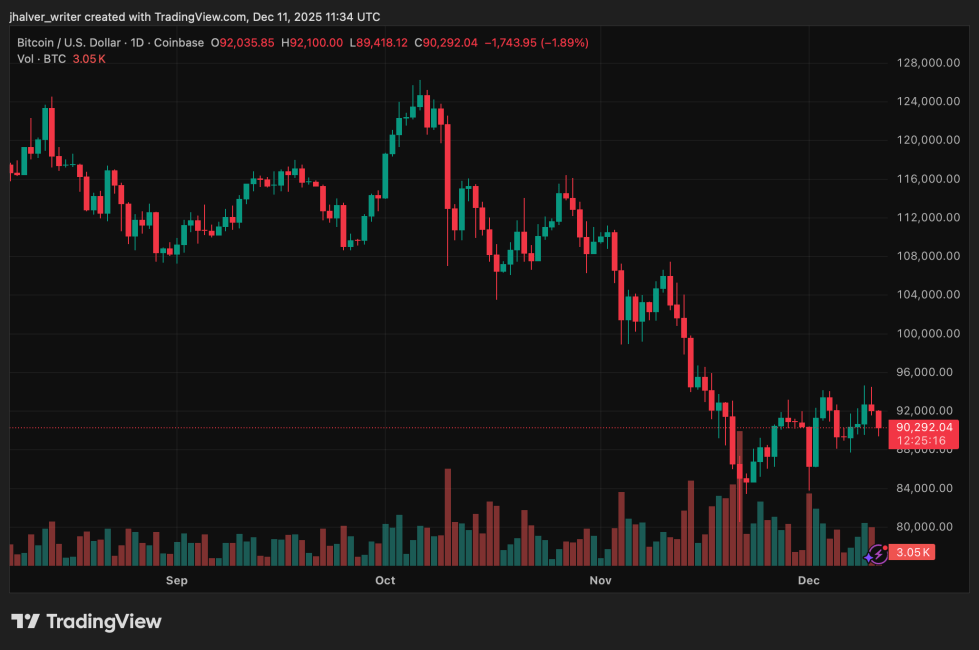
BTC's price trends downwards on the daily chart. Source: BTCUSD on Tradingview

Analysts Question Whether the Cycle Has Ended

A growing number of major firms now argue that Bitcoin may be moving beyond its historic halving-driven rhythm. Investment firm Bernstein said in a recent note that the asset is in an “elongated bull cycle,” pointing to minimal ETF outflows despite a nearly 30% correction.

The firm has raised its 2026 price target to $150,000, projecting a potential cycle peak of $200,000 in 2027 and maintaining a $1 million long-term estimate for 2033.

ARK Invest CEO Cathie Wood echoed this view, saying that institutional adoption is reducing the likelihood of the steep 75–90% drawdowns seen in previous cycles. Grayscale has also suggested Bitcoin could break the four-year pattern, forecasting renewed strength in 2026.

Bitcoin is currently trading near $90,000–$93,000 depending on the venue, with recent intraday swings highlighting a lack of strong directional conviction.

Fed Signals Keep Markets Cautious

The Federal Reserve’s 25 bps rate cut initially lifted risk sentiment, but a shift toward cautious, data-dependent language quickly reversed momentum.

Bitcoin and Ethereum slipped after the announcement, with BTC falling below $90,000 at one point as traders reassessed the macro backdrop. Liquidity remains thin, contributing to choppy movements across major crypto assets.

Analysts note that Bitcoin’s inability to sustain gains, despite the weaker dollar and softer Fed stance, reflects persistent uncertainty. Several commentators say BTC must hold above $90,000 to avoid strengthening bearish pressure, while a break above $94,500 could reopen a path toward $100,000 if inflows improve.

Derivatives and On-Chain Data Flag Rising Bearish Sentiment

Options and on-chain indicators are also signaling caution. Traders have increased bearish option positions, with the put/call ratio turning positive ahead of a significant expiry window. More than $500 million in crypto liquidations occurred within 24 hours, reflecting heightened volatility.

On-chain data shows declining bullish momentum. The Bitcoin Bull Score Index has fallen back to zero, and realized losses suggest further downside could be possible. Analysts warn that despite past buy-the-dip patterns, current readings do not yet reflect the levels typically associated with market bottoms.

Related Reading: Cardano Founder Reacts As NIGHT Token Crashes From $150 To $0.02

As Bitcoin continues to trade in a tight range, the broader debate remains unresolved. Whether the four-year cycle is fading, or simply paused, may depend on how markets digest macro uncertainty, institutional flows, and the next wave of economic data.

Cover image from ChatGPT, BTUSD chart from Tradingview

İlgili Okumalar

You Should Still Believe in Crypto

The article "You Should Still Believe in Crypto" addresses the growing sense of burnout and disillusionment within the cryptocurrency industry, sparked by a post from Aevo co-founder Ken Chan titled "I Wasted 8 Years of My Life in Crypto." It acknowledges the collective fatigue many feel due to the industry's fast-paced, often speculative nature, where narratives shift rapidly, and projects frequently fail or disappear. However, the piece argues that the core value of crypto remains vital. It references Nic Carter’s response, highlighting crypto’s potential to create a more robust monetary system, encode business logic via smart contracts, establish true digital property rights, improve capital market efficiency, and enhance global financial inclusion. The article revisits Bitcoin’s origin as a peer-to-peer electronic cash system born from the 2008 financial crisis, emphasizing its purpose as a trustless, decentralized alternative to traditional finance. It points to real-world adoption in high-inflation countries like Argentina and Turkey, where Bitcoin and stablecoins serve as essential financial tools, and notes increasing institutional embrace from firms like BlackRock and Fidelity. Finally, it draws a parallel to the early internet era, arguing that despite chaos, failed projects, and speculative excess, the crypto industry—like the internet—is laying foundational groundwork for future technological and financial evolution. The conclusion is a call to persevere, recognizing that the collective efforts of developers, researchers, and builders worldwide are contributing to a transformative global shift.

marsbit2 dk önce

You Should Still Believe in Crypto

marsbit2 dk önce

Oracle Plunges 40%, Will Excessive AI Infrastructure Overbuild Drag Down Giants?

Oracle's stock has plummeted 40% from its September peak, despite securing over $500 billion in AI infrastructure orders, signaling that massive backlogs alone no longer assure investor confidence. Similarly, Broadcom, with a $73 billion AI order backlog, and CoreWeave, which recently landed $36 billion in deals with OpenAI and Meta, have also faced stock declines. The market is growing skeptical of the AI infrastructure boom, concerned not only about suppliers' ability to fund and deliver these projects but also about the financial health and commitment of their major clients—primarily tech giants like Meta, Alphabet, Microsoft, Amazon, Apple, and Nvidia, alongside AI startups like OpenAI and Anthropic. While giants have robust finances, they are increasingly relying on debt to fuel AI capex, with soaring expenditures on data centers straining cash reserves and free cash flow. For instance, Microsoft, Alphabet, and Amazon are projected to collectively invest $1 trillion over four years. However, AI still contributes minimally to their overall revenue, raising questions about the sustainability of using profits from core businesses to fund speculative AI expansions. Execution challenges—such as power grid limitations, cooling issues, and community opposition—further complicate timely deployment. The critical uncertainty remains: if exponential AI demand fails to materialize and monetize quickly enough, these vast investments could lead to underutilized infrastructure, massive losses, and a fundamental weakening of these tech titans. The race between AI infrastructure build-out and actual market payoff will determine whether this bet becomes a triumph or a disastrous overreach.

marsbit51 dk önce

Oracle Plunges 40%, Will Excessive AI Infrastructure Overbuild Drag Down Giants?

marsbit51 dk önce

İşlemler

Spot
Futures
活动图片