Bitcoin Mining Companies Flee for the Nth Time

marsbit2026-04-03 tarihinde yayınlandı2026-04-03 tarihinde güncellendi

Özet

Since late last year, major publicly traded Bitcoin mining companies have initiated a significant wave of Bitcoin (BTC) sell-offs. Cango sold about 60% of its holdings (4,451 BTC) in February, Bitdeer liquidated its entire Bitcoin inventory in January, Riot Platforms sold 3,778 BTC in the first quarter, and Core Scientific planned to sell approximately 2,500 BTC. Notably, Marathon Digital (MARA) sold 15,133 BTC in just three weeks in March, cashing out over $1 billion, while also cutting 15% of its workforce as part of a strategic shift toward becoming an energy and digital infrastructure company. This collective divestment is driven by three primary motives. First, mining has become unprofitable for many; the average cash cost to mine one BTC is approximately $79,995, while BTC trades around $68,000–70,000, resulting in an average loss of about $19,000 per coin. Second, AI data centers offer a more stable and lucrative alternative, with tech giants like Google, Microsoft, and financial institutions like Morgan Stanley providing substantial backing and contracts. Mining companies are repurposing their existing infrastructure—cheap power contracts, data centers, and cooling systems—toward AI, which promises higher, predictable margins. Third, some firms are using BTC sales to optimize their balance sheets, such as repurchasing convertible debt at a discount to reduce liabilities and avoid equity dilution. The industry is diverging into three paths: some, like CleanSpark and ...

Author: Zhou, ChainCatcher

Since the end of last year, listed mining companies have set off a wave of collective sell-offs.

Cango sold 4,451 bitcoins in February, about 60% of its holdings; Bitdeer liquidated its entire bitcoin inventory in January; Riot Platforms sold multiple times in December and sold 3,778 BTC in the first quarter; Core Scientific also previously planned to sell about 2,500 bitcoins in the first quarter.

Recently, the leading mining company MARA disclosed in an announcement that in just three weeks from March 4 to 25, the company sold 15,133 bitcoins, cashing out over $1 billion. Simultaneously, the company announced a reduction of approximately 15% of its workforce as part of its strategic transformation into an energy and digital infrastructure company.

In fact, miners selling bitcoin is not new. In the bear markets of 2018 and 2022, mining companies also experienced large-scale liquidation and capitulation, and those that remained were the more efficient players. But this time, the trigger for the sell-off is not just the falling coin price; they also have a new destination—AI data centers.

I. The Triple Motives Behind the Sell-Off

On the surface, it appears to be a collective sell-off by mining companies, but upon closer inspection, their underlying motives are not uniform and can be roughly divided into three distinct types of selling logic.

Mining Itself Has Fallen into Loss

The first, and most direct, motive: cost pressure.

The latest mining report from CoinShares shows that the weighted average cash cost for listed mining companies to mine one BTC is currently about $79,995, while the BTC market price hovers between $68,000 and $70,000, resulting in an average loss of nearly $19,000 per coin, putting the industry in a state of approximately 21% loss overall.
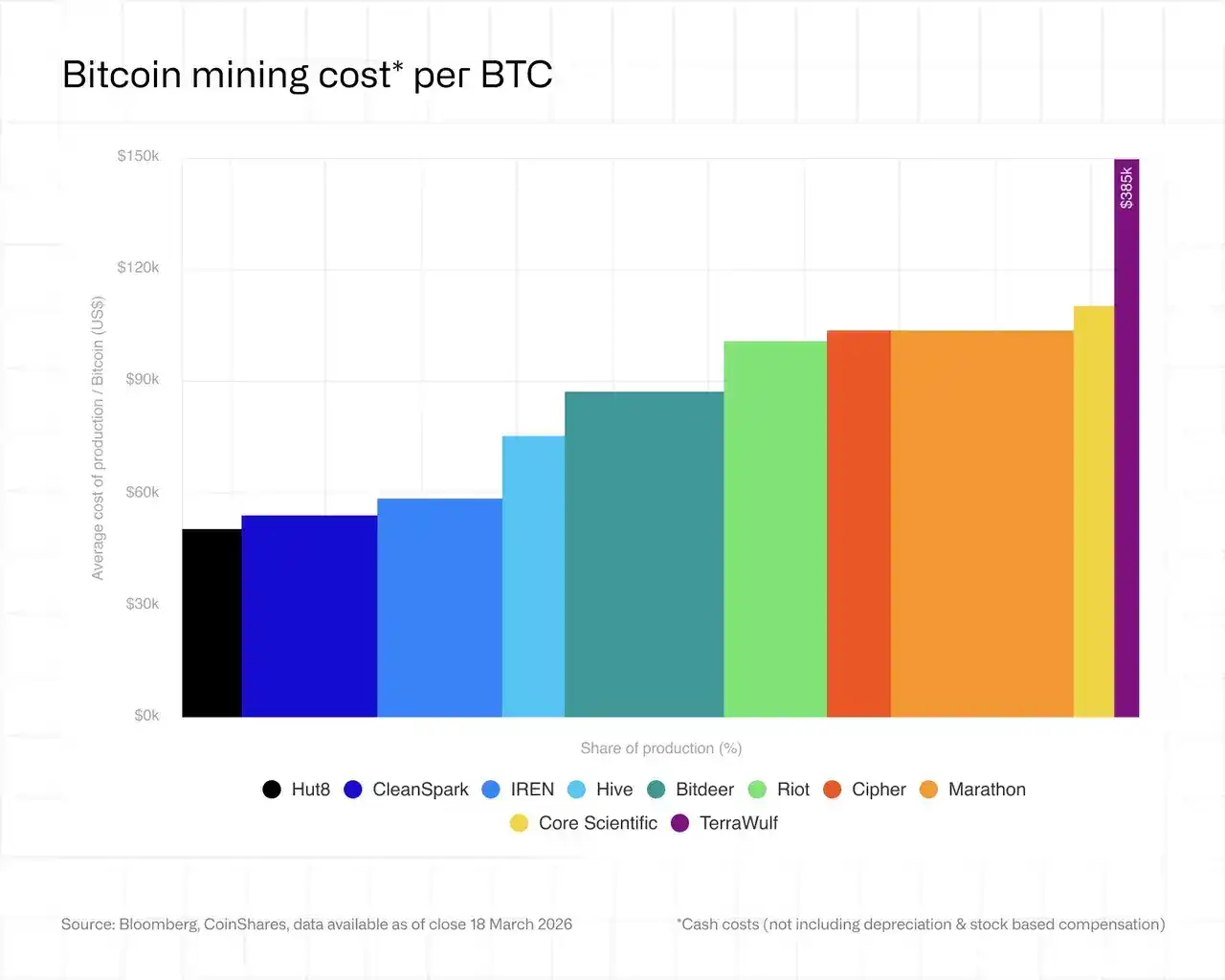
This is no longer just a matter of narrowing profit margins, but a question of whether cash flow can sustain continued mining.

The report also shows that the hash price fell to a historical post-halving low of $28 to $30/PH/day in early March. At this level, most active mining rigs need electricity prices to be压到 below $0.05/kWh to maintain cash profitability. Currently, about 15% to 20% of the network's mining rigs are on the edge of breakeven.

Meanwhile, tensions in the Middle East are pushing up energy prices, putting continuous pressure on electricity costs, an external variable that mining companies themselves have little control over.

QCP Group pointed out in a report that with the bitcoin price significantly below the average mining cost, mining companies are under obvious pressure, and liquidity priority has surpassed the HODL strategy.

Against this background, for some mining companies, selling bitcoin is a practical necessity to maintain operations.

AI Offers a More Stable Revenue Logic

The second motive is more strategic and the most值得深究 part of this sell-off.

Bloomberg analysis pointed out that unlike previous sell-offs to cover costs, the funds from this round are being reallocated to the artificial intelligence sector.

The business logic behind this is clear: mining revenue is highly dependent on coin price, hash rate difficulty, and electricity price, making it extremely volatile. In contrast, AI infrastructure is closer to long-term leases, with CoinShares' report指出其利润率可达 80% to 90%, and revenue is predictably long-term.

More crucially, mining companies already hold ready-made resources—cheap power contracts, built data centers,完善的散热系统, and mature operations teams.

Some analysts point out that the construction cost of Bitcoin mining infrastructure is about $700,000 to $1 million per megawatt, while AI infrastructure costs as much as $8 million to $15 million per megawatt. This huge cost gap is being monetized on a large scale by mining companies.

Notably, behind this transformation stands a group of unexpected drivers—tech giants and traditional financial institutions.

Previously, Google provided credit support for the lease obligations of the AI cloud platform Fluidstack, with disclosed credit support累计 exceeding $5 billion,先后为 TeraWulf, Cipher Mining, Hut 8 and other mining companies' AI transformation提供担保并换取相应股权; Microsoft signed a five-year, $9.7 billion AI cloud services contract with mining company IREN; Morgan Stanley provided a $500 million loan to Core Scientific, with a potential total credit line of $1 billion.

Their entry provides far more solid capital endorsement for this transformation than imagined.

Meanwhile, mining companies like Core Scientific, TeraWulf, Hut 8, and Cipher have successively signed large AI/HPC contracts, with cumulative amounts exceeding $70 billion. The CoinShares report mentioned that mining companies with AI/HPC contracts have valuation multiples approximately twice those of pure mining companies, and the market is rewarding those who complete the transformation first with valuation premiums.

Even the most financially sound mining companies with the lowest leverage, like HIVE, have actively scaled back mining operations and turned to expanding AI data centers. This indicates that the pressure to transform is no longer exclusive to highly indebted mining companies but is a directional choice facing the entire industry.

Actively Using BTC as a Financial Tool

The third logic is relatively精明 and the most proactive.

Some mining companies choose to sell BTC not due to operational pressure but to use it as a tool to optimize their balance sheets, like MARA. The specific operation is: use the proceeds from the sale to repurchase previously issued convertible bonds at a discount below par value, thereby compressing the scale of liabilities and reducing potential equity dilution risks.

For these mining companies, the role of BTC on the balance sheet has quietly changed from a long-term holding象征信仰 to a strategic asset that can be flexibly allocated.

Additionally, a relatively rare type of seller has emerged in this round of sell-offs: sovereign nations.

On-chain data shows that the BTC holdings of the Royal Government of Bhutan have decreased by about 66% from the peak at the end of 2024, with the single transfer size in March rising to $35 million to $45 million, and the pace of selling持续加快.

Unlike most countries that accumulate BTC through market purchases, Bhutan's holdings come from its domestic hydroelectric mining operations. This large-scale reduction may be related to the funding needs of its national development projects. This is also one of the largest government bitcoin reduction actions on record.

The叠加 of three logics—mining losses, AI transformation, debt optimization—plus selling pressure at the sovereign level—means the market is承受 structural supply pressure from multiple directions and of varying nature. The Bitcoin faith of mining companies is being reshaped by more realistic business logic.

II. After Leaving, Each Goes Its Own Way

Of course, selling off does not mean completely liquidating positions. The remaining holdings and subsequent strategies of various mining companies are showing截然不同的分化.

Three Paths, Three Choices

The first path:坚守挖矿.

Represented by CleanSpark and HIVE. They do not chase the AI transformation narrative, do not叠加 debt, and rely on a combination of low electricity prices, new-generation矿机, and low leverage to seek victory in the industry's liquidation process. Their logic is that as high-cost capacity gradually withdraws, the per-unit hash rate收益 for remaining mining companies will increase accordingly.

CleanSpark has publicly stated that继续大规模投入比特币挖矿"在经济上已不太合理" at the current hash price level, but the company still chooses to stick to its main business, betting that the cycle will eventually reverse.

Well-known crypto KOL蓝狐 pointed out that historically, almost every halving has been followed by miner capitulation, and those who remain are often the more efficient players, securing a larger share in the next rebound.

For these companies,坚守挖矿 is not stubbornness but trust in the laws of the cycle.

The second path:两条腿走路.

Represented by MARA, IREN, and Riot. They retain a considerable规模 of BTC holdings while simultaneously布局 AI/HPC, using the relatively stable income from AI business to hedge against the cyclical fluctuations of mining income.

These companies are essentially solving an asset allocation problem. The answers vary by company, but the core logic is that the two business lines support each other,分散单一风险.

The third path:全面转向 AI.

Represented by Core Scientific, TeraWulf, and Cipher. BTC holdings have exited the position of core assets, and mining is gradually becoming an附属部分 of the data center business.

CoinShares predicts that by the end of 2026, the AI revenue share of some mining companies could be as high as 70%, while the mining revenue share may drop from about 85% in early 2025 to less than 20%. These companies are nominally still mining companies, but in essence, they are becoming AI infrastructure operators that started with mining.

The potential risk of this path is that a heavy-asset transformation意味着巨额债务负担. Once AI demand cools down, both businesses will be under pressure.

也有观点指出, the credit guarantee structure provided by Google through Fluidstack actually creates highly concentrated counterparty risk—the entire cash flow chain relies on Fluidstack as an intermediary. Once the AI lease market experiences major changes, this structure could become a single point of failure.

BTC Price Determines Their Fate

No matter which path is chosen, it ultimately points to the same variable: the direction of the BTC price.

CoinShares gives three scenarios:

If BTC recovers to $100,000 by the end of 2026, the hash price will rebound to about $37/PH/day, mining profits will be repaired, and overall industry pressure will ease;

If it remains below $80,000, high-cost miners will accelerate their exit, and the traditional model of mining and HODLing等待牛市 will become increasingly difficult to sustain;

If it breaks through the historical high, the hash price could soar to $59/PH/day, and the industry will enter a new expansion cycle.

Conclusion

Overall, mining companies face two ultimate outcomes: either the coin price recovers, they return to their main business, and everything now is just a cyclical historical footnote; or the price remains low for an extended period, more and more mining companies complete their transformation into AI data centers, and the company model of mining and HODLing等待牛市 becomes increasingly rare in this industry.

However, there is another question worth asking beyond the business logic of this transformation. Mining companies are not ordinary listed companies; the continuous investment in hash rate is itself the security budget of the Bitcoin network.

Sazmining CEO Kent Halliburton once直言, these companies "hold power contracts, land, and infrastructure, yet hand these resources over to Microsoft and Google in exchange for rent checks, transforming from protecting the Bitcoin network to保管机架空间 for hyperscale cloud providers."

When mining no longer generates sufficient economic returns, the rational business decision is naturally to转移资源; but if this trend continues to spread, who will bear the long-term cost of maintaining the security of the Bitcoin network will become a problem that cannot be ignored.

History may have given an answer to this question.

The Bitcoin network has experienced several large-scale miner liquidations, and each time之后, it has operated with higher efficiency.

But this time, the miners who are leaving are not just turning off their machines.

The times have changed.

İlgili Sorular

QWhat are the three main motivations behind the recent large-scale Bitcoin sales by mining companies?

AThe three main motivations are: 1) Mining operations are unprofitable due to high costs and low Bitcoin prices, creating cash flow pressure. 2) A strategic pivot towards the more stable and lucrative AI data center business, backed by major tech firms. 3) Using Bitcoin as a financial tool to optimize balance sheets, such as repurchasing debt.

QWhich major technology companies are backing the mining companies' transition to AI infrastructure, and how?

AGoogle has provided over $5 billion in credit support for AI platform Fluidstack, taking equity in companies like TeraWulf, Cipher Mining, and Hut 8. Microsoft signed a $9.7 billion AI cloud services contract with IREN. Morgan Stanley provided a $500 million loan to Core Scientific, with a potential total of $1 billion.

QAccording to the CoinShares report, what is the current weighted average cash cost for a public miner to produce one Bitcoin, and how does it compare to the market price?

AThe weighted average cash cost for a public miner to produce one Bitcoin is approximately $79,995. With Bitcoin market price fluctuating between $68,000 and $70,000, this results in an average loss of nearly $19,000 per Bitcoin, representing an overall loss-making state of about 21%.

QWhat are the three potential future paths for mining companies as outlined in the article?

AThe three paths are: 1) Staying in mining (e.g., CleanSpark, HIVE), relying on low costs to survive the cycle. 2) A dual-track approach (e.g., MARA, IREN, Riot), maintaining Bitcoin holdings while expanding into AI to hedge risk. 3) A full pivot to AI (e.g., Core Scientific, TeraWulf, Cipher), where Bitcoin mining becomes ancillary to their new core data center business.

QWhat broader concern does the article raise about the long-term health of the Bitcoin network as miners pivot to AI?

AThe article raises the concern that if the economic incentive to mine Bitcoin continues to diminish, the security budget for the Bitcoin network—funded by mining—could be at risk. As miners reallocate their resources (power contracts, land, infrastructure) to rent-seeking AI deals with tech giants, the question of who will bear the long-term cost of securing the Bitcoin network becomes critical.

İlgili Okumalar

Why Hasn't the U.S. Seen the Rise of 'Huabei' or 'Jiebei'?

The article explores why the U.S. lacks large-scale consumer credit products like China's "Huabei" and "Jiebei," despite having a developed financial sector. Key reasons include: 1. **Structural Barriers**: A fragmented federal and state regulatory system, reinforced by post-2008 reforms like the Dodd-Frank Act, raises compliance costs and protects traditional banks, stifling fintech innovation. 2. **Credit Card Dominance**: Credit cards, used by 70-80% of adults, form a $1.28 trillion debt market with high APRs (avg. 22.3%). This system cross-subsidizes users who pay in full with those carrying balances, creating a predatory yet entrenched ecosystem. 3. **Data Privacy Laws**: Strict regulations (e.g., FCRA, CCPA) prevent tech giants from leveraging behavioral data for credit scoring, unlike in China where such data fuels fintech models. 4. **Capital Market Disincentives**: Wall Street penalizes tech firms entering finance due to lower valuations associated with heavy regulation and risk, as seen in Apple’s failure with Apple Card. 5. **Banking Oligopoly**: Major banks control consumer lending, leveraging lobbying power and consumer habits to maintain high-cost credit, while alternatives like payday loans (400% APR) or "unbanked" services remain niche or exploitative. Ultimately, regulatory, structural, and corporate interests collectively block the emergence of accessible, low-cost digital lending in the U.S.

Odaily星球日报44 dk önce

Why Hasn't the U.S. Seen the Rise of 'Huabei' or 'Jiebei'?

Odaily星球日报44 dk önce

More and More 'Model Supermarkets' Are Opening: ByteDance, Alibaba, and Tencent Compete to Integrate

Chinese tech giants like ByteDance, Alibaba, and Tencent are accelerating the rollout of integrated AI model subscription services—dubbed “model supermarkets”—to provide developers with bundled access to multiple leading domestic large language models (LLMs). ByteDance’s Volcengine recently upgraded its "Coding Plan" by adding newer models like GLM-5.1, Minimax M2.7, and Kimi k2.6, allowing subscribers to use various top models under a single monthly fee starting at ¥40. However, user feedback reveals significant issues, including rapid consumption of usage limits (e.g., hitting caps within hours), frequent server errors (like HTTP 429), and slow response times during peak hours. Complaints about misleading deduction rates—where calls to advanced models consume more quota—are also common. The trend is industry-wide: Alibaba, Tencent, and Baidu have all launched similar multi-model coding plans. While these platforms reduce trial costs for developers, they also expose challenges in balancing affordability with service quality and computational stability. Amid this shift, independent AI companies like Zhipu, MiniMax, and Moonlight Face (Kimi) are developing strategies to avoid becoming mere “pipes” in this ecosystem—focusing on vertical applications, autonomous agents, and long-context models to retain competitiveness. Analysts suggest that, while platform aggregation may pressure model firms in the short term, specialized and vertical AI capabilities will remain differentiated in the long run.

marsbit48 dk önce

More and More 'Model Supermarkets' Are Opening: ByteDance, Alibaba, and Tencent Compete to Integrate

marsbit48 dk önce

İşlemler

Spot
Futures

Popüler Makaleler

BITCOIN Nedir

HarryPotterObamaSonic10Inu (ERC-20)'yu ve Kripto Alanındaki Yerini Anlamak Son yıllarda, kripto para piyasası, hem ticaret yapanların hem de topluluk etkileşimi ve eğlence değeri arayanların ilgisini çeken meme coin'lerin popülaritesinde bir artış gördü. Bu benzersiz token'lar arasında, kripto para dokusuna kültürel referansları harmanlayan ilginç bir proje olan HarryPotterObamaSonic10Inu (ERC-20) bulunmaktadır. Bu makale, HarryPotterObamaSonic10Inu'nun temel yönlerini, mekanizmalarını, topluluk odaklı ethosunu ve daha geniş kripto manzarasıyla etkileşimini incelemektedir. HarryPotterObamaSonic10Inu (ERC-20) Nedir? Adından da anlaşılacağı gibi, HarryPotterObamaSonic10Inu, Ethereum blok zinciri üzerinde inşa edilen bir meme coin'dir ve ERC-20 standardı altında sınıflandırılmaktadır. Geleneksel kripto paraların pratik kullanılabilirlik veya yatırım potansiyeline odaklandığı durumların aksine, bu token eğlence değeri ve topluluğunun gücü üzerine kuruludur. Proje, bağlı kullanıcıların bir araya gelebileceği, fikirlerini paylaşabileceği ve çeşitli kültürel fenomenlerden ilham alan etkinliklere katılabileceği bir ortam yaratmayı hedeflemektedir. HarryPotterObamaSonic10Inu'nun dikkate değer özelliklerinden biri işlemlerde sıfır vergi olmasıdır. Bu çekici unsur, küçük ölçekli yatırımcıları caydırabilecek ek ücretlerden yoksun olarak ticareti ve topluluk katılımını teşvik etmeyi amaçlamaktadır. Coin'in toplam arzı bir milyar token olarak belirlenmiştir; bu, topluluk içinde önemli bir dolaşım sağlama niyetini göstermektedir. HarryPotterObamaSonic10Inu (ERC-20) Yaratıcısı HarryPotterObamaSonic10Inu'nun kökenleri bir miktar gizemlidir; yaratıcısı hakkında spesifik bilgilerin ne olduğu bilinmemektedir. Bu token'ın geliştirilmesi, belirli bir ekip veya açık bir plan eksikliği ile gerçekleşmiştir; bu durum, meme coin sektöründe oldukça yaygındır. Proje, topluluğunun heyecanı ve katılımına dayalı olarak organik bir şekilde ortaya çıkmıştır. HarryPotterObamaSonic10Inu (ERC-20) Yatırımcıları Dış yatırımlar ve destekler söz konusu olduğunda, HarryPotterObamaSonic10Inu da belirsiz kalmaktadır. Token, bilinen herhangi bir yatırım fonunu veya önemli bir kurumsal desteği listelememektedir. Bunun yerine, projenin can damarı, kolektif eylem ve kripto alanındaki katılım yoluyla büyüme ve sürdürülebilirlik sağlayan temel topluluğudur. HarryPotterObamaSonic10Inu (ERC-20) Nasıl Çalışır? Bir meme coin olarak, HarryPotterObamaSonic10Inu, genellikle varlık değerini yöneten geleneksel çerçevelerin dışında çalışmaktadır. Projenin nasıl çalıştığını tanımlayan birkaç özelliği vardır: Sıfır Vergi İşlemleri: İşlemlerde vergi ücreti olmadan, kullanıcılar gizli maliyet endişesi olmadan token'ı serbestçe alıp satabilirler. Topluluk Etkileşimi: Proje, topluluk etkileşimi üzerine kuruludur ve sosyal medya platformlarını kullanarak heyecan yaratarak katılımı kolaylaştırır. Tartışmalar, içerik paylaşımı ve katılım, projenin erişimini genişletmeye ve destekleyiciler arasında sadakat oluşturmaya yardımcı olan kritik unsurlardır. Pratik Kullanılabilirlik Yok: HarryPotterObamaSonic10Inu'nun mali ekosistem içinde somut bir kullanılabilirlik sunmadığı belirtilmelidir. Daha ziyade, eğlence ve topluluk etkinlikleri için bir token olarak sınıflandırılmaktadır. Kültürel Referans: Token, popüler kültürden unsurları zekice harmanlayarak ilgi çekmektedir ve hem meme meraklıları hem de kripto takipçileriyle bağlantı kurmaktadır. HarryPotterObamaSonic10Inu, meme coin'lerin, daha geleneksel kripto para projelerinden nasıl farklı çalıştığını örneklendirmektedir; bu projeler, utilitarist varlıklar yerine yenilikçi sosyal yapıların bir parçası olarak piyasaya girmektedir. HarryPotterObamaSonic10Inu (ERC-20) Zaman Çizelgesi HarryPotterObamaSonic10Inu'nun tarihi, birkaç dikkate değer kilometre taşı ile işaretlenmiştir: Oluşum: Token, birçok kripto meraklısının hayal gücünü yakalayan bir viral meme'den ortaya çıkmıştır. Spesifik yaratım tarihleri mevcut değildir ve bu onun organik yükselişini vurgulamaktadır. Borsa Listelemeleri: HarryPotterObamaSonic10Inu, topluluğun daha kolay erişim ve ticaret yapabilmesini sağlamak için çeşitli borsalarda yer bulmuştur. Topluluk Katılım İnisiyatifleri: Yarışmalar, sosyal medya kampanyaları ve hayranlar ile destekçilerden içerik üretimini içeren topluluk etkileşimini artırmayı amaçlayan devam eden etkinlikler. Gelecek Genişleme Planları: Projenin yol haritası, kültürel temalarına ilişkin bir NFT koleksiyonu, ticari ürünler ve bir e-ticaret sitesi başlatılmasını içermektedir; bu da topluluğun daha fazla katılımını sağlamayı ve ekosistemine daha fazla boyut kazandırmayı hedeflemektedir. HarryPotterObamaSonic10Inu (ERC-20) Hakkında Kilit Noktalar Topluluk Odaklı Doğası: Proje, kullanıcı katılımını geliştirme önceliği taşır ve böylece kullanıcıların sürecin en önünde yer almasını sağlar. Meme Coin Sınıflandırması: Eğlenceye dayalı kripto paranın doruk noktasıdır ve geleneksel yatırım araçlarından ayrılmaktadır. Bitcoin ile Doğrudan İlişki Yok: Ticker ismindeki benzeliğe rağmen, HarryPotterObamaSonic10Inu ayırt edicidir ve Bitcoin veya diğer yerleşik kripto paralarla herhangi bir ilişkisi yoktur. İşbirliğine Odaklanma: HarryPotterObamaSonic10Inu, sahipleri arasında işbirliği ve hikaye paylaşımı için bir alan oluşturmak üzere tasarlanmıştır ve bu da yaratıcılık ve topluluk bağlarını sağlamaktadır. Gelecek Beklentileri: Başlangıçta belirlendiği temalardan NFTs ve ticari ürünlere genişleme arzusu, projenin dijital kültürde daha ana akıma girebilmesi için bir yol haritası çizmektedir. Meme coin'ler, kripto para topluluğunun hayal gücünü çalmaya devam ederken, HarryPotterObamaSonic10Inu (ERC-20), kültürel bağları ve topluluk merkezli yaklaşımıyla öne çıkmaktadır. Geleneksel bir hizmet odaklı token modeliyle uyumlu olmasa da, özünde destekçileri arasında sağlanan neşe ve dostluğu vurgulayarak, giderek dijitalleşen bir çağda kripto paraların evrilen doğasını göstermektedir. Proje gelişmeye devam ettikçe, topluluk dinamiklerinin blockchain teknolojisi dünyasındaki seyrini nasıl etkilediğini izlemek önemli olacaktır.

1.4k Toplam GörüntülenmeYayınlanma 2024.04.01Güncellenme 2024.12.03

BITCOIN Nedir

BTC Nasıl Satın Alınır

HTX.com’a hoş geldiniz! Bitcoin (BTC) satın alma işlemlerini basit ve kullanışlı bir hâle getirdik. Adım adım açıkladığımız rehberimizi takip ederek kripto yolculuğunuza başlayın. 1. Adım: HTX Hesabınızı OluşturunHTX'te ücretsiz bir hesap açmak için e-posta adresinizi veya telefon numaranızı kullanın. Sorunsuzca kaydolun ve tüm özelliklerin kilidini açın. Hesabımı Aç2. Adım: Kripto Satın Al Bölümüne Gidin ve Ödeme Yönteminizi SeçinKredi/Banka Kartı: Visa veya Mastercard'ınızı kullanarak anında Bitcoin (BTC) satın alın.Bakiye: Sorunsuz bir şekilde işlem yapmak için HTX hesap bakiyenizdeki fonları kullanın.Üçüncü Taraflar: Kullanımı kolaylaştırmak için Google Pay ve Apple Pay gibi popüler ödeme yöntemlerini ekledik.P2P: HTX'teki diğer kullanıcılarla doğrudan işlem yapın.Borsa Dışı (OTC): Yatırımcılar için kişiye özel hizmetler ve rekabetçi döviz kurları sunuyoruz.3. Adım: Bitcoin (BTC) Varlıklarınızı SaklayınBitcoin (BTC) satın aldıktan sonra HTX hesabınızda saklayın. Alternatif olarak, blok zinciri transferi yoluyla başka bir yere gönderebilir veya diğer kripto para birimlerini takas etmek için kullanabilirsiniz.4. Adım: Bitcoin (BTC) Varlıklarınızla İşlem YapınHTX'in spot piyasasında Bitcoin (BTC) ile kolayca işlemler yapın.Hesabınıza erişin, işlem çiftinizi seçin, işlemlerinizi gerçekleştirin ve gerçek zamanlı olarak izleyin. Hem yeni başlayanlar hem de deneyimli yatırımcılar için kullanıcı dostu bir deneyim sunuyoruz.

7.3k Toplam GörüntülenmeYayınlanma 2024.12.12Güncellenme 2025.03.21

BTC Nasıl Satın Alınır

$BITCOIN Nedir

DİJİTAL ALTIN ($BITCOIN): Kapsamlı Bir Analiz DİJİTAL ALTIN ($BITCOIN) Tanıtımı DİJİTAL ALTIN ($BITCOIN), geleneksel değerli metallerin özelliklerini merkeziyetsiz teknolojilerin yeniliği ile birleştirmeyi amaçlayan Solana ağı üzerinde çalışan blockchain tabanlı bir projedir. Bitcoin ile aynı isme sahip olmasına rağmen, genellikle bir değer saklama aracı olarak algılandığı için “dijital altın” olarak anılmaktadır; DİJİTAL ALTIN, Web3 ortamında benzersiz bir ekosistem yaratmak için tasarlanmış ayrı bir tokendir. Hedefi, uygulanabilir bir alternatif dijital varlık olarak kendini konumlandırmaktır, ancak uygulamaları ve işlevleri ile ilgili ayrıntılar hala gelişmektedir. DİJİTAL ALTIN ($BITCOIN) Nedir? DİJİTAL ALTIN ($BITCOIN), Solana blockchain'inde kullanılmak üzere açıkça tasarlanmış bir kripto para tokenidir. Bitcoin'in yaygın olarak tanınan bir değer saklama rolü sağlamasının aksine, bu token daha geniş uygulamalara ve özelliklere odaklanıyor gibi görünmektedir. Dikkate değer yönler şunlardır: Blockchain Altyapısı: Token, yüksek hızlı ve düşük maliyetli işlemleri yönetme kapasitesi ile bilinen Solana blockchain'inde inşa edilmiştir. Arz Dinamikleri: DİJİTAL ALTIN'ın maksimum arzı 100 katrilyon token (100P $BITCOIN) ile sınırlıdır, ancak dolaşımdaki arzı ile ilgili ayrıntılar şu anda açıklanmamıştır. Kullanım Alanı: Kesin işlevler açıkça belirtilmemiş olsa da, token'ın merkeziyetsiz uygulamalar (dApps) veya varlık tokenizasyon stratejileri ile ilgili çeşitli uygulamalar için kullanılabileceğine dair işaretler bulunmaktadır. DİJİTAL ALTIN ($BITCOIN) Yaratıcısı Kimdir? Şu anda, DİJİTAL ALTIN ($BITCOIN) arkasındaki yaratıcıların ve geliştirme ekibinin kimliği bilinmemektedir. Bu durum, merkeziyetsiz finans ve meme coin fenomenleriyle uyumlu olan birçok yenilikçi proje arasında yaygındır. Böyle bir anonimlik, topluluk odaklı bir kültürü teşvik edebilirken, yönetişim ve hesap verebilirlik konusundaki endişeleri artırmaktadır. DİJİTAL ALTIN ($BITCOIN) Yatırımcıları Kimlerdir? Mevcut bilgiler, DİJİTAL ALTIN ($BITCOIN) için bilinen herhangi bir kurumsal destekçi veya önde gelen risk sermayesi yatırımı olmadığını göstermektedir. Proje, geleneksel finansman yolları yerine topluluk desteği ve benimsemeye odaklanan bir eşler arası modelde çalışıyor gibi görünmektedir. Faaliyetleri ve likiditesi esas olarak PumpSwap gibi merkeziyetsiz borsalarda (DEX'ler) yer almakta olup, bu da onun taban hareketine vurgu yapmaktadır. DİJİTAL ALTIN ($BITCOIN) Nasıl Çalışır DİJİTAL ALTIN ($BITCOIN) 'ın operasyonel mekanikleri, blockchain tasarımı ve ağ özellikleri temelinde açıklanabilir: Konsensüs Mekanizması: Solana'nın benzersiz tarih kanıtı (PoH) ile bir hisse kanıtı (PoS) modelini birleştirerek, proje ağın yüksek performansına katkıda bulunan verimli işlem doğrulamasını sağlar. Tokenomik: Belirli deflasyonist mekanizmalar kapsamlı bir şekilde detaylandırılmamış olsa da, geniş maksimum token arzı, henüz tanımlanmamış mikro işlemler veya niş kullanım durumlarına hitap edebileceğini ima etmektedir. Etkileşim: Solana'nın daha geniş ekosistemi ile entegrasyon potansiyeli bulunmaktadır; bu, çeşitli merkeziyetsiz finans (DeFi) platformlarını içermektedir. Ancak, belirli entegrasyonlarla ilgili ayrıntılar belirtilmemiştir. Önemli Olayların Zaman Çizelgesi DİJİTAL ALTIN ($BITCOIN) ile ilgili önemli kilometre taşlarını vurgulayan bir zaman çizelgesi: 2023: Token'ın Solana blockchain'inde ilk dağıtımı, sözleşme adresi ile işaretlenmiştir. 2024: DİJİTAL ALTIN, PumpSwap gibi merkeziyetsiz borsalarda işlem görmeye başladıkça görünürlük kazanır ve kullanıcıların bunu SOL karşısında ticaret yapmasına olanak tanır. 2025: Proje, topluluk odaklı etkileşimlere yönelik potansiyel ilgi ve ara sıra ticaret faaliyetleri görür, ancak şu ana kadar dikkate değer ortaklıklar veya teknik ilerlemeler belgelenmemiştir. Kritik Analiz Güçlü Yönler Ölçeklenebilirlik: Temel Solana altyapısı, yüksek işlem hacimlerini destekleyerek $BITCOIN'in çeşitli işlem senaryolarındaki faydasını artırabilir. Erişilebilirlik: Token başına potansiyel düşük ticaret fiyatı, perakende yatırımcıları çekebilir ve parçalı mülkiyet fırsatları sayesinde daha geniş katılımı kolaylaştırabilir. Riskler Şeffaflık Eksikliği: Kamuya açık olarak bilinen destekçilerin, geliştiricilerin veya bir denetim sürecinin olmaması, projenin sürdürülebilirliği ve güvenilirliği konusunda şüpheler doğurabilir. Piyasa Volatilitesi: Ticaret faaliyeti büyük ölçüde spekülatif davranışa dayanmakta olup, bu da yatırımcılar için önemli fiyat dalgalanmalarına ve belirsizliklere yol açabilir. Sonuç DİJİTAL ALTIN ($BITCOIN), hızla gelişen Solana ekosisteminde ilginç ama belirsiz bir proje olarak ortaya çıkmaktadır. “Dijital altın” anlatısını kullanmaya çalışırken, Bitcoin'in değer saklama rolünden ayrılması, amaçlanan faydasının ve yönetişim yapısının daha net bir şekilde tanımlanması gerekliliğini vurgulamaktadır. Gelecekteki kabul ve benimseme, mevcut belirsizliklerin giderilmesine ve operasyonel ile ekonomik stratejilerinin daha açık bir şekilde tanımlanmasına bağlı olacaktır. Not: Bu rapor, Ekim 2023 itibarıyla mevcut olan sentezlenmiş bilgileri kapsamaktadır ve araştırma döneminin ötesinde gelişmeler yaşanmış olabilir.

92 Toplam GörüntülenmeYayınlanma 2025.05.13Güncellenme 2025.05.13

$BITCOIN Nedir

Tartışmalar

HTX Topluluğuna hoş geldiniz. Burada, en son platform gelişmeleri hakkında bilgi sahibi olabilir ve profesyonel piyasa görüşlerine erişebilirsiniz. Kullanıcıların BTC (BTC) fiyatı hakkındaki görüşleri aşağıda sunulmaktadır.

活动图片