Bitcoin Mining at a Crossroads as Difficulty Hovers Near Yearly Low

cryptonews.ru2026-08-23 tarihinde yayınlandı2026-08-23 tarihinde güncellendi

Özet

Bitcoin mining is at a crossroads as the network's difficulty lingers near its lowest levels of the year. In 2026, mining difficulty has decreased ten times compared to only seven increases, resulting in a net drop of about 15.1% from its starting point. Currently at 125.81 trillion, the difficulty is just 0.7% above its annual low recorded in June, effectively erasing most gains made by miners since then. The latest adjustment saw a 1.31% drop, indicating an ongoing loss of roughly 150 exahashes per second (EH/s) of mining power from the network. While the recent Bitcoin price recovery from being 50% below its October 2025 all-time high to 38.8% below has provided a much-needed respite for miners, boosting profitability, the series of false starts suggests this is more of a pause than a trend reversal. The next difficulty adjustment will be a crucial test. If Bitcoin's price stagnates, difficulty could drop further; continued price growth could fuel a sustained recovery. For now, the sector is more likely to face further market consolidation and volatility before achieving any semblance of stable equilibrium.

Bitcoin mining is currently 1.31% easier than it was the day before, and year-to-date results show that miners have spent more time losing ground than gaining it. From the first adjustment in 2026 until the latest one at block 963,648, Bitcoin's mining difficulty has decreased ten times while increasing only seven times.
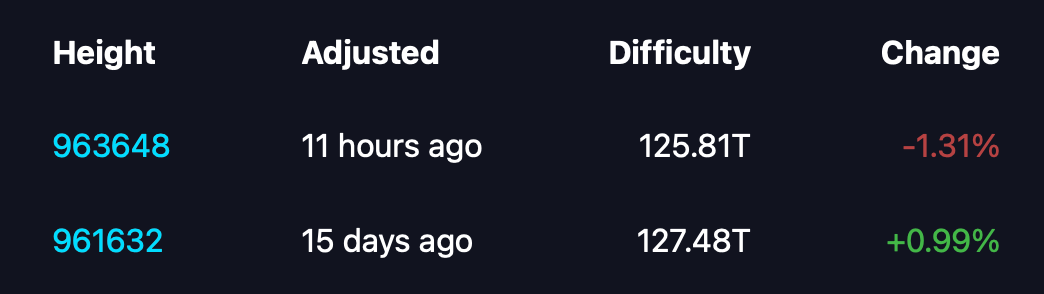
The last two Bitcoin mining difficulty adjustments recorded by mempool.space.

More importantly, the declines have repeatedly far outweighed the subsequent recoveries. Prior to the January 8th adjustment, difficulty entered 2026 at around 148.25 trillion, and it now stands at 125.81 trillion. This leaves Bitcoin's mining difficulty approximately 15.1% lower than the level just before the year's first adjustment. The current figure is where the difficulty has settled after all these sharp fluctuations.

Virtually All Difficulty Recoveries Have Been Erased

On June 13th, difficulty crashed to 124.93 trillion—the lowest point of 2026. It then rose to 133.87 trillion, fell to 127.17 trillion, dropped again to 126.23 trillion, jumped to 127.48 trillion, and has now declined again to 125.81 trillion. Thus, today's difficulty is only 0.7% above the 2026 low. In other words, virtually all significant gains miners achieved since June have been erased.

Roughly 150 EH/s of Mining Power Vanishes

The latest difficulty adjustment is particularly telling as it followed an extremely modest 0.99% increase at block 961,632. Instead of kickstarting another recovery cycle, this small gain was immediately negated by a 1.31% drop at block 963,648. The hashrate is already significantly below its all-time high, and difficulty data suggests roughly 150 exahashes per second (EH/s) of effective mining power has vanished from the network.

Nevertheless, the situation has begun to improve, but only very recently. For most of 2026, Bitcoin has been in a slow downtrend, with the price of $BTC falling more than 50% below its all-time high (ATH)—the mark above $126,000 set 11 months ago in October 2025.

Today, that gap has narrowed to 38.8%, giving the weary mining industry a chance to catch its breath. The recovery has led to an increase in mining revenue, or the "hash price," and higher profitability means more miners can afford to get back in the game. Miners are also aided by the lower difficulty rating, which is only 0.7% above the 2026 low.

Miners Face the Next Major Test

A series of false starts suggests this uptick still resembles a respite more than a trend reversal. The roughly 150 EH/s of idled hashpower could come roaring back if Bitcoin holds its ground, quickly erasing the difficulty discount miners currently enjoy. However, with $BTC still 39% below its ATH, profitability remains vulnerable.

The next adjustment will be the real test. If the price gets stuck, the floor could break again; if Bitcoin's price continues to rise, the recovery will gain fresh momentum. For now, another market cleanse and choppy consolidation are more likely before mining achieves anything resembling lasting stability.

end-content

İlgili Sorular

QAccording to the article, what has been the overall trend in Bitcoin mining difficulty adjustments in 2026?

AIn 2026, the overall trend for Bitcoin mining difficulty has been downward. There have been ten decreases in difficulty compared to only seven increases since the first adjustment of the year. The net result is that difficulty is approximately 15.1% lower now than it was before the year's first adjustment.

QWhat does the article state happened to the significant gains in mining difficulty achieved since June?

AThe article states that nearly all significant gains in mining difficulty achieved since June have been wiped out. The current difficulty is only 0.7% above the 2026 low recorded in June.

QHow much effective mining hash power has reportedly left the network according to the difficulty data?

AAccording to the difficulty data cited in the article, approximately 150 exahashes per second (EH/s) of effective mining hash power has left the network.

QWhat recent improvement in Bitcoin's price has given the mining industry some relief?

AThe gap between Bitcoin's current price and its all-time high (ATH) has narrowed. While BTC fell more than 50% below its ATH for most of 2026, that gap has now reduced to 38.8%, leading to higher mining revenue (hash price) and providing the struggling industry a chance to recover.

QWhat does the article suggest is the next major test for Bitcoin miners?

AThe article suggests the next difficulty adjustment will be the next major test. If the Bitcoin price stagnates, the lower boundary of difficulty could be broken again. If the price continues to rise, the recovery could gain momentum. Currently, the article anticipates further market cleansing and volatile consolidation before mining finds sustainable stability.

İlgili Okumalar

Fed Research: Crypto Investors Driven by Beliefs, Returns Change Their Decisions

A new working paper from the Federal Reserve Bank of Cleveland provides a novel explanation for cryptocurrency's divergence from traditional financial assets. It finds that American crypto investors are distinguished not by demographics or risk tolerance alone, but by their radically different beliefs about future returns. This divergence in expectations better explains who owns crypto than factors like age or income, a reversal of the pattern seen with stocks or bonds. The research, based on surveys of up to 25,000 US households, shows crypto owners expected an average 22% annual return, compared to just 7% for non-owners. A one-percentage-point increase in an individual's expected return was linked to a 0.8-point rise in ownership likelihood. A randomized experiment revealed that simply showing information about Bitcoin's past 12-month performance increased respondents' desired crypto portfolio share by about 47% and spurred subsequent purchases, primarily among those who previously felt uninformed. The study suggests this dynamic—where past gains attract new buyers, pushing prices higher and reinforcing bullish beliefs—could fuel speculative bubbles. It also indicates crypto wealth gains are treated more like "gambling winnings" than permanent income, boosting purchases of durable goods but not everyday spending. The broader conclusion is that crypto volatility stems partly from investor disagreement and learning, not just market fundamentals. With widespread misunderstanding and shifting expectations driven by performance data, price swings are likely to remain a defining feature of the asset class. Future retail demand may depend not just on Bitcoin's price, but on what information investors receive about its past performance.

cryptonews.ru33 dk önce

Fed Research: Crypto Investors Driven by Beliefs, Returns Change Their Decisions

cryptonews.ru33 dk önce

İşlemler

Spot
活动图片