Bitcoin miners could boost corporate adoption as crypto treasury buys slow

cointelegraph2025-12-12 tarihinde yayınlandı2025-12-12 tarihinde güncellendi

Özet

According to BitcoinTreasuries.NET, Bitcoin miners are poised to become key drivers of corporate Bitcoin adoption as purchases by crypto treasury companies slow significantly. Corporate treasuries are projected to buy only 40,000 BTC in Q4, the lowest since Q3 2024. Miners, who can generate BTC at a discount through block production, now account for 5% of new additions and 12 of public company balances. They are already among the largest corporate holders, with MARA Holdings and Riot Platforms ranking second and seventh, respectively. A November price drop below $90,000 created a stress test, leaving roughly 65% of corporate buyers with unrealized losses. This has not caused widespread distress but has led companies to a slower, more selective purchasing cadence as they reassess risk. The report concludes that miners' ability to acquire BTC cheaply makes their balance sheets increasingly vital for supporting corporate adoption.

Bitcoin miners, which can acquire the cryptocurrency at below-market costs, could be in the best position to shape corporate adoption as accumulation by crypto treasury companies slows, says BitcoinTreasuries.NET.

Bitcoin (BTC) treasury companies are projected to buy 40,000 BTC in the fourth quarter, the lowest since Q3 2024, BitcoinTreasuries.NET President Pete Rizzo said in a corporate adoption report released on Thursday.

Despite the slowdown, Rizzo said Bitcoin mining companies continue to “anchor public‐market Bitcoin holdings” and accounted for 5% of new additions and 12% of aggregate public company balances in November.

“Because miners can acquire BTC at an effective discount to spot markets via block production, their balance sheets may become increasingly important in supporting corporate adoption, especially if other treasuries pause or slow purchases,” he said.

Miners already among top Bitcoin holders

On average, miners generate about 900 Bitcoin per day, according to Bitbo and MARA Holdings has the second largest Bitcoin stash among public companies, with a stash of 53,250 Bitcoin.
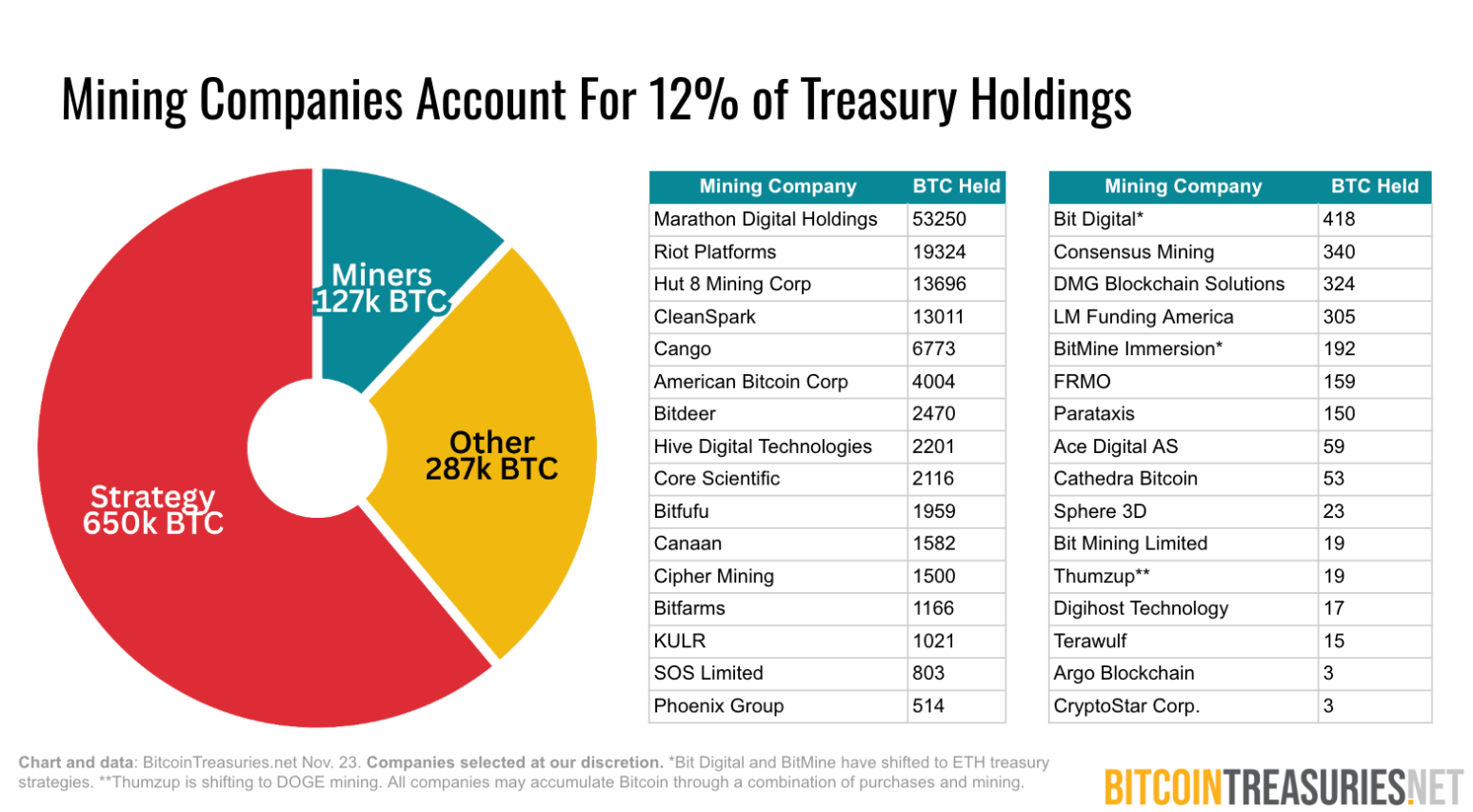
Source: BitcoinTreasuries.NET

Riot Platforms is the seventh largest public Bitcoin holder, with 19,324, while Hut 8 Mining is ninth with 13,696.

Rizzo said that the “summer buying frenzy” from crypto treasury companies has eased, but “demand has not vanished.”

“Public corporations appear to be normalizing to a slower, more selective cadence as they digest recent purchases and reassess risk,” he added.

November a stress test for treasury companies

In November, Bitcoin’s price sank below $90,000 for the first time since April, which created one of the first true stress tests for the Bitcoin capital markets era, Rizzo said.

Roughly 65% of buyers purchased Bitcoin above current market prices and now have unrealized losses.

Related: Businesses are absorbing Bitcoin 4x faster than it is mined: Report

“Bitcoin’s late‐November drawdown pushed spot prices toward $90,000, dragging many 2025 buyers into the red. For the 100 companies where cost basis could be measurable, about two‐thirds now sit on unrealized losses at current prices,” he said.

“This does not yet point to widespread distress, but it does force risk committees and boards to confront the downside of averaging into elevated prices and relying on long-term upside to validate treasury decisions.”

Magazine: Mysterious Mr Nakamoto author — Finding Satoshi would hurt Bitcoin

İlgili Okumalar

Why Can HashKey Become Hong Kong's 'First Crypto Stock'?

HashKey, a licensed Virtual Asset Trading Platform (VATP) in Hong Kong, has passed the listing hearing of the Hong Kong Stock Exchange (HKEX) and is poised to become the city’s first listed crypto-native company. Its Post-Hearing Information Pack (PHIP) reveals key aspects of its business, compliance, and governance. A major strength lies in its global multi-jurisdictional regulatory compliance, with licenses in financial hubs including Hong Kong, Singapore, Japan, Bermuda, the UAE, and Ireland. This allows it to operate across borders while adhering to local regulations. The platform emphasizes strong technical and internal controls: 96.9% of user assets are stored in cold wallets, customer funds are segregated, and multi-signature approval processes are implemented. It has also developed HashKey Chain, a compliant Ethereum Layer-2 network designed for institutional use, particularly in tokenized securities, which embeds regulatory requirements at the protocol level. HashKey Holdings is incorporated in Cayman Islands and has established a corporate governance structure aligned with HKEX standards, including a board with independent directors and a fully independent audit committee. Its potential listing is seen as a significant milestone, demonstrating that Web3 businesses can operate within regulatory frameworks. It also reflects Hong Kong’s supportive stance toward virtual asset innovation. However, ongoing compliance across multiple regions entails high and continuous operational and legal costs.

marsbit2 saat önce

Why Can HashKey Become Hong Kong's 'First Crypto Stock'?

marsbit2 saat önce

The Crisis Behind Silver's Surge: When the Paper System Begins to Fail

Silver has emerged as the star performer in the precious metals market, with its price surging nearly 110% year-to-date, far outpacing gold's 60% gain. This dramatic rise, driven by seemingly rational factors like Fed rate cut expectations and strong industrial demand from solar, EVs, and AI, masks a deeper and more dangerous reality. The core of the crisis lies in the market's structure. Unlike gold, which is backed by central bank purchases, silver is an "island asset" with almost no official reserves and a much smaller, less liquid market. Its daily trading volume is a fraction of gold's. The rally is increasingly fueled by a futures market squeeze, where paper contracts (derivatives, ETFs) vastly outweigh physical metal. This has created a dangerous inversion where futures prices trade at a persistent premium to spot—a sign of potential market manipulation or a short squeeze. A major red flag is the surge in physical silver withdrawals from key exchanges like COMEX, LBMA, and Shanghai. Investors are increasingly demanding physical delivery, distrusting the "paper silver" system. This has led to plunging exchange inventories, exposing the system's fragility: a small physical base supports a massive pyramid of paper claims. Suspicions of market manipulation are heightened by the dominant role of JPMorgan, which holds nearly half of COMEX silver inventory and is the custodian for a major silver ETF. While no wrongdoing is proven, its immense influence over both physical supply and paper markets places it at the center of the volatility. Ultimately, the silver surge signals a broader crisis of confidence in financialized paper assets. A global shift is underway from financial instruments to physical possession, a movement driven by de-dollarization and a quest for certainty. The rules of the game are changing: when the music stops, only those holding real metal will have a seat.

marsbit2 saat önce

The Crisis Behind Silver's Surge: When the Paper System Begins to Fail

marsbit2 saat önce

İşlemler

Spot
Futures
活动图片