Bitcoin Is Entering A Window For A Santa Rally, Analyst Says

bitcoinist2025-12-22 tarihinde yayınlandı2025-12-22 tarihinde güncellendi

Özet

Bitcoin is showing signs of a potential Santa rally, according to CryptoQuant analyst Axel Adler Jr. The market’s current “Regime Score” sits at +16.3, placing it in the upper neutral zone (+15 to +30), which historically has delivered average returns of +3.8% over 30 days. This suggests a tactical bullish setup without excessive optimism. Additionally, the derivatives market shows a skew toward short liquidations, creating mechanical upward pressure as forced buyers enter the market. However, Adler cautions that entering the formal Bull regime (above +30) has historically coincided with local tops. The current “bullish neutrality” offers a favorable window for upside, though a drop in the Regime Score below zero or a shift toward long liquidations would signal exhaustion. Bitcoin traded at $89,864 at the time of writing.

Bitcoin might be stumbling into a very seasonal setup, not because Santa is real, but because positioning and one of those composite “regime” dashboards are flashing the kind of “bullish, but not sweaty” signal traders love to cling to in late December.

CryptoQuant analyst Axel Adler Jr. put it bluntly on X on Monday: “BTC is entering a window for a Santa rally: the Regime Score is bullish but not overheated. Short liquidations are reinforcing the asymmetry in favor of buyers.”
That’s the headline claim. The longer version is basically: the market is in a zone that has historically had decent forward returns, and the derivatives plumbing is currently doing that annoying-but-useful thing where it mechanically pushes price higher when shorts get forced out.

Will Bitcoin See A ‘Santa Rally’ This Year?

In his Monday Substack post, Adler framed it as a tactical setup rather than some grand, end-of-year prophecy. “The BTC market is in the upper part of the Regime Score neutral zone, which has historically shown positive expected returns,” he wrote. Then he tightened the screw: “The current liquidation structure in the futures market indicates a predominance of short position closures, creating additional mechanical pressure in favor of buyers.”

So what’s this Regime Score thing, exactly? Adler describes it as a composite indicator that “combines taker imbalance, OI pressure, funding, ETF flows, exchange flows, and price trend into a single scale from −100 to +100.” The number matters less than the band it sits in. Right now, he says the score “stands at +16.3, corresponding to the upper part of the neutral zone (+15 to +30).”
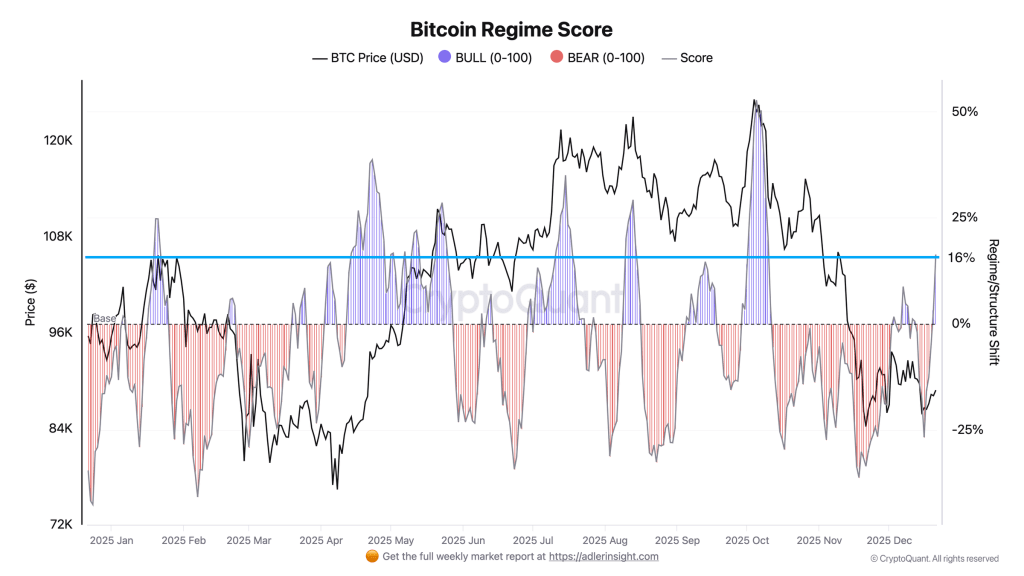
Bitcoin Regime Score | Source: Axel Adler Jr

And that particular subzone is doing the heavy lifting in his argument. “Backtesting for 2025 shows this subzone historically delivered average returns of +3.8% over 30 days,” Adler wrote, contrasting it with the weaker ranges below. He also pointed out that, “unlike the −15 to 0 subzone where expected returns were negative (−1.5% over 7d),” the +15 to +30 band tended to be a more forgiving place to put on risk.

It’s also worth noting how quickly the tape can flip, because his own charting suggests it already did. Adler says the indicator “has emerged from a recent bearish phase (score dropped to −27 a week ago) and is showing recovery.” That’s the kind of detail traders latch onto: not just where you are, but how fast you got there.

But here’s the funny part — the “most bullish” zone, in his backtest, wasn’t actually bullish for forward returns. He flags that “transition into the formal Bull regime (+30 and above) historically coincided with local tops” and that it “delivered negative average returns of −3.3% over 7 days.” In other words, if you wait for the indicator to scream “bull market,” you might be buying the exact moment everyone else is already leaning the same way.

Which is why Adler ends up with a pretty trader-ish conclusion: the current band might be the sweet spot because it’s optimistic without being euphoric.

“This means the current +15–30 zone may be optimal for tactical positions, while aggressive accumulation upon breaking +30 carries elevated risk,” he wrote.

Then there’s the derivatives side — the part that can turn a calm-looking market into a sudden wick up (or down) just because leverage is sitting in the wrong place. Adler’s liquidation dominance oscillator is currently negative, which he reads as a short liquidation skew. “The oscillator’s current value has dropped into negative territory (−11%), while the 30-day moving average remains positive (+10%). This divergence points to a recent surge in forced short position closures,” he wrote.

He doubles down with a second stat: “Long Liquidation Dominance stands at 44%, below the 50% baseline, confirming the predominance of short liquidations.” Put simply: more shorts are getting forced out than longs are getting wiped, and those forced closes are buys.
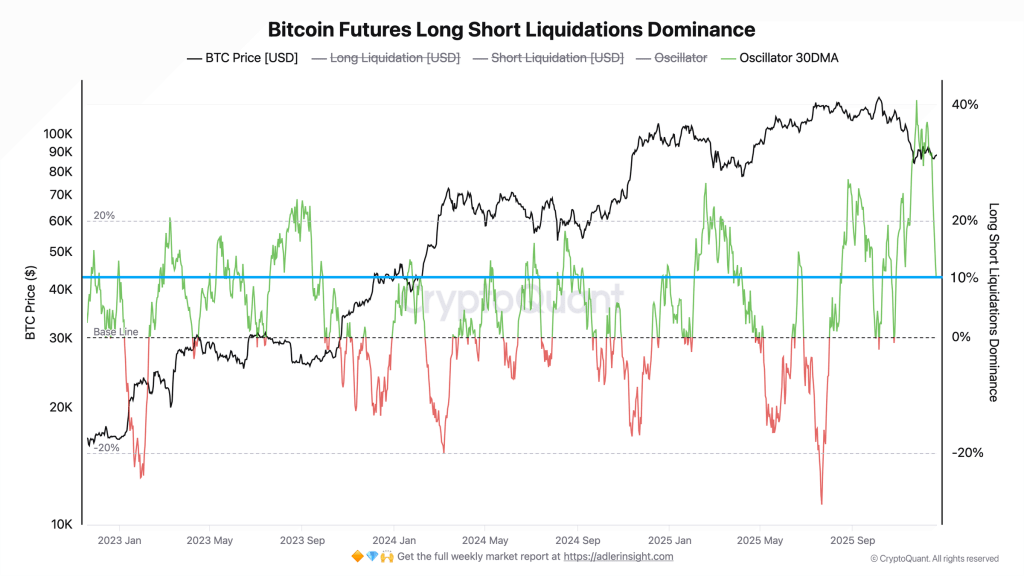
Bitcoin Futures Long Short- Liquidations Dominance | Source: Axel Adler Jr

And his takeaway is basically: this is tactical fuel. “The predominance of short liquidations creates tactical fuel for upside,” Adler wrote, adding that the setup “reinforces the positive signal from Regime Score: the market has not only entered a zone with historically positive expected returns but is also receiving additional support from derivatives structure.”

Still, this is Bitcoin, and these setups don’t last forever. Adler even lays out what would invalidate it, in pretty plain language. “A return of Regime Score below zero accompanied by a reversal of the liquidation oscillator into positive territory (rising long liquidations) would signal exhaustion of the current impulse,” he wrote. Translation: if longs start being the ones getting punished, that “asymmetry” flips.

For now, he’s calling it a “bullish neutrality” moment. Not full-blown melt-up territory, not the kind of reading that screams “local top” either. Just a window where, if the market wants to drift higher into year-end, the positioning doesn’t look like it’s going to fight it.

At press time, Bitcoin traded at $89,864.
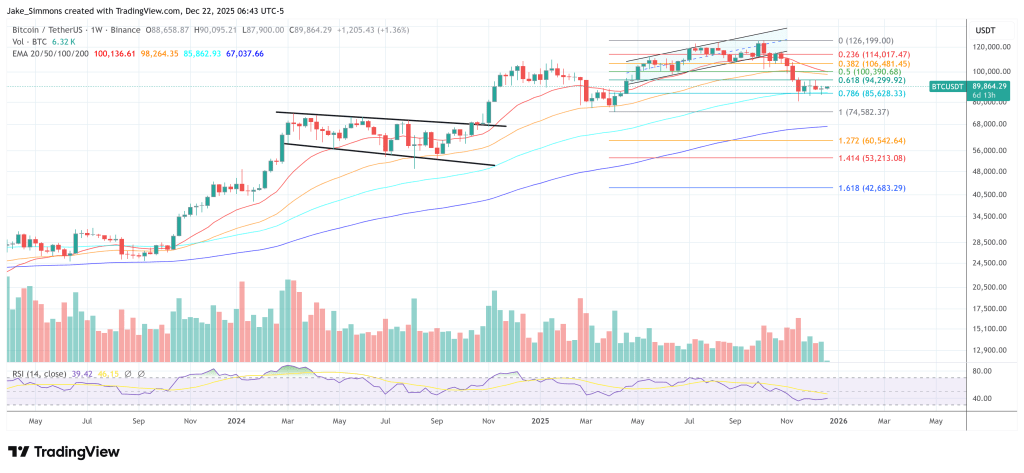
Bitcoin remains stuck between the 0.618 and 0.786 Fib, 1-week chart | Source: BTCUSDT on TradingView.com

İlgili Sorular

QWhat is the current Bitcoin Regime Score and what does it indicate according to Axel Adler Jr.?

AThe current Bitcoin Regime Score is +16.3, which is in the upper part of the neutral zone (+15 to +30). This zone has historically shown positive expected returns of +3.8% over 30 days, indicating a 'bullish, but not overheated' market condition that is optimal for tactical positions.

QHow does the liquidation structure in the futures market currently support a potential price increase?

AThe liquidation dominance oscillator is in negative territory (-11%), indicating a predominance of short position closures. With Long Liquidation Dominance at 44% (below the 50% baseline), this confirms that more shorts are being forced out than longs. These forced short liquidations create mechanical buying pressure, reinforcing the upside for buyers.

QAccording to the analyst, what would invalidate the current bullish tactical setup?

AThe setup would be invalidated by a return of the Regime Score below zero, accompanied by a reversal of the liquidation oscillator into positive territory. This would signal a shift where long liquidations are rising, indicating exhaustion of the current bullish impulse and a flip in market asymmetry.

QWhy does the analyst consider the current 'Bull' regime (score above +30) to be less ideal for entering positions?

AHistorical backtesting shows that a transition into the formal Bull regime (score of +30 and above) has often coincided with local tops and delivered negative average returns of -3.3% over 7 days. This suggests that entering at that point might mean buying when the market is already euphoric and due for a pullback.

QWhat is the overall market condition described by the analyst, and at what price was Bitcoin trading at press time?

AThe overall market condition is described as 'bullish neutrality' or a 'bullish, but not sweaty' signal. It is a tactical setup where the market is optimistic without being euphoric, providing a window for a year-end rally. At press time, Bitcoin was trading at $89,864.

İlgili Okumalar

If the AI Bubble Is Already Bursting, Who Will Truly Survive?

If the AI Bubble is Bursting, Who Will Remain? The debate over an AI bubble is intensifying, with figures like Ray Dalio warning of high levels and Jensen Huang seeing immense, early-stage opportunity. Both views hold truth: a speculative bubble in capital markets likely exists, mirroring the dot-com era, but the underlying technological shift is real and transformative. History shows that while bubbles burst—wiping out overvalued companies and speculative capital—they often leave behind critical physical and digital infrastructure. The dot-com bust, for instance, eliminated many firms but left the global fiber optic networks and data centers that enabled the rise of Amazon, Netflix, and cloud computing. Today's massive AI infrastructure investments (projected at trillions by 2030) in data centers, power, cooling, and GPUs may follow a similar path, creating the foundation for future applications. A key divergence from past bubbles is the "Jevons Paradox" effect in AI. As the cost of AI inference has plummeted by over 99.7% since 2023, enterprise spending on AI has skyrocketed. Cheap "tokens" have unlocked vast, previously uneconomical use cases, moving AI from simple chatbots into core business workflows—code generation, legal document review, scientific simulation, and financial analysis. The market is now in a phase of self-correction, weeding out superficial "API-wrapper" startups, but this cleansing process strengthens the ecosystem. The long-term trajectory is clear. The value is gradually shifting from capital expenditure (CapEx) on hardware to operational expenditure (OpEx) on transformative applications. As AI becomes a utility, the winners will be firms that deeply integrate it to solve vertical industry problems in law, healthcare, finance, and manufacturing. The泡沫 will recede, but the foundational shift towards an AI-powered era across all sectors is irreversible. The underlying productive force of AI contains no bubble.

marsbit22 dk önce

If the AI Bubble Is Already Bursting, Who Will Truly Survive?

marsbit22 dk önce

If the AI Bubble Is Already Bursting, Who Will Truly Remain?

**Summary: If the AI Bubble is Bursting, What Will Remain?** The debate around an AI bubble is intensifying, with figures like Ray Dalio warning of high valuations while Jensen Huang sees immense opportunity. This echoes the dot-com bubble, which saw massive wealth destruction but ultimately left behind critical infrastructure like undersea cables and broadband, enabling future giants like Amazon and Netflix. Similarly, today's AI boom involves trillions invested in data centers, power, cooling, and GPUs, while application-layer revenue remains comparatively modest. This investment-disparity signals a bubble. However, the core technological progress is real and accelerating. AI inference costs have plummeted by over 99.7% since 2023, making intelligence increasingly cheap and accessible. This cost collapse is unlocking vast new demand. Instead of reducing spending, enterprises are tripling their AI cloud expenditure. Cheap "tokens" enable AI to move beyond simple chatbots into complex workflows—automating code writing, legal document review, financial analysis, and scientific research. This follows "Jevons's paradox": improved efficiency leads to greater total consumption. The market is now undergoing a necessary purification, weeding out "API-wrapper" startups with no real moat. The deeper evolution involves a shift from capital expenditure (CapEx) on infrastructure to operational expenditure (OpEx) on value-creation in applications. While hardware vendors currently profit most, long-term value will migrate to AI-native firms solving vertical industry problems. Ultimately, a market correction will cleanse speculative excess but will not reverse the AI+ trend. The massive physical and algorithmic infrastructure being built will endure, becoming a cheap, utility-like foundation. Just as the internet became indispensable to all industries post-2000, AI is poised to empower and redefine every sector, moving society irreversibly toward an intelligence-augmented era. The bubble may burst, but the underlying productive momentum is solid.

链捕手29 dk önce

If the AI Bubble Is Already Bursting, Who Will Truly Remain?

链捕手29 dk önce

Microsoft CEO: In the AI Era, How Do You Define a Company's Moat?

Microsoft CEO Satya Nadella argues that in the AI era, a company's true competitive edge, or "moat," is not determined by choosing the single most powerful model, but by its ability to build a continuous "learning loop." This system integrates and evolves by connecting human workflows, domain expertise, organizational judgment, and employee experience. He posits that future companies will accumulate two types of capital: Human Capital (employee knowledge, judgment, creativity) and "Token Capital" (a firm's own built and owned AI capabilities). Importantly, AI amplifies rather than devalues human capital. Human direction is essential to guide progress, as computational power alone is aimless. The core opportunity lies in creating a closed-loop system where human and token capital reinforce each other in a compound, self-improving cycle. A company must be able to preserve its unique institutional knowledge—its "company veteran" expertise—even if it switches underlying general-purpose AI models. This requires private evaluation benchmarks, reinforcement learning environments based on internal data, and queryable knowledge bases. Nadella warns against a future where economic value is concentrated by a few dominant models that commoditize entire industries' knowledge. Instead, the priority should be building a broad "frontier ecosystem" where every company, industry, and nation can own its learning loop. This allows organizations to retain control of their intellectual property, amplify employee capabilities, and ensure the economic value created by AI is captured within their own businesses and communities. True corporate sovereignty in the AI age comes from turning organizational knowledge into a compounding system that creates enduring, defensible value.

marsbit1 saat önce

Microsoft CEO: In the AI Era, How Do You Define a Company's Moat?

marsbit1 saat önce

ETFs Are Just the Ticket: The True Institutionalization of Bitcoin Is Happening Where You Can't See It

Beyond the Bitcoin ETF spotlight, a deeper institutionalization is underway, leveraging Bitcoin as a foundational financial primitive. Institutions are using Bitcoin for purposes long reserved for assets like U.S. Treasuries and gold: as collateral for loans, insurance reserves, and the backbone of rated bonds. Examples include a Barbados-based insurer capitalizing with $40M in Bitcoin reserves and Ledn's $188M securitization of Bitcoin-backed loans, which received the first-ever investment-grade rating (BBB-) from S&P for a digital asset-backed security. This structure was stress-tested during a 27% price drop in early 2026, triggering automatic liquidations that functioned as designed but revealed the systemic risk of synchronized selling across leveraged positions. Infrastructure is evolving to support this, with platforms like Anchorage Digital's Atlas network enabling secure, institutional-grade settlement and collateral management. Strategies like basis trades and corporate treasuries (exemplified by companies like MicroStrategy issuing billions in equity and debt to fund Bitcoin acquisitions) further integrate Bitcoin into financial mechanics. While ETFs solved "how to own" Bitcoin, these developments answer "what to do with it," embedding the asset into the working machinery of finance—as collateral upon which loans, derivatives, and structured products are built. The real, enduring institutional shift is happening in these largely invisible plumbing and financing systems.

marsbit1 saat önce

ETFs Are Just the Ticket: The True Institutionalization of Bitcoin Is Happening Where You Can't See It

marsbit1 saat önce

ZEC Co-Founder Responds to Orchard Vulnerability: No Signs of Theft, Orchard Pool to Be Sealed

ZEC Co-Founder Addresses Orchard Vulnerability: No Signs of Theft, Plans to Sunset Orchard Pool A security vulnerability was recently discovered in Zcash's Orchard shielded pool, raising key concerns. The primary questions are whether the flaw was exploited, if user funds are safe, whether users can verify the total ZEC supply, and if other similar vulnerabilities exist. Analysis suggests the vulnerability was likely not exploited prior to its discovery. It was found proactively by a researcher using specialized tools, not due to an active breach. The development team and mining pools acted quickly to contain the issue. Typical financially-motivated attacks would likely have left visible on-chain evidence, which has not been observed. User funds in Orchard are considered safe and should be recoverable, assuming no prior exploitation. If the flaw was never used, all legitimate funds can be withdrawn. The article outlines risks associated with moving funds to transparent addresses or other pools, but concludes that leaving assets in place is a reasonable option. Currently, users cannot independently verify that the total ZEC supply hasn't been inflated due to this bug. However, the planned Ironwood network upgrade is designed to resolve this. It will permanently close the Orchard pool to new deposits and internal transfers, allowing only withdrawals. This mechanism will cap total withdrawals at the amount of legitimately deposited funds, enabling anyone to cryptographically verify the supply post-upgrade. Multiple teams, including Shielded Labs, have conducted extensive audits focused on counterfeiting vulnerabilities, assisted by advanced AI tools. No additional flaws of this type have been found so far, increasing confidence that no other similar undisclosed vulnerabilities exist. In summary, evidence indicates the Orchard bug was probably not used, user funds are secure, and no other counterfeiting flaws are currently known. The upcoming Ironwood upgrade will restore users' ability to independently verify the total ZEC supply, closing this chapter.

Foresight News1 saat önce

ZEC Co-Founder Responds to Orchard Vulnerability: No Signs of Theft, Orchard Pool to Be Sealed

Foresight News1 saat önce

İşlemler

Spot
Futures

Popüler Makaleler

BILL Nasıl Satın Alınır

HTX.com’a hoş geldiniz! Billions Network (BILL) satın alma işlemlerini basit ve kullanışlı bir hâle getirdik. Adım adım açıkladığımız rehberimizi takip ederek kripto yolculuğunuza başlayın. 1. Adım: HTX Hesabınızı OluşturunHTX'te ücretsiz bir hesap açmak için e-posta adresinizi veya telefon numaranızı kullanın. Sorunsuzca kaydolun ve tüm özelliklerin kilidini açın. Hesabımı Aç2. Adım: Kripto Satın Al Bölümüne Gidin ve Ödeme Yönteminizi SeçinKredi/Banka Kartı: Visa veya Mastercard'ınızı kullanarak anında Billions Network (BILL) satın alın.Bakiye: Sorunsuz bir şekilde işlem yapmak için HTX hesap bakiyenizdeki fonları kullanın.Üçüncü Taraflar: Kullanımı kolaylaştırmak için Google Pay ve Apple Pay gibi popüler ödeme yöntemlerini ekledik.P2P: HTX'teki diğer kullanıcılarla doğrudan işlem yapın.Borsa Dışı (OTC): Yatırımcılar için kişiye özel hizmetler ve rekabetçi döviz kurları sunuyoruz.3. Adım: Billions Network (BILL) Varlıklarınızı SaklayınBillions Network (BILL) satın aldıktan sonra HTX hesabınızda saklayın. Alternatif olarak, blok zinciri transferi yoluyla başka bir yere gönderebilir veya diğer kripto para birimlerini takas etmek için kullanabilirsiniz.4. Adım: Billions Network (BILL) Varlıklarınızla İşlem YapınHTX'in spot piyasasında Billions Network (BILL) ile kolayca işlemler yapın.Hesabınıza erişin, işlem çiftinizi seçin, işlemlerinizi gerçekleştirin ve gerçek zamanlı olarak izleyin. Hem yeni başlayanlar hem de deneyimli yatırımcılar için kullanıcı dostu bir deneyim sunuyoruz.

292 Toplam GörüntülenmeYayınlanma 2026.05.07Güncellenme 2026.06.02

BILL Nasıl Satın Alınır

ATWO Nedir

I. Proje TanıtımıArena Two, hayranların gerçek zamanlı etkinlik sonuçlarında aktif, tokenleştirilmiş bir rol oynamasına olanak tanıyan merkeziyetsiz bir etkileşimli platformdur. Hayranları pasif izleyicilere indirgeyen geleneksel yayıncılık modellerinin aksine, Arena Two, hayranların doğrudan gerçek zamanlı oy kullanmalarını ve sahadaki sonuçları etkilemelerini sağlamak için blok zinciri teknolojisini kullanır.II. Token BilgileriToken adı: ATWO(Arena Two)III. İlgili BağlantılarWeb sitesi:https://arenatwo.com/Keşif araçları:https://basescan.org/token/0x499D35eBE6cEe9B2Ac35Fd003fcBbeeB9CFc7B32Twitter:https://x.com/arenatwoXNot: Proje tanıtımı, resmi proje ekibi tarafından yayınlanan veya sağlanan materyallerden gelmektedir ve yalnızca referans amaçlıdır, yatırım tavsiyesi niteliği taşımaz. HTX, ortaya çıkan doğrudan veya dolaylı kayıplardan sorumluluk kabul etmez.

271 Toplam GörüntülenmeYayınlanma 2026.05.18Güncellenme 2026.06.02

ATWO Nedir

ATWO Nasıl Satın Alınır

HTX.com’a hoş geldiniz! Arena Two (ATWO) satın alma işlemlerini basit ve kullanışlı bir hâle getirdik. Adım adım açıkladığımız rehberimizi takip ederek kripto yolculuğunuza başlayın. 1. Adım: HTX Hesabınızı OluşturunHTX'te ücretsiz bir hesap açmak için e-posta adresinizi veya telefon numaranızı kullanın. Sorunsuzca kaydolun ve tüm özelliklerin kilidini açın. Hesabımı Aç2. Adım: Kripto Satın Al Bölümüne Gidin ve Ödeme Yönteminizi SeçinKredi/Banka Kartı: Visa veya Mastercard'ınızı kullanarak anında Arena Two (ATWO) satın alın.Bakiye: Sorunsuz bir şekilde işlem yapmak için HTX hesap bakiyenizdeki fonları kullanın.Üçüncü Taraflar: Kullanımı kolaylaştırmak için Google Pay ve Apple Pay gibi popüler ödeme yöntemlerini ekledik.P2P: HTX'teki diğer kullanıcılarla doğrudan işlem yapın.Borsa Dışı (OTC): Yatırımcılar için kişiye özel hizmetler ve rekabetçi döviz kurları sunuyoruz.3. Adım: Arena Two (ATWO) Varlıklarınızı SaklayınArena Two (ATWO) satın aldıktan sonra HTX hesabınızda saklayın. Alternatif olarak, blok zinciri transferi yoluyla başka bir yere gönderebilir veya diğer kripto para birimlerini takas etmek için kullanabilirsiniz.4. Adım: Arena Two (ATWO) Varlıklarınızla İşlem YapınHTX'in spot piyasasında Arena Two (ATWO) ile kolayca işlemler yapın.Hesabınıza erişin, işlem çiftinizi seçin, işlemlerinizi gerçekleştirin ve gerçek zamanlı olarak izleyin. Hem yeni başlayanlar hem de deneyimli yatırımcılar için kullanıcı dostu bir deneyim sunuyoruz.

189 Toplam GörüntülenmeYayınlanma 2026.05.18Güncellenme 2026.06.02

ATWO Nasıl Satın Alınır

Tartışmalar

HTX Topluluğuna hoş geldiniz. Burada, en son platform gelişmeleri hakkında bilgi sahibi olabilir ve profesyonel piyasa görüşlerine erişebilirsiniz. Kullanıcıların A (A) fiyatı hakkındaki görüşleri aşağıda sunulmaktadır.

活动图片