Bitcoin has spent several weeks struggling around a pivotal price range, frustrating traders and reinforcing bearish narratives across the market. After failing to reclaim key resistance levels, a growing number of analysts are calling for a broader bear market to unfold. Price action has been choppy, momentum has faded, and volatility has compressed—conditions that often amplify pessimism. Yet beneath the surface, some analysts argue that Bitcoin is no longer behaving as it did in previous cycles.
According to this view, the market structure itself is changing. Long-term holders appear less reactive, sell-side pressure has moderated, and on-chain activity suggests a slower, more deliberate market. Rather than a reflexive risk asset, Bitcoin is increasingly traded and held with a longer time horizon. This shift becomes especially relevant as the policy backdrop evolves in the United States.
The US Senate Banking Committee is scheduled to mark up the crypto market structure bill known as the CLARITY Act on January 15, 2026. This event should not be interpreted as a short-term price catalyst. Instead, it represents a potential inflection point in how Bitcoin is positioned within the US regulatory framework.
While prices remain relatively stable, on-chain data already hints at a market adapting to a more institutional, regulated environment. The implication is clear: Bitcoin may be entering a structurally different phase, even as sentiment remains divided.
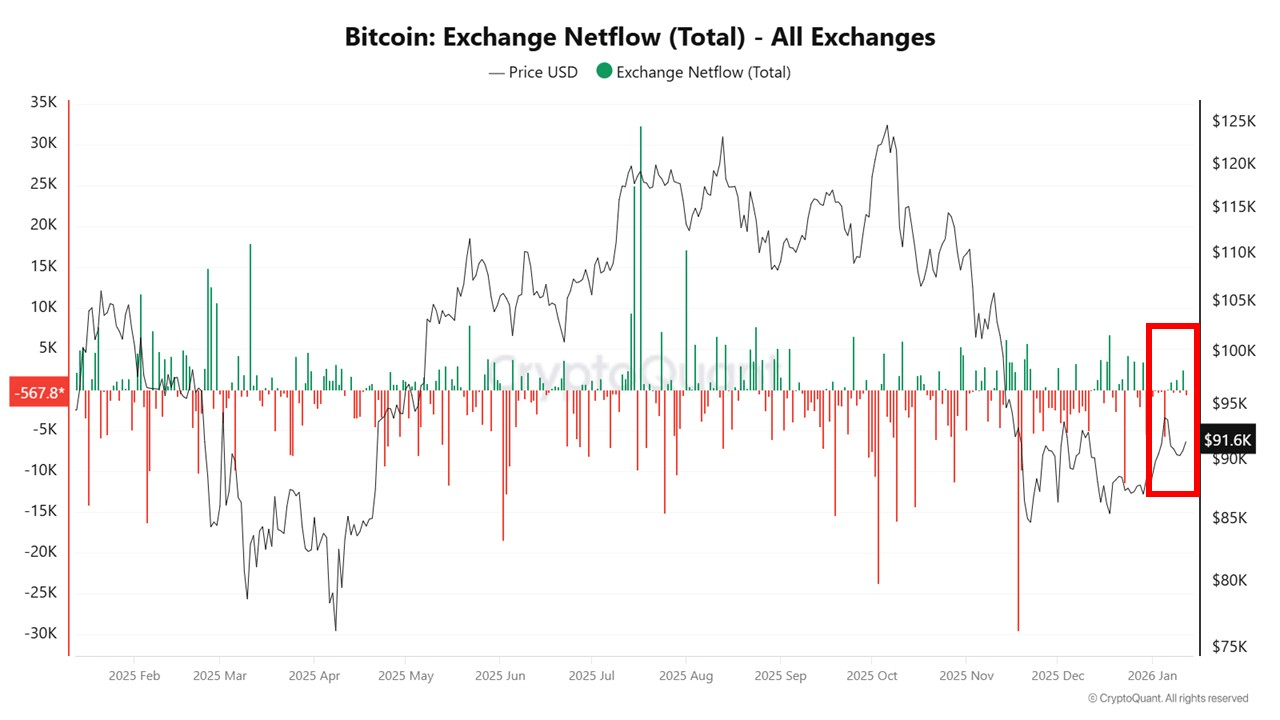
A report by CryptoQuant, authored by XWIN Research Japan, highlights that Exchange Netflow remains a critical signal in the current environment. Historically, periods of regulatory uncertainty tend to push Bitcoin into exchanges as investors prepare to sell or reduce exposure.
Ahead of the upcoming CLARITY bill discussions, however, this behavior has not materialized. Exchange inflows have stayed relatively muted, suggesting that market participants are not positioning defensively or treating the legislative process as an immediate threat.
SOPR (Spent Output Profit Ratio) reinforces this interpretation. The metric, which measures whether moved coins are sold at a profit or a loss, is hovering around or slightly below the 1.0 threshold. This indicates subdued profit-taking activity. More importantly, it implies that on-chain spending itself remains low. In simple terms, Bitcoin is not being moved aggressively, either to realize gains or to exit positions.
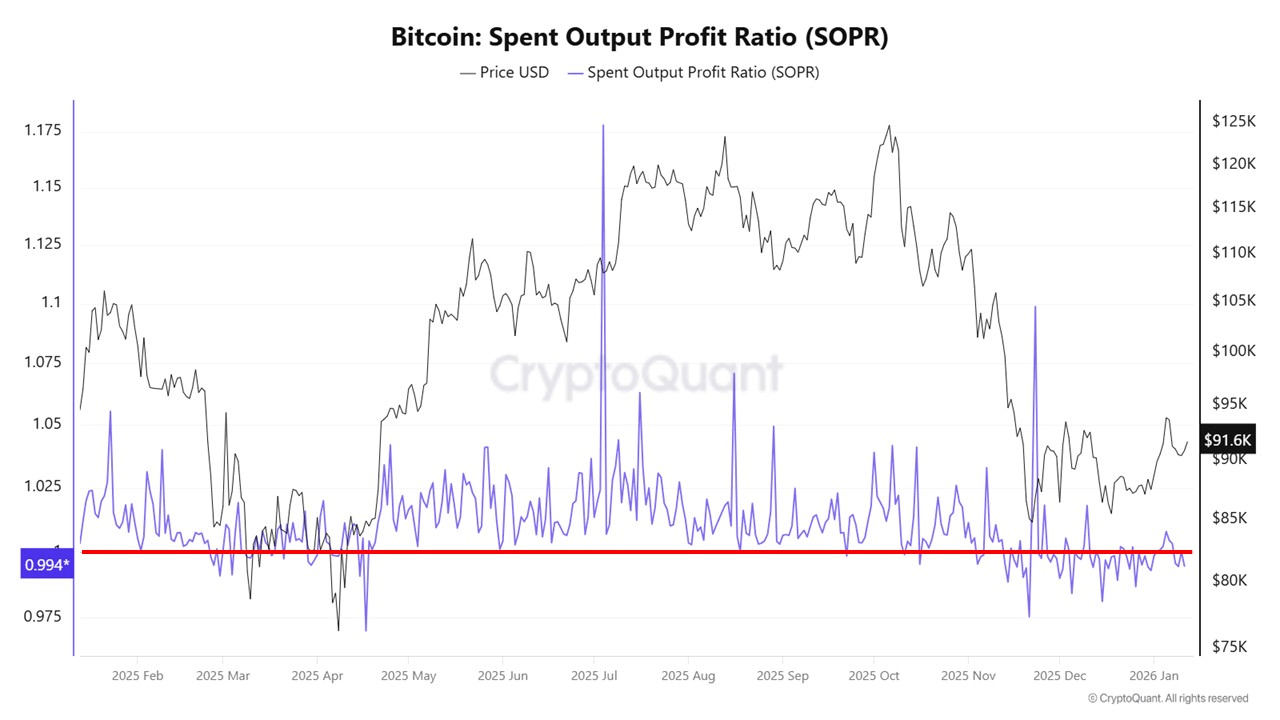
Together, Exchange Netflow and SOPR point to a market posture that is patient rather than defensive. Investors appear willing to hold through uncertainty instead of rotating capital or rushing to de-risk. The time horizon is clearly lengthening.
From this perspective, the CLARITY Act represents more than a policy debate. It marks a potential step toward integrating Bitcoin into the U.S. financial framework as a regulated digital commodity. On-chain data already reflects this shift: before any major price move, Bitcoin is becoming increasingly “sticky,” signaling a transition away from speculative trading and toward institutional-grade holding behavior.