Bitcoin Erases May Gains in 2 Days, Ending 6-Week ETF Inflow Streak: A Washout or Turning Signal?

marsbit2026-05-19 tarihinde yayınlandı2026-05-19 tarihinde güncellendi

Özet

Bitcoin plummeted below $77,000, erasing all gains made since the beginning of May within 48 hours. The sell-off was triggered by a combination of factors: soaring U.S. PPI data, which reduced rate cut expectations, and a shift in institutional flows. U.S. spot Bitcoin ETFs saw over $1 billion in net outflows for the week, ending a six-week inflow streak, contributing to a market-wide liquidation of $657 million, predominantly from long positions. Amidst the panic, notable institutional moves signaled a strategic consolidation. Michael Saylor's Strategy (formerly MicroStrategy) doubled down, purchasing nearly 25,000 BTC for approximately $2 billion. Meanwhile, Goldman Sachs's Q1 13F filing revealed a clear pivot towards Bitcoin, completely exiting its XRP and Solana ETF holdings, drastically reducing its Ethereum exposure by ~70%, and maintaining its ~$700 million Bitcoin ETF position. The actions highlight a growing institutional dichotomy: either avoiding crypto entirely or concentrating exposure solely on Bitcoin.

Author: Claude, Deep Chao TechFlow

Deep Chao Insight: Bitcoin fell below $77,000 on Monday, retreating to its opening level from May 1st, wiping out half a month's gains within 48 hours. The triggers overlapped densely: U.S. April PPI surged 6% year-over-year, hitting a three-year high; Bitcoin spot ETFs recorded a weekly net outflow exceeding $1 billion, ending six consecutive weeks of inflows; the crypto market saw $657 million in liquidations within 24 hours. While retail investors fled in panic, Strategy Group bucked the trend, spending $2 billion to add nearly 25,000 BTC. Meanwhile, Goldman Sachs liquidated all its XRP and Solana ETF holdings in Q1, slashed its Ethereum exposure by 70%, and retained only $700 million in Bitcoin ETFs. Institutional choices are becoming increasingly clear: either avoid crypto entirely, or only touch Bitcoin.

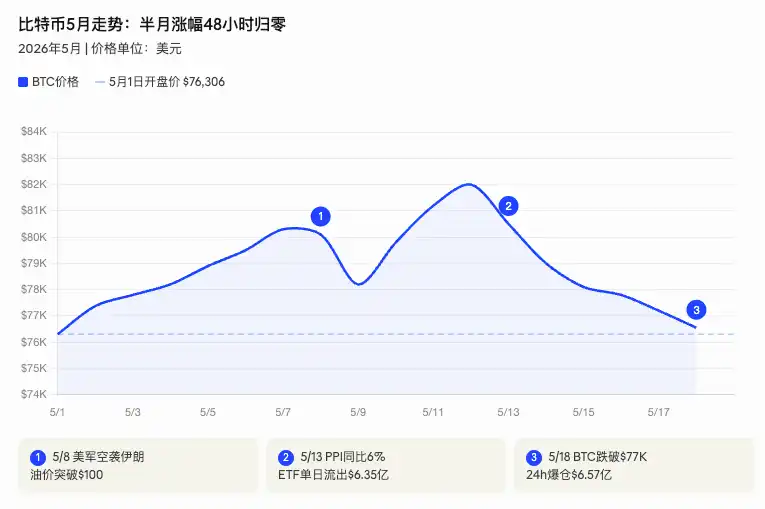
Bitcoin briefly dropped to $76,551 during Monday's Asian trading session, its lowest level since May 1st. According to a Bloomberg report on May 18th, widespread risk aversion triggered by Middle East tensions prompted traders to slash positions significantly, with the crypto market seeing nearly $500 million in liquidations within 15 minutes.

What does this price signify? On May 1st, Bitcoin opened around $76,306. Over the following two weeks, it climbed to above $82,000, then declined for four consecutive trading days, erasing all of May's gains. For traders who chased the rally mid-month, turning from floating profits to floating losses within 48 hours happened too fast to react.
PPI Soars 6% Year-Over-Year, Hitting Three-Year High, Rate Hike Probability Rises to 39%

The fuse that ignited this round of selling was the U.S. April Producer Price Index (PPI) released on May 13th. According to data from the U.S. Bureau of Labor Statistics, PPI rose 1.4% month-over-month, the largest monthly increase since March 2022; it surged 6% year-over-year, the highest level since December 2022, far exceeding market expectations of 4.9%.

Energy prices were the main driver. Gasoline prices jumped 15.6% month-over-month in April, diesel prices rose 12.6%, and the impact of the Iran conflict on the energy complex is transmitting down the supply chain. Even excluding food and energy, the core PPI still rose 1% month-over-month and reached 5.2% year-over-year, indicating price pressure is no longer confined to the pump.

High Frequency Economics Chief Economist Carl Weinberg warned after the PPI report that the data would sound alarms at both the Federal Reserve and financial markets. The CME FedWatch tool shows the market's pricing for a 25 basis point rate hike this year has risen to about 39%, with expectations for a rate cut this year largely eliminated.

Just one day before the PPI data, April CPI rose to 3.8% year-over-year, the highest since May 2023. According to CNN, several economists raised their forecasts for May CPI after the PPI release, expecting it to exceed 4%. The transmission of wholesale prices to the consumer end is accelerating.

ETF Six-Week Inflow Streak Ends, Weekly Net Outflow Exceeds $1 Billion

Macro pressures quickly transmitted to the institutional capital level. According to SoSoValue data, for the week ending May 15th, U.S. Bitcoin spot ETFs recorded a net outflow of approximately $1 billion, ending six consecutive weeks of net inflows. A CoinShares report on May 18th showed digital asset investment products overall saw a net outflow of $1.07 billion, the third-largest weekly outflow of 2026.

James Butterfill, Head of Research at CoinShares, stated this shift "may reflect geopolitical risk aversion triggered by developments related to Iran."

The total net inflow over the previous six weeks was about $3.4 billion, averaging about $568 million per week, with April alone seeing inflows of $1.97 billion, the strongest monthly performance of 2026. This accumulation was reversed intensively this week. May 13th saw a single-day net outflow of $635 million, the largest daily decline of the week; on May 15th, none of the 11 Bitcoin ETFs recorded positive inflows, with another $290 million outflow.

Ethereum spot ETFs also suffered five consecutive days of outflows, with a weekly net outflow of $255 million. By the weekend, Bitcoin ETF cumulative net inflows still stood at $58.34 billion, with total assets under management around $104.29 billion.

$657 Million in Liquidations, 89% Long Positions

As ETF capital fled, the derivatives market experienced a brutal long squeeze. According to Coinglass data, total crypto market liquidations within 24 hours reached $657 million, with long positions accounting for about 89%. According to bitcoin.com, $584 million came from long positions. The Fear & Greed Index plummeted from a neutral 50 a few days earlier to 29, entering the fear zone.

The domino effect of leveraged liquidations accelerated the decline. Bitcoin triggered a large number of stop-loss and forced liquidation orders after breaking below key support, forming a "liquidation → selling → more liquidation" spiral. LMAX crypto strategist Joel Kruger described this process as "forced position closures and position washouts" pushing Bitcoin below key technical support.

Bitcoin is currently hovering in the $76,000 to $76,800 range, with the 50-day moving average around $76,716 providing short-term support, and the 200-day moving average around $83,513 acting as resistance above.

Strategy Group Adds 20,000 BTC Against the Trend, Saylor Not Reading the Same Sentiment Report

While retail investors were liquidated and ETFs bled, Strategy Group (formerly MicroStrategy) operated in the opposite direction during the same period.

According to an 8-K filing with the SEC on May 18th, the company purchased 24,869 Bitcoin for approximately $2.01 billion between May 11th and 17th, at an average price of $80,985. This transaction brought Strategy's total holdings to 843,738 BTC, with a total cost of about $63.87 billion and an average price of around $75,700. This purchase was primarily funded through the sale of STRC preferred stock.

Strategy also disclosed that its "BTC yield" for the year-to-date 2026 (a metric measuring Bitcoin holdings relative to diluted share count growth) reached 12.6%.

This isn't the first time Saylor has added during market panic. Throughout 2026, Strategy has maintained a near-weekly or bi-weekly purchase rhythm, regardless of market ups and downs. From January to May, the company increased its holdings from about 560,000 BTC to over 840,000, adding nearly 60,000 new BTC per month on average. In the same week everyone was watching PPI data and ETF outflow data, he spent another $2 billion buying.

Goldman Sachs Liquidates XRP and Solana ETFs in Q1, Keeps Only Bitcoin

If Strategy's actions represent the "Bitcoin maximalist" stance, Goldman Sachs' Q1 13F holdings report presents a more representative institutional choice.

According to Goldman's latest Q1 2026 13F report, the bank completely liquidated all its XRP and Solana ETF holdings in the first quarter. At the end of the previous quarter, Goldman held about $154 million in XRP-related ETFs (distributed across issuers like Bitwise, Franklin Templeton, Grayscale, and 21Shares), and over $100 million in Solana-related ETFs. Now both positions are zero.

Ethereum ETF exposure was cut by about 70%, reduced from previous levels to around $114 million. The Bitcoin ETF position remained largely unchanged at around $700-720 million, with only a slight reduction of about 10%.
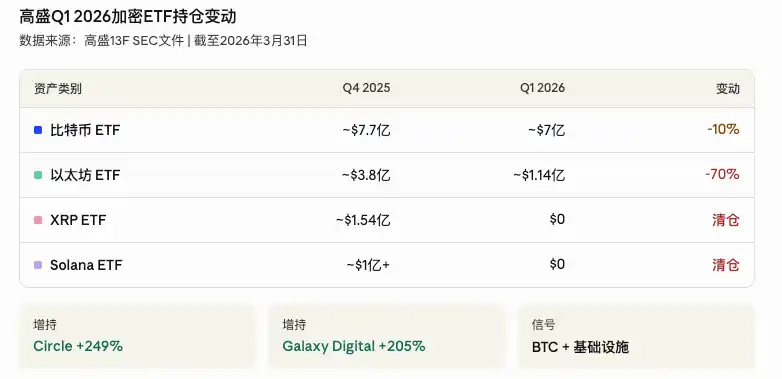
At the same time, Goldman increased its holdings in crypto infrastructure stocks: Circle holdings increased 249%, Galaxy Digital holdings increased 205%, and Coinbase also saw an increase. The signal from this set of actions is clear: Goldman hasn't exited crypto, but is narrowing its bets—shifting from "casting a wide net" back to "BTC-only."

According to a CCN report, the Harvard University Endowment also reduced its Bitcoin ETF holdings by 43% during the same period and completely exited Ethereum ETFs. Institutions are synchronizing a concentration of their crypto exposure by asset type.


İlgili Sorular

QWhat are the main factors cited as triggers for the recent sharp decline in Bitcoin's price?

AThe main triggers are the higher-than-expected US Producer Price Index (PPI) report showing a 6% year-over-year increase, leading to heightened expectations of potential Federal Reserve rate hikes. This macroeconomic pressure coincided with a shift in institutional fund flows, marked by US spot Bitcoin ETFs seeing their first net outflow in six weeks, exceeding $1 billion. Additionally, significant liquidations in the derivatives market, with $657 million in positions forcibly closed, accelerated the downward price movement.

QHow did the investment behavior of Strategy (formerly MicroStrategy) contrast with the general market trend during the sell-off?

AStrategy engaged in significant contrarian buying during the market sell-off. According to its SEC filing, the company purchased 24,869 BTC for approximately $2.01 billion between May 11 and May 17, at an average price of $80,985 per Bitcoin. This increased its total holdings to 843,738 BTC. This action demonstrates a consistent strategy of accumulating Bitcoin regardless of short-term price volatility, directly opposing the trend of retail panic selling and ETF outflows.

QWhat significant change did Goldman Sachs make to its cryptocurrency portfolio in Q1 2026, according to its 13F report?

AAccording to its Q1 2026 13F report, Goldman Sachs made a significant shift towards concentrating its crypto exposure primarily on Bitcoin. The bank completely liquidated its entire holdings of XRP and Solana ETFs. It also reduced its Ethereum ETF exposure by approximately 70%. Meanwhile, it largely maintained its Bitcoin ETF holdings at around $700-$720 million, making only a minor ~10% reduction. The report indicates a strategic move from a diversified crypto portfolio to a more focused 'BTC-only' stance among cryptocurrency investments.

QWhat was the impact of the recent market downturn on leveraged traders in the cryptocurrency market?

AThe market downturn led to massive liquidations for leveraged traders. Within 24 hours, total liquidations across the crypto market reached $657 million. A vast majority of these, approximately 89% or $584 million, were long positions that were forcibly closed. This created a cascading effect where initial liquidations triggered further selling, leading to more stop-losses and liquidations, which accelerated the price decline and pushed the market fear and greed index from a neutral 50 into the 'fear' territory at 29.

QWhat does the article suggest is the emerging institutional consensus regarding cryptocurrency investment, based on the actions of firms like Goldman Sachs?

AThe article suggests an emerging institutional consensus of strategic concentration on Bitcoin. The actions of Goldman Sachs—exiting other major altcoins like XRP and Solana while maintaining core Bitcoin exposure—are presented as a representative example. The trend indicates that major institutions are moving away from a 'broad exposure' approach to a more selective one. The implied consensus is: if institutions are to engage with crypto assets at all, they are increasingly choosing to focus their bets primarily or exclusively on Bitcoin, viewing it as the core, foundational asset in the space.

İlgili Okumalar

Why Haven't Forex Stablecoins Taken Off?

Why FX Stablecoins Never Took Off: A Path Forward via Synthetic FX Despite the explosive growth of stablecoin-powered digital banking, which has seen ~$6B in VC investment and a 24x surge in crypto card spending in under a year, a major limitation persists: these banks are essentially dollar-only accounts. This leaves 95-99% of global accounts, which are denominated in non-USD currencies, underserved. Attempts to create native foreign currency (FX) stablecoins (like EURC) have largely failed, with total FX stablecoin TVL at ~$600M compared to $400B for USD stablecoins—a 700x gap. These FX tokens face critical challenges: fragile pegs due to low liquidity, limited exchange/FinTech acceptance, poor on/off-ramps, complex regional compliance, and a chicken-and-egg adoption problem. The article argues that the solution lies not in competing with entrenched USD stablecoin networks (USDT/USDC), but in adopting a synthetic FX model inspired by traditional finance. Specifically, it advocates for Mark-to-Market Non-Deliverable Forwards (NDFs)—cash-settled FX derivatives that allow users to maintain underlying USD stablecoin holdings while having their account balance and P&L denominated in a foreign currency. This approach offers key advantages: strong oracle-based pegs, retention of deep USD stablecoin liquidity and yield, superior on/off-ramps, scalability to any currency with a reliable feed, and capital efficiency. It mirrors how modern institutional FX markets operate. Primary use cases for on-chain NDFs include: 1. **Digital Banks/Wallets:** Enabling multi-currency accounts for international users without leaving the USD stablecoin ecosystem, boosting deposits and retention. 2. **FX Carry Trade Vaults:** Offering access to sovereign interest rate differentials (e.g., earning yield on BRL) in a more stable and scalable format than crypto-native products like Ethena. 3. **Global Enterprise Payments:** Allowing merchants to receive payments in local currency equivalents while settling in USD stablecoins, similar to services offered by Stripe for fiat. The conclusion is that synthetic FX, not native FX stablecoins, is the viable path to integrating foreign exchange into the growing stablecoin digital banking landscape, potentially unlocking the next phase of institutional DeFi and multi-trillion-dollar global adoption.

链捕手31 dk önce

Why Haven't Forex Stablecoins Taken Off?

链捕手31 dk önce

IOSG Founder: Web3 Is 'Losing Blood,' How Can Practitioners Survive Better?

IOSG Founder: Web3 Is "Bleeding Out" – How Can Practitioners Survive Better? In a candid reflection, the founder of IOSG Ventures voices deep concerns about the current state of Web3, describing an ecosystem experiencing severe "blood loss." Despite the recent MuShanghai event showcasing a successful pivot towards a more diverse, global community, a somber reality persists: many crypto-native attendees were there exploring exits or new labels in biotech, AI, and robotics. The core issue is identified as a breakdown in the ecosystem's positive feedback loop. Alarmingly, underestimated "low-probability bad events" are occurring simultaneously: a significant brain drain of Chinese developers to AI, a lack of breakout applications despite massive funding, and a widening credibility gap for practitioners globally, often stigmatized as scam artists. This has created a dire接班人 (successor) problem, with the next generation seeing little professional prestige or financial upside in crypto compared to fields like AI. A significant portion of the critique focuses on Ethereum and Vitalik Buterin. While not pessimistic about Ethereum's technology, the founder worries that critical development windows were missed by focusing on niche technical narratives like ZK and L2 instead of mass-market applications. A more urgent concern is that Vitalik may be isolated in an "information bubble," shielded from the grassroots community's hardships by layers of intermediaries, preventing crucial feedback from reaching him. The call is for Vitalik to return to a founder's mindset, re-engage directly with the community, and rally efforts for the next decade. The divergence between U.S. and Chinese OG (Original Gangster) ecosystems is stark. While many U.S. builders reinvest their wealth into the ecosystem, the Chinese scene suffers from a severe lack of "造血能力" (blood-making ability), with most market-driven funds struggling and many early success stories cashing out entirely. This threatens the entire Asian Web3 ecosystem's survival. For individual practitioners, survival advice is pragmatic: find your core "why," maintain life balance beyond token prices, continuously learn new skills (like AI), form small, trusted alliances for mutual support, and practice self-compassion. The industry's greatest need is not money or tech, but lighthouses—individuals at all levels who offer mentorship, grants, referrals, and honest reflection to guide others. The piece concludes with a direct appeal: OGs must pay forward the opportunities the industry gave them; founders must not struggle alone; and builders must continue their work, ensuring it remains a viable profession. The survival of Web3's "cathedral" depends not on any single leader but on the collective responsibility of everyone who remains.

marsbit1 saat önce

IOSG Founder: Web3 Is 'Losing Blood,' How Can Practitioners Survive Better?

marsbit1 saat önce

Deficits, Inflation, and the New Fed: The Deep Logic Behind US Bond Yields Breaking 5% and the Market Reset

In the week of May 15-19, 2026, U.S. long-term Treasury yields surged to multi-year highs, with the 30-year yield hitting 5.2%, a level unseen since 2007, and the 10-year yield climbing to 4.687%. Equity markets declined in response. Four primary factors are driving the rise in yields. First, stubborn inflation persists, with April wholesale prices rising 6% year-over-year, fueling expectations of potential future Fed rate hikes instead of cuts. Second, newly confirmed Fed Chair Kevin Warsh inherits a complex inflation battle, with markets closely awaiting his first FOMC meeting. Third, deteriorating U.S. fiscal health, marked by large deficits and rising debt servicing costs, is eroding the traditional "safe-haven" premium for Treasuries. Fourth, the "One Big Beautiful Bill" tax cuts are projected to add trillions to the national debt, contributing to Moody's recent credit rating downgrade. Rising yields pressure stocks through several channels: a higher discount rate reduces the present value of future earnings (especially for growth stocks); rising risk-free rates compress equity risk premiums, making bonds relatively more attractive; higher borrowing costs impact consumers and corporations; and a stronger dollar affects multinational earnings. For investors, the environment favors value and financial stocks over long-duration growth stocks. Bond investors find attractive yields in short to intermediate maturities, while income investors see the best fixed-income opportunities in over a decade. Key developments to watch include Chair Warsh's first FOMC meeting, upcoming inflation data, Treasury auction demand, and whether the 30-year yield approaches 6%, a level that could trigger a more sustained equity valuation reset. The bond market's message is clear: the era of cheap government borrowing is over, posing a central challenge for markets in late 2026.

marsbit1 saat önce

Deficits, Inflation, and the New Fed: The Deep Logic Behind US Bond Yields Breaking 5% and the Market Reset

marsbit1 saat önce

Is MicroStrategy Selling Bitcoin Not a Bearish Signal? Deconstructing the 5 Financial Logics Behind Corporate Bitcoin Divestment

The article "Is Strategy Selling Bitcoin Not a Bearish Signal? Decoding 5 Financial Logics Behind Corporate Bitcoin Divestment" analyzes why companies might sell their bitcoin holdings, arguing it's not necessarily negative. It begins by noting the market's surprise at Strategy's potential sale, contrasting its previous "never sell" stance. The core argument is that corporate decisions prioritize shareholder value, and selling bitcoin can be a rational strategic choice. The article outlines five key financial reasons for such sales: 1. **Increase Bitcoin Holdings Per Share:** Companies can use proceeds from bitcoin sales to repurchase shares when the stock price is undervalued relative to its bitcoin assets. This reduces the outstanding share count, potentially increasing the bitcoin amount backing each remaining share. 2. **Optimize Capital Structure & Reduce Financing Costs:** Building cash reserves through bitcoin sales can improve credit ratings (as favored by agencies like S&P), leading to lower future borrowing costs. Repaying debt with sale proceeds also reduces financial leverage. 3. **Legitimate Tax Planning:** In the absence of wash-sale rules for bitcoin in the US, companies can sell to realize capital losses, then repurchase, lowering the tax basis of their holdings and creating tax offsets. 4. **Counter Negative Market Narratives:** A controlled, non-disruptive sale could demonstrate market resilience and disprove fears that corporate selling would crash the market, thereby normalizing bitcoin as a corporate treasury asset. 5. **Repurchase Preferred Stock at a Discount:** If a company's preferred stock trades significantly below its face value, using bitcoin sale proceeds to repurchase it can retire expensive liabilities at a profit, saving on future dividend payments. The conclusion emphasizes that bitcoin's monetary properties offer flexibility. Strategic sales can protect corporate and shareholder interests, making asset utilization more important than rigid "hold" mandates.

marsbit1 saat önce

Is MicroStrategy Selling Bitcoin Not a Bearish Signal? Deconstructing the 5 Financial Logics Behind Corporate Bitcoin Divestment

marsbit1 saat önce

İşlemler

Spot
Futures

Popüler Makaleler

BITCOIN Nedir

HarryPotterObamaSonic10Inu (ERC-20)'yu ve Kripto Alanındaki Yerini Anlamak Son yıllarda, kripto para piyasası, hem ticaret yapanların hem de topluluk etkileşimi ve eğlence değeri arayanların ilgisini çeken meme coin'lerin popülaritesinde bir artış gördü. Bu benzersiz token'lar arasında, kripto para dokusuna kültürel referansları harmanlayan ilginç bir proje olan HarryPotterObamaSonic10Inu (ERC-20) bulunmaktadır. Bu makale, HarryPotterObamaSonic10Inu'nun temel yönlerini, mekanizmalarını, topluluk odaklı ethosunu ve daha geniş kripto manzarasıyla etkileşimini incelemektedir. HarryPotterObamaSonic10Inu (ERC-20) Nedir? Adından da anlaşılacağı gibi, HarryPotterObamaSonic10Inu, Ethereum blok zinciri üzerinde inşa edilen bir meme coin'dir ve ERC-20 standardı altında sınıflandırılmaktadır. Geleneksel kripto paraların pratik kullanılabilirlik veya yatırım potansiyeline odaklandığı durumların aksine, bu token eğlence değeri ve topluluğunun gücü üzerine kuruludur. Proje, bağlı kullanıcıların bir araya gelebileceği, fikirlerini paylaşabileceği ve çeşitli kültürel fenomenlerden ilham alan etkinliklere katılabileceği bir ortam yaratmayı hedeflemektedir. HarryPotterObamaSonic10Inu'nun dikkate değer özelliklerinden biri işlemlerde sıfır vergi olmasıdır. Bu çekici unsur, küçük ölçekli yatırımcıları caydırabilecek ek ücretlerden yoksun olarak ticareti ve topluluk katılımını teşvik etmeyi amaçlamaktadır. Coin'in toplam arzı bir milyar token olarak belirlenmiştir; bu, topluluk içinde önemli bir dolaşım sağlama niyetini göstermektedir. HarryPotterObamaSonic10Inu (ERC-20) Yaratıcısı HarryPotterObamaSonic10Inu'nun kökenleri bir miktar gizemlidir; yaratıcısı hakkında spesifik bilgilerin ne olduğu bilinmemektedir. Bu token'ın geliştirilmesi, belirli bir ekip veya açık bir plan eksikliği ile gerçekleşmiştir; bu durum, meme coin sektöründe oldukça yaygındır. Proje, topluluğunun heyecanı ve katılımına dayalı olarak organik bir şekilde ortaya çıkmıştır. HarryPotterObamaSonic10Inu (ERC-20) Yatırımcıları Dış yatırımlar ve destekler söz konusu olduğunda, HarryPotterObamaSonic10Inu da belirsiz kalmaktadır. Token, bilinen herhangi bir yatırım fonunu veya önemli bir kurumsal desteği listelememektedir. Bunun yerine, projenin can damarı, kolektif eylem ve kripto alanındaki katılım yoluyla büyüme ve sürdürülebilirlik sağlayan temel topluluğudur. HarryPotterObamaSonic10Inu (ERC-20) Nasıl Çalışır? Bir meme coin olarak, HarryPotterObamaSonic10Inu, genellikle varlık değerini yöneten geleneksel çerçevelerin dışında çalışmaktadır. Projenin nasıl çalıştığını tanımlayan birkaç özelliği vardır: Sıfır Vergi İşlemleri: İşlemlerde vergi ücreti olmadan, kullanıcılar gizli maliyet endişesi olmadan token'ı serbestçe alıp satabilirler. Topluluk Etkileşimi: Proje, topluluk etkileşimi üzerine kuruludur ve sosyal medya platformlarını kullanarak heyecan yaratarak katılımı kolaylaştırır. Tartışmalar, içerik paylaşımı ve katılım, projenin erişimini genişletmeye ve destekleyiciler arasında sadakat oluşturmaya yardımcı olan kritik unsurlardır. Pratik Kullanılabilirlik Yok: HarryPotterObamaSonic10Inu'nun mali ekosistem içinde somut bir kullanılabilirlik sunmadığı belirtilmelidir. Daha ziyade, eğlence ve topluluk etkinlikleri için bir token olarak sınıflandırılmaktadır. Kültürel Referans: Token, popüler kültürden unsurları zekice harmanlayarak ilgi çekmektedir ve hem meme meraklıları hem de kripto takipçileriyle bağlantı kurmaktadır. HarryPotterObamaSonic10Inu, meme coin'lerin, daha geleneksel kripto para projelerinden nasıl farklı çalıştığını örneklendirmektedir; bu projeler, utilitarist varlıklar yerine yenilikçi sosyal yapıların bir parçası olarak piyasaya girmektedir. HarryPotterObamaSonic10Inu (ERC-20) Zaman Çizelgesi HarryPotterObamaSonic10Inu'nun tarihi, birkaç dikkate değer kilometre taşı ile işaretlenmiştir: Oluşum: Token, birçok kripto meraklısının hayal gücünü yakalayan bir viral meme'den ortaya çıkmıştır. Spesifik yaratım tarihleri mevcut değildir ve bu onun organik yükselişini vurgulamaktadır. Borsa Listelemeleri: HarryPotterObamaSonic10Inu, topluluğun daha kolay erişim ve ticaret yapabilmesini sağlamak için çeşitli borsalarda yer bulmuştur. Topluluk Katılım İnisiyatifleri: Yarışmalar, sosyal medya kampanyaları ve hayranlar ile destekçilerden içerik üretimini içeren topluluk etkileşimini artırmayı amaçlayan devam eden etkinlikler. Gelecek Genişleme Planları: Projenin yol haritası, kültürel temalarına ilişkin bir NFT koleksiyonu, ticari ürünler ve bir e-ticaret sitesi başlatılmasını içermektedir; bu da topluluğun daha fazla katılımını sağlamayı ve ekosistemine daha fazla boyut kazandırmayı hedeflemektedir. HarryPotterObamaSonic10Inu (ERC-20) Hakkında Kilit Noktalar Topluluk Odaklı Doğası: Proje, kullanıcı katılımını geliştirme önceliği taşır ve böylece kullanıcıların sürecin en önünde yer almasını sağlar. Meme Coin Sınıflandırması: Eğlenceye dayalı kripto paranın doruk noktasıdır ve geleneksel yatırım araçlarından ayrılmaktadır. Bitcoin ile Doğrudan İlişki Yok: Ticker ismindeki benzeliğe rağmen, HarryPotterObamaSonic10Inu ayırt edicidir ve Bitcoin veya diğer yerleşik kripto paralarla herhangi bir ilişkisi yoktur. İşbirliğine Odaklanma: HarryPotterObamaSonic10Inu, sahipleri arasında işbirliği ve hikaye paylaşımı için bir alan oluşturmak üzere tasarlanmıştır ve bu da yaratıcılık ve topluluk bağlarını sağlamaktadır. Gelecek Beklentileri: Başlangıçta belirlendiği temalardan NFTs ve ticari ürünlere genişleme arzusu, projenin dijital kültürde daha ana akıma girebilmesi için bir yol haritası çizmektedir. Meme coin'ler, kripto para topluluğunun hayal gücünü çalmaya devam ederken, HarryPotterObamaSonic10Inu (ERC-20), kültürel bağları ve topluluk merkezli yaklaşımıyla öne çıkmaktadır. Geleneksel bir hizmet odaklı token modeliyle uyumlu olmasa da, özünde destekçileri arasında sağlanan neşe ve dostluğu vurgulayarak, giderek dijitalleşen bir çağda kripto paraların evrilen doğasını göstermektedir. Proje gelişmeye devam ettikçe, topluluk dinamiklerinin blockchain teknolojisi dünyasındaki seyrini nasıl etkilediğini izlemek önemli olacaktır.

1.7k Toplam GörüntülenmeYayınlanma 2024.04.01Güncellenme 2024.12.03

BITCOIN Nedir

BTC Nasıl Satın Alınır

HTX.com’a hoş geldiniz! Bitcoin (BTC) satın alma işlemlerini basit ve kullanışlı bir hâle getirdik. Adım adım açıkladığımız rehberimizi takip ederek kripto yolculuğunuza başlayın. 1. Adım: HTX Hesabınızı OluşturunHTX'te ücretsiz bir hesap açmak için e-posta adresinizi veya telefon numaranızı kullanın. Sorunsuzca kaydolun ve tüm özelliklerin kilidini açın. Hesabımı Aç2. Adım: Kripto Satın Al Bölümüne Gidin ve Ödeme Yönteminizi SeçinKredi/Banka Kartı: Visa veya Mastercard'ınızı kullanarak anında Bitcoin (BTC) satın alın.Bakiye: Sorunsuz bir şekilde işlem yapmak için HTX hesap bakiyenizdeki fonları kullanın.Üçüncü Taraflar: Kullanımı kolaylaştırmak için Google Pay ve Apple Pay gibi popüler ödeme yöntemlerini ekledik.P2P: HTX'teki diğer kullanıcılarla doğrudan işlem yapın.Borsa Dışı (OTC): Yatırımcılar için kişiye özel hizmetler ve rekabetçi döviz kurları sunuyoruz.3. Adım: Bitcoin (BTC) Varlıklarınızı SaklayınBitcoin (BTC) satın aldıktan sonra HTX hesabınızda saklayın. Alternatif olarak, blok zinciri transferi yoluyla başka bir yere gönderebilir veya diğer kripto para birimlerini takas etmek için kullanabilirsiniz.4. Adım: Bitcoin (BTC) Varlıklarınızla İşlem YapınHTX'in spot piyasasında Bitcoin (BTC) ile kolayca işlemler yapın.Hesabınıza erişin, işlem çiftinizi seçin, işlemlerinizi gerçekleştirin ve gerçek zamanlı olarak izleyin. Hem yeni başlayanlar hem de deneyimli yatırımcılar için kullanıcı dostu bir deneyim sunuyoruz.

7.6k Toplam GörüntülenmeYayınlanma 2024.12.12Güncellenme 2025.03.21

BTC Nasıl Satın Alınır

$BITCOIN Nedir

DİJİTAL ALTIN ($BITCOIN): Kapsamlı Bir Analiz DİJİTAL ALTIN ($BITCOIN) Tanıtımı DİJİTAL ALTIN ($BITCOIN), geleneksel değerli metallerin özelliklerini merkeziyetsiz teknolojilerin yeniliği ile birleştirmeyi amaçlayan Solana ağı üzerinde çalışan blockchain tabanlı bir projedir. Bitcoin ile aynı isme sahip olmasına rağmen, genellikle bir değer saklama aracı olarak algılandığı için “dijital altın” olarak anılmaktadır; DİJİTAL ALTIN, Web3 ortamında benzersiz bir ekosistem yaratmak için tasarlanmış ayrı bir tokendir. Hedefi, uygulanabilir bir alternatif dijital varlık olarak kendini konumlandırmaktır, ancak uygulamaları ve işlevleri ile ilgili ayrıntılar hala gelişmektedir. DİJİTAL ALTIN ($BITCOIN) Nedir? DİJİTAL ALTIN ($BITCOIN), Solana blockchain'inde kullanılmak üzere açıkça tasarlanmış bir kripto para tokenidir. Bitcoin'in yaygın olarak tanınan bir değer saklama rolü sağlamasının aksine, bu token daha geniş uygulamalara ve özelliklere odaklanıyor gibi görünmektedir. Dikkate değer yönler şunlardır: Blockchain Altyapısı: Token, yüksek hızlı ve düşük maliyetli işlemleri yönetme kapasitesi ile bilinen Solana blockchain'inde inşa edilmiştir. Arz Dinamikleri: DİJİTAL ALTIN'ın maksimum arzı 100 katrilyon token (100P $BITCOIN) ile sınırlıdır, ancak dolaşımdaki arzı ile ilgili ayrıntılar şu anda açıklanmamıştır. Kullanım Alanı: Kesin işlevler açıkça belirtilmemiş olsa da, token'ın merkeziyetsiz uygulamalar (dApps) veya varlık tokenizasyon stratejileri ile ilgili çeşitli uygulamalar için kullanılabileceğine dair işaretler bulunmaktadır. DİJİTAL ALTIN ($BITCOIN) Yaratıcısı Kimdir? Şu anda, DİJİTAL ALTIN ($BITCOIN) arkasındaki yaratıcıların ve geliştirme ekibinin kimliği bilinmemektedir. Bu durum, merkeziyetsiz finans ve meme coin fenomenleriyle uyumlu olan birçok yenilikçi proje arasında yaygındır. Böyle bir anonimlik, topluluk odaklı bir kültürü teşvik edebilirken, yönetişim ve hesap verebilirlik konusundaki endişeleri artırmaktadır. DİJİTAL ALTIN ($BITCOIN) Yatırımcıları Kimlerdir? Mevcut bilgiler, DİJİTAL ALTIN ($BITCOIN) için bilinen herhangi bir kurumsal destekçi veya önde gelen risk sermayesi yatırımı olmadığını göstermektedir. Proje, geleneksel finansman yolları yerine topluluk desteği ve benimsemeye odaklanan bir eşler arası modelde çalışıyor gibi görünmektedir. Faaliyetleri ve likiditesi esas olarak PumpSwap gibi merkeziyetsiz borsalarda (DEX'ler) yer almakta olup, bu da onun taban hareketine vurgu yapmaktadır. DİJİTAL ALTIN ($BITCOIN) Nasıl Çalışır DİJİTAL ALTIN ($BITCOIN) 'ın operasyonel mekanikleri, blockchain tasarımı ve ağ özellikleri temelinde açıklanabilir: Konsensüs Mekanizması: Solana'nın benzersiz tarih kanıtı (PoH) ile bir hisse kanıtı (PoS) modelini birleştirerek, proje ağın yüksek performansına katkıda bulunan verimli işlem doğrulamasını sağlar. Tokenomik: Belirli deflasyonist mekanizmalar kapsamlı bir şekilde detaylandırılmamış olsa da, geniş maksimum token arzı, henüz tanımlanmamış mikro işlemler veya niş kullanım durumlarına hitap edebileceğini ima etmektedir. Etkileşim: Solana'nın daha geniş ekosistemi ile entegrasyon potansiyeli bulunmaktadır; bu, çeşitli merkeziyetsiz finans (DeFi) platformlarını içermektedir. Ancak, belirli entegrasyonlarla ilgili ayrıntılar belirtilmemiştir. Önemli Olayların Zaman Çizelgesi DİJİTAL ALTIN ($BITCOIN) ile ilgili önemli kilometre taşlarını vurgulayan bir zaman çizelgesi: 2023: Token'ın Solana blockchain'inde ilk dağıtımı, sözleşme adresi ile işaretlenmiştir. 2024: DİJİTAL ALTIN, PumpSwap gibi merkeziyetsiz borsalarda işlem görmeye başladıkça görünürlük kazanır ve kullanıcıların bunu SOL karşısında ticaret yapmasına olanak tanır. 2025: Proje, topluluk odaklı etkileşimlere yönelik potansiyel ilgi ve ara sıra ticaret faaliyetleri görür, ancak şu ana kadar dikkate değer ortaklıklar veya teknik ilerlemeler belgelenmemiştir. Kritik Analiz Güçlü Yönler Ölçeklenebilirlik: Temel Solana altyapısı, yüksek işlem hacimlerini destekleyerek $BITCOIN'in çeşitli işlem senaryolarındaki faydasını artırabilir. Erişilebilirlik: Token başına potansiyel düşük ticaret fiyatı, perakende yatırımcıları çekebilir ve parçalı mülkiyet fırsatları sayesinde daha geniş katılımı kolaylaştırabilir. Riskler Şeffaflık Eksikliği: Kamuya açık olarak bilinen destekçilerin, geliştiricilerin veya bir denetim sürecinin olmaması, projenin sürdürülebilirliği ve güvenilirliği konusunda şüpheler doğurabilir. Piyasa Volatilitesi: Ticaret faaliyeti büyük ölçüde spekülatif davranışa dayanmakta olup, bu da yatırımcılar için önemli fiyat dalgalanmalarına ve belirsizliklere yol açabilir. Sonuç DİJİTAL ALTIN ($BITCOIN), hızla gelişen Solana ekosisteminde ilginç ama belirsiz bir proje olarak ortaya çıkmaktadır. “Dijital altın” anlatısını kullanmaya çalışırken, Bitcoin'in değer saklama rolünden ayrılması, amaçlanan faydasının ve yönetişim yapısının daha net bir şekilde tanımlanması gerekliliğini vurgulamaktadır. Gelecekteki kabul ve benimseme, mevcut belirsizliklerin giderilmesine ve operasyonel ile ekonomik stratejilerinin daha açık bir şekilde tanımlanmasına bağlı olacaktır. Not: Bu rapor, Ekim 2023 itibarıyla mevcut olan sentezlenmiş bilgileri kapsamaktadır ve araştırma döneminin ötesinde gelişmeler yaşanmış olabilir.

92 Toplam GörüntülenmeYayınlanma 2025.05.13Güncellenme 2025.05.13

$BITCOIN Nedir

Tartışmalar

HTX Topluluğuna hoş geldiniz. Burada, en son platform gelişmeleri hakkında bilgi sahibi olabilir ve profesyonel piyasa görüşlerine erişebilirsiniz. Kullanıcıların BTC (BTC) fiyatı hakkındaki görüşleri aşağıda sunulmaktadır.

活动图片