Bitcoin Capital Continues to Exit: Why A Negative 7dMA Signals A High-Risk Regime

bitcoinist2025-12-27 tarihinde yayınlandı2025-12-27 tarihinde güncellendi

Özet

Bitcoin is struggling to regain market confidence as sentiment deteriorates and apathy dominates trading. Price remains below $90,000, with repeated recovery attempts failing. On-chain data reveals a negative seven-day moving average of net capital flow at approximately -$160 million, indicating more capital is exiting the network through loss-making sales than entering via profits. Despite weak conditions, Bitcoin supply activity remains elevated, with 31.79% of supply moving in the last 180 days. This high activity reflects distribution and stress rather than accumulation, as holders exit positions at unfavorable prices. For the trend to turn positive, net capital flows must recover alongside sustained activity.

Bitcoin is struggling to regain market confidence as sentiment continues to deteriorate and apathy dominates trading behavior. Price remains capped below the $90,000 level, with repeated recovery attempts failing to gain traction. As volatility compresses and participation thins, an increasing number of analysts are warning that the market may face further downside before stability can return. For now, conviction on both sides remains limited, leaving Bitcoin vulnerable to renewed selling pressure.

On-chain data underscores this fragile backdrop. A recent report by Axel Adler examines daily capital inflows and outflows across the Bitcoin network, using a seven-day moving average of net capital flow to assess market health.

This metric captures the balance between realized profits, which represent capital entering the network, and realized losses, which reflect capital being destroyed through loss-making sales. When the net flow turns negative, it signals that participants are selling at a loss more aggressively than they are taking profits.

Currently, the seven-day average stands at approximately negative $160 million, meaning the market has been losing an average of $160 million in capital per day over the past week. The period between December 17 and 24 was marked by sharp volatility, with large outflows interspersed with brief positive days. Although December 25 saw another net inflow, it was not enough to offset prior losses.

Elevated Coin Activity Signals Distribution Under the Surface

On-chain data highlighted by Adler shows that Bitcoin remains unusually active despite weak market conditions. The Bitcoin “% Supply Active (Last 180 Days)” metric tracks the share of total BTC supply that has moved at least once over the past six months.

Currently, that figure stands at 31.79%, slightly above its 30-day average of 31.43% and firmly in the 80th percentile compared with historical data. Activity has also risen sharply on a year-over-year basis, up 14.4%, indicating that coins are changing hands far more frequently than they were a year ago.
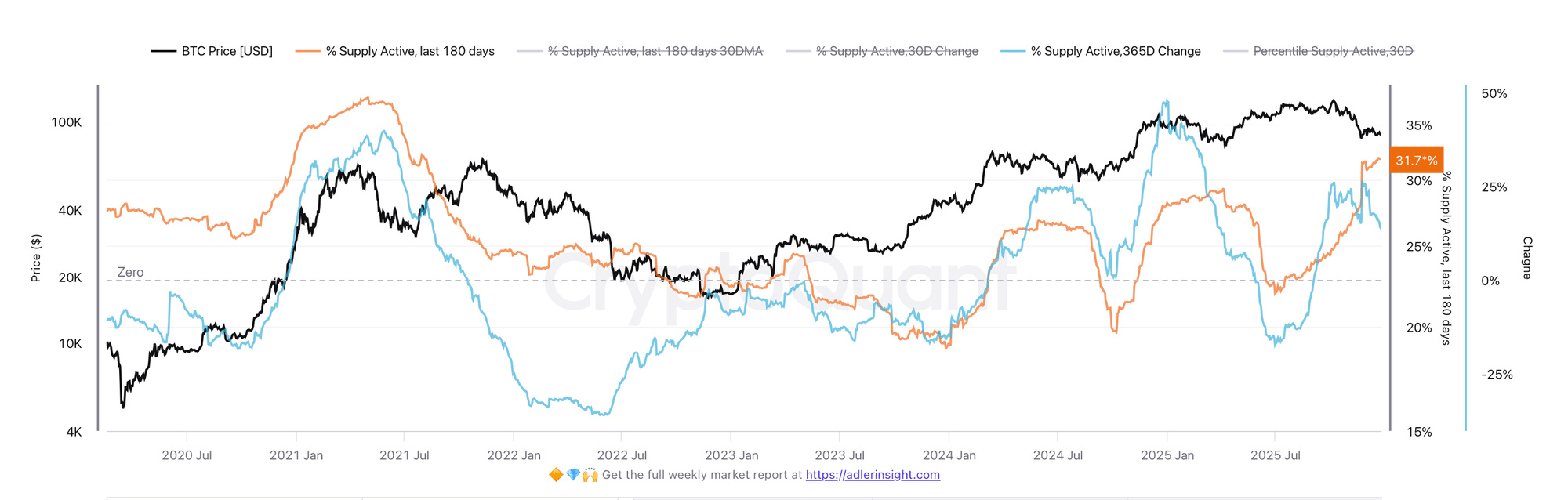
Bitcoin % Supply Active | Source: CryptoQuant

At face value, elevated activity can sometimes signal renewed interest or accumulation. In the current context, however, it carries a more cautionary implication. High supply activity is occurring alongside a negative net capital flow regime, meaning that much of this movement reflects loss-making sales rather than profitable distribution. Coins are not simply rotating between long-term holders; they are being sold under pressure.

This combination challenges the idea that the market is simply apathetic. Instead, it points to active distribution, with holders choosing to exit positions despite unfavorable prices. The distinction is important: apathy implies indecision, while distribution suggests stress.

For this metric to turn constructive, elevated activity would need to persist while net capital flows recover toward zero or positive territory. Only then would increased coin movement begin to reflect accumulation rather than capitulation.


İlgili Sorular

QWhat does a negative 7-day moving average of net capital flow indicate for the Bitcoin market?

AA negative 7-day moving average of net capital flow indicates that participants are selling Bitcoin at a loss more aggressively than they are taking profits, signaling capital destruction and a high-risk regime where the market is losing value.

QWhat is the current value of Bitcoin's 7-day average net capital flow, and what does it represent?

AThe current 7-day average net capital flow is approximately negative $160 million, meaning the Bitcoin market has been losing an average of $160 million in capital per day over the past week.

QHow does the '% Supply Active (Last 180 Days)' metric behave in the current market, and what does it suggest?

AThe '% Supply Active (Last 180 Days)' metric stands at 31.79%, above its 30-day average and in the 80th percentile historically, with a 14.4% year-over-year increase. This elevated activity, combined with negative capital flows, suggests active distribution and loss-making sales rather than accumulation.

QWhat is the difference between market apathy and distribution according to the on-chain analysis?

AMarket apathy implies indecision and lack of trading conviction, while distribution indicates active selling under pressure, with holders exiting positions despite unfavorable prices, reflecting stress and capitulation in the market.

QWhat conditions would need to occur for increased coin movement to signal accumulation rather than capitulation?

AFor increased coin movement to signal accumulation rather than capitulation, elevated supply activity would need to persist alongside a recovery in net capital flows toward zero or positive territory, indicating that coins are being bought for profit rather than sold at a loss.

İlgili Okumalar

Agents Take Over Traffic Distribution Power: What Are Tencent, ByteDance, and Alibaba Competing For?

In the race to dominate the AI era's entry point, China's tech giants—Tencent, ByteDance, and Alibaba—are aggressively deploying AI Agents to control the future of traffic distribution. Alibaba is pursuing a dual-track "closed loop + openness" strategy. Its Qianwen app is evolving into a super-Agent integrated across its ecosystem (Taobao, Alipay, etc.) to handle complex tasks like travel planning. Concurrently, it is opening its platform to external brands (Luckin Coffee, KFC) and has launched a B2B Agent platform, "Wukong," targeting enterprise automation. Its other flagship, Quark, aims to be an "AI super search box" for information and tasks. ByteDance is executing an omnipresent "sprawl strategy." Its Doubao app boasts over 300 million monthly active users and is evolving into a default AI entry point for daily life, with plans for paid versions and e-commerce integration. Its core weapon is the Kouzi platform, a visual "AI assembly factory" for developers to build custom Agents. ByteDance is also pushing hardware integration, collaborating on AI phones and developing smart glasses to embed Doubao everywhere. Tencent is playing its long-held "ultimate card" by quietly embedding an AI Agent directly into WeChat. This Agent, accessible via a swipe, can understand user commands and automatically execute tasks by calling upon WeChat's millions of mini-programs (e.g., finding and ordering coffee). This leverages WeChat's unparalleled 1.4-billion-user ecosystem to position the app as an AI-powered "service operating system," a move that could dramatically reshape the competitive landscape. The core battleground is shifting from competing for "user screen time" to competing to be the "default execution layer" for user intent. The business model is evolving from an "attention economy" to an "intent economy," where the Agent that can most efficiently fulfill a user's need gains control over service access and token flow. This represents a fundamental change in how users connect with digital services, making the fight for the Agent入口 (entry point) a pivotal moment for redefining industry leadership in the AI age.

marsbit55 dk önce

Agents Take Over Traffic Distribution Power: What Are Tencent, ByteDance, and Alibaba Competing For?

marsbit55 dk önce

From Banning Doubao to Embracing Honor: Why Did WeChat Suddenly 'Change Its Face'?

The article explores the sudden shift in WeChat's strategy towards AI assistants from mobile phone manufacturers, transitioning from strict opposition to active collaboration. For over a year, WeChat fiercely resisted attempts by phone AI assistants (like ByteDance's Doubao in late 2025) to control its features via GUI automation ("simulated clicking"), citing security and data control concerns. This stance created a significant barrier for system-level AI integration. Now, Tencent has initiated A2A (Agent-to-Agent) partnerships with major phone brands like Honor, Xiaomi, OPPO, and vivo. This model allows a phone's system AI (e.g., Honor's YOYO) to parse a user's voice command and send a structured request directly to WeChat's own internal AI agent via secure APIs. WeChat then executes the action (e.g., sending a message) and returns the result. The article attributes Tencent's "change of face" to strategic pressure. While leading in social app usage, Tencent trails rivals like ByteDance and Alibaba in standalone AI app popularity. WeChat, with its vast mini-program ecosystem, is Tencent's key asset for an AI comeback. The upcoming WeChat AI agent aims to handle tasks like booking and payments within the app. However, phone system assistants remain the primary AI entry point for most users. The A2A collaboration allows Tencent to extend WeChat's AI reach to this crucial system layer while maintaining control over its core functions and data. For phone manufacturers, embracing A2A is a pragmatic move. The GUI route proved unviable due to WeChat's blocks. A2A offers a compliant path to integrate a vital service, enhancing their AI assistants' usefulness. It allows them to focus on developing their own AI ecosystems for other services while cooperating on WeChat access. The collaboration is framed as a mutual, strategic necessity: Tencent gains a distribution channel, and manufacturers gain a key functionality. The partnership relies on a "dual authorization" mechanism for security, requiring both user and app consent for each action. While questions about long-term data privacy practices remain, experts note A2A is more secure and compliant than GUI automation. Ultimately, this cooperation is seen as a tentative, calculated truce. Tencent's long-term goal is to make WeChat an AI-powered "service OS." Phone manufacturers aim to make their system AI the central user interface. Their paths may converge or clash in the future, but for now, the A2A deal represents the opening chapter in the battle for the AI-era user入口, driven by necessity and strategic calculus on both sides.

marsbit2 saat önce

From Banning Doubao to Embracing Honor: Why Did WeChat Suddenly 'Change Its Face'?

marsbit2 saat önce

İşlemler

Spot
Futures

Popüler Makaleler

BILL Nasıl Satın Alınır

HTX.com’a hoş geldiniz! Billions Network (BILL) satın alma işlemlerini basit ve kullanışlı bir hâle getirdik. Adım adım açıkladığımız rehberimizi takip ederek kripto yolculuğunuza başlayın. 1. Adım: HTX Hesabınızı OluşturunHTX'te ücretsiz bir hesap açmak için e-posta adresinizi veya telefon numaranızı kullanın. Sorunsuzca kaydolun ve tüm özelliklerin kilidini açın. Hesabımı Aç2. Adım: Kripto Satın Al Bölümüne Gidin ve Ödeme Yönteminizi SeçinKredi/Banka Kartı: Visa veya Mastercard'ınızı kullanarak anında Billions Network (BILL) satın alın.Bakiye: Sorunsuz bir şekilde işlem yapmak için HTX hesap bakiyenizdeki fonları kullanın.Üçüncü Taraflar: Kullanımı kolaylaştırmak için Google Pay ve Apple Pay gibi popüler ödeme yöntemlerini ekledik.P2P: HTX'teki diğer kullanıcılarla doğrudan işlem yapın.Borsa Dışı (OTC): Yatırımcılar için kişiye özel hizmetler ve rekabetçi döviz kurları sunuyoruz.3. Adım: Billions Network (BILL) Varlıklarınızı SaklayınBillions Network (BILL) satın aldıktan sonra HTX hesabınızda saklayın. Alternatif olarak, blok zinciri transferi yoluyla başka bir yere gönderebilir veya diğer kripto para birimlerini takas etmek için kullanabilirsiniz.4. Adım: Billions Network (BILL) Varlıklarınızla İşlem YapınHTX'in spot piyasasında Billions Network (BILL) ile kolayca işlemler yapın.Hesabınıza erişin, işlem çiftinizi seçin, işlemlerinizi gerçekleştirin ve gerçek zamanlı olarak izleyin. Hem yeni başlayanlar hem de deneyimli yatırımcılar için kullanıcı dostu bir deneyim sunuyoruz.

251 Toplam GörüntülenmeYayınlanma 2026.05.07Güncellenme 2026.06.02

BILL Nasıl Satın Alınır

ATWO Nedir

I. Proje TanıtımıArena Two, hayranların gerçek zamanlı etkinlik sonuçlarında aktif, tokenleştirilmiş bir rol oynamasına olanak tanıyan merkeziyetsiz bir etkileşimli platformdur. Hayranları pasif izleyicilere indirgeyen geleneksel yayıncılık modellerinin aksine, Arena Two, hayranların doğrudan gerçek zamanlı oy kullanmalarını ve sahadaki sonuçları etkilemelerini sağlamak için blok zinciri teknolojisini kullanır.II. Token BilgileriToken adı: ATWO(Arena Two)III. İlgili BağlantılarWeb sitesi:https://arenatwo.com/Keşif araçları:https://basescan.org/token/0x499D35eBE6cEe9B2Ac35Fd003fcBbeeB9CFc7B32Twitter:https://x.com/arenatwoXNot: Proje tanıtımı, resmi proje ekibi tarafından yayınlanan veya sağlanan materyallerden gelmektedir ve yalnızca referans amaçlıdır, yatırım tavsiyesi niteliği taşımaz. HTX, ortaya çıkan doğrudan veya dolaylı kayıplardan sorumluluk kabul etmez.

229 Toplam GörüntülenmeYayınlanma 2026.05.18Güncellenme 2026.06.02

ATWO Nedir

ATWO Nasıl Satın Alınır

HTX.com’a hoş geldiniz! Arena Two (ATWO) satın alma işlemlerini basit ve kullanışlı bir hâle getirdik. Adım adım açıkladığımız rehberimizi takip ederek kripto yolculuğunuza başlayın. 1. Adım: HTX Hesabınızı OluşturunHTX'te ücretsiz bir hesap açmak için e-posta adresinizi veya telefon numaranızı kullanın. Sorunsuzca kaydolun ve tüm özelliklerin kilidini açın. Hesabımı Aç2. Adım: Kripto Satın Al Bölümüne Gidin ve Ödeme Yönteminizi SeçinKredi/Banka Kartı: Visa veya Mastercard'ınızı kullanarak anında Arena Two (ATWO) satın alın.Bakiye: Sorunsuz bir şekilde işlem yapmak için HTX hesap bakiyenizdeki fonları kullanın.Üçüncü Taraflar: Kullanımı kolaylaştırmak için Google Pay ve Apple Pay gibi popüler ödeme yöntemlerini ekledik.P2P: HTX'teki diğer kullanıcılarla doğrudan işlem yapın.Borsa Dışı (OTC): Yatırımcılar için kişiye özel hizmetler ve rekabetçi döviz kurları sunuyoruz.3. Adım: Arena Two (ATWO) Varlıklarınızı SaklayınArena Two (ATWO) satın aldıktan sonra HTX hesabınızda saklayın. Alternatif olarak, blok zinciri transferi yoluyla başka bir yere gönderebilir veya diğer kripto para birimlerini takas etmek için kullanabilirsiniz.4. Adım: Arena Two (ATWO) Varlıklarınızla İşlem YapınHTX'in spot piyasasında Arena Two (ATWO) ile kolayca işlemler yapın.Hesabınıza erişin, işlem çiftinizi seçin, işlemlerinizi gerçekleştirin ve gerçek zamanlı olarak izleyin. Hem yeni başlayanlar hem de deneyimli yatırımcılar için kullanıcı dostu bir deneyim sunuyoruz.

158 Toplam GörüntülenmeYayınlanma 2026.05.18Güncellenme 2026.06.02

ATWO Nasıl Satın Alınır

Tartışmalar

HTX Topluluğuna hoş geldiniz. Burada, en son platform gelişmeleri hakkında bilgi sahibi olabilir ve profesyonel piyasa görüşlerine erişebilirsiniz. Kullanıcıların A (A) fiyatı hakkındaki görüşleri aşağıda sunulmaktadır.

活动图片













