Bitcoin Bear Market Triggers Crypto Layoffs, Yet Fuels Industry's Most Aggressive M&A Wave Ever

marsbit2026-06-26 tarihinde yayınlandı2026-06-26 tarihinde güncellendi

Özet

A prolonged Bitcoin downturn is forcing crypto companies to lay off employees and automate operations, but has simultaneously triggered the industry's most aggressive wave of mergers and acquisitions (M&A). In the first half of 2026, crypto M&A deal value reached $93.7 billion, 26 times higher than the same period last year. This activity is primarily driven by traditional financial institutions—banks, payment processors, and asset managers—who are acquiring compliant crypto infrastructure like custody solutions, payment rails, and regulatory licenses instead of building them internally. Examples include Mastercard's acquisition of stablecoin firm BVNK and Franklin Templeton's launch of a dedicated crypto division via acquisition. This consolidation contrasts sharply with a shrinking crypto labor market, where active job openings have plummeted. Companies like Coinbase are restructuring to become "AI-native," leading to a sharp increase in roles requiring AI skills, while engineering and compliance positions now dominate hiring. Financially pressured crypto firms, such as Messari which was acquired at a fraction of its prior valuation, are becoming prime targets. Capital remains available but is highly selective, flowing overwhelmingly into businesses that bridge digital assets with traditional finance, such as tokenization platforms and regulated trading venues. The trend indicates a market where capital is rewarding compliant, utility-focused infrastructure while weaker m...

Author: Oluwapelumi Adejumo

Compiled by: Deep Chao TechFlow

Deep Chao's Guide: The ongoing decline of BTC is forcing crypto companies to conduct large-scale layoffs, but it is also spawning the most aggressive wave of mergers and acquisitions in the industry's history - with transaction volumes reaching $9.4 billion in the first half of 2026, 26 times the volume from the same period last year. Traditional financial institutions are no longer building their own infrastructure but are instead directly acquiring licenses, custody solutions, and payment rails. This divergence reveals the true direction of capital flow during a bear market.

Bitcoin's prolonged downturn is forcing cryptocurrency companies to cut staff, automate more tasks, and abandon expansion plans formulated during the last bull run. Simultaneously, it is creating one of the busiest periods for acquisitions in the sector's history.

In the second quarter of 2026, cryptocurrency M&A deals reached $7.23 billion, up from $2.14 billion in the first quarter.

The total transaction value for the two quarters reached $9.37 billion. Data from CryptoRank shows that the overall growth in the first half of the year was 26 times higher than the same period last year, highlighting a dramatic acceleration in deal activity even as spot market conditions worsen.
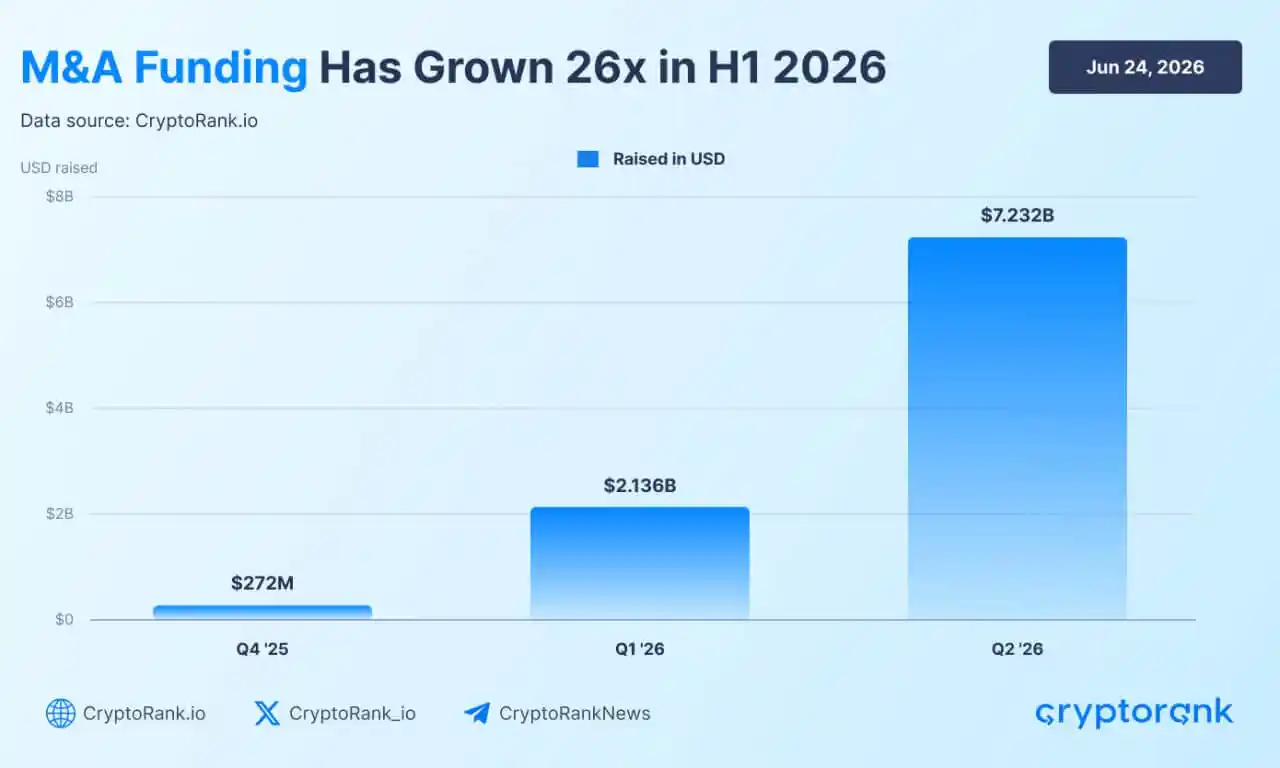
This acceleration is occurring against a backdrop of Bitcoin trading near its lowest levels in nearly two years and continued layoffs at some of the industry's largest employers.

This divergence shows where capital is flowing during the downturn – companies are spending less on broad hiring and speculative growth.

Instead, traditional financial institutions, banks, card networks, trading firms, and well-funded crypto businesses are acquiring payment systems, regulatory licenses, custody businesses, and market infrastructure that could take years to build internally.

The result is a bear market that is weakening many crypto companies but not eliminating institutional demand for their technology.

Traditional Finance Drives Wave of Crypto Infrastructure Acquisitions

Traditional financial institutions are driving the wave of crypto acquisitions, opting to buy fully-fledged digital asset infrastructure rather than building compliance and technical systems from scratch.

Banks, payment processors, and fintech companies are actively targeting startups that already possess custody solutions, payment rails, and regulatory approvals.

This acquisition frenzy is largely driven by the stabilization of global policy. The European Union's Markets in Crypto-Assets (MiCA) framework establishes unified licensing standards, while ongoing stablecoin legislation in the US gives corporate giants the confidence to make long-term bets.

Legal and consulting experts point to this policy support as a primary catalyst. According to Architect Partners' Q1 Crypto M&A and Financing Report, banking and securities industries are fully embracing blockchain, repositioning the technology as a foundational layer for traditional financial markets.

Mastercard's $1.8 billion acquisition of stablecoin company BVNK is a prime example. This acquisition gave the card network immediate access to the technology and licenses needed to process stablecoin payments, bypassing years of internal development.

Other Wall Street giants are also securing strategic footholds through targeted investments. Intercontinental Exchange backed prediction platform Polymarket, Citadel Securities invested in brokerage services provider Alpaca, and Standard Chartered's venture arm funded market maker Keyrock.

Asset managers are also capturing institutional demand through direct acquisitions. Franklin Templeton, which manages $1.7 trillion in assets, recently launched a dedicated digital assets unit called Franklin Crypto.

This move was executed via the acquisition of 250 Digital, which absorbed the firm's investment team and previously managed liquid crypto strategies under CoinFund, to offer actively managed cryptocurrency products directly to Franklin Templeton's global client base.

Overall, private capital strongly favors businesses that connect blockchain to the wider financial system. First-quarter financing data reveals a clear investor preference for stablecoin utility—such as foreign exchange, corporate payments, and cross-border settlement—over speculative crypto-native projects.

In this environment, regulatory credentials have become a major competitive barrier. Acquisition targets with broker-dealer capabilities, federal banking charters, or registered investment advisor qualifications, including Alpaca, Anchorage, and Superstate, attract stronger buyer interest as they provide immediate operational legitimacy.

While traditional finance demonstrates its balance sheet strength, blockchain networks are quietly emerging as a new class of aggressive buyers.

Historically, Layer 1 and Layer 2 networks relied on independent developers to build applications on their chains. Now, faced with fierce competition for users, these networks are directly purchasing consumer-facing applications.

Polygon's recent acquisitions of Coinme and Sequence highlight this shift. By buying payment channels and wallet infrastructure, the blockchain is securing an end-to-end user experience and locking in transaction volume, suggesting that technical capability alone is insufficient to maintain market share.

Crypto Layoffs Deepen, AI and Compliance Reshape Workforce

The pace of corporate acquisitions starkly contrasts with the continued contraction of the digital asset labor market.

According to data compiled by Tiger Research for June 2026, the industry currently has only 2,932 active job openings globally.
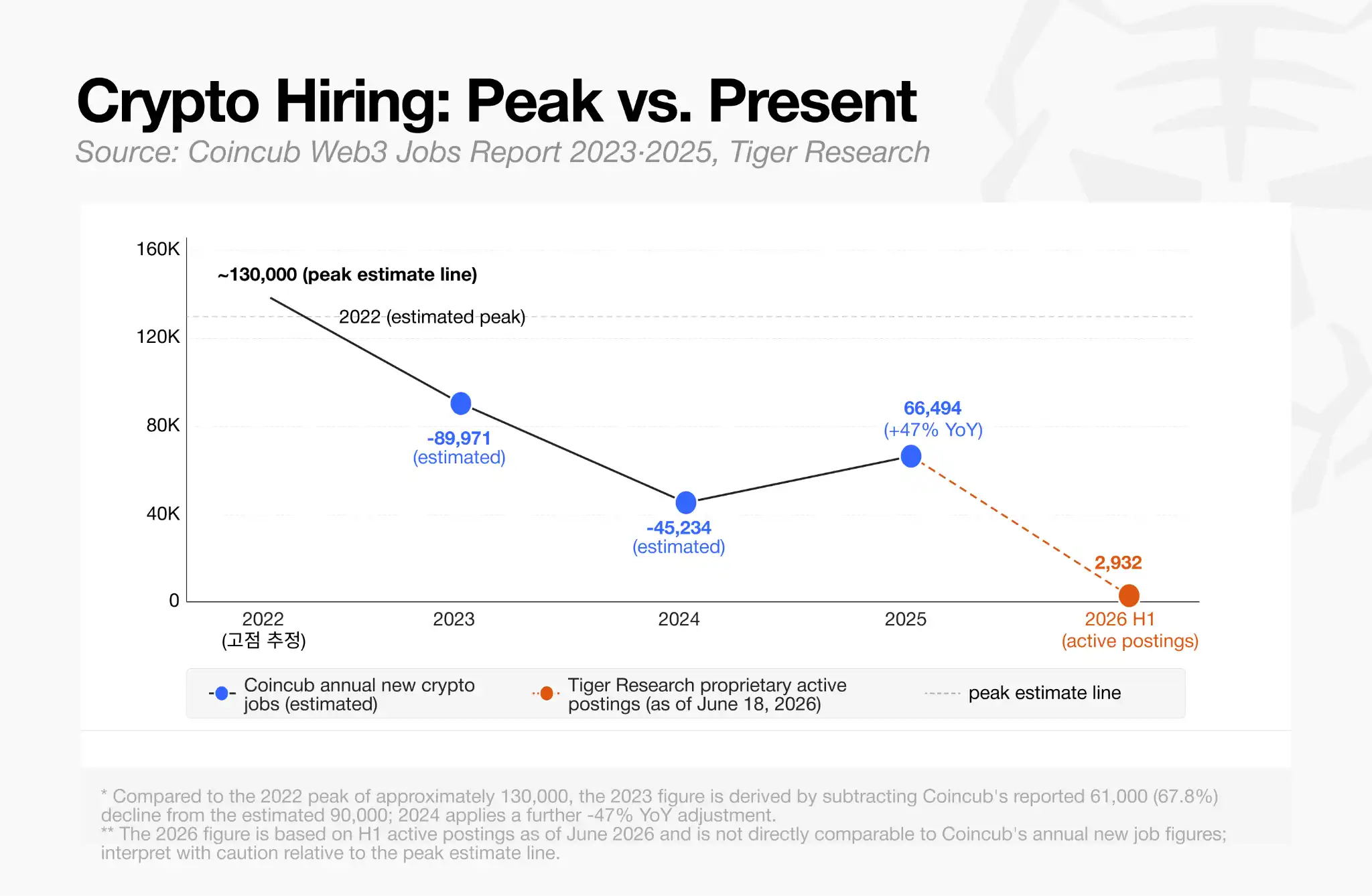
This figure pales in comparison to the aggressive hiring sprees of 2021 and early 2022, when trading platforms, DeFi protocols, and NFT markets were all expanding headcount simultaneously.

The employment shrinkage began during the market downturn of 2022 and accelerated after the FTX collapse, leading to roughly a 40% decline in job openings across North America and Europe. The market has not rebounded to previous highs.

Indeed, layoffs have been steadily continuing throughout the first half of this year. Major platforms including Gemini, Coinbase, Kraken, Algorand, Crypto.com, and most recently, the Ethereum Foundation, have initiated new rounds of job cuts.

Executives have attributed the cuts to low token valuations, broader macroeconomic pressures, and AI-driven operational efficiencies. Specifically, Coinbase framed its restructuring as a shift towards an "AI-native" operational model.

This technological pivot is evident in the hiring data: the proportion of crypto jobs requiring AI skills has more than doubled in a year, surging from 23% in early 2025 to over 53% by March 2026.
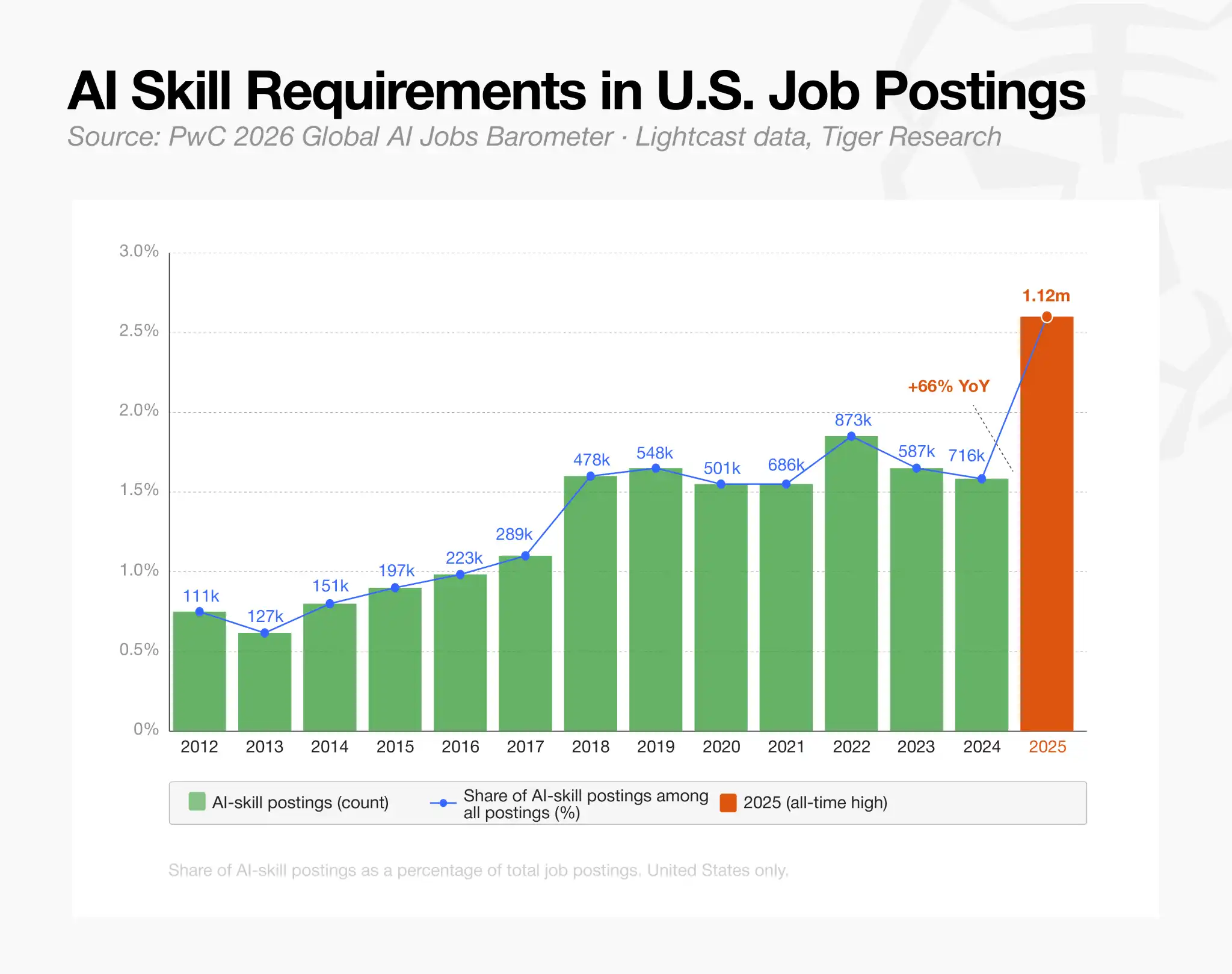
While overall hiring remains sluggish, the composition of the workforce is undergoing a fundamental change. Companies are not implementing a complete hiring freeze. Instead, they are actively narrowing their focus to technical and regulatory expertise.

According to Tiger Research, engineering roles constitute approximately 34% of active openings, while legal and compliance roles account for about 10%. This shift is more pronounced at centralized exchanges, where compliance positions make up 16% of vacancies—more than double the share for sales and business development roles.

This indicates these companies are prioritizing staffing needs to obtain licenses, manage risk, and maintain core infrastructure, while reducing spending on marketing and community growth.

Furthermore, the limited hiring that exists is highly concentrated among a few heavyweights rather than distributed across early-stage startups. Centralized exchanges generate nearly one-third of all open positions.

Stablecoin and payments divisions account for another significant portion, but this activity is highly concentrated. Tether and Ripple alone constitute over 80% of listings in that category.

Ultimately, the data paints a picture of targeted corporate restructuring and a defensive posture, not an industry-wide labor market recovery.

Distressed Crypto Companies Become Acquisition Targets

Blockworks' recent acquisition of Messari perfectly embodies the intersection of large-scale layoffs and accelerated consolidation.

The crypto analytics company Blockworks acquired the analytics provider for approximately $10 million, a significant markdown from its $300 million valuation following a 2022 funding round. Prior to the sale, the research firm underwent three separate rounds of layoffs starting in 2023.

Shortening runways and slow revenue growth are forcing smaller businesses to the negotiating table, enabling well-funded buyers to absorb specialized talent, proprietary data, and distribution channels for a fraction of their former private market valuations.

Industry analysts expect these financial pressures to soon ripple into digital asset treasury sectors. Throughout 2025, many public treasury entities successfully raised capital by trading at a premium relative to their crypto reserves.

Meanwhile, the M&A wave may also eventually encompass Decentralized Autonomous Organizations, thanks to maturing legal frameworks.

Recent legislative progress, such as Wyoming's Decentralized Unincorporated Nonprofit Association (DUNA) structure, provides DAOs with a recognized legal mechanism to hold off-chain assets and intellectual property.

With clearer governance and ownership, protocol treasuries are better positioned to acquire complementary software projects or specialized development teams.

However, compared to the traditional, compliance-driven corporate acquisitions dominating the current market cycle, these decentralized mergers remain highly experimental.

Capital Remains Available, But Has Become Discerning

Despite nearly $10 billion in crypto deal activity in the first half of 2026, capital allocation has become more discerning.

A notable exception to this strict institutional focus is the prediction markets sector. Event-betting platforms have secured significant funding commitments as they vie for mainstream dominance.

For context, Kalshi is reportedly negotiating a funding round that would value the federally regulated exchange at $40 billion, nearly double its previous $22 billion price tag. Polymarket has also absorbed substantial backing as competition for prediction market supremacy intensifies.

However, outside of predictions, the venture capital thesis has narrowed dramatically. Capital is overwhelmingly flowing to businesses acting as bridges between digital assets and the traditional financial system.

Tokenization firms and institutional trading venues secure large checks because they pitch sustainable, isolated revenue models: charging banks, brokerages, and asset managers fees for regulated services, rather than relying on fickle retail crypto traders. Superstate recently closed an $82.5 million funding round to expand its blockchain-based securities issuance, while Alpaca dominates in settling tokenized US stocks and ETFs.

This funding trajectory indicates investors are shifting bets from conceptual tokenization pilots to live, regulated financial products.

Notably, pure DeFi protocols and experimental base-layer blockchains are entirely absent from this quarter's major funding rounds.

This selective deployment of venture capital mirrors the broader M&A trend. Liquidity exists, but it is ring-fenced for startups with regulatory licenses, institutional distribution channels, and specific utility for traditional finance.

The bear market is effectively pruning the industry, forcing weaker models to consolidate or cut staff, while richly rewarding the infrastructure providers built to weather the crypto winter.

Trend Kriptolar

İlgili Sorular

QWhat has been the impact of the prolonged Bitcoin downturn on the crypto industry, according to the article?

AThe prolonged Bitcoin downturn has forced crypto companies to conduct mass layoffs, automate more work, and abandon expansion plans from the previous bull market. However, it has simultaneously created one of the industry's busiest periods for mergers and acquisitions (M&A).

QHow does the scale of crypto M&A activity in the first half of 2026 compare to the previous year?

AThe total value of crypto M&A deals in the first half of 2026 reached $9.37 billion. According to CryptoRank, this represented a growth that was 26 times higher compared to the same period in the previous year.

QWhat is the primary driver behind the wave of crypto infrastructure acquisitions by traditional financial institutions?

AThe primary driver is the stabilization of global crypto policy, such as the EU's MiCA framework and ongoing stablecoin legislation in the US. This provides traditional banks and financial institutions the confidence to make long-term bets by purchasing ready-made digital asset infrastructure (like custody, payment rails, and regulatory licenses) instead of building it internally.

QHow is the composition of the crypto workforce changing during this period of layoffs, as highlighted in the article?

AThe composition is shifting towards a greater emphasis on technical and regulatory expertise. Engineering roles now make up about 34% of active job vacancies, while legal and compliance roles account for about 10%. There is also a significant increase in demand for AI skills, with over 53% of crypto job postings requiring them by March 2026.

QWhat type of companies are currently receiving the majority of venture capital funding, according to the article's analysis?

AVenture capital is overwhelmingly flowing to companies that act as bridges between digital assets and the traditional financial system. This includes tokenization firms and institutional trading venues with regulated, fee-based revenue models, rather than speculative crypto-native projects or pure DeFi protocols.

İlgili Okumalar

Stablecoins Becoming the Next Policy Challenge for the Fed's Walsh Version

Fed Governor Christopher Waller's speech at the June 22 conference on the U.S. dollar's international role signifies a notable policy shift: stablecoins like USDT and USDC are now being formally considered as potential channels for transmitting U.S. dollar liquidity globally. With their combined market cap surpassing $250 billion and high transaction volumes, these digital assets are moving from the periphery of crypto policy to the core of monetary system research. The key concern for policymakers is how stablecoin flows interact with traditional dollar infrastructure. Their growth could affect bank deposits, demand for short-term Treasury securities (like T-bills), and global access to dollars, depending on whether demand originates overseas or substitutes for domestic bank balances. Issuers' reserve management—holding assets in banks, money market funds, or Treasuries—links stablecoin activity directly to these core markets. The Fed's research agenda now examines whether stablecoins, by combining payment and balance-holding functions on digital rails, could complicate monetary policy implementation or transmit liquidity stress to banks. While current Treasury holdings by issuers are under 1% of the total market, their concentrated demand could marginally impact yields, especially during periods of stress. Consequently, stablecoins are evolving from mere crypto trading tools into a private-layer dollar transmission system with public policy implications, prompting closer regulatory scrutiny of their reserve robustness, redemption mechanisms, and systemic integration.

marsbit5 dk önce

Stablecoins Becoming the Next Policy Challenge for the Fed's Walsh Version

marsbit5 dk önce

A 380% Soar, Shenzhen’s 100-Billion-Yuan IPO Rings the Bell

HKC Holdings, a major Chinese display panel manufacturer, has successfully listed on the Shenzhen Stock Exchange's main board. The company's shares surged over 380% on its debut, pushing its market capitalization to around 350 billion yuan (formerly reaching 500 billion yuan). Founded by Wang Zhiyong in Shenzhen's Huaqiangbei electronics market nearly three decades ago, HKC evolved from assembling monitors to becoming a global top-tier supplier of semiconductor display panels for TVs, monitors, and smartphones. The IPO marks a significant milestone for HKC and its backers. The company's growth into the capital-intensive panel manufacturing sector was supported through partnerships with state-owned capital from regions like Chongqing, Mianyang, and Chuzhou. Its shareholder list also includes BOE Technology's investment arm. In recent years, HKC reported strong financials, with core panel business contributing over 70% of revenue and clients including Samsung, TCL, and Xiaomi. This listing is seen as part of a broader trend in Shenzhen's evolving tech landscape. Beyond established giants, the city is nurturing clusters of leading companies in specialized sectors like robotics—exemplified by the "Shenzhen Robot Valley"—and storage chips, where a group of firms dubbed the "Storage Five Tigers" has achieved a combined trillion-yuan market valuation. Shenzhen's strategic focus on emerging industries such as AI terminals, low-altitude economy, and humanoid robotics aims to build new industrial depth and foster the next generation of tech champions.

marsbit17 dk önce

A 380% Soar, Shenzhen’s 100-Billion-Yuan IPO Rings the Bell

marsbit17 dk önce

Domestic First Explosion-Proof Certification, World's First Fueling Brain Solution: How Did They Secure Two 'Firsts'?

China's embodied AI sector is booming, with over ¥37 billion in funding this year. The focus has shifted decisively to real-world application, particularly in hazardous, repetitive tasks humans should avoid. A key, often prohibitive, barrier to entry for robots in environments like gas stations and oil fields is obtaining explosion-proof certification, requiring meticulous hardware and circuit design from the ground up. The article explores three main application areas. At gas stations, the challenge lies in executing a long, precise sequence of actions (opening caps, handling the fuel nozzle) with millimeter accuracy across diverse car models. For facility inspections, robots need sustained autonomous patrols combined with real-time anomaly detection and response. Port scenarios introduce the complexity of multi-robot coordination. Addressing the core challenge of long-horizon tasks, the piece highlights a technical breakthrough: a "world model"-driven approach. This enables predictive planning, allowing the AI to visualize the desired end-state (e.g., nozzle returned, cap closed) and work backward to synthesize intermediate visual frames. This "imagination" of the task trajectory, as implemented in the H-GAR architecture, guides action generation, significantly reducing cumulative error in multi-step operations. The three-step H-GAR process involves generating a coarse action draft, synthesizing target-conditioned observation frames, and then refining actions based on visual context and a memory of past successful motions. The conclusion emphasizes that success in specialized, safety-critical fields requires long-term commitment and deep integration of the "embodied brain" (AI) with a purpose-built, certified physical "body." Mastering this brain-body-data闭环 (closed-loop) is positioned as a crucial competitive advantage for commercialization.

marsbit1 saat önce

Domestic First Explosion-Proof Certification, World's First Fueling Brain Solution: How Did They Secure Two 'Firsts'?

marsbit1 saat önce

İşlemler

Spot
Futures

Popüler Makaleler

DOGE M Nedir

Doge Matrix ($doge m): Topluluk Destekli Kripto Paranın Yeni Türü Giriş Kripto para dünyası sürekli evrilen bir manzaraya sahipken, yeni projeler sürekli olarak ortaya çıkmakta ve her biri yatırımcıların ve meraklıların ilgisini çekmeyi hedeflemektedir. Bu alandaki en son katılımcılardan biri, $doge m sembolü ile temsil edilen Doge Matrix'tir. Bu proje, Dogecoin etrafındaki popüler meme kültürüne dayanan kökleri sayesinde dikkat çekmiş ve web3 alanında kendine bir yer edinmiştir. Bu makale, Doge Matrix'in genel bir analizini sunmayı amaçlamakta; genel bakış, yaratıcı, yatırımcılar, işlevsellik, zaman çizelgesi ve dikkat çekici yönleri kapsayacaktır. Doge Matrix ($doge m) Nedir? Doge Matrix, görünüşte Dogecoin'in geniş çekiciliği üzerine inşa edilen, topluluk destekli bir kripto para projesidir. Dogecoin, Shiba Inu maskotu ve meme kökenleri ile bilinen bir dijital para birimidir. Doge Matrix'in genel hedefleri geniş bir şekilde tanımlanmamış olsa da, topluluk katılımı ve desteğini kullanma taahhüdü ile karakterize edilmektedir. Geleneksel kripto paralardan farklı olarak, genellikle altyapı teknolojileri aracılığıyla fayda veya içsel değer vurgulayan Doge Matrix, kripto paraların kültürel fenomenini benimseyen bir alanda kendini konumlandırmaktadır; özellikle meme tabanlı varlıkların ethos'u ile özdeşleşenlere hitap etmektedir. Dogeoin topluluğunun güçlü yönlerinden yararlanan Doge Matrix, daha geniş bir ekosistemin parçası olarak faaliyet göstermekte ve kripto para ve dijital alanla ilgilenen kullanıcıların katılımını ve etkileşimini davet etmektedir. Doge Matrix'in ($doge m) Yaratıcısı Kimdir? Doge Matrix'in yaratıcısının kimliği bilinmemektedir. Bu şeffaflık eksikliği, bazı projelerin kurucularının kimliklerini açıklamadan başlatıldığı kripto para alanında yaygın bir durumdur. Kurucu ekip hakkında bilgi eksikliği, potansiyel yatırımcılar arasında projenin hesap verebilirliği ve yönü hakkında sorular doğurabilir. Doge Matrix'in ($doge m) Yatırımcıları Kimlerdir? Şu anda, Doge Matrix'i destekleyen yatırımcılar veya yatırım fonları hakkında kamuya açık bir bilgi bulunmamaktadır. Proje, esasen topluluk desteğine dayanmakta ve kurumsal yatırım yerine bu desteği kullanmaktadır. Bu model, girişimin topluluk destekli doğası ile uyumlu olup, projenin yönünün katılımcılar tarafından şekillendirildiği bir ortam yaratmaktadır. Doge Matrix ($doge m) Nasıl Çalışır? Doge Matrix'in operasyonel mekanizmaları ile ilgili ayrıntılar biraz belirsizdir ve bu durum, meme coin alanındaki projelerin genel bir eğilimini yansıtmaktadır; burada yenilikçi işlevsellikler her zaman net bir şekilde ifade edilmemektedir. Bununla birlikte, Doge Matrix'in mevcut kripto para ekosisteminden yararlanmayı ve kullanıcı katılımını teşvik etmeyi amaçladığı görünmektedir; ayrıca Dogecoin ile ilişkilendirilen tanıdık kültürel referansları kullanmaktadır. Potansiyel olarak benzersiz özellikleri, teknolojik ilerlemelerden ziyade topluluk etkileşimlerinden kaynaklanmakta ve token sahipleri arasında paylaşılan deneyimleri ve işbirliğini vurgulamaktadır. Kesin yenilikler açıkça belirtilmemiş olsa da, proje, topluluk üyelerinin katılabileceği, fikir paylaşabileceği ve projenin potansiyelini ileriye taşıyabileceği bir alan yaratmaktadır. Doge Matrix'in ($doge m) Zaman Çizelgesi Projenin zaman çizelgesine bakmak, şimdiye kadar tanımlayıcı olayları ortaya koymaktadır: 25 Kasım 2024: Doge Matrix, erken tarihindeki önemli bir dönüm noktası olarak tüm zamanların en yüksek değerine ulaştı. 1 Ocak 2025: Aksine, Doge Matrix tüm zamanların en düşük değerine ulaştı ve bu durum, kripto paralarla sıkça ilişkilendirilen dalgalanmayı göstermektedir; özellikle bir projenin yaşam döngüsünün erken aşamalarında. Devam Ediyor: Proje, topluluğu tarafından aktif bir şekilde işlem görmeye ve desteklenmeye devam etmekte, ancak belirli gelecekteki dönüm noktaları veya hedefler henüz açıklanmamıştır. Doge Matrix ($doge m) Hakkında Ana Noktalar Topluluk Odaklılık Doge Matrix'in merkezinde topluluk katılımına olan taahhüt bulunmaktadır. Proje, üyeleri arasında işbirliği ve ortak hedefler üzerine inşa edilmiştir ve kolektif çabanın önemini vurgulamaktadır. Genellikle tanımlı bir liderlik yapısına sahip merkezi projelerin aksine, Doge Matrix şu anda her topluluk üyesinin sesinin önemli olduğu daha akışkan bir yönetişim yaklaşımını sergilemektedir. Dalgalanma Kripto para piyasası, dalgalanması ile ünlüdür ve Doge Matrix de bu durumdan muaf değildir. Fiyat geçmişi, yüksek ve düşük değerler arasında önemli dalgalanmaları yansıtmaktadır; bu durum birçok yeni kripto para için tipik olmakla birlikte, yeni token'lara yapılan yatırımlarla ilişkili riskleri vurgulamaktadır. Ayrıntılı Bilgi Eksikliği Doge Matrix hakkında en çarpıcı özelliklerden biri, teknolojik altyapısı ve operasyonel mekanizmaları ile ilgili ayrıntılı bilginin kıtlığıdır. Bu belirsizlik, potansiyel yatırımcıların projeye katılmadan önce kapsamlı bir araştırma yapmalarını gerektirmektedir. Sonuç Özetle, Doge Matrix ($doge m), topluluk katılımı ve kültürel anlamda önem taşıyan projelerin yeni bir dalgasını temsil etmektedir. Belirli ayrıntılardan yoksun olsa da—örneğin, net bir liderlik, tanımlı hedefler ve ayrıntılı işlevsellik—proje, meme kültürünün yerleşik çekiciliğinden yararlanarak kripto topluluğunda ilgi uyandırmayı başarmıştır. Kripto para alanındaki herhangi bir yatırımda olduğu gibi, doğasında var olan riskleri anlamak ve kapsamlı bir araştırma yapmak, potansiyel katılımcılar için esastır. Doge Matrix, kripto endüstrisinin dinamik, bazen öngörülemez doğasının bir hatırlatıcısı olarak durmakta; sürekli evrim ve topluluk destekli girişimlere olan heyecan ile işaretlenmektedir.

389 Toplam GörüntülenmeYayınlanma 2025.02.03Güncellenme 2025.02.03

DOGE M Nedir

$M Nedir

Mantis'i Anlamak ($M): Zincirler Arası İşlemde Yeni Bir Dönem Web3 ve kripto para dünyasının sürekli gelişen manzarasında, yeni projeler kullanıcı deneyimini artırmayı ve merkeziyetsiz finans ekosistemindeki işlevsel olanakları genişletmeyi amaçlayan yenilikçi çözümler sunmaya çalışıyor. Dikkat çeken projelerden biri, zincirler arası etkileşim ve niyet tabanlı uzlaşma ilkeleri üzerine kurulu öncü bir protokol olan Mantis ($M). Bu makale, Mantis'in temel işlevselliği, yaratıcıları, yatırım destekleri, yenilikçi özellikleri ve kritik dönüm noktaları dahil olmak üzere temel yönlerini inceliyor. Mantis ($M) Nedir? Mantis, çok alanlı niyet uzlaşma protokolü olarak tanımlanır ve kullanıcıların çeşitli blockchain platformları arasında karmaşık finansal işlemleri sorunsuz bir şekilde gerçekleştirmelerini sağlar. Protokol, üç ana katman üzerinden çalışır: Niyet İfadesi: Kullanıcılar, DISE LLM adlı gelişmiş bir AI dil modeli aracılığıyla doğal dil kullanarak işlem hedeflerini ifade edebilirler. Örneğin, bir kullanıcı belirli bir kayma toleransı ile Ethereum (ETH) ile Solana (SOL) takası yapmak istediğini ifade edebilir. İcra: Bu katman, kullanıcı niyetlerini yerine getirmek için rekabet eden bir çözücü ağı kullanır. İşlemler, kullanıcı taleplerinin en iyi şekilde karşılanmasını sağlayan İsteklerin Tesadüfü (CoWs) ve Emir Akışı İhaleleri (OFAs) gibi mekanizmalarla gerçekleştirilir. Uzlaşma: Mantis, Inter-Blockchain Communication (IBC) protokolünü kullanarak atomik zincirler arası işlemleri mümkün kılar ve kullanıcıların Ethereum, Solana ve Cosmos dahil olmak üzere çeşitli desteklenen zincirler arasında işlem yapmalarını sağlar. Mantis, tüm süreç boyunca işlemlerin bütünlüğünü korumak için kriptografik kanıtlar kullanarak yerel getiri üretimi sunmak üzere tasarlanmıştır. Yaratıcılar ve Geliştirme Ekibi Mantis, blockchain etkileşim çözümlerine vurgu yapan araştırma odaklı bir kuruluş olan Composable Foundation tarafından tasarlanmıştır. Bu vakıf, Mantis'in mimarisi ve işlevselliğini bilgilendiren kapsamlı araştırma ve geliştirme çabalarına katkıda bulunan Harvard Üniversitesi ve Lizbon Üniversitesi gibi saygın akademik kurumlarla işbirliği yapmaktadır. Composable Foundation'ın blockchain alanında yeniliği teşvik etme konusundaki kararlılığı, Mantis'i çoklu blockchain ağları arasında artan etkileşim talebine yönelik sağlam bir çözüm olarak konumlandırmaktadır. Yatırımcılar ve Destek Bireysel yatırımcılarla ilgili belirli detaylar kamuya açıklanmamış olsa da, Mantis çeşitli kuruluşlardan önemli destek almaktadır: IBC destekli zincirlerden ekosistem hibeleri, protokolün büyümesini ve merkeziyetsiz finans ekosistemleri içindeki entegrasyonunu destekler. Altyapı sağlayıcılarıyla stratejik ortaklıklar, Mantis'in ağ yeteneklerini ve dağıtım stratejilerini geliştirmektedir. Composable Foundation'ın hazinesi aracılığıyla finansman, sürekli gelişim ve operasyonel maliyetler için sürdürülebilir finansal destek sağlamaktadır. Bu işbirlikçi çabalar, paydaşlar arasında zincirler arası işlevselliği artırmanın önemine ve Mantis'in altyapısal yeniliklerinin potansiyel faydasına dair bir uzlaşmayı yansıtmaktadır. Ana Yenilikler Mantis, işlevselliğini ve faydasını artıran birkaç öncü yenilikle kendini farklı kılar: Zincir Bağımsız Niyetler: Kullanıcılar, herhangi bir desteklenen zincirden işlem başlatabilirken, başka bir zincirde uzlaşma yapabilirler. Bu esneklik, kullanıcıları güçlendirir ve farklı platformlar arasında etkileşimi artırır. AI Destekli Arayüz: DISE LLM entegrasyonu, kullanıcıların doğal dil kullanarak karmaşık DeFi işlemleri gerçekleştirmelerini sağlar, böylece etkileşimleri basitleştirir ve blockchain teknolojisini daha geniş bir kitleye erişilebilir hale getirir. Zincirler Arası MEV Yakalama: Mantis, çözücüler arasında rekabet yoluyla maksimum çıkarılabilir değer (MEV) için iç bir pazar oluşturur. Bu yenilikçi yaklaşım, karmaşık işlemlerde daha büyük verimlilik ve değer çıkarımı sağlar. Modüler Uzlaşma Katmanı: Protokol, sıfır bilgi kanıtları ve iyimser rolluplar gibi çeşitli doğrulama yöntemlerini destekleyerek, ortaya çıkan blockchain teknolojilerine uyum sağlayabilen çok yönlü bir çerçeve sunar. Tarihsel Zaman Çizelgesi Mantis'in gelişimi, yolculuğunu ve büyümesini belirleyen birkaç kritik dönüm noktası ile işaretlenmiştir: | Yıl | Dönüm Noktası | |———–|————————————————————————–| | 2022 | Composable Foundation'ın araştırma bölümünde ilk konsept geliştirilmesi. | | Q3 2024 | Solana ve Ethereum arasında köprüleme yetenekleri ile testnet'in başlatılması. | | Q1 2025 | Ana ağ lansmanı ile birlikte beklenen Token Üretim Etkinliği (TGE). | | Q2 2025 | DISE LLM entegrasyonu ve zincirler arası yeteneklerin genişletilmesi bekleniyor. | | 2025 H2 | Daha fazla IBC güncellemeleri ile 15'ten fazla zincir için planlanan destek. | Bu zaman çizelgesi, Mantis'in evrimini, kavramsal tartışmalardan aktif uygulamaya ve gelecekteki büyüme aşamalarına kadar özetlemektedir. Ekosistem Büyüme Stratejisi Mantis'in ekosistem büyüme stratejisi, kullanıcı katılımını ve geliştirici etkileşimini teşvik etmeyi amaçlayan birkaç girişim içermektedir: Kredi Sistemi: Kullanıcılar, likidite sağlayarak ve referans programlarına katılarak protokol kredileri kazanabilirler. Bu krediler, gelecekte teşvikler için kullanılabilir, böylece güçlü bir kullanıcı topluluğu oluşturur. Modüler Yazılım Geliştirme Kiti (SDK): Bu araç seti, geliştiricilerin Mantis'in altyapısını kullanarak niyet odaklı modellere dayalı uygulamalar oluşturmasını sağlar ve böylece ekosistem içinde yeniliği teşvik eder. Yönetim Modeli: Protokol olgunlaştıkça, $M token sahipleri protokol yönetiminde söz sahibi olacak, önerilen güncellemeler ve değişiklikler üzerinde oy kullanabilecek, böylece topluluk katılımını ve merkeziyetsizliği artıracaktır. Mantis, zincirler arası mimaride önemli bir ilerlemeyi temsil etmektedir. Gelişmiş AI algoritmalarını sağlam bir uzlaşma çerçevesi ile sorunsuz bir şekilde entegre ederek, Mantis çoklu zincir ekosistemlerindeki parçalanma sorunlarını ele almayı hedeflemektedir. Yenilikçi yaklaşımı, geliştirilmiş kullanıcı deneyimlerini önceliklendirirken, merkeziyetsizlik ve güvenlik ilkelerine bağlı kalmakta ve blockchain teknolojilerinin gelecekteki etkileşimi için yeni bir standart belirlemektedir. Mantis, büyüme ve uygulama yolculuğuna devam ederken, Web3 ve merkeziyetsiz finans alanındaki rekabetçi manzarada dikkatle izlenmesi gereken bir proje olma vaadini taşımaktadır. Sınırları aşma ve kullanıcı katılımını artırma konusundaki odaklanmasıyla, Mantis kripto para alanındaki gelecekteki gelişmelerin ayrılmaz bir parçası olmaya hazırlanıyor.

44 Toplam GörüntülenmeYayınlanma 2025.03.18Güncellenme 2025.03.18

$M Nedir

M Nasıl Satın Alınır

HTX.com’a hoş geldiniz! MemeCore (M) satın alma işlemlerini basit ve kullanışlı bir hâle getirdik. Adım adım açıkladığımız rehberimizi takip ederek kripto yolculuğunuza başlayın. 1. Adım: HTX Hesabınızı OluşturunHTX'te ücretsiz bir hesap açmak için e-posta adresinizi veya telefon numaranızı kullanın. Sorunsuzca kaydolun ve tüm özelliklerin kilidini açın. Hesabımı Aç2. Adım: Kripto Satın Al Bölümüne Gidin ve Ödeme Yönteminizi SeçinKredi/Banka Kartı: Visa veya Mastercard'ınızı kullanarak anında MemeCore (M) satın alın.Bakiye: Sorunsuz bir şekilde işlem yapmak için HTX hesap bakiyenizdeki fonları kullanın.Üçüncü Taraflar: Kullanımı kolaylaştırmak için Google Pay ve Apple Pay gibi popüler ödeme yöntemlerini ekledik.P2P: HTX'teki diğer kullanıcılarla doğrudan işlem yapın.Borsa Dışı (OTC): Yatırımcılar için kişiye özel hizmetler ve rekabetçi döviz kurları sunuyoruz.3. Adım: MemeCore (M) Varlıklarınızı SaklayınMemeCore (M) satın aldıktan sonra HTX hesabınızda saklayın. Alternatif olarak, blok zinciri transferi yoluyla başka bir yere gönderebilir veya diğer kripto para birimlerini takas etmek için kullanabilirsiniz.4. Adım: MemeCore (M) Varlıklarınızla İşlem YapınHTX'in spot piyasasında MemeCore (M) ile kolayca işlemler yapın.Hesabınıza erişin, işlem çiftinizi seçin, işlemlerinizi gerçekleştirin ve gerçek zamanlı olarak izleyin. Hem yeni başlayanlar hem de deneyimli yatırımcılar için kullanıcı dostu bir deneyim sunuyoruz.

473 Toplam GörüntülenmeYayınlanma 2025.07.02Güncellenme 2026.06.02

M Nasıl Satın Alınır

Tartışmalar

HTX Topluluğuna hoş geldiniz. Burada, en son platform gelişmeleri hakkında bilgi sahibi olabilir ve profesyonel piyasa görüşlerine erişebilirsiniz. Kullanıcıların M (M) fiyatı hakkındaki görüşleri aşağıda sunulmaktadır.

活动图片