BIP-110 Could Split Bitcoin In New Soft Fork Fight, Jameson Lopp Warns

bitcoinist2026-02-25 tarihinde yayınlandı2026-02-25 tarihinde güncellendi

Jameson Lopp is escalating his criticism of BIP-110, arguing the proposal could trigger a disruptive Bitcoin chain split while failing to stop the behavior it is meant to curb. In a Feb. 23 post, Lopp frames the plan as a consensus-layer response to a policy and cultural dispute around transaction “spam,” with risks that extend well beyond mempool debates.

BIP-110 is pitched as a soft fork led by Luke Dashjr that would temporarily restrict arbitrary data in transactions. Lopp summarizes it as adding seven new transaction-validity restrictions, including limits on where data can be placed and constraints on certain script behavior, but says the tradeoffs are far more severe than supporters admit. He calls the proposal “reckless and doomed to fail,” setting the tone for a post that is less a technical explainer than a warning about governance and coordination risk.

Why Lopp Thinks The Activation Path Is Dangerous For Bitcoin

The core of Lopp’s argument is not just what BIP-110 changes, but how it tries to activate. He points to the proposal’s 55% miner-signaling threshold for a user-activated soft fork and says that low bar materially increases the probability of two competing chains if the ecosystem is not aligned.

He also stresses that BIP-110 nodes would reject non-compliant blocks outright, which raises coordination risk compared with soft forks that old nodes can continue to follow without enforcement conflicts.

Lopp is especially pointed on the mandatory activation posture at block height 961,632. In one of the sharpest passages, he writes: “This is not a neutral, low-drama deployment posture. It’s dogmatic bullying. [...] you cannot pretend it’s low-risk.” He ties that warning to a broader point: even if one views UASF tactics as legitimate, the proposal’s design increases the odds of a messy failure mode if miners, exchanges, wallets, and infrastructure providers do not converge in time.

He also pushes back on comparisons to 2017, noting that the UASF many people cite in the SegWit era never actually had to run to the edge because SegWit activated via miner signaling instead. That distinction matters in Lopp’s framing, because BIP-110 proponents are, in his view, leaning on a historical precedent that did not test the exact scenario they now describe as manageable.

Another major section of Lopp’s post targets the claim that BIP-110 has meaningful grassroots momentum. He argues that raw node counts (roughly 20% run Knots) are a weak proxy for consensus because signaling is cheap, node operation can be low-cost, and Tor addresses are “effectively zero” cost to create at scale. He publishes a breakdown of reachable nodes and highlights the higher Tor-to-IPv4 ratio among Knots and BIP-110 signaling nodes as a reason to treat node-count narratives cautiously.

On mining support, Lopp says the gap is more straightforward. At the time of publication, he writes miner signaling was “precisely [...] zero,” and he cites public opposition from F2Pool while arguing miners have limited incentive to back a proposal that could reduce fee revenue. That point reinforces his broader thesis that BIP-110 supporters are overestimating social signaling and underestimating the role of economically significant actors in Bitcoin upgrade politics.

Lopp’s post ultimately reads as a warning that the immediate issue is not simply whether BIP-110 activates, but what the campaign reveals about where Bitcoin’s internal dispute over neutrality, censorship resistance, and block-space usage is heading. Even a failed fork push, in his framing, can still impose real costs by forcing operators and businesses to plan around low-probability but high-impact coordination failure.

At press time, Bitcoin traded at $62,791.
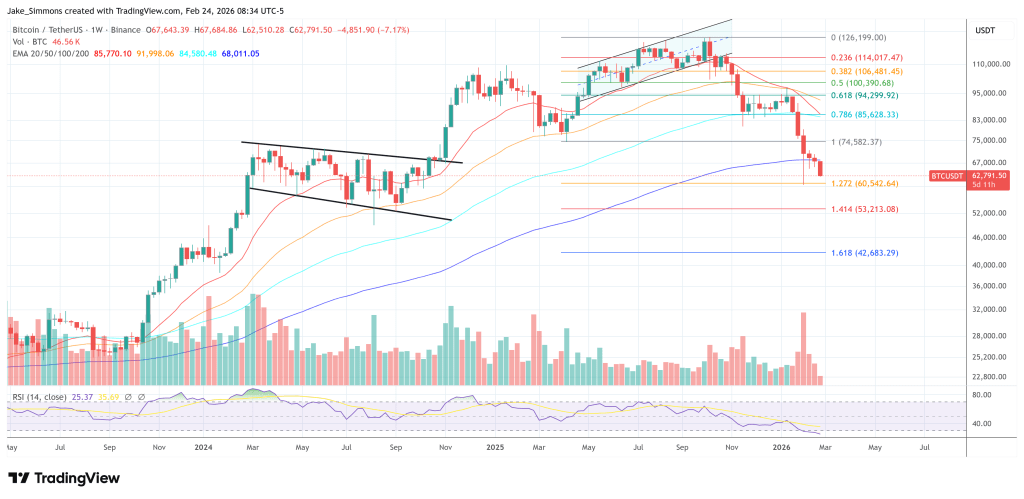
Bitcoin falls below $63,000, 1-week chart | Source: BTCUSDT on TradingView.com

İlgili Sorular

QWhat is the main concern Jameson Lopp raises about BIP-110?

AJameson Lopp's main concern is that BIP-110 could trigger a disruptive Bitcoin chain split due to its low 55% miner-signaling threshold for activation and its design that increases coordination risks, while failing to effectively stop the 'spam' behavior it aims to curb.

QHow does BIP-110 propose to activate, and why does Lopp find this dangerous?

ABIP-110 proposes a user-activated soft fork (UASF) with a 55% miner-signaling threshold. Lopp finds this dangerous because the low activation threshold and the node's policy of outright rejecting non-compliant blocks significantly increase the probability of creating two competing chains if the broader Bitcoin ecosystem is not fully aligned.

QWhat does Jameson Lopp say about the grassroots support for BIP-110?

ALopp argues that the raw node count signaling support for BIP-110 is a weak proxy for consensus. He highlights that a high percentage of these nodes are on the Tor network, which are cheap to create at scale, and cautions against overestimating this form of social signaling, especially since miner support was precisely zero at the time of his writing.

QAccording to Lopp, why is the comparison to the 2017 SegWit UASF flawed?

ALopp states the comparison is flawed because the 2017 SegWit UASF never actually had to run to its full extent; SegWit activated via miner signaling before the UASF was triggered. This means the historical precedent did not test the high-risk scenario of a contentious chain split that BIP-110 proponents are now describing as manageable.

QWhat is the broader implication of the BIP-110 debate, beyond the proposal itself?

AThe broader implication is that the debate reveals a deepening internal conflict within Bitcoin over core principles like neutrality, censorship resistance, and block-space usage. Even if BIP-110 fails, the campaign forces operators and businesses to incur real costs by having to plan for a low-probability but high-impact coordination failure.

İlgili Okumalar

From Robinhood to Polymarket: Is the Era of Integrating All Assets on a Single Platform Coming?

From Robinhood to Polymarket: The Era of All-in-One Asset Platforms Is Coming Asset classes are rapidly converging. Platforms that once specialized in single categories—such as stocks, cryptocurrencies, or prediction markets—are now moving toward offering all three. Robinhood pioneered this model, starting with equities, adding crypto in 2018, and prediction markets in 2025. This strategy has proven resilient: when crypto revenues fell, other segments like options and stocks filled the gap. Now, prediction market leaders Polymarket and Kalshi are moving in the same direction, both announcing perpetual futures trading on April 21, 2026, pending regulatory approval. These futures will cover assets like Bitcoin, gold, and stocks such as Nvidia. This trend mirrors the consolidation seen in consumer tech, like smartphones replacing dedicated cameras and MP3 players. Younger users, accustomed to interacting with multiple asset types from an early age, will increasingly demand unified platforms. A key competitive advantage in prediction markets is collateral utilization—idle assets locked during betting periods. Polymarket’s move into perpetuals may be a strategy to generate yield from that capital, similar to earlier DeFi integrations like PolyAave. As the regulatory landscape evolves, traditional finance is also likely to incorporate crypto and prediction markets, further accelerating this convergence.

marsbit11 dk önce

From Robinhood to Polymarket: Is the Era of Integrating All Assets on a Single Platform Coming?

marsbit11 dk önce

OpenAI Goes Left, DeepSeek Goes Right

On April 24, 2026, DeepSeek released V4, a Chinese large language model offering a free "million-token context window," enabling it to process vast amounts of data like entire books or years of corporate documents in one go. In contrast, OpenAI’s GPT-5.5, released around the same time, is more powerful but significantly more expensive, charging up to $180 per million output tokens. DeepSeek’s strategy represents a shift from a pure AI research firm to a heavy-infrastructure player, building data centers in Inner Mongolia’s Ulanqab to bypass U.S. chip export restrictions. This move, supported by Huawei’s Ascend chips and China’s cheap green electricity, highlights a fundamental divergence in AI development models: U.S. firms focus on high-cost, high-margin services, while Chinese players like DeepSeek prioritize accessibility and affordability. Facing intense talent poaching from tech giants, DeepSeek is seeking a $44 billion valuation funding round to retain researchers and scale infrastructure. Meanwhile, Chinese manufacturers are compressing AI models to run on smartphones, making AI accessible offline and across the Global South. Through open-source models and localized solutions, Chinese AI is empowering non-English speakers and low-income users, driving a form of "digital equality." While Silicon Valley builds walled gardens, DeepSeek and others are turning AI into a public utility—like tap water—flowing freely to those previously left behind.

marsbit37 dk önce

OpenAI Goes Left, DeepSeek Goes Right

marsbit37 dk önce

$292 Million KelpDAO Cross-Chain Bridge Hack: Who Should Foot the Bill?

On April 18, 2026, an attacker stole 116,500 rsETH (worth ~$292M) from KelpDAO’s cross-chain bridge in 46 minutes—the largest DeFi exploit of 2026. The stolen assets were deposited into Aave V3 as collateral, causing $177–200M in bad debt and triggering a cascade of losses across nine DeFi protocols. Aave’s TVL dropped by ~$6B overnight. This legal analysis argues that KelpDAO and LayerZero Labs share concurrent liability, with fault apportioned 60%/40%. KelpDAO negligently configured its bridge with a 1-of-1 decentralized verifier network (DVN)—a single point of failure—despite LayerZero’s explicit recommendation of a 2-of-3 setup. LayerZero, which operated the compromised DVN, failed to secure its RPC infrastructure against a known poisoning attack vector. Both protocols’ terms of service cap liability at $200 (KelpDAO) or $50 (LayerZero), but these limits are likely unenforceable due to unconscionability, gross negligence exceptions, and potential securities law invalidation (if rsETH is deemed a security under the Howey test). Aave’s governance also faces fiduciary duty claims for raising rsETH’s loan-to-value ratio to 93%—far above competitors’ 72–75%—without adequately assessing bridge risks, amplifying the systemic fallout. Practical recovery targets include LayerZero Labs (a registered Canadian entity), KelpDAO’s founders, auditors, and identifiable Aave governance delegates. The incident underscores escalating legal risks for DeFi protocols, infrastructure providers, and governance participants.

marsbit1 saat önce

$292 Million KelpDAO Cross-Chain Bridge Hack: Who Should Foot the Bill?

marsbit1 saat önce

İşlemler

Spot
Futures
活动图片