Based on a number of indicators closely watched by the market, the scenario of keeping rates unchanged currently has the advantage. Polymarket assesses the probability of unchanged rates at 63%, Kalshi at 65%, while the CME Fedwatch tool shows a much tighter range—a 55.6% probability that the Fed will maintain the target range at 3.50%–3.75%.
Prediction Markets Favor the 'Hold Rates' Position
The total trading volume on the Polymarket 'Fed Decision in September?' market exceeds $20.3 million.
On Polymarket, the 'no change' contract is priced at 63 cents, corresponding to an implied probability of approximately 63%, while a quarter-point increase is priced at 36%. A quarter-point cut is priced at just 1.6%, making the real bet obvious: traders are betting on whether the Fed will pause at the current level or raise rates.
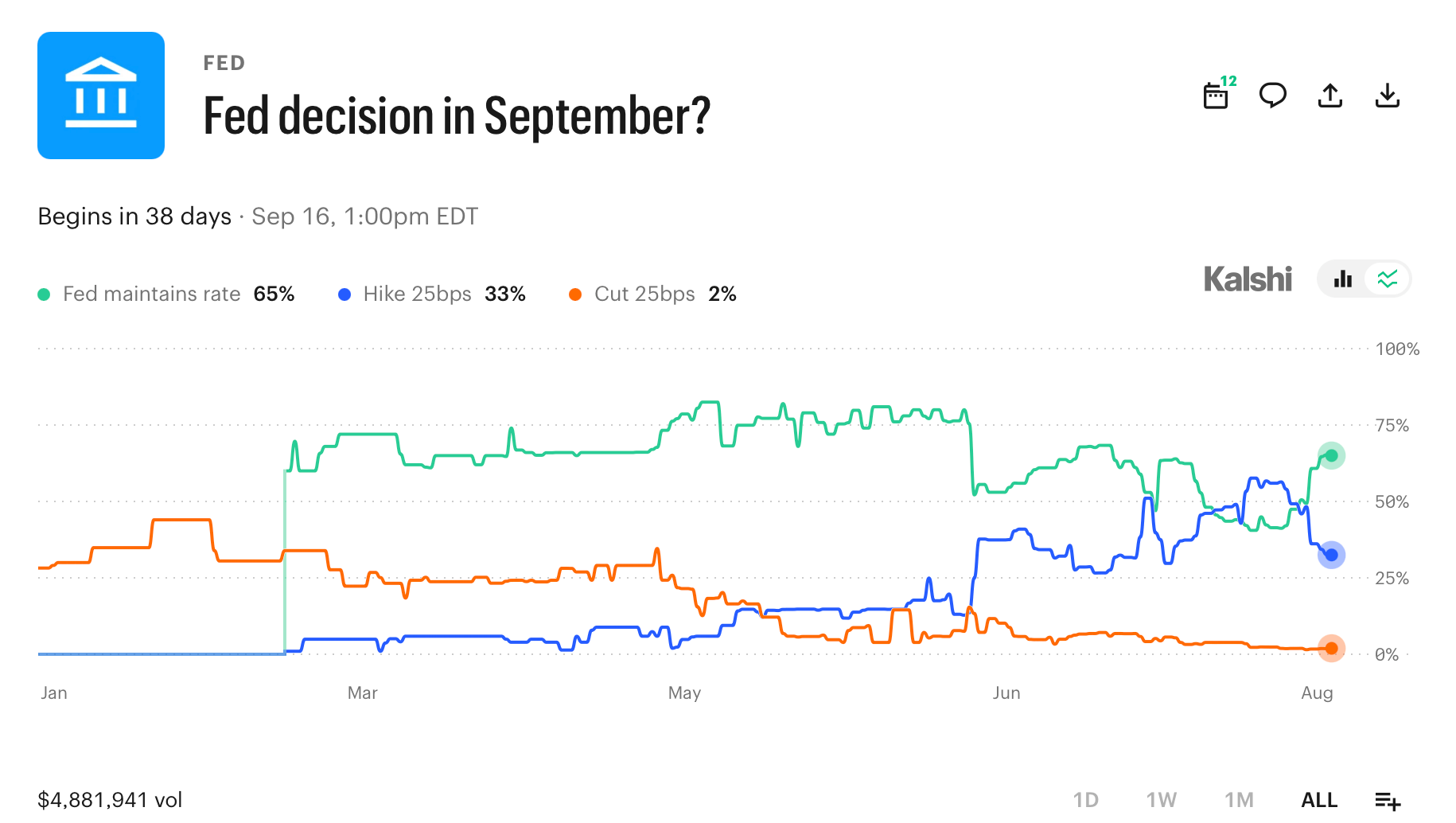
The Kalshi market dedicated to the September Fed decision, with a trading volume of nearly $4.9 million, shows practically the same picture. Contracts price the probability of the Fed holding rates steady at 65%, compared to 33% for a 25-basis-point hike and just 2% for a quarter-point cut. One basis point equals one-hundredth of a percentage point, meaning a 25-basis-point change equals a quarter percentage point.
The alignment of forecasts from the two leading prediction markets is significant because these are not survey answers or Wall Street chatter. Traders are putting real money behind these probabilities. On the Polymarket and Kalshi markets related to the September decision, trades worth over $25 million have been executed, and both markets currently price the probability of a hold at roughly 30 percentage points higher than the probability of a hike.
CME Fedwatch Still Considers a Rate Hike Quite Likely
However, the CME Fedwatch tool refuses to call the outcome of this race prematurely. The tool currently estimates the probability of a hold on September 16 at 55.6%, and the probability of a quarter-point hike at 44.4%. The CME's Fedwatch calculates these probabilities based on prices of 30-day federal funds futures—contracts traders use to take positions based on expectations for future Federal Reserve policy.
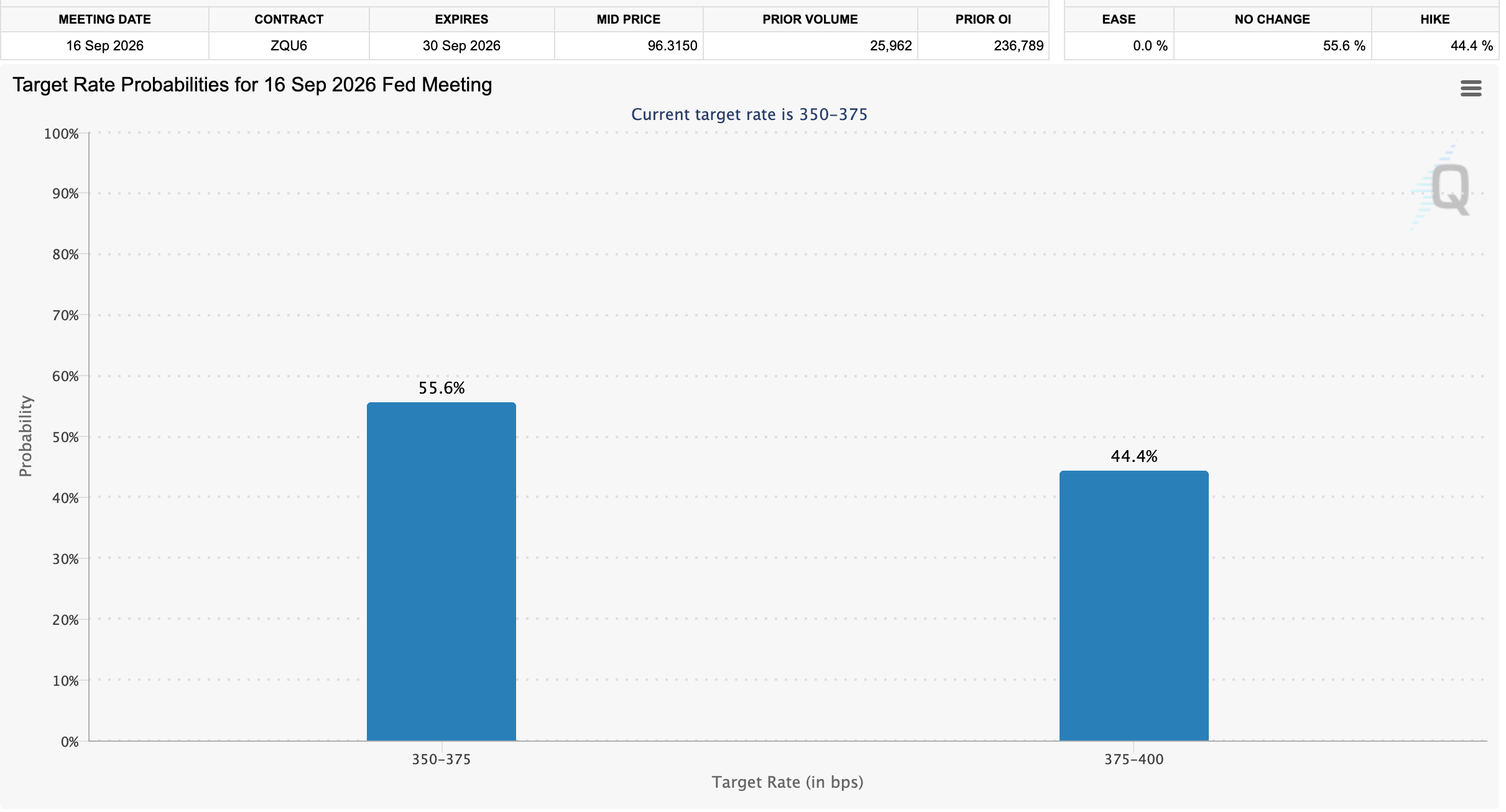
Thus, the CME market is clearly the most 'hawkish' of these three. Polymarket prices a rate hike at 36%, and Kalshi at 33%, while the CME Fedwatch tool's figures exceed them by almost 9–11 percentage points. All three sources lean towards a hold, but futures traders clearly do not believe the September question is already settled.
The CME figures have also changed dramatically. A week earlier, on July 31, according to provided market data, Fedwatch showed a 67% probability of a quarter-point rate hike and only a 33% probability of a hold. Thus, the current 55.6% probability of a hold indicates a serious trend reversal in just over a week.
One Employment Report Flipped the Rate Outlook
This reversal accelerated after the July employment report showed a decline of 23,000 nonfarm payrolls while the unemployment rate remained at 4.1%. The worsening labor market conditions gave traders new grounds to doubt whether the Fed needs to raise borrowing costs again so quickly. The Bureau of Labor Statistics released the report on August 7.
Prediction markets reacted by strengthening the 'hold' position to a clearer lead, while CME futures moved closer to a 'coin toss' situation. This gap matters because the three markets price expectations differently but arrive at the same core conclusion: a rate cut is barely considered, and September has turned into a decisive contest between holding rates steady and a quarter-point hike.
At its July 28-29 meeting, the Fed left the target range unchanged at 3.50-3.75%. The next meeting is scheduled for September 15-16, with the monetary policy decision announcement planned for September 16.
The Consumer Price Index Could Flip All Forecasts Again
The next major test for Polymarket, Kalshi, and CME Fedwatch will be inflation. If price pressures prove stronger than expected, the 33% to 44.4% probability of a rate hike could surge. More moderate data would likely cause even more market participants to lean towards the hold option.
For now, the odds favor a pause but offer no certainty: Polymarket shows a 63% probability of a hold, Kalshi 65%, and CME Fedwatch 55.6%. The question is no longer whether traders support a September pause. They do. The real question is whether upcoming inflation and labor market data will support that stance until the Fed's September 16 vote.
end-content