Best Crypto Presales 2026: Analysts Flag Early Projects Worth Tracking

bitcoinist2026-02-06 tarihinde yayınlandı2026-02-06 tarihinde güncellendi

Özet

Crypto markets face a risk-off environment in early 2026, with BTC near $66,805 and ETH at $1,895, alongside significant Bitcoin ETF outflows. In this climate, capital is focusing on infrastructure and distribution. A key trend is Bitcoin Layer-2 solutions, where execution moves off-chain while Bitcoin remains the settlement layer. Bitcoin Hyper emerges as a notable presale, positioning itself as the first Bitcoin L2 with Solana Virtual Machine integration for high-speed, low-cost transactions. It has raised over $31 million, with early whale activity, and aims to enable DeFi, NFTs, and payments on Bitcoin. Key questions remain about its bridge security and developer adoption.

Crypto is kicking off February 2026 with a distinct chill in the air. The tape is doing exactly what it always does during drawdowns: punishing leverage first, then forcing narratives to prove they have actual demand.

At the time of writing, $BTC hovers around $66,805 and $ETH struggles near $1,895, per CoinGecko, following a sharp multi-month retrace from late-2025 highs. (coingecko.com) But price is just the headline. The real signal is positioning. When the market de-risks this aggressively, liquidity fragments, spreads widen, and “beta” plays (memecoins, small caps) stop being forgiving.

ETF flows tell a similar story. Data tracked by SoSoValue indicates U.S. spot Bitcoin ETFs recently endured a $1.33B net outflow week—the worst bleed since February 2025—even though flows managed a notable one-day rebound early this month. (fastbull.com) Meanwhile, mainstream coverage notes that the post-2025 euphoria has given way to deleveraging and renewed regulatory friction. It’s the classic cocktail that squeezes speculative excess out of the system. (apnews.com)

Why does this matter for the “best crypto presales 2026” conversation?

Because presales don’t exist in a vacuum. Gravity applies here too. However, capital tends to concentrate around two specific themes that survive risk-off regimes: infrastructure and distribution. If smart money is going to take early-stage risk right now, it wants a defensible thesis—scaling, settlement, and credible user demand. Which raises the uncomfortable question: where is crypto’s next useful throughput coming from—especially on Bitcoin?

Bitcoin L2s Take Center Stage As Execution Moves Off L1

The most actionable presale theme in 2026 is simple: Bitcoin remains the settlement layer, but the actual work is moving elsewhere.

Lightning continues to anchor the payments narrative. Capacity metrics hit records around 5,637 BTC in late 2025, suggesting that “Bitcoin as a medium of exchange” is compounding quietly even while price sentiment sours. (bitcoinmagazine.com) In the same vein, Stacks has pushed the “programmable Bitcoin” thesis forward via its Nakamoto upgrade milestones. (stacks.co)

But here’s what most coverage misses: when markets draw down, builders don’t stop. They consolidate. Payments networks (Lightning) and execution environments (Bitcoin L2s) are currently fighting for the same prize—Bitcoin liquidity that actually does something.

That’s where Bitcoin Hyper enters the fray.

The project pitches itself as “THE FIRST EVER BITCOIN LAYER 2” with Solana Virtual Machine (SVM) integration. The goal? Deliver extremely low-latency L2 processing and fast smart contract execution while relying on Bitcoin L1 for final settlement. The architecture is modular—Bitcoin settles, the SVM executes—with a decentralized canonical bridge for BTC transfers. (Yes, combining Bitcoin security with Solana speed is an ambitious play).

The risk? Execution speed narratives can be intoxicating. Bridging design and sequencer assumptions—Bitcoin Hyper utilizes a single trusted sequencer with periodic L1 state anchoring—are where serious investors will focus their due diligence. Fast is easy to market; resilient is hard to ship.

Review Bitcoin Hyper’s L2 thesis.

Bitcoin Hyper ($HYPER) Presale Metrics: Big Raise, Clear Narrative

In this environment, metrics speak louder than whitepapers. Presales that survive 2026 typically show sustained fundraising and a narrative that aligns with the market’s “infrastructure-first” bias.

On the fundraising front, Bitcoin Hyper’s numbers aren’t small. According to the official presale page, the project has raised $31,257,822.88, with tokens priced at $0.0136751. In a market actively repricing risk, these figures suggest the bid isn’t purely momentum—there’s conviction behind the theme.
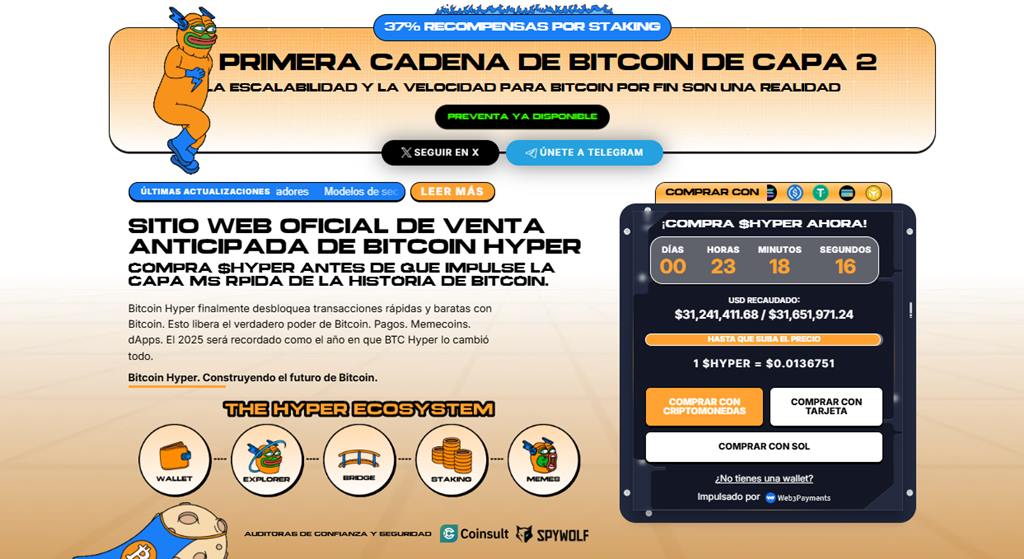
We’re also seeing early “smart money” movement. Etherscan records show 2 whale wallets have accumulated $116K, with the largest single transaction of $63K occurring on Jan 15, 2026. (Etherscan) While whale buys aren’t a guarantee of future performance, in a skittish tape, they often function as a sentiment catalyst.

Utility-wise, Bitcoin Hyper is targeting:

  • High-speed payments in wrapped BTC with negligible fees.
  • DeFi primitives (swaps, lending, staking protocols).
  • NFT and gaming dApps, supported by a developer SDK/API in Rust.

On the incentive side, staking is advertised with high APY (rate not disclosed), featuring immediate staking after TGE and a 7-day vesting period for presale stakers, plus rewards tied to governance participation.

For traders building a 2026 watchlist, here are the key questions: 1) Can the bridge model earn trust under stress? 2) Will developers actually deploy SVM apps, or will it remain theoretical? 3) Does Bitcoin liquidity migrate into on-chain apps as ETF flows stabilize?

If the macro clouds part and Bitcoin’s ecosystem narrative rotates from “hold” to “use,” Bitcoin Hyper is positioned squarely in that slipstream.

Visit the official Bitcoin Hyper site.

This article is not financial advice; crypto is volatile, presales are high risk, and smart-contract/bridge designs can fail. Always do your own research.

Key Takeaways

  • $BTC (~$66,805) and $ETH (~$1,895) signal a risk-off market where leverage unwinds faster than narratives can rebuild.
  • ETF flow whiplash (heavy outflows followed by rebounds) suggests institutional positioning is tactical, not a blind “up only” bet.
  • Bitcoin scaling is fragmenting into payments (Lightning) and execution layers (L2s), putting “productive BTC” back in focus.
  • Bitcoin Hyper targets this shift by bringing fast SVM execution to a Bitcoin-settled L2 environment.


İlgili Sorular

QWhat are the two main themes that capital tends to concentrate around during risk-off regimes in the crypto market, according to the article?

AInfrastructure and distribution.

QWhat is the name of the Bitcoin Layer 2 project featured in the article and what key technology does it integrate?

AThe project is called Bitcoin Hyper ($HYPER) and it integrates the Solana Virtual Machine (SVM).

QHow much had the Bitcoin Hyper presale raised at the time of writing, and what was the token price?

AThe presale had raised $31,257,822.88, with tokens priced at $0.0136751.

QWhat was the approximate price of Bitcoin ($BTC) and Ethereum ($ETH) mentioned at the beginning of the article?

ABitcoin was around $66,805 and Ethereum was near $1,895.

QWhat does the article cite as the risk associated with Bitcoin Hyper's design?

AThe risk is in its bridging design and sequencer assumptions, which utilize a single trusted sequencer with periodic L1 state anchoring, making resilience hard to ship.

İlgili Okumalar

In Conversation with Ray Dalio: We Are Currently in an AI Bubble, with 1% of My Portfolio in Bitcoin

Ray Dalio, founder of Bridgewater Associates, warns in an interview that the current AI boom shows classic bubble characteristics, which could lead to significant economic downturns as seen in past cycles like 1929 or 2000. He explains that speculative enthusiasm, fueled by debt and overvaluation, often precedes a crash when rising rates or taxation force asset sales, causing widespread losses and recession. Dalio also outlines his "Big Cycle" theory, describing an approximate 80-year pattern where widening wealth gaps, massive government deficits, and shifting geopolitical power (like China's rise) create internal conflict and global instability. He emphasizes that we are in a late-cycle, transitional phase where traditional powers like the US and UK face decline. For personal wealth protection, Dalio advises diversification beyond cash into assets like stocks, bonds, real estate, and particularly gold, which he prefers over Bitcoin. While he holds about 1% of his portfolio in Bitcoin as a non-printable hard asset, he views gold as more secure from technological or governmental threats. Regarding AI's impact, Dalio believes it will disproportionately benefit capital owners, worsening inequality by replacing both physical and cognitive labor. He suggests that human intuition and emotional intelligence, combined with AI, will be key for future workers. On taxation, Dalio argues that wealth taxes are impractical and risk triggering asset sell-offs, reducing productive investment. He points to the UK as a cautionary example of debt, low productivity, and political strife. Geopolitically, Dalio foresees a more regionalized world, with the US showing weakness in prolonged conflicts like with Iran, akin to past imperial declines. The ideal outcome, he suggests, is coexisting powerful blocs (e.g., Americas, China-Asia Pacific) without major war.

marsbit36 dk önce

In Conversation with Ray Dalio: We Are Currently in an AI Bubble, with 1% of My Portfolio in Bitcoin

marsbit36 dk önce

Daily 7.2 Trillion KRW: Foreign Capital's Record Net Buying on Friday! Wall Street Says Headwinds for Korean Stock Fund Flows Have Subsided

South Korean stock market sees a dramatic shift in fund flows. On July 31, foreign investors made a record net purchase of approximately KRW 7.2 trillion in KOSPI stocks, marking a fundamental reversal from the persistent large-scale net outflows seen in previous months. This contributed to a significant narrowing of foreign net selling in July to KRW 9.8 trillion, down sharply from KRW 48.4 trillion in June and KRW 44.5 trillion in May. Simultaneously, domestic institutional pressure eased. South Korean pension funds and asset managers turned to a net buying position in July, purchasing KRW 1.0 trillion worth of KOSPI shares, contrasting with net sales in May and June. Market volatility is expected to be dampened by new financial regulations. Effective July 31, the Financial Services Commission tightened access for retail investors to single-stock leveraged ETFs by raising the minimum cash deposit requirement. Trading volumes for these products subsequently dropped to about 50% of their monthly average. Citigroup Research maintains its year-end KOSPI target of 10,000 points. The firm cites several supportive factors: the substantial easing of headwinds from capital outflows, a robust fundamental outlook for the semiconductor sector, historically low market valuations, strong economic fundamentals, and the potential for policy support from financial authorities if needed.

marsbit36 dk önce

Daily 7.2 Trillion KRW: Foreign Capital's Record Net Buying on Friday! Wall Street Says Headwinds for Korean Stock Fund Flows Have Subsided

marsbit36 dk önce

Thanks to Dice Rolls, Bitcoin Keys Are Stored Offline, But Not Everyone Will Do It

The article discusses using dice rolls to generate secure Bitcoin wallet seeds, providing entropy independent of potentially flawed hardware random number generators. It explains that each fair dice roll offers about 2.585 bits of entropy, with around 50 rolls needed for a standard 12-word seed phrase and 99+ recommended for higher security. This method gained attention after a vulnerability was revealed in some Coldcard hardware wallets, where a faulty firmware RNG (dating back to 2021) compromised generated keys. The analysis notes that while a dice-generated main seed was safe from this specific flaw, other Coldcard functions (like creating paper wallets, backup keys, or passwords) could still be vulnerable if they used the defective RNG. The piece argues that while dice-based entropy is technically robust, the manual process is error-prone, tedious, and unrealistic for most new users, who might make mistakes in recording or inputting rolls. It concludes that while manual entropy generation should remain an option for advanced users, the long-term goal is to develop reliable, user-friendly hardware and software that securely generates randomness without requiring specialized knowledge. Coldcard users are advised to check their firmware version and replace any secondary secrets (like paper wallet keys) created with vulnerable devices, while also considering multi-signature setups with devices from different manufacturers for added security.

cryptonews.ru5 saat önce

Thanks to Dice Rolls, Bitcoin Keys Are Stored Offline, But Not Everyone Will Do It

cryptonews.ru5 saat önce

İşlemler

Spot
活动图片




