Bessent Urges Senate to Fast-Track Warsh Nomination as Institutional Liquidity Pivot Favors LiquidChain

bitcoinist2026-02-09 tarihinde yayınlandı2026-02-09 tarihinde güncellendi

Özet

Treasury Secretary Scott Bessent is urging the Senate to fast-track the confirmation of Kevin Warsh to the Federal Reserve Board, signaling a potential shift toward pro-growth monetary policies and reduced regulatory uncertainty. This move is seen as a precursor to a more disciplined economic environment, which could slash uncertainty premiums and push institutional capital toward risk assets. Concurrently, institutional investors are seeking unified infrastructure to manage liquidity across fragmented blockchain ecosystems. LiquidChain ($LIQUID) emerges as a key solution, offering a Layer 3 infrastructure that merges Bitcoin, Ethereum, and Solana into a single execution layer. Its 'Deploy-Once' architecture and Cross-Chain Virtual Machine eliminate the need for complex bridges and multiple gas tokens, addressing critical friction points for capital efficiency. The protocol has raised over $532K in its ongoing presale, indicating smart money is positioning for a liquidity rotation. As macro conditions improve and federal policy evolves, interoperability layers like LiquidChain are poised to capture the volume from traditional finance entering the digital asset space.

Trusted Editorial content, reviewed by leading industry experts and seasoned editors. Ad Disclosure

Quick Facts:

  • ➡️ Treasury Secretary Bessent’s push for Kevin Warsh’s confirmation signals a potential shift toward pro-growth monetary policies and reduced regulatory uncertainty.
  • ➡️ Institutional investors are seeking a unified infrastructure to manage liquidity across fragmented blockchains as macro conditions improve.
  • ➡️ LiquidChain ($LIQUID) merges Bitcoin, Ethereum, and Solana into a single execution layer, solving critical friction points for capital efficiency.
  • ➡️ Capital rotation into risk assets historically accelerates following major shifts in Federal Reserve leadership and policy direction.

In an interview with Fox News, U.S. Treasury Secretary Scott Bessent indicated he wants the Senate to move fast on Kevin Warsh’s confirmation to the Federal Reserve Board. That’s not just procedural housekeeping. It signals a coordinated push to reshape the Fed’s doctrinal approach before the next tightening cycle can even take hold.

Wall Street sees the Warsh nomination as a precursor to a more disciplined, pro-growth environment. Historically, clarity at the central bank slashes uncertainty premiums, pushing capital further out on the risk curve. That matters. Institutional allocators are currently sitting on record levels of dry powder, just waiting for a signal that the headwinds are finally abating.

If confirmed, Warsh, a former Morgan Stanley banker, will likely champion capital formation over aggressive interventionism. For digital assets? The implications are massive. While the Treasury pushes for leadership that understands modern financial plumbing, the infrastructure underneath is evolving rapidly. (The timing here isn’t exactly coincidental.)

Smart money is prepping for a liquidity rotation, shifting focus from accumulation to efficiency. This macro setup creates a perfect storm for interoperability layers like LiquidChain ($LIQUID), designed to capture the volume traditional rails are about to unleash.

Unified Execution Environments Solve the Fragmentation Crisis

While the Treasury streamlines federal policy, crypto faces its own bureaucracy: liquidity silos that trap capital. Institutional investors entering the space are finding that managing positions across Bitcoin, Ethereum, and Solana requires a messy web of bridges and distinct wallets. Frankly, it’s a friction point that kills true institutional adoption.

LiquidChain tackles this by establishing a Layer 3 (L3) infrastructure that fuses these major ecosystems into one execution environment. Using a ‘Deploy-Once’ architecture, the protocol allows developers to write code interacting simultaneously with $BTC, $ETH, and $SOL liquidity. That’s a game-changer. It eliminates the security risks of traditional bridges (often the weak link in DeFi) while providing the unified experience Wall Street desks demand.
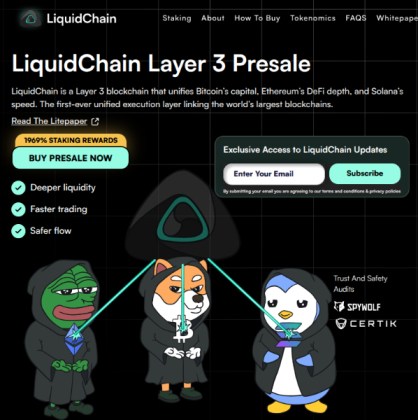
The protocol’s Cross-Chain Virtual Machine acts as a universal translator for value. Instead of forcing users to juggle different gas tokens, LiquidChain abstracts the complexity for single-step execution. For an asset manager looking to stake Bitcoin while accessing Solana’s high-velocity markets, this isn’t just convenient; it’s an operational necessity.

LEARN MORE ON THE OFFICIAL LIQUIDCHAIN WEBSITE

Presale Data Suggests Smart Money is Front-Running the Pivot

The appetite for infrastructure plays is already showing up in the data. LiquidChain has raised over $532K in its ongoing presale, a figure pointing to specific accumulation patterns rather than broad retail speculation. With tokens currently priced at $0.0136, the valuation implies significant room for growth relative to interoperability competitors trading at multi-billion dollar caps.

This traction validates a core thesis: the next cycle will be defined by utility, not just meme-driven hype. Funds are bolstering the Unified Liquidity Layer to ensure the pipes are wide enough when the macro floodgates open. Unlike governance-only tokens, $LIQUID functions as transaction fuel, creating a direct link between network usage and token demand.

The risk here, of course, is execution. Building a secure L3 that interoperates with Bitcoin’s rigid scripting and Solana’s speed is technically demanding. But the market’s willingness to fund this vision early suggests high conviction that fragmentation is a problem worth solving.

As the Treasury works to unclog the regulatory gears in D.C., LiquidChain is quietly building the machinery to unclog the flow of value on-chain.

BUY YOUR $LIQUID HERE

This article is for informational purposes only and does not constitute financial advice. Cryptocurrency investments carry inherent risks, and readers should perform their own due diligence before making any investment decisions.

Editorial Process for bitcoinist is centered on delivering thoroughly researched, accurate, and unbiased content. We uphold strict sourcing standards, and each page undergoes diligent review by our team of top technology experts and seasoned editors. This process ensures the integrity, relevance, and value of our content for our readers.

Ben Wallis

Follow

Ben is a freelance writer, and AI editor specializing in crypto developments (mainly altcoins) and the intricate ways global economics shape the digital asset space. His B.Ed. in Education provides a unique foundation for his writing, enabling him to distill complex crypto concepts and market shifts into clear, digestible insights. This skill is key to helping readers adapt and apply their understanding to the ever-evolving world of crypto investment. Passionate about making crypto accessible, Ben crafts content designed to educate a broad audience, from current market events to the essential foundational knowledge that underpins them. His goal is to empower readers through understanding. When he’s not immersed in crypto analysis and breaking down complex topics, Ben is an avid Pokémon fan and enjoys all things Disney.

Full Profile

Related Posts

South Korea’s FSS To Probe Whale Manipulation: How SUBBD Is Built For Fair And Transparent Trading

Infini Exploiter Hackers Resurface to Buy the $ETH Dip: How $BMIC Adds Security for the Future

Turkey & Tether Freeze $544M: Why $BMIC Is The Safe Haven

Tether’s $23B Gold Hoard Rivals Nation States As Smart Money Pivots To $HYPER

Story Co-Founder Defends Token Unlock Delays; Why Long-Term Scaling Matters For $MAXI

Takaichi’s Victory Sends Nikkei to Records as Bitcoin Reclaims $72K; What this Means for $HYPER

İlgili Sorular

QWhat is the significance of Treasury Secretary Scott Bessent urging the Senate to fast-track Kevin Warsh's nomination to the Federal Reserve Board?

AIt signals a coordinated push to reshape the Fed's doctrinal approach toward a more disciplined, pro-growth monetary policy and reduced regulatory uncertainty, which is seen as a precursor to slashing uncertainty premiums and encouraging capital to move further out on the risk curve.

QWhat problem does LiquidChain ($LIQUID) aim to solve in the cryptocurrency space?

ALiquidChain aims to solve the liquidity fragmentation crisis by creating a unified Layer 3 (L3) infrastructure that merges Bitcoin, Ethereum, and Solana into a single execution layer, eliminating the friction and security risks of managing capital across multiple, distinct blockchains and bridges.

QHow does LiquidChain's 'Deploy-Once' architecture function?

ALiquidChain's 'Deploy-Once' architecture allows developers to write code that can interact simultaneously with $BTC, $ETH, and $SOL liquidity, creating a unified execution environment that abstracts away the complexity of using different gas tokens and separate wallets.

QWhat does the presale data for LiquidChain ($LIQUID) indicate about investor sentiment?

AThe presale raising over $532K indicates smart money is accumulating and front-running a potential macro pivot, showing high conviction that solving blockchain fragmentation is a critical utility play for the next market cycle, rather than mere retail speculation.

QHow is the potential confirmation of Kevin Warsh linked to the thesis for investing in infrastructure like LiquidChain?

AA Warsh-led Fed is expected to create a pro-growth, clarity-driven environment that reduces uncertainty. This macro shift is anticipated to unleash a wave of institutional capital into risk assets, making high-efficiency infrastructure like LiquidChain essential for capturing and managing that incoming liquidity.

İlgili Okumalar

Will the Next Crypto Bull Run Start with On-Chain Trading of SpaceX?

This article presents a scenario-based forecast for the crypto industry from 2026 to 2029, arguing that the next major cycle will be driven not by technological narratives but by legal access to real-world assets. The author predicts that by mid-2026, pre-IPO perpetual contracts for top private companies like SpaceX, OpenAI, and Anthropic on platforms like Hyperliquid will become the primary gateway for accessing quality assets, as most crypto-native tokens fail to capture real value. The much-hyped AI x Crypto intersection largely fails except for prediction markets, which thrive on betting on AI model supremacy. By 2027, public blockchain foundations are forced to choose between catering to retail speculation or building compliant infrastructure for institutions, with many opting for the latter. Growth in stablecoins and tokenized private credit/equity hits a "triple ceiling" due to regulatory and political uncertainty rather than market demand. The pivotal shift is forecast for 2028. A major liquidation event in pre-IPO perpetuals exposes the structural flaw of synthetic markets lacking a real underlying asset anchor. In response, regulatory changes finally allow the public solicitation of private securities resales to verified accredited investors. This creates a legitimate secondary market for real company equity, which then becomes the core asset class of the new bull market, relegating synthetic perps to a niche role. By 2029, the industry becomes "boring" but foundational. Tokens without claims on real cash flows or assets cease trading. Stablecoin growth is steady but politically capped. Crypto infrastructure fades from view as it gets absorbed into traditional finance backends. The article's central thesis is that the key bottleneck for crypto's next phase is legal and regulatory channels for real asset ownership, not technology.

marsbit1 saat önce

Will the Next Crypto Bull Run Start with On-Chain Trading of SpaceX?

marsbit1 saat önce

The Value Distribution of Stablecoins

**Summary: The Value Distribution of Stablecoins** The article argues that stablecoins are evolving from mere trading tools into broader channels for dollar access. It divides the stablecoin ecosystem into four layers to analyze how value is distributed: 1. **Issuance Layer:** Mints stablecoins, holds reserve assets, and captures the spread between reserve yield and user costs (e.g., Tether, Circle). This layer currently earns the largest profit margin. 2. **Infrastructure Layer:** Connects stablecoins to the traditional financial system, handling fiat on/off-ramps, banking integration, compliance (KYC/AML), and asset management (e.g., Bridge, BVNK). This is the "unglamorous" but critical work, building the essential bridges between crypto and real-world finance. 3. **Acquiring/Distribution Layer:** Integrates stablecoins into merchant systems, manages payment flows, and provides enterprise financial software (e.g., Stripe, Coinbase). They act as the access point for businesses. 4. **Application Layer:** The end-users and businesses that ultimately use stablecoins for payments, settlements, or as a store of value. They benefit from convenience but have little pricing power. The core thesis is that while the issuance layer currently dominates profits, the often-overlooked **infrastructure layer holds significant long-term potential**. The real challenge and barrier to mass adoption is not the on-chain transfer of stablecoins (which is simple), but the complex "last mile" integration into existing business workflows, banking systems, and regulatory frameworks across different countries. Companies in this layer are currently in a "land grab" phase, investing heavily to build networks, secure bank partnerships, and establish compliance pathways. While their position is currently pressured by the profitable issuers above and distribution platforms below, the article suggests that if stablecoins become a default financial rail for businesses, the infrastructure providers who have done the hard work of integration will ultimately gain strong pricing power and become entrenched, essential players.

marsbit8 saat önce

The Value Distribution of Stablecoins

marsbit8 saat önce

The Value Distribution of Stablecoins

The Value Distribution of Stablecoins The article argues that stablecoins are evolving from a mere trading tool into a broad "dollar channel." It analyzes the industry's value chain through four layers: 1. **Issuance Layer (e.g., Tether, Circle):** The top layer that mints stablecoins, holds reserve assets, and captures the thickest interest rate spread. 2. **Infrastructure Layer (e.g., Bridge, BVNK):** Connects stablecoins to the traditional financial system, handling critical but complex "dirty work" like fiat on/off-ramps, banking integration, compliance (KYC/AML), and cross-border settlement. 3. **Acquiring/Distribution Layer (e.g., Stripe, Coinbase):** Embeds stablecoins into merchant systems, manages payment flows, and integrates with enterprise software. 4. **Application Layer:** End-users and businesses that ultimately use stablecoins for payments, settlement, or storing value. The author posits that while the issuance layer currently captures the most profit, the most overlooked and potentially critical layer is infrastructure. The core challenge for stablecoin adoption isn't the on-chain transfer (which is simple), but bridging the gap between blockchain and the real-world financial system. This involves solving practical problems for businesses: fiat conversion, reconciliation, tax handling, and user onboarding. Infrastructure companies are currently in a difficult "land-grab" phase—building networks, securing banking relationships, and achieving compliance country-by-country. They face pressure from both the profitable issuance layer above and distribution platforms below. However, the author suggests this layer is building a crucial moat. Once stablecoins become a default business rail, the infrastructure players who have done the hard work of integration may gain significant, durable value and pricing power.

链捕手8 saat önce

The Value Distribution of Stablecoins

链捕手8 saat önce

İşlemler

Spot
Futures
活动图片